
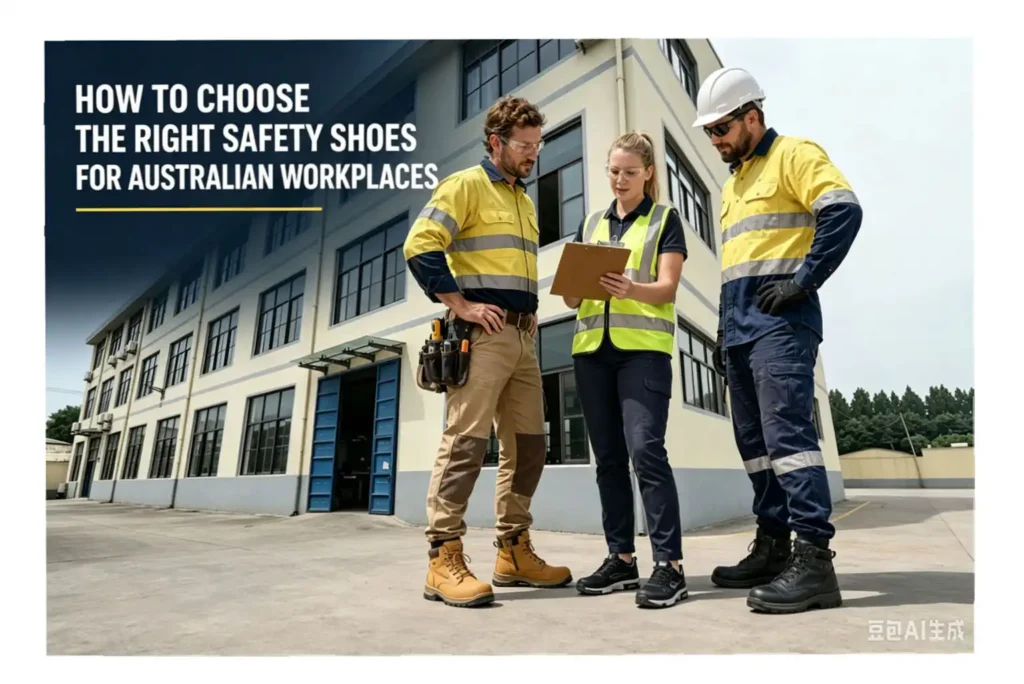
A tradesperson begins the day on dry concrete, crosses a muddy construction site before lunch, drives between projects in the afternoon, and finishes the shift working on wet steel near a loading area. One pair of safety shoes must cope with every stage.
This type of mixed work is common across Australia. Employees may face heat, sudden rain, rough ground, smooth warehouse floors, sharp debris, heavy materials, oils, electrical systems, or long hours of standing and walking. A safety boot that performs well in one environment may be uncomfortable—or unsuitable—in another.
That is why selecting Australian workplace safety footwear requires more than asking for a steel toe and an AS certificate.
The correct protective work shoes should be based on:
- Workplace hazards
- Job tasks
- Ground and floor surfaces
- Indoor or outdoor exposure
- Climate
- Required safety standard
- Worker fit
- Shift duration
- Product durability
- Maintenance and replacement needs
Comfort is not separate from safety. Footwear that is excessively heavy, narrow, hot, unstable, or difficult to put on may be worn incorrectly or rejected by workers. Safe Work Australia states that PPE should be suitable for the worker and task, fit properly, be reasonably comfortable, and be selected in consultation with workers. (Safe Work Australia: PPE duties)
This guide explains how to match safety shoes to Australian construction, mining, warehousing, manufacturing, agriculture, transport, utilities, and other workplaces. It also covers Australian standards, toe and midsole options, outsole selection, fitting, wear trials, maintenance, and B2B procurement.
Safety Footwear and the Australian WHS Framework
Australia’s model work health and safety framework requires risks to be eliminated so far as reasonably practicable or, when elimination is not possible, minimised using suitable controls.
Personal protective equipment is generally a lower-order control. It should not replace:
- Safe plant and equipment
- Traffic separation
- Guarding
- Secure storage
- Good housekeeping
- Spill control
- Safe work procedures
- Worker training
- Effective supervision
For example, slip resistant safety shoes may help manage residual slip risk, but a business should still repair leaks, improve drainage, clean spills, and maintain floor surfaces.
Where footwear is required, the person conducting a business or undertaking should ensure that it:
- Protects against the identified risk
- Suits the work being performed
- Fits the individual worker
- Is reasonably comfortable
- Is compatible with other PPE
- Is used correctly
- Is properly maintained
- Remains effective over time
Providing an employee with a footwear allowance does not remove the business’s responsibility to ensure that the selected PPE is suitable, comfortable, correctly fitted, and protective. (Safe Work Australia: PPE overview)
This means a policy stating “wear safety boots” is not enough. The business should define what protection is required and verify that the approved footwear provides it.
What Are Safety Shoes and Why Are They Important?
Safety shoes are occupational PPE designed to reduce exposure to workplace foot hazards. Certified safety footwear differs from ordinary work boots because its protective features are tested against defined requirements.
Depending on the classification, industrial safety shoes may provide:
- Toe impact resistance
- Compression protection
- Penetration resistance
- Slip resistance
- Heel energy absorption
- Antistatic properties
- Water resistance
- Fuel- and oil-resistant outsole performance
- Heat-resistant outsole performance
- Electrical protection under specified conditions
- Resistance to selected chemicals
- Protection from hot or cold environments
These features are relevant across Australian industries including:
- Construction
- Mining
- Manufacturing
- Logistics
- Warehousing
- Transport
- Utilities
- Agriculture
- Oil and gas
- Food processing
- Engineering
- Property maintenance
Even a moderate foot injury can cause lost working time, medical costs, operational disruption, and considerable personal hardship. Poorly selected footwear can also contribute to fatigue, discomfort, unstable movement, and poor PPE compliance.
Safety footwear does not need to be heavy to be protective. Modern products can use fiberglass toe caps, flexible non-metallic midsoles, breathable technical textiles, shock-absorbing outsoles, and lightweight reinforcements.
Understanding AS 2210.3:2019
AS 2210.3:2019 is the Australian standard covering general-purpose safety footwear with protective toe caps. It is a modified adoption of ISO 20345:2011 and specifies basic and additional optional requirements. (Standards Australia: AS 2210.3:2019)
Testing and classification may address:
- Protective toe impact
- Protective toe compression
- Upper performance
- Outsole performance
- Penetration resistance
- Slip resistance
- Heel energy absorption
- Antistatic properties
- Water resistance
- Fuel and oil resistance
- Heat or cold performance
Certification Does Not Replace Risk Assessment
AS 2210.3 certification confirms tested properties of a particular footwear construction. It does not decide whether the shoe is suitable for a specific workplace.
For example:
- A certified low-cut shoe may lack the ankle coverage wanted on rough ground.
- A certified leather boot may not be completely waterproof.
- A slip-tested outsole may perform differently on mud, oil, wet steel, and smooth tiles.
- Antistatic footwear is not automatically electrically insulating.
- A toe-protected shoe may not include penetration resistance.
The buyer must combine certification evidence with the workplace hazard assessment.
What Buyers Should Verify
Before purchasing, request:
- Certificate
- Test report
- Exact model number
- Product photographs
- Certified size range
- Factory identity
- Toe-cap material
- Penetration-resistant insert
- Outsole construction
- Safety classification
- Optional performance markings
- User instructions
- Product and packaging labels
The documentation must cover the exact construction being supplied. A certificate for a similar-looking boot is not sufficient.
Different Types of Safety Shoes for Australian Workplaces
Steel Toe Safety Shoes
Steel toe safety shoes use a metal cap to resist impact and compression.
Key features:
- Strong protective performance
- Thin toe-cap profile
- Proven durability
- Competitive cost
- Wide availability
Benefits: Steel is practical for heavy industrial work involving dense materials, tools, machinery, and rolling loads.
Best applications:
- Construction
- Manufacturing
- Mining
- Engineering
- Workshops
- Building-material distribution
- Heavy transport maintenance
Steel can add weight and transfer heat or cold more readily than composite materials. Correct positioning, padding, and toe room remain essential.
Composite Toe Safety Shoes
Composite toe caps may be made from fiberglass, carbon composite, reinforced polymer, or similar materials.
Key features:
- Metal-free protection
- Lower weight in many constructions
- Reduced thermal transfer
- Suitability for metal-sensitive workplaces
Benefits: Composite toe safety shoes can reduce footwear weight and improve comfort during long walking shifts or in temperature-controlled environments.
Best applications:
- Warehousing
- Logistics
- Airports
- Cold storage
- Electronics
- Utilities
- Light manufacturing
Composite protection is not automatically inferior or superior to steel. The completed shoe must pass the applicable standard.
Slip Resistant Safety Shoes
Slip resistance depends on the interaction among:
- Outsole compound
- Tread pattern
- Contact area
- Surface material
- Contaminant
- Temperature
- Worker movement
Safe Work Australia notes that footwear for wet conditions should use tread deep enough to penetrate surface water and make contact with the floor. In dry conditions, a flatter construction with more contact area may offer better grip. (Safe Work Australia: Slips, trips and falls)
Best applications:
- Warehouses
- Loading docks
- Food processing
- Commercial kitchens
- Workshops
- Hospitals
- Transport yards
- Cleaning operations
No outsole is slip-proof under every condition. Test shortlisted models on representative workplace surfaces.
Waterproof Safety Shoes
A waterproof safety shoe normally contains:
- Water-resistant leather or synthetic upper
- Waterproof membrane or bootie
- Sealed seams
- Seam-sealing tape
- Gusseted tongue
- Controlled upper-to-sole construction
Best applications:
- Roadwork
- Utilities
- Agriculture
- Landscaping
- Construction
- Outdoor maintenance
- Wet industrial sites
Water-resistant leather alone does not make the complete footwear waterproof. Confirm the tested claim and examine the internal structure.
For hot, mostly dry environments, a waterproof membrane may retain unnecessary heat. Breathable non-waterproof footwear may be more comfortable.
Electrical Hazard, Antistatic, and ESD Safety Shoes
These terms describe different performance categories:
- Antistatic footwear reduces static accumulation within a controlled resistance range.
- ESD footwear forms part of an electrostatic-discharge control system.
- Electrical-hazard footwear provides secondary protection under defined conditions.
- Conductive footwear serves specialised static-control applications.
- Electrically insulating footwear is designed and tested for specific electrical protection.
A composite toe or metal-free shoe is not automatically electrical hazard safety footwear. Electrical risks require specialist assessment and the correct test standard.
How to Choose Safety Shoes for Different Australian Industries
Construction and Civil Work
Australian construction sites may combine:
- Falling tools and materials
- Exposed nails
- Broken timber
- Wet concrete
- Mud
- Uneven ground
- Hot surfaces
- Frequent kneeling and climbing
Potential footwear requirements include:
- Certified toe protection
- Penetration-resistant midsole
- Cleated outsole
- Water-resistant or waterproof construction
- Reinforced scuff toe
- Ankle coverage
- Fuel- and oil-resistant outsole
- Heat-resistant outsole where necessary
A lace-up boot can provide adjustable fit. A side zipper allows faster removal, but the laces should still be adjusted to hold the foot securely.
Mining and Quarrying
Mining safety footwear may need:
- Heavy-duty toe protection
- Penetration resistance
- Metatarsal protection
- High-cut structure
- Water resistance
- Aggressive tread
- Reinforced toe and heel
- Fuel and oil resistance
- Heat resistance where identified
- Strong leather upper
Weight should still be managed. Workers walking, climbing, and entering vehicles may experience unnecessary fatigue in excessively heavy boots.
Underground, open-cut, processing, and maintenance roles should not automatically receive identical footwear. Each task has different exposure.
Warehousing and Logistics
Warehouse workers often walk long distances on hard floors.
Priorities may include:
- Lightweight composite toe
- Slip-resistant outsole
- Shock-absorbing heel
- Flexible forefoot
- Breathable upper
- Secure heel retention
- Sufficient toe room
- ESD properties where required
A low-cut safety sneaker can suit controlled indoor picking. Receiving employees who move through outdoor loading docks may need a water-resistant mid-cut alternative.
Manufacturing and Engineering
Factories may expose employees to:
- Heavy parts
- Rolling carts
- Metal swarf
- Oils
- Hot floors
- Repeated standing
- Welding or cutting processes
Potential requirements include:
- Toe protection
- Penetration resistance
- Metatarsal protection
- Fuel- and oil-resistant outsole
- Heat-resistant outsole
- Stable cushioning
- Leather upper
- Specialised welding or foundry footwear where necessary
General-purpose safety shoes may not be suitable for molten-metal or specialised thermal hazards.
Agriculture and Rural Work
Agricultural footwear may encounter:
- Mud
- Water
- Uneven terrain
- Machinery
- Livestock
- Chemicals
- Sharp tools
- Temperature changes
Appropriate options may include leather safety boots, waterproof boots, or protective gumboots.
Chemical resistance must be checked against the substance, concentration, exposure time, and temperature. “Chemical resistant” is not a universal property.
Transport and Delivery
Drivers and delivery workers need footwear that protects without interfering with vehicle control.
Useful features include:
- Flexible forefoot
- Secure heel fit
- Controlled sole thickness
- Slip resistance
- Toe protection
- Lightweight construction
- Water resistance for outdoor deliveries
A very deep or stiff outsole may reduce pedal feel.
Food Processing and Commercial Kitchens
Priorities include:
- Slip-resistant outsole
- Easy-clean upper
- Water resistance
- Minimal dirt traps
- Resistance to relevant oils and cleaning agents
- Cushioned support
- Toe protection where the risk assessment requires it
Tread must be cleaned regularly. Grease-filled channels cannot maintain their intended floor contact.
Utilities and Electrical Work
Electrical and utility workers may require:
- Precisely specified electrical properties
- Composite toe cap
- Non-metallic penetration-resistant insert
- Waterproof construction
- Slip-resistant outsole
- Lightweight design for ladder work
Do not specify “metal-free” as a substitute for a tested electrical-protection requirement.
Choosing the Right Safety Shoe Height
Low-Cut Safety Shoes
Advantages include:
- Low weight
- Ankle mobility
- Breathability
- Suitability for walking
- Sport-style appearance
Best for controlled indoor environments, logistics, light manufacturing, and warehousing.
Mid-Cut Safety Shoes
Advantages include:
- More ankle coverage
- Greater debris protection
- Improved structure
- Suitability for mixed environments
Best for trades, delivery, utilities, receiving, maintenance, and light construction.
High-Cut Safety Boots
Advantages include:
- Greater lower-leg coverage
- More structured support
- Protection in heavy or muddy conditions
- Suitability for specialised tasks
Best for mining, agriculture, heavy construction, and some industrial applications.
Boot height alone does not guarantee ankle support. Last design, heel fit, sole stability, and closure adjustment also matter.
Comfort and Fit for Australian Workers
Width Is Critical
Many Australian work-boot customers prefer a broad forefoot and sufficient toe space. A narrow fashion last can become uncomfortable once a protective cap and thick work sock are added.
Check:
- Ball width
- Toe-box width
- Instep volume
- Heel fit
- Internal toe-cap edges
- Sock allowance
A wide toe box should not allow excessive heel movement. The shoe must hold the foot securely.
Fit Both Feet
Feet are rarely identical. Measure both and fit the larger foot.
Workers should try footwear:
- With normal work socks
- Later in the day
- While standing and walking
- On steps or ramps where possible
- While kneeling or crouching
- With orthotics if normally used
Cushioning Must Also Be Stable
Hard surfaces increase demand for shock absorption, but very soft cushioning may feel unstable.
Look for:
- Removable PU or EVA footbed
- Shock-absorbing heel
- Stable midsole
- Firm lateral support
- Natural forefoot flex
- Secure heel structure
Manage Heat
Australian climates vary widely, but heat is a significant issue in many regions.
Breathability can be improved through:
- Moisture-managing lining
- Mesh panels
- Technical knitted uppers
- Breathable footbeds
- Lower-cut construction
- Appropriate socks
Waterproof membranes should be reserved for jobs that genuinely need them.
Consider Weight
Every step lifts the footwear. Weight matters for employees who walk, climb, or repeatedly enter vehicles.
Compare the weight of the same size and construction. Do not accept a lighter product if weight has been reduced by compromising required protection or durability.
Safety Shoe Materials and Technologies
Full-Grain Leather
Full-grain leather offers:
- Durability
- Structure
- Abrasion resistance
- Good water resistance when treated
- Long service potential
It suits construction, mining, utilities, and premium work boots.
Nubuck Leather
Nubuck provides durability with a softer surface and is widely used in Australian-style wheat-coloured boots.
Split Leather
Split leather can provide economical durability for general industrial use.
Mesh and Technical Textiles
Mesh, flyknit, and engineered fabrics reduce weight and improve ventilation.
They are suitable for:
- Warehousing
- Logistics
- Assembly
- Indoor maintenance
- Light manufacturing
High-wear areas should be reinforced.
Microfiber
Microfiber offers consistent thickness, easy cleaning, low weight, and flexible colour options.
PU/PU Outsoles
Dual-density PU/PU soles provide:
- Low weight
- Cushioning
- Flexibility
- Efficient injected construction
PU/TPU Outsoles
PU/TPU combines a shock-absorbing midsole with an abrasion-resistant TPU contact layer.
This construction is common in premium Australian work boots.
EVA/Rubber and PU/Rubber
These constructions combine cushioning with durable rubber traction.
Depending on the compound, rubber can provide:
- Abrasion resistance
- Heat resistance
- Fuel and oil resistance
- Strong grip
- Outdoor durability
The compound and tread must be matched to the work environment.
Common Mistakes When Buying Safety Shoes
Choosing the Lowest Price
Low-cost footwear may use thinner leather, basic footbeds, inconsistent components, or less quality control.
Solution: Compare the complete specification and total cost of ownership.
Assuming Every Worker Needs the Same Boot
A warehouse picker and an outdoor maintenance technician face different hazards.
Solution: Create role-based or zone-based footwear specifications.
Ignoring Comfort
Poorly fitted PPE may be worn incorrectly or rejected.
Solution: Consult workers and conduct structured wear trials.
Believing “AS Certified” Without Checking Documents
A certificate may cover another model or construction.
Solution: Match the certificate and test report to the exact product.
Assuming All Deep Treads Are Slip Resistant
Deep tread can help in mud and water but may not be ideal on every smooth, dry floor.
Solution: Evaluate the outsole against actual workplace surfaces.
Confusing Water Resistance With Waterproofing
Treated leather can resist occasional moisture but may not keep feet dry in prolonged rain.
Solution: Verify whole-footwear waterproof testing where required.
Treating Composite Toe as Electrical Protection
Non-metallic protection does not prove electrical insulation.
Solution: Specify and verify the correct electrical category.
Ignoring Maintenance
Even premium safety boots lose performance when damaged, contaminated, or badly worn.
Solution: Establish cleaning, inspection, and replacement procedures.
How to Run an Effective Footwear Wear Trial
Choose Representative Workers
Include workers with:
- Different sizes
- Different widths
- Men’s and women’s fitting needs
- Various job roles
- Long and short shifts
- Existing orthotic requirements
Test Normal Tasks
The trial should include:
- Walking
- Climbing
- Kneeling
- Driving
- Working on ramps
- Turning
- Carrying
- Moving between indoor and outdoor areas
Collect Consistent Feedback
Record:
- Toe space
- Heel movement
- Instep pressure
- Flexibility
- Cushioning
- Stability
- Breathability
- Traction
- Weight
- End-of-shift comfort
- Visible wear
Review Objective Results
Where possible, compare:
- Return rate
- Replacement interval
- Worker complaints
- Slip incidents
- Outsole wear
- Closure failures
- Sole separation
- Absence associated with foot discomfort
A well-run trial is more useful than choosing footwear based on a five-minute fitting or product catalogue.
Benefits of Investing in Quality Safety Shoes
Reduced Workplace Injuries
Appropriate footwear helps control impact, compression, penetration, slip, water, and other identified risks.
Better Worker Comfort
Correct fit, cushioning, breathability, and weight can reduce discomfort during long shifts.
Improved PPE Compliance
Workers are more likely to use footwear correctly when it suits their tasks and feet.
Increased Productivity
Employees can focus on their work instead of pressure points, wet feet, poor grip, or heavy footwear.
Lower Replacement Costs
Durable materials and controlled production can provide better lifecycle value.
Fewer Returns
Good sizing, wear trials, and consistent manufacturing reduce fit-related complaints.
Stronger Safety Culture
Worker consultation and evidence-based purchasing show that PPE is treated as a working control rather than a uniform item.
How to Maintain Safety Shoes for a Longer Lifespan
Clean Them Regularly
Remove dirt with a soft brush. Use cleaning products appropriate for leather, mesh, or synthetic materials.
Clean the Outsole
Remove mud, stones, grease, metal fragments, and debris from tread channels.
Dry Naturally
Remove footbeds, loosen laces, and dry footwear in a ventilated area.
Avoid direct heaters or flames, which can damage:
- Leather
- Waterproof membranes
- Adhesives
- Foams
- PU and rubber components
Store Correctly
Keep footwear in a dry area away from direct sunlight, chemicals, and extreme temperatures.
Inspect Frequently
Check for:
- Smooth tread
- Uneven wear
- Cracks
- Sole separation
- Broken stitching
- Damaged closures
- Exposed toe caps
- Penetration damage
- Waterproof-lining failure
- Permanent contamination
- Loss of cushioning or support
Replace When Protection May Be Compromised
There is no single replacement interval for every Australian workplace. Service life depends on work conditions, walking distance, climate, materials, maintenance, and exposure.
A pair subjected to a severe impact should be removed from service even when damage is not immediately visible.
Safety Shoes Buying Guide for Australian Businesses
Create a Hazard-Based Specification
Include:
- Industry and job role
- Work environment
- Australian standard
- Safety classification
- Toe-cap type
- Penetration protection
- Upper material
- Outsole
- Slip requirement
- Water requirement
- Electrical properties
- Fit and width
- Size range
- Inspection criteria
Assess the Supplier
Evaluate:
- Experience with Australian safety footwear
- Certification
- Test reports
- Product-development ability
- Quality-control system
- Material traceability
- Factory capacity
- Sample accuracy
- Repeat-order consistency
- Complaint handling
Verify Australian-Focused Fit
Ask for:
- Last measurements
- Width options
- Fitting samples
- Size-conversion chart
- Representative size set
- Wear-trial samples
Do not assume that an EU or Asian last will automatically suit Australian users.
Consider OEM and Private Label Options
Distributors and importers may customise:
- Leather colours
- Wide-fitting lasts
- Side zippers
- Toe bumpers
- Toe-cap material
- Penetration inserts
- Waterproof membranes
- Outsoles
- Footbeds
- Branding
- Packaging
Any safety-critical change should be reviewed for its effect on certification.
Control Production Quality
A suitable quality plan includes:
- Material inspection
- Leather thickness and colour checks
- Toe-cap verification
- Midsole verification
- Cutting and stitching checks
- Lasting inspection
- Injection or bonding control
- Size measurement
- Finished-product inspection
- Marking and packaging checks
- Pre-shipment inspection
Plan Size Ratios
Use sales data or employee records rather than accepting a generic size assortment. Keep access to less common sizes so no worker is forced to use poorly fitting PPE.
Maintain Compliance Records
Retain:
- Risk assessment
- Product specification
- Worker consultation records
- Wear-trial results
- Certificates
- Test reports
- Approved samples
- Inspection reports
- Issue records
- Replacement history
- Complaints and corrective actions
Frequently Asked Questions About Australian Safety Shoes
1. What standard should safety shoes meet in Australia?
General-purpose safety footwear with protective toe caps is commonly assessed to AS 2210.3:2019. The required classification and optional properties depend on the workplace hazard assessment.
2. Are steel toe caps compulsory in Australian workplaces?
Not universally. Certified composite or fiberglass toe caps may be suitable where they meet the applicable standard and workplace requirements.
3. Are side-zip safety boots suitable for construction?
They can be, provided the complete boot offers the necessary protection. The laces should be correctly adjusted so the zipper is not the only element controlling fit.
4. Are composite toe safety shoes good for Australian warehouses?
Yes. Composite toe shoes can reduce weight and thermal transfer, making them practical for long walking shifts, cold storage, and metal-sensitive facilities.
5. Do Australian safety boots need to be waterproof?
Only where the work requires waterproof protection. Dry indoor employees may be more comfortable in breathable, non-waterproof footwear.
6. How should safety boots fit?
They should provide adequate toe clearance, secure heel retention, appropriate width, and no damaging pressure points. Try them with normal work socks.
7. How long do safety shoes usually last?
Many products may remain serviceable for six to eighteen months, but the actual period varies with use, walking distance, climate, maintenance, and materials.
8. When should safety footwear be replaced?
Replace footwear when the tread, upper, sole attachment, protective components, waterproofing, fit, or support has deteriorated enough to affect performance.
Conclusion
Choosing the right safety shoes for Australian workplaces starts with understanding the job.
Construction and civil workers may need toe protection, penetration resistance, cleated outsoles, and weather protection. Warehouse employees may benefit from lightweight composite toe safety shoes and stable cushioning. Mining workers may require high-cut, heavy-duty footwear, while drivers need flexible soles that preserve pedal control. Electrical and ESD environments require precisely tested properties rather than general metal-free claims.
AS 2210.3:2019 provides an important technical foundation, but certification is only one part of selection. Fit, comfort, outsole design, materials, climate, durability, worker consultation, and maintenance all affect whether workplace safety footwear performs effectively.
For Australian businesses, quality protective work shoes are an investment in worker protection, comfort, PPE acceptance, and long-term operational value. The strongest purchasing programmes combine hazard assessment, verified certification, role-based specifications, structured wear trials, reliable suppliers, and routine inspection.
Australian Safety Footwear Manufacturing Support from Ocean Safety Shoes
Ocean Safety Shoes manufactures safety footwear for Australian PPE brands, importers, distributors, wholesalers, retailers, and industrial suppliers.
With approximately 15 years of experience producing Australian-style safety footwear, we understand the market’s preference for practical wide-fitting lasts, premium leather, side-zip convenience, reinforced toe areas, reliable outsole performance, and all-day comfort.
Our available product and development options include:
- Wheat and black nubuck safety boots
- Full-grain leather industrial footwear
- Side-zip lace-up work boots
- Chelsea safety boots
- Waterproof bootie construction
- Steel, fiberglass, and composite toe caps
- Steel and non-metallic penetration-resistant midsoles
- PU/PU and PU/TPU injected outsoles
- EVA/rubber and PU/rubber cemented footwear
- Lightweight sport safety shoes
- Custom colours, branding, and packaging
- OEM, ODM, and private-label development
Our production group operates four PU injection lines and two cemented lines, supporting daily capacity of up to approximately 5,000 pairs depending on the product mix. Selected models have Australian BSI certification, and our factory has experience supporting established Australian footwear and retail customers.
Looking for reliable safety shoes for Australian workplaces? Contact Ocean Safety Shoes to discuss your target industry, AS certification requirements, fitting, materials, samples, custom design, quality inspection, and wholesale production plan.