
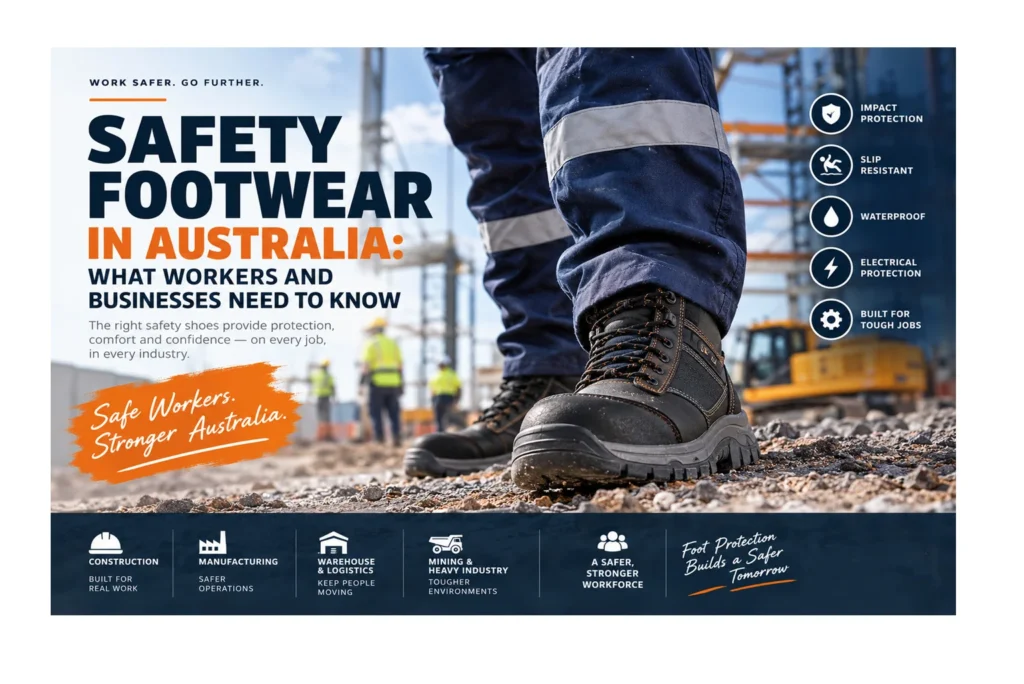
Safety Footwear in Australia: What Workers and Businesses Need to Know
A worker arrives at a construction site early on a wet Monday morning. Before the first break, he has walked across uneven ground, climbed temporary stairs, moved around steel components and worked beside mobile equipment. The hazards around his feet are constantly changing: slippery surfaces, sharp debris, heavy materials and long hours spent standing on hard ground.
In this environment, safety footwear is more than a uniform requirement. The right pair can help protect against impact, compression, penetration, slips and other workplace hazards while providing the support and comfort needed for a full shift.
For Australian workers, safety managers and procurement teams, however, choosing safety shoes should not begin with appearance, price or even the type of toe cap. It should begin with a simple question:
What hazards does the worker actually face?
Australian workplace safety guidance treats safety boots as personal protective equipment (PPE), but PPE should form part of a broader risk-management approach rather than replace higher-level controls. Safe Work Australia also states that PPE selected for workers should be suitable for the task, fit properly and be reasonably comfortable.
That makes footwear selection both a safety decision and a practical workplace decision.
This guide explains what Australian workers and businesses need to know about workplace safety footwear, including different types of protective work shoes, materials, comfort, selection, common purchasing mistakes, maintenance and B2B procurement.
What Are Safety Shoes and Why Are They Important?
Safety shoes are purpose-built footwear designed to help protect workers against specific occupational hazards.
Unlike ordinary boots or sneakers, certified industrial safety shoes may incorporate protective components such as:
- Impact- and compression-resistant toe caps
- Penetration-resistant midsoles
- Slip-resistant outsoles
- Energy-absorbing heel systems
- Water-resistant or waterproof construction
- Antistatic properties
- Heat-resistant outsole materials
- Fuel- or oil-resistant outsoles
- Additional ankle and metatarsal protection on certain designs
The important distinction is that safety footwear is designed around measurable workplace risks.
A heavy leather boot may look extremely rugged, for example, but appearance alone tells a buyer very little about its tested protective performance.
Safety Footwear as Part of PPE
In Australia, safety boots are recognised as a form of PPE. Under the model WHS framework, businesses must manage risks and, where PPE is required, select equipment appropriate to the worker and task. PPE should not be treated as a substitute for eliminating or minimising hazards through more effective controls where reasonably practicable.
Consider a warehouse with an oil leak on a pedestrian route. Providing slip resistant safety shoes may reduce the worker’s exposure to the remaining risk, but fixing the leak and controlling the contaminated area are still necessary.
Good safety management uses footwear as one layer of protection—not as an excuse to leave hazards uncontrolled.
Where Safety Shoes Are Commonly Used
Protective footwear is found across a wide range of industries.
Construction workers may need protection from falling materials, sharp objects, uneven surfaces and changing weather.
Manufacturing employees may encounter machinery, components, oils, hot surfaces or heavy materials.
Warehouse and logistics workers often spend long shifts walking on concrete while working around pallets, forklifts, loading docks and handling equipment.
Mining and heavy industry workers can face more demanding combinations of mechanical, environmental and surface hazards.
Oil and gas workers may require specialised footwear selected for the particular environment, including appropriate outsole, antistatic or other protective properties.
The correct footwear can therefore differ significantly between two workers who both technically require “safety boots.”
Different Types of Safety Shoes Explained
There is no universal safety shoe that is ideal for every job. The most effective approach is to match footwear features with the hazards identified through workplace risk assessment.
Steel Toe Safety Shoes
Steel toe safety shoes use a steel protective cap incorporated into the front of the footwear.
Their main purpose is to help protect the toes against impact and compression hazards when the complete footwear has been designed and tested to the applicable standard.
Key features
- Strong protective toe structure
- Proven technology widely used in industrial footwear
- Suitable for demanding work environments
- Available in boots, low-cut shoes and athletic-style designs
Benefits
Steel toe caps offer robust protection without requiring a particularly bulky external design. They remain popular where mechanical hazards are a primary concern.
Best applications
They are commonly used in:
- Construction
- Manufacturing
- Warehousing
- Engineering
- Workshops
- Transport
- Heavy industry
Steel toes do add weight compared with some non-metallic alternatives, so buyers should consider the complete footwear rather than choosing a shoe solely because it contains steel.
Composite Toe Safety Shoes
Composite toe safety shoes use non-metallic materials such as fibreglass or other engineered composites instead of conventional steel.
Key features
- Non-metallic toe protection
- Lower weight is possible depending on construction
- Lower thermal conductivity than steel
- Useful for metal-free footwear designs
Benefits
Reducing footwear weight can make a noticeable difference for employees who walk many kilometres during a shift. Composite caps are therefore popular in modern lightweight safety footwear.
Metal-free construction may also be useful for particular workplaces, although buyers should confirm that the entire shoe—not merely the toe cap—is metal-free if that characteristic is important.
Best applications
Composite footwear can work well for:
- Warehousing
- Logistics
- Airports and security-sensitive workplaces
- Light manufacturing
- Indoor industrial operations
- Workers seeking lighter protective footwear
The decision between composite and steel should be based on tested protection, work conditions, comfort and purchasing requirements rather than assuming one material is universally superior.
Slip Resistant Safety Shoes
A worker does not need to have an object fall on their foot to suffer a footwear-related injury.
Wet concrete, oils, grease, smooth warehouse floors, mud and contaminants can all increase slip risk.
Slip resistant safety shoes use outsole compounds and tread designs intended to improve traction on specified surfaces. Safe Work Australia specifically identifies slip-resistant footwear as one possible control when managing slip and trip hazards.
Key features
- Purpose-designed tread geometry
- Rubber, PU, TPU or combined outsole systems
- Compounds selected for particular working surfaces
- Channels designed to help manage contaminants
Best applications
- Warehouses
- Food processing
- Workshops
- Manufacturing plants
- Maintenance operations
- Construction sites
Remember that “anti-slip” is not an absolute promise. Traction changes with the surface, contaminant, tread condition and worker movement.
Waterproof Safety Shoes
Australian workers can move between hot, dry conditions and wet outdoor environments depending on location, season and occupation.
Waterproof safety shoes may use a waterproof membrane or bootie construction combined with suitable upper materials and seam design.
Water-resistant leather and fully waterproof construction are not necessarily the same thing.
Benefits
Keeping feet dry can improve comfort during prolonged outdoor work and reduce the distraction caused by wet socks and footwear.
Best applications
- Civil construction
- Landscaping
- Utilities
- Agriculture
- Outdoor maintenance
- Wet worksites
Buyers should also consider breathability. A waterproof design that traps excessive heat may be uncomfortable during demanding work in warmer conditions.
Electrical Hazard Safety Shoes
Electrical work requires especially careful footwear selection.
Terms such as electrical hazard safety shoes, electrically insulating footwear and antistatic footwear should not be used interchangeably. Different electrical properties serve different purposes.
Electricians, maintenance technicians and workers exposed to electrical hazards should use footwear selected as part of a proper electrical risk assessment and according to the applicable requirements.
Footwear should never be treated as the only control against electrical hazards.
How to Choose the Right Safety Shoes
The best safety shoes are not simply the strongest pair available. They provide the appropriate protection while remaining practical enough to be worn correctly throughout the working day.
1. Start With the Workplace Environment
Before comparing brands or styles, document the environment.
Ask:
- Is the work mainly indoors or outdoors?
- Are floors smooth, rough, wet, oily or muddy?
- Are sharp objects present?
- Could heavy objects fall or roll onto the foot?
- Does the worker climb ladders frequently?
- Is the employee walking for most of the shift?
- Are extreme temperatures involved?
- Are chemicals present?
- Are there electrical hazards?
- Does water regularly enter the work area?
This quickly changes purchasing priorities.
A warehouse employee walking all day on smooth concrete may value lightweight construction, cushioning, breathability and suitable slip resistance.
A construction worker exposed to rubble, wet ground and sharp debris may need a completely different boot with more robust upper construction and additional underfoot protection.
2. Define the Protection Requirements
Once hazards have been identified, determine the required protective properties.
These may include:
Toe protection: for impact and compression hazards.
Penetration resistance: where nails, sharp metal or other objects may penetrate from below.
Slip resistance: where workers encounter contaminated, wet or smooth surfaces.
Water protection: for repeated exposure to wet environments.
Electrical properties: where the risk assessment identifies relevant electrical hazards.
Avoid purchasing features simply because they sound impressive. Unnecessary features can increase weight, reduce flexibility and raise cost without improving safety for the actual task.
3. Prioritise Comfort and Fit
Comfort is a safety issue as well as an employee-satisfaction issue.
Safe Work Australia states that PPE should fit properly and be reasonably comfortable for the worker. Businesses are also expected to address problems when PPE does not fit properly or causes difficulties.
When evaluating comfortable work shoes, consider:
- Correct length and width
- Toe room
- Secure heel fit
- Arch support
- Underfoot cushioning
- Breathable lining
- Flexibility
- Footwear weight
- Collar padding
- Shock absorption
A worker standing at a machine may have different comfort requirements from a picker walking ten kilometres around a distribution centre.
Whenever practical, businesses should trial footwear with actual employees before committing to a large order.
4. Evaluate Durability
Durability cannot be judged by leather thickness alone.
Look at the complete construction:
- Upper material quality
- Stitching and reinforcement
- Toe-area abrasion protection
- Sole bonding
- Outsole abrasion resistance
- Flex points
- Eyelets and lacing components
- Zippers on zip-sided boots
- Lining quality
- Insole durability
A cheaper boot replaced frequently may cost more over a year than a better-designed alternative.
Procurement teams should therefore consider cost per wear, not simply cost per pair.
5. Check the Correct Safety Standard
This point is particularly important for Australian buyers.
Australia commonly references AS 2210.3:2019 for general-purpose safety footwear with protective toe caps. International procurement teams may also encounter EN ISO 20345 for European markets and ASTM F2413 for the United States.
These standards should not be treated as interchangeable labels.
A product being suitable for one market does not automatically prove compliance with another market’s requirements.
For Australian procurement, buyers should verify the exact standard, classification, applicable optional properties and supporting documentation rather than relying on a general statement such as “international standard safety shoe.”
It is also important to distinguish product standards from workplace law. Safe Work Australia notes that Australian Standards are not automatically legal requirements simply because they exist; applicable WHS duties and jurisdiction-specific requirements must also be considered.
Common Mistakes When Buying Safety Shoes
Even experienced procurement teams can make footwear decisions that look economical on paper but create problems once the shoes reach workers.
Mistake 1: Choosing Price Over Quality
Buying the cheapest compliant-looking option can be tempting when ordering hundreds or thousands of pairs.
But purchase price is only one component of cost.
Premature outsole wear, broken stitching, failed zippers, uncomfortable footbeds and frequent replacements can quickly eliminate the initial saving.
Better approach: Compare durability, test documentation, worker feedback and expected replacement rates alongside unit price.
Mistake 2: Ignoring Comfort
A boot may provide the required protection yet still be poorly suited to a twelve-hour shift.
Better approach: Conduct wearer trials with employees representing different sizes and job roles. Collect feedback after full working shifts rather than after a five-minute fitting.
Mistake 3: Buying the Wrong Protection Level
More protection is not automatically better.
A heavily constructed boot may be unnecessary for a light indoor logistics operation, while a lightweight safety sneaker may be inappropriate for a demanding outdoor site.
Better approach: Build the specification from the risk assessment.
Mistake 4: Ignoring the Working Environment
Footwear purchased centrally for an entire organisation may perform differently across departments.
Better approach: Segment footwear requirements by task and environment. One business may need several approved models.
Mistake 5: Ignoring Maintenance
Even premium protective work shoes deteriorate when they remain wet, contaminated or poorly stored.
Better approach: Include care, inspection and replacement instructions in the footwear program.
Safety Shoes Materials and Technologies
Understanding materials helps procurement professionals evaluate why two apparently similar shoes can perform and feel very differently.
Leather Uppers
Full-grain, nubuck and split leather are widely used in industrial footwear.
Leather can provide:
- Good abrasion resistance
- Structural support
- Durability
- Traditional industrial appearance
- Water resistance when appropriately treated
Different leather grades and treatments can produce very different results, so “genuine leather” alone is not a complete specification.
Mesh and Knitted Uppers
Modern lightweight safety footwear increasingly uses engineered mesh or knitted materials.
Advantages may include:
- Lower weight
- Improved airflow
- Greater flexibility
- Athletic styling
These materials are particularly attractive for warehouses, logistics operations and warm indoor environments.
Synthetic Materials
Microfibre, PU-coated materials and engineered textiles can provide consistent appearance, low weight and useful resistance properties depending on their construction.
They can also be practical where easy cleaning is important.
Rubber Outsoles
Rubber is widely valued for traction, abrasion resistance and heat-related performance in appropriate formulations.
It is often combined with lighter midsole materials to balance durability and comfort.
PU Outsoles
Polyurethane is extremely common in industrial safety shoes because it can offer cushioning, flexibility and relatively low weight.
Dual-density systems can use a softer cushioning layer with a harder wearing contact layer.
PU/TPU and EVA/Rubber Systems
Hybrid outsole systems allow designers to combine different material properties.
For example, an EVA midsole can reduce weight and provide cushioning while a rubber contact layer improves wear resistance and traction.
The best construction depends on the intended worker, environment and required certification.
Comfort Technology
Modern workplace footwear may incorporate:
- Removable cushioned footbeds
- Shock-absorbing midsoles
- Padded collars
- Breathable mesh linings
- Anatomically shaped insoles
- Flexible forefoot construction
- Lightweight protective components
Comfort should be evaluated as part of the entire footwear system rather than attributed to one component.
Benefits of Investing in Quality Safety Shoes
For a business purchasing hundreds of pairs, footwear quality affects more than the PPE budget.
Better Protection Against Identified Hazards
The primary purpose remains protection.
Properly selected workplace safety footwear adds a protective layer against hazards that cannot be eliminated through higher-level controls.
Improved Employee Comfort
Workers who stand and walk for long periods notice footwear performance quickly.
A well-fitted shoe with appropriate cushioning and breathability can make long shifts more manageable.
Better Practical Compliance
PPE only works when people wear it correctly.
When footwear fits badly, is excessively heavy or creates discomfort, employees may be more likely to modify it, wear it incorrectly or resist using it.
Comfort therefore supports effective PPE implementation.
Potentially Lower Replacement Costs
Durable footwear may cost more initially but provide better value over its service life.
Businesses should monitor:
Annual footwear cost = unit cost × replacement frequency
This is often more informative than comparing quotations solely on price per pair.
Stronger Safety Culture
Providing appropriate PPE sends a practical message that safety requirements are based on real working conditions rather than paperwork.
Worker consultation is particularly valuable here. Australian WHS guidance states that PCBUs should consult workers when selecting suitable PPE.
How to Maintain Safety Shoes for a Longer Lifespan
Good maintenance cannot make unsuitable footwear safe, but it can help preserve the condition and performance of suitable footwear.
Clean Footwear Regularly
Remove mud, dust and surface contaminants after work.
Leather footwear should be cleaned using methods appropriate to the leather finish. Avoid aggressive chemicals unless the footwear manufacturer specifically approves them.
Outsole tread should also be checked for stones, metal fragments and compacted debris.
Dry Shoes Correctly
Wet boots should normally be allowed to dry naturally in a ventilated location.
Excessive direct heat can damage leather, adhesives, membranes and other components.
Where workers frequently operate in wet environments, rotating between two pairs may allow footwear to dry properly between shifts.
Store Footwear Properly
Keep footwear in a dry, ventilated area away from unnecessary heat, moisture and chemical contamination.
Use a Simple Inspection Checklist
Workers should regularly inspect:
- Outsole tread
- Cuts or cracks
- Sole separation
- Exposed protective components
- Damaged stitching
- Broken eyelets
- Failed zippers
- Worn interior lining
- Deformed toe areas
- Penetration damage
- Chemical contamination
Australian WHS guidance requires PPE to continue to be effective and workers should report damage or defects.
Know When to Replace Safety Footwear
There is no universal replacement interval that applies to every worker.
A warehouse employee and a civil construction worker can wear out identical boots at dramatically different rates.
Replacement should be based on condition, exposure, manufacturer guidance and whether the footwear can still provide the required protection.
Safety Shoes Buying Guide for Businesses
Buying one pair for yourself is different from sourcing 1,000 pairs for a workforce, distribution network or private-label PPE range.
B2B buyers need to evaluate both the footwear and the supply system behind it.
Start With a Technical Purchasing Specification
Before requesting quotations, define:
- Destination market
- Applicable standard
- Required protection
- Work environment
- Preferred upper
- Outsole requirements
- Toe-cap type
- Penetration resistance requirements
- Waterproofing needs
- Size range
- Colour
- Branding
- Packaging
- Estimated annual volume
The more specific the brief, the easier it becomes to compare suppliers fairly.
Evaluate the Supplier, Not Just the Sample
A good sample does not guarantee consistent mass production.
Importers, distributors and PPE companies should investigate:
- Manufacturing experience
- Production capacity
- Quality-control procedures
- Material traceability
- Testing capabilities
- Certification support
- Sample-development process
- Batch consistency
- Communication
- Corrective-action procedures
Verify Certification and Test Documentation
Do not accept a PDF certificate simply because the product photograph looks similar.
Check whether documentation corresponds to:
- The actual model
- Relevant construction
- Required standard
- Applicable classification
- Materials/components covered
- Intended market
Changing a toe cap, outsole, penetration-resistant insert or other critical component may affect tested performance.
Conduct Pre-Production Approval
Before mass production, approve a reference sample containing the agreed materials, colours, construction and branding.
The supplier and buyer should work from the same specification.
Plan Quality Inspection
For larger orders, inspections can include:
- Material checks
- Size verification
- Workmanship inspection
- Bonding checks
- Branding verification
- Packaging checks
- Quantity confirmation
- Relevant performance testing
Quality assurance should happen throughout production rather than only when the container is ready to ship.
Consider Customisation Carefully
OEM and private-label projects may involve:
- Custom colours
- Leather selection
- Outsole design
- Logo embossing
- Labels
- Insoles
- Eyelets
- Laces
- Packaging
- Cartons
However, certification-sensitive components should not be changed casually.
Design, compliance and commercial objectives need to be considered together.
Define Packaging Requirements Early
For distributors and importers, packaging is part of the supply chain.
Confirm:
- Individual box dimensions
- Carton quantities
- Product labels
- Size markings
- Barcodes
- Country-specific information
- Carton strength
- Shipping marks
Small packaging errors become expensive when multiplied across thousands of pairs.
Frequently Asked Questions About Safety Shoes
1. How long do safety shoes usually last?
There is no fixed lifespan. Service life depends on work intensity, walking distance, surface conditions, moisture, chemicals, maintenance, materials and construction. Inspect footwear regularly and replace it when damage or wear could affect protection, fit or safe use.
2. Are steel toe safety shoes better than composite toe shoes?
Neither is automatically better. Steel toe caps are robust and widely used, while composite toe caps can support lighter, metal-free designs and have different thermal properties. Choose according to the required standard, workplace hazards and worker needs.
3. What industries require safety shoes?
Safety footwear is commonly used in construction, manufacturing, warehousing, logistics, mining, engineering, utilities, maintenance, transport and other environments where foot hazards are identified. The required PPE should come from workplace risk assessment and applicable WHS requirements rather than industry name alone.
4. Are safety shoes comfortable for all-day wear?
They can be, provided the footwear is correctly fitted and designed for the task. Look for appropriate width, cushioning, breathable materials, secure heel fit and suitable weight. Trialling footwear under actual working conditions is preferable to choosing solely from a catalogue.
5. How do I choose the correct size?
Measure both feet and follow the manufacturer’s sizing system. Workers should try footwear with the socks normally worn at work. Check toe room, width and heel security while standing and walking. Do not assume the same nominal size fits identically across different brands or constructions.
6. How often should safety shoes be replaced?
Replace them when significant wear, damage or contamination means they may no longer provide the required protection or fit. High-use footwear should be inspected frequently rather than replaced according to an arbitrary calendar date.
7. What safety standards should safety shoes meet?
It depends on the market and intended use. Australian buyers commonly encounter AS 2210.3:2019, while European and U.S. buyers may specify EN ISO 20345 and ASTM F2413 respectively. Buyers should confirm the current applicable requirements, classification and documentation for their specific market and workplace.
8. Can safety shoes prevent workplace injuries?
Safety footwear can help reduce exposure to particular foot hazards when correctly selected and used, but no shoe can prevent every injury. PPE is one component of risk control. Hazard elimination, engineering controls, safe systems of work, training and other measures remain essential.
Conclusion: Choosing Safety Footwear for Real Australian Workplaces
The most important lesson about safety footwear is simple: start with the job, not the shoe.
A construction worker moving across wet, debris-covered ground does not have the same footwear needs as a warehouse picker walking all day on smooth concrete. An electrician faces different hazards from a logistics employee, and an outdoor utility worker has different requirements from someone operating a machine indoors.
Effective safety shoes should therefore combine three things:
appropriate protection, practical comfort and suitability for the actual workplace.
For Australian businesses, that means conducting a proper risk assessment, understanding applicable WHS responsibilities, checking relevant footwear standards and selecting PPE that workers can wear correctly throughout their shifts.
For procurement teams, it also means looking beyond the initial unit price. Fit, durability, documentation, production consistency and replacement frequency all influence the true value of industrial safety shoes.
Most importantly, safety footwear should remain part of a wider safety system. Australian WHS guidance makes clear that PPE is a lower-level control and should support—not replace—more effective measures for eliminating or minimising workplace hazards.
When businesses approach footwear this way, the purchasing question changes from:
“Which safety boot is cheapest?”
to:
“Which footwear provides the right protection and performance for our workers?”
That is a far better starting point for long-term workplace safety.
Professional Safety Footwear Solutions for B2B Buyers
For distributors, wholesalers, PPE brands and industrial buyers looking for dependable safety shoes, Ocean Safety Shoes provides factory-direct safety footwear manufacturing and OEM/ODM development for international markets.
Rather than selecting footwear from appearance alone, B2B buyers can develop products around their target workers, required protection, materials, comfort expectations and destination-market requirements.
Whether your project involves steel toe work boots, lightweight composite toe footwear, slip-resistant industrial shoes, waterproof work boots or customised private-label safety footwear, the objective should remain the same: build a product that is appropriate for the people and working conditions it is intended to protect.
For bulk purchasing, wholesale supply or customised safety footwear development, explore Ocean Safety Shoes’ professional manufacturing solutions and discuss your application, target market and technical requirements before placing a production order.