
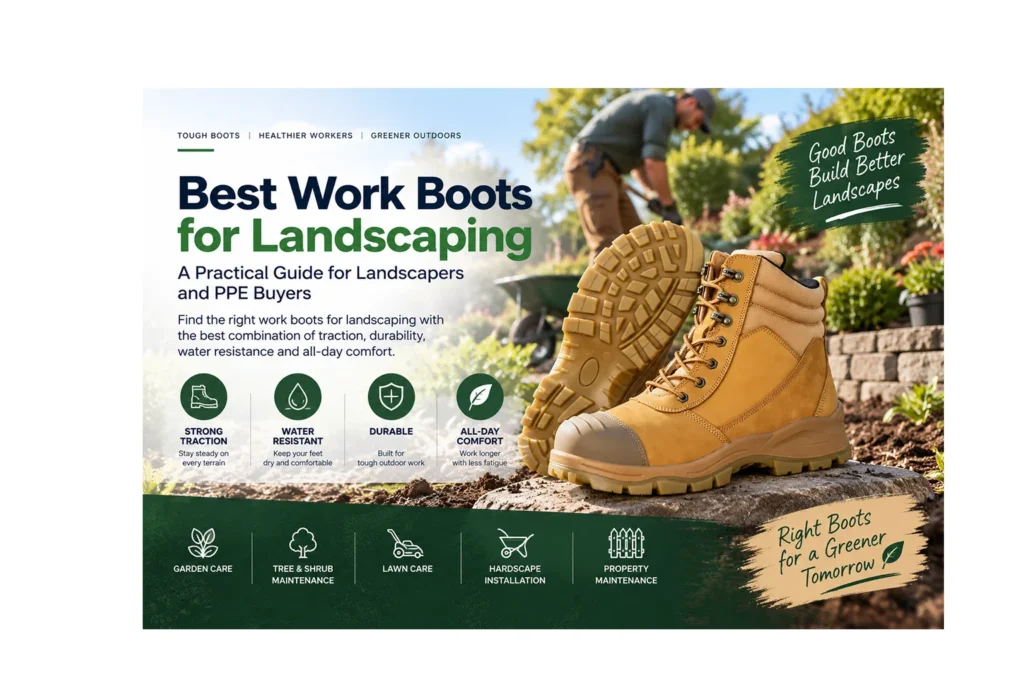
Landscaping can be surprisingly hard on footwear.
A landscaper may spend the day walking over wet grass, loose soil, gravel, mulch, concrete, slopes and muddy ground. The same worker may also operate mowers, trimmers, blowers and other outdoor power equipment, carry materials, climb in and out of trucks and work through rain, heat and humidity.
That means the best work boots for landscaping need to do more than look rugged.
They should provide the right combination of:
- Traction
- Water resistance
- Comfort
- Durability
- Support
- Appropriate toe protection
- Breathability
- Mud-shedding outsole design
For most professional landscapers, a waterproof or water-resistant 6-inch work boot with aggressive outdoor traction and good cushioning is the safest starting point. If the job involves heavier equipment, dropped-object hazards or stricter site rules, a safety-toe model may also be appropriate.
In 2026, strong options include boots from KEEN Utility, Red Wing, Ariat, Timberland PRO and Wolverine, but the right choice depends on whether the worker primarily needs mobility, mud traction, waterproofing or industrial protection.
What Makes a Good Landscaping Work Boot?
Landscaping footwear has different priorities from warehouse or factory footwear.
A flat wedge boot may feel excellent on concrete, but landscaping workers often move over:
- Soft soil
- Wet grass
- Hills
- Mud
- Gravel
- Tree roots
- Paving stones
- Uneven terrain
That makes outsole grip and stability especially important.
A good landscaping boot should generally combine several characteristics.
Waterproof or Water-Resistant Construction
Landscaping often begins early in the morning when grass is covered with dew.
Even without rain, workers can quickly soak ordinary footwear simply by walking through wet lawns.
For crews operating in irrigation, rainy climates or muddy environments, waterproof construction can significantly improve comfort.
Aggressive Outdoor Traction
Smooth soles are rarely ideal for landscaping.
Look for tread designed to grip:
- Soft ground
- Mud
- Wet grass
- Gravel
- Uneven surfaces
The outsole should also release dirt reasonably well rather than packing completely with mud.
Good Cushioning
Landscapers can walk continuously for hours.
A supportive midsole can help reduce the impact of repeatedly walking over hard and irregular surfaces.
Secure Heel and Ankle Fit
Uneven ground increases the importance of footwear stability.
A boot does not need to feel excessively stiff, but the heel should remain secure and the upper should provide enough structure for the terrain.
Appropriate Weight
Heavy boots can become tiring during long mowing, trimming and maintenance jobs.
Modern composite toes, lighter midsoles and mixed-material uppers can reduce footwear weight without eliminating required protection.
Best Work Boots for Landscaping in 2026
Rather than treating one pair as universally superior, the following models are better choices for different landscaping situations.
| Work Boot | Best For | Key Advantage |
|---|---|---|
| KEEN Utility St. Paul | Uneven ground and general landscaping | Waterproof, outdoor traction, safety toe |
| Red Wing Apex | Professional landscaping crews | Lightweight waterproof construction |
| Ariat Stump Jumper BOA | Mud and wet ground | Aggressive outsole and waterproof design |
| Timberland PRO Boondock UL | Long outdoor shifts | Cushioning, waterproof leather, composite toe |
| Ariat Rebar Wedge | Hardscape and mixed landscaping | Cushioning and support on hard surfaces |
| Wolverine Rancher Pro | Muddy yard and property work | Tall pull-on construction |
These are not objective safety rankings. Exact model specifications, fit and workplace requirements should always be checked before purchase.
1. KEEN Utility St. Paul — Excellent for Uneven Landscaping Terrain
The KEEN Utility St. Paul has been specifically tested in landscaping and outdoor power-equipment work.
Pro Tool Reviews found the boot particularly well suited to soft and uneven ground, describing it as a good option for construction and landscaping workers who need a safety toe and waterproof construction.
That makes it unusually relevant to landscapers.
The St. Paul combines:
- Carbon-fiber safety toe
- Waterproof construction
- Leather, mesh and synthetic upper
- Oil- and slip-resistant rubber outsole
- Dual-density EVA/PU midsole
- Moisture-wicking interior
- Removable PU footbed
Its design is closer to an outdoor/hiking work boot than a traditional heavy leather industrial boot.
Why It Works for Landscaping
Landscapers constantly transition between different surfaces.
A boot that feels good on concrete but performs poorly on soil can become frustrating.
The St. Paul is better suited to:
- Grass
- Gravel
- Soil
- Mulch
- Uneven terrain
- Outdoor maintenance
than a completely flat industrial sole.
Best For
- Professional landscapers
- Grounds maintenance
- Outdoor power equipment crews
- Irrigation work
- Property maintenance
- Workers needing safety toes
2. Red Wing Apex — Best for Lightweight Waterproof Landscaping Work
For landscapers who want protection without wearing a very heavy boot, the Red Wing Apex is worth considering.
Bob Vila’s testing team wore the Apex for more than 40 hours during landscaping and tree-cutting work and reported that the waterproofing held up during rainy and muddy conditions. They also praised its hiking-boot-like feel and relatively low weight.
Depending on configuration, features include:
- Waterproof construction
- Aluminum safety toe
- BOA closure
- Vibram outsole
- Lightweight cemented construction
- Nubuck leather upper
- Slip-resistant design
Why It Works for Landscapers
A landscaping boot needs to be protective without feeling like a brick.
The Apex is particularly interesting because it combines occupational safety features with the walking characteristics of outdoor footwear.
The BOA closure can also be useful for workers who repeatedly tighten or loosen their boots during the day.
Best For
- Landscaping contractors
- Tree-care crews
- Grounds maintenance
- Workers walking long distances
- Wet-weather work
- Workers wanting a lighter safety boot
3. Ariat Stump Jumper BOA — Best for Wet and Muddy Ground
Landscaping often becomes difficult when the ground is wet.
Mud reduces traction and can quickly soak footwear.
The Ariat Stump Jumper BOA is designed around exactly these conditions.
A recent work-boot evaluation highlighted its 90-degree heel, aggressive debris-shedding outsole and waterproof construction, noting that it performs particularly well on soft and wet ground.
Features include:
- Full-grain leather
- Waterproof construction
- Composite safety toe
- Aggressive outdoor tread
- 90-degree heel
- BOA closure
- Toe and heel reinforcement
Why the 90-Degree Heel Matters
A defined heel can be useful on uneven terrain.
Compared with a completely flat wedge sole, it can provide more secure footing when working on:
- Slopes
- Loose soil
- Soft ground
- Uneven landscaping areas
It may also be useful when workers spend time on ladders.
Best For
- Wet landscaping
- Muddy jobsites
- Irrigation work
- Tree care
- Outdoor construction
- Slope maintenance
4. Timberland PRO Boondock UL — Best for Long Outdoor Shifts
Timberland PRO’s Boondock UL is another strong option for professional outdoor workers.
A 2026 workwear review highlights its waterproof abrasion-resistant leather, composite safety toe, slip-resistant TPU outsole and cushioning technologies, including Hover Spring foam and Anti-Fatigue technology.
That combination is relevant to landscapers who spend most of the day on their feet.
Why It Works for Landscaping
Landscaping is often a mobility-intensive job.
Workers may spend hours:
- Walking behind mowers
- Carrying tools
- Moving plants
- Pushing wheelbarrows
- Trimming hedges
- Loading vehicles
Underfoot comfort matters almost as much as outsole durability.
The Boondock UL attempts to balance rugged construction with lighter weight and higher-rebound cushioning.
Best For
- Commercial landscaping
- Long shifts
- Construction landscaping
- Grounds crews
- Workers who need safety-toe protection
5. Ocean Safety Boots — Best for Hardscape and Mixed Landscaping
Not every landscaper spends the entire day on mud.
Some crews focus heavily on:
- Pavers
- Patios
- Retaining walls
- Concrete
- Stone installation
- Outdoor construction
For these jobs, a wedge boot can become more attractive.
Ariat specifically recommends its Rebar wedge work boot for trades including construction, agriculture and landscaping, highlighting its cushioning and support on harder surfaces.
Features include:
- Grade A nubuck leather
- Waterproof construction
- Composite safety toe
- Removable footbed
- Supportive shank
- Oil- and slip-resistant TPU outsole
- Flat wedge-style platform
Why It Works for Hardscape
Wedge soles provide a broad ground-contact area.
That can feel comfortable when workers spend long periods on:
- Concrete
- Stone
- Pavers
- Workshops
- Finished outdoor surfaces
But landscapers working primarily in deep mud or on steep slopes may prefer a more aggressive heeled outsole.
Best For
- Hardscape contractors
- Paver installation
- Garden construction
- Landscape carpentry
- Mixed indoor/outdoor work
6. Wolverine Rancher Pro — Good for Wet Yard and Property Work
Some landscaping workers simply want a tall boot they can pull on quickly and wear through mud, grass and wet conditions.
The Wolverine Rancher Pro is one example.
Bob Vila’s testing found it useful for wet grass, mud and sandy soil, with tall coverage and a roomy toe box.
Pull-on construction also eliminates exposed laces that can collect mud or catch on vegetation.
Best For
- Property maintenance
- Yard work
- Farm landscaping
- Wet grass
- Muddy environments
- Workers who prefer pull-on boots
For precise slope work or situations requiring very secure ankle adjustment, a lace-up boot may still provide a better fit.
Safety Toe or Soft Toe: Which Is Better for Landscaping?
Not every landscaper automatically needs a safety toe.
The answer depends on hazards and employer requirements.
Safety Toe May Be Appropriate When Workers Handle
- Heavy stones
- Pavers
- Timber
- Machinery
- Equipment
- Large plant containers
- Landscaping materials
A protective toe may also be required when landscaping is performed on construction or industrial sites.
Soft Toe May Be Suitable When
The job involves primarily:
- Lawn maintenance
- Trimming
- Light gardening
- General groundskeeping
and no significant falling-object hazard has been identified.
The correct sequence is:
Hazard assessment → required protection → footwear selection.
Do not buy a steel toe simply because it appears more rugged.
And do not choose a soft toe simply because it is lighter.
Steel Toe vs Composite Toe for Landscapers
For mobile outdoor work, composite toes can be particularly attractive.
Steel Toe
Advantages:
- Strong protection
- Compact construction
- Widely available
- Often lower cost
Potential disadvantage:
- Added weight
Composite Toe
Advantages:
- Lower weight in many designs
- Non-metallic
- Useful for workers walking continuously
Potential disadvantage:
- Can require more internal volume depending on construction
The best option depends on the finished footwear design.
A comfortable steel-toe boot can be better than a badly shaped composite-toe boot.
Should Landscaping Boots Be Waterproof?
For most professional landscapers, waterproofing is highly desirable, but not universally necessary.
Think about how often the worker encounters:
- Morning dew
- Irrigation
- Rain
- Wet lawns
- Mud
- Puddles
If exposure is frequent, waterproof construction can dramatically improve comfort.
However, waterproof membranes can reduce breathability.
In extremely hot, dry environments, a breathable water-resistant boot may sometimes be preferable.
The ideal choice depends on climate and task.
Best Boots for Landscaping in Hot Weather
Heat can be one of the biggest comfort problems in outdoor work.
A heavy waterproof leather boot may feel excellent in cool rain but uncomfortable in hot summer conditions.
For warm climates, consider:
- Breathable lining
- Moisture-wicking materials
- Mesh panels where protection allows
- Lightweight toe caps
- Lower overall boot weight
- Moisture-management footbeds
If waterproofing is not required every day, crews may even benefit from maintaining different footwear for wet and dry seasons.
What Type of Outsole Is Best for Landscaping?
This may be the most important technical question after fit.
A landscaping outsole should usually provide:
Deep Lugs
These help grip loose surfaces.
Open Tread Channels
Large channels can help release mud rather than trapping it.
Defined Heel
Useful for slopes and uneven terrain.
Slip Resistance
Important when transitioning between wet grass, concrete and hardscape surfaces.
Appropriate Compound
The rubber or TPU compound needs to balance:
- Grip
- Wear
- Flexibility
- Weight
No tread pattern performs perfectly everywhere.
Wedge Sole vs Lug Sole for Landscaping
Both can work, but for different tasks.
Wedge Sole
Better for:
- Concrete
- Pavers
- Hardscape
- Workshops
- Flat ground
Advantages:
- Comfortable
- Broad contact area
- Often good for standing
Lugged Heel Sole
Better for:
- Soil
- Mud
- Hills
- Gravel
- Uneven terrain
Advantages:
- Better ground penetration
- Better slope grip
- Better debris handling
For general professional landscaping, a lugged outsole is usually the more versatile choice.
How High Should Landscaping Boots Be?
Common work-boot heights include 4, 6 and 8 inches.
Low-Cut or 4-Inch
Best for:
- Light landscaping
- Warm climates
- High mobility
6-Inch
Often the best all-around landscaping option.
It provides a balance of:
- Mobility
- Ankle coverage
- Support
- Debris protection
8-Inch
Useful for:
- Mud
- Heavy outdoor work
- Tall vegetation
- Rough terrain
But the extra material increases weight and heat.
Best Work Boots for Landscapers Who Walk All Day
For high-step jobs, focus on:
- Lightweight construction
- Responsive cushioning
- Secure heel
- Flexible forefoot
- Appropriate toe width
Red Wing Apex and KEEN’s hiking-inspired Utility designs are good examples of this direction.
The best landscaping footwear increasingly borrows design principles from hiking shoes rather than traditional heavy industrial boots.
That makes sense.
Landscapers walk over terrain that looks much more like a hiking trail than a factory floor.
Best Landscaping Boots for Rain and Mud
For persistent mud and rain, prioritize:
- Waterproof construction
- Deep outsole lugs
- Mud-shedding tread
- Secure ankle fit
- Higher shaft where appropriate
The Ariat Stump Jumper is particularly relevant because its outsole is specifically designed for outdoor ground and debris release.
For extremely wet environments, waterproof rubber safety boots may sometimes be more practical than leather work boots.
Are Rubber Boots Good for Landscaping?
Yes, in certain conditions.
Rubber boots are excellent for:
- Heavy rain
- Irrigation
- Mud
- Standing water
- Pressure washing
- Wet garden work
They are less ideal for all-day walking if they lack sufficient cushioning and anatomical fit.
Professional landscaping crews may therefore use rubber boots as special-purpose footwear, rather than their only daily boot.
How Long Should Landscaping Work Boots Last?
There is no fixed lifespan.
Landscaping can be particularly hard on footwear because of repeated:
- Moisture
- Mud
- Abrasion
- Flexing
- Walking
- Sun exposure
For a full-time landscaper, roughly 6–12 months can be a useful planning range, but high-quality boots may last longer, while severe use can wear footwear out sooner.
Replace or inspect boots when you notice:
- Worn tread
- Sole separation
- Cracked uppers
- Water leakage
- Loss of cushioning
- Damaged toe areas
- Failed closures
- Significant structural deformation
Actual condition matters more than calendar age.
How Can Landscapers Make Work Boots Last Longer?
Remove Mud Regularly
Do not leave thick mud permanently attached to the outsole and leather.
Dry Boots Properly
Allow them to dry naturally.
Avoid repeatedly placing wet footwear against excessive direct heat.
Rotate Two Pairs
If crews work in wet conditions every day, alternating pairs allows more drying time.
Maintain Leather
Use appropriate manufacturer-recommended leather-care products.
Replace Insoles When Appropriate
A worn removable footbed can sometimes be replaced without replacing an otherwise functional boot.
What PPE Buyers Should Look for When Buying Landscaping Boots
Large landscaping companies have different concerns from individual workers.
A company buying hundreds of pairs should evaluate:
- Worker duties
- Terrain
- Climate
- Footwear weight
- Waterproofing
- Outsole design
- Toe-protection requirement
- Size range
- Wide-fit availability
- Product consistency
- Replacement availability
A useful procurement process is:
Terrain → hazards → required protection → outsole → waterproofing → fit → comfort → durability → cost.
This produces much better results than simply buying the cheapest “work boot.”
Landscaping Work Boots for Different Jobs
Lawn Maintenance Crews
Prioritize:
- Lightweight design
- Wet-grass traction
- Water resistance
- Breathability
Irrigation Workers
Prioritize:
- Waterproofing
- Mud traction
- Higher shaft
- Easy-clean construction
Tree and Arborist Support Crews
Prioritize:
- Aggressive traction
- Ankle stability
- Durable uppers
- Safety toe where required
Specialized climbing or chainsaw work may require footwear designed and tested specifically for those hazards.
Hardscape Installers
Prioritize:
- Toe protection
- Cushioning
- Durable leather
- Support
- Outsole suitable for concrete and stone
Commercial Grounds Maintenance
Prioritize:
- Long-shift comfort
- Moderate waterproofing
- Low weight
- Durable tread
Common Mistakes When Choosing Landscaping Boots
Buying Flat-Sole Boots for Muddy Terrain
A comfortable wedge boot may become frustrating if the tread repeatedly fills with mud.
Choosing the Heaviest Boot Available
More weight does not automatically mean more protection.
Ignoring Waterproofing
Wet grass can soak boots surprisingly quickly.
Ignoring Breathability
Waterproof boots that trap too much heat can become uncomfortable during summer landscaping.
Buying the Wrong Safety Toe
Protection should match the actual risk assessment.
Ignoring Fit
An expensive boot with the wrong toe box or heel shape will still be uncomfortable.
Frequently Asked Questions
What are the best work boots for landscaping?
Strong options include KEEN Utility St. Paul, Red Wing Apex, Ariat Stump Jumper BOA, Timberland PRO Boondock UL and Ariat Rebar Wedge. The right model depends on terrain, hazards, climate and personal fit.
Should landscaping boots be waterproof?
Usually yes if workers regularly encounter wet grass, rain, irrigation or mud. For extremely hot and dry conditions, breathability may sometimes be more important.
Are steel toe boots good for landscaping?
They can be when workers face falling or rolling object hazards. Composite toes may provide a lighter alternative for highly mobile landscaping work.
Are hiking boots good for landscaping?
Hiking-style work boots can be excellent because landscaping involves similar uneven outdoor terrain. However, ordinary recreational hiking boots may lack required occupational protection.
Are wedge boots good for landscaping?
They can be very comfortable for hardscape and concrete work, but lugged soles are generally more versatile on mud, grass and slopes.
What height boot is best for landscaping?
A 6-inch boot is often the best compromise between mobility, ankle coverage and protection. Taller boots can be useful for mud and rough vegetation.
What boots are best for mowing lawns?
Lightweight, water-resistant or waterproof boots with strong wet-grass traction and good cushioning are generally appropriate.
What boots are best for muddy landscaping jobs?
Look for waterproof construction, aggressive open lugs and a defined heel. Ariat’s Stump Jumper is an example of this outdoor-oriented design.
How long do landscaping work boots last?
Six to twelve months can be a useful planning range for daily professional use, but actual lifespan depends heavily on terrain, moisture, usage and boot construction.
Conclusion: What Are the Best Work Boots for Landscaping?
For most landscaping professionals, the best overall footwear is not the heaviest industrial boot and not the lightest athletic shoe.
It is a boot designed for continuous outdoor movement over wet and uneven ground.
For mixed landscaping and safety-toe work, KEEN Utility St. Paul is particularly relevant because it combines waterproofing, cushioning and traction for soft terrain.
For workers prioritizing lightweight waterproof performance, Red Wing Apex deserves consideration and has been tested specifically during landscaping and tree-cutting tasks.
For muddy outdoor work, Ariat Stump Jumper BOA provides the aggressive heel and tread pattern many landscapers need.
For hardscape and concrete-heavy jobs, a boot such as the Ariat Rebar Wedge can provide a more comfortable underfoot platform.
Ultimately, remember this sequence:
Terrain → workplace hazards → protection → waterproofing → traction → comfort → durability.
That is a much better way to choose landscaping boots than shopping by appearance alone.
OEM Landscaping Work Boots for Distributors and PPE Brands
For PPE distributors, workwear wholesalers and private-label brands, landscaping footwear can be developed around specific outdoor working conditions.
Ocean Safety Shoes supports OEM and ODM work boot development with options such as:
- Waterproof leather uppers
- Steel or composite toe protection
- Aggressive outdoor outsoles
- Mud-shedding tread patterns
- Breathable linings
- Wide-fit constructions
- Side-zip designs
- Custom colours, logos and packaging
For B2B buyers, the best starting point is simple:
Define the terrain, hazards, climate and target price first—then build the boot around the worker’s real needs.