
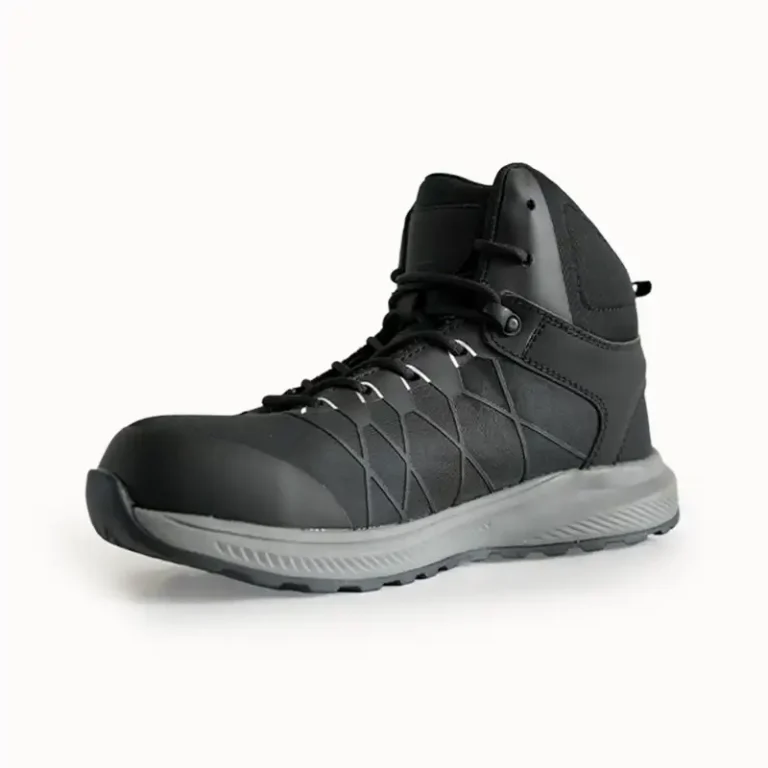
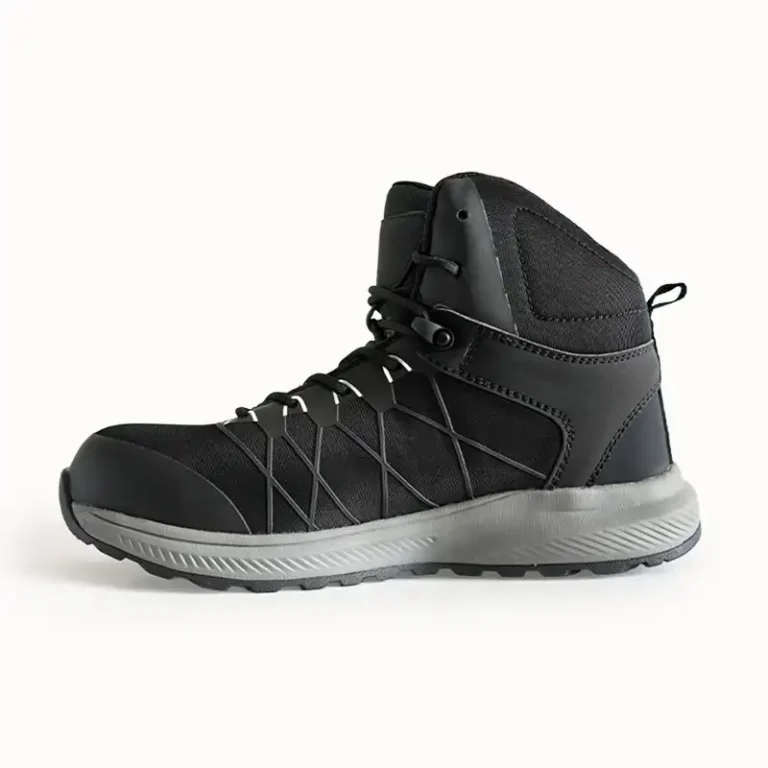
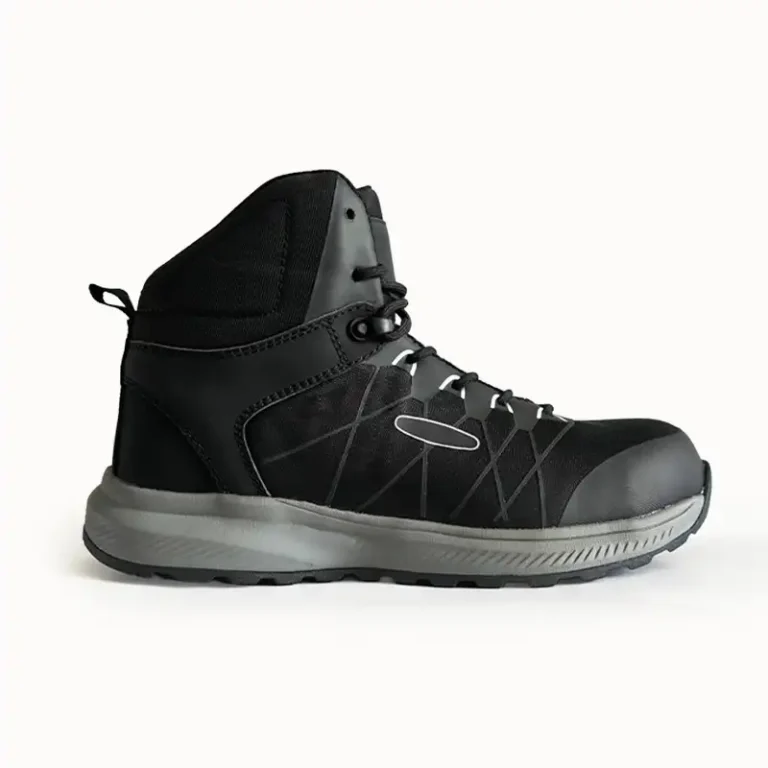

Black Breathable Mesh Outdoor Sports Safety Shoes
Upper: black mesh +Hot TPU cutting+Printing+Microfiber in the heel
Collar: Padded collar mesh+foam
Lining: Mesh lining
Footbed: Hi-poly+mesh
Outsole: MD EVA+slip-resistant rubber outsole
Standard: S1PS Composite toe(fiber glass)+kevlar
Inquiry NowCollar: Padded collar mesh+foam
Lining: Mesh lining
Footbed: Hi-poly+mesh
Outsole: MD EVA+slip-resistant rubber outsole
Standard: S1PS Composite toe(fiber glass)+kevlar
Modern safety footwear does not always need the weight and appearance of a traditional leather work boot. Black Breathable Mesh Outdoor Sports Safety Shoes combine an athletic, low-cut profile with lightweight protective components, making them a practical choice for workers who spend much of the day walking, bending and moving between different work areas.
The shoe uses a black breathable mesh upper reinforced with hot-cut TPU and microfiber, together with a fiberglass composite toe and flexible Kevlar penetration-resistant midsole. An MD EVA and slip-resistant rubber outsole completes the sports-inspired construction. The result is safety footwear aimed at active workers who value ventilation, flexibility and cushioning alongside workplace protection.
Breathable Black Mesh Upper for Active Work
The main upper uses black mesh, selected to promote airflow around the foot while keeping the overall shoe lightweight. This construction is particularly useful in warmer workplaces or for employees whose jobs involve continuous movement.
Compared with a heavy full-leather upper, mesh allows the shoe to flex more naturally with the foot. This can be beneficial for warehouse picking, logistics, maintenance, light manufacturing and other active jobs where employees may cover considerable distances during a shift. Mesh and engineered textiles are increasingly used for lightweight industrial footwear where breathability and reduced weight are priorities.
Black also gives the shoe a versatile industrial appearance, while printed details prevent the upper from looking like a basic uniform work shoe.
Hot-Cut TPU Reinforcement Adds Structure
Breathability is useful, but mesh alone does not provide enough structure for a well-designed safety shoe. For this reason, hot-cut TPU reinforcements are applied to selected areas of the upper.
These lightweight overlays help stabilize the mesh and provide additional resistance against everyday rubbing without covering the entire upper with heavy synthetic panels. They also allow more freedom in creating an athletic visual design.
At the rear, microfiber reinforcement around the heel helps create a more stable heel structure. Combining different materials according to the function of each area allows the shoe to remain light while providing reinforcement where it is most useful.
Padded Collar for a More Secure Fit
The ankle opening features a padded mesh collar with foam.
This is particularly important in low-cut sports safety shoes because the footwear needs to hold the heel securely without the ankle support of a traditional high-cut work boot. The foam padding creates softer contact around the ankle, while the mesh surface maintains the breathable character of the shoe.
For workers who repeatedly walk, climb stairs, squat or operate in fast-moving logistics environments, a comfortable collar can also help reduce rubbing around the heel and ankle during extended wear.
Mesh Lining and Cushioned Hi-Poly Footbed
Breathability continues inside the shoe with a mesh lining. The material provides a softer interior contact surface while supporting air circulation around the foot.
Underfoot, the shoe uses a Hi-Poly footbed with mesh covering. The cushioned structure helps improve comfort when standing or walking on hard industrial surfaces, while the mesh top layer gives the insole a softer and more breathable finish.
Comfort should be considered as a complete footwear system rather than one isolated component. Fit, upper flexibility, collar padding, footbed cushioning and outsole shock absorption all influence how the shoe feels during a full working shift.
MD EVA Midsole for Sports-Style Cushioning
A major difference between this design and many conventional industrial shoes is the MD EVA midsole.
EVA is widely used in athletic footwear because it provides cushioning without adding excessive weight. In this safety shoe, the MD EVA layer helps absorb repeated impact generated when walking across concrete, warehouse floors and other hard surfaces.
This construction creates a softer, more sports-oriented underfoot experience than many traditional solid work-shoe outsoles.
For employees whose work involves continuous movement rather than remaining at one workstation, reducing unnecessary footwear weight can make the shoe more suitable for an active working routine.
Slip-Resistant Rubber Contact Outsole
The cushioning EVA midsole is combined with a slip-resistant rubber outsole.
Each material has a different job: EVA contributes lightweight cushioning, while rubber provides the durable ground-contact surface. Rubber is especially useful where traction and abrasion resistance are important, and EVA/rubber combinations are commonly selected for sport-style safety footwear.
Actual slip performance always depends on the outsole compound, tread design, floor surface and contaminants. Buyers should therefore match the outsole to the intended workplace rather than relying only on the visual tread pattern.
Fiberglass Composite Toe: Protection Without a Steel Cap
Inside the athletic-looking front is a fiberglass composite toe cap.
Fiberglass provides protective toe performance without using a traditional steel cap. This supports a lighter, more athletic footwear concept and also reduces the rapid transfer of heat and cold associated with metal components.
Importantly, the safety standard evaluates protective performance rather than requiring every toe cap to be steel. Properly tested composite and fiberglass toe caps can therefore provide certified impact and compression protection.
For buyers developing modern safety sneaker collections, this creates an opportunity to provide genuine protective footwear without making the finished product look unnecessarily bulky.
Flexible Kevlar Penetration-Resistant Midsole
Under the foot is a Kevlar non-metallic penetration-resistant insert, helping protect against sharp objects approaching through the outsole.
Unlike a traditional steel plate, the textile construction supports the flexible character of the sports-style shoe. This is particularly useful when workers frequently bend at the forefoot, walk long distances or move between different work positions.
The model is designed around an S1PS configuration, combining a composite toe with non-metallic penetration protection. Under EN ISO 20345:2022, the PS designation identifies non-metallic penetration-resistant footwear tested using the smaller 3.0 mm test nail and its applicable performance criteria.
The exact certification and marking should, of course, correspond to the final production model and approved test documentation.
A Different Position for the Modern Safety Footwear Market
These Black Breathable Mesh Outdoor Sports Safety Shoes are best positioned where buyers want something between an industrial work shoe and an athletic sneaker.
They can be considered for warehousing, logistics, distribution, light manufacturing, maintenance, assembly, workshops and general active industrial work, provided the S1PS protection level matches the workplace risk assessment.
Although the product has an outdoor sports appearance, its breathable mesh construction means it should not be marketed as waterproof footwear. For prolonged rain, standing water or highly abrasive heavy-construction environments, a different upper and protection specification may be more appropriate.
This distinction helps distributors sell the shoe according to its genuine strengths: breathability, low weight, flexibility, cushioning and non-metallic protective components.
Developed by Ocean Safety Shoes for OEM/ODM Buyers
At Ocean Safety Shoes, we manufacture and develop safety footwear for brands, wholesalers, importers and PPE distributors.
For this type of sports safety shoe, customization can go well beyond changing the logo. Buyers can develop different mesh patterns, TPU shapes, printed graphics, microfiber reinforcements, outsole colour combinations, footbeds and branding details. Our existing OEM development process also considers the intended industry, walking distance, climate, protection requirements and target price before materials are finalized.
This approach is particularly useful for customers building a lightweight safety sneaker range and looking for a product with a more distinctive identity than standard catalogue footwear.
Frequently Asked Questions
1. Are Black Breathable Mesh Outdoor Sports Safety Shoes suitable for long working shifts?
Yes. The breathable mesh upper, padded collar, cushioned Hi-Poly footbed and MD EVA midsole are designed to improve comfort for workers who spend long periods walking or standing.
2. Does this safety shoe use a steel toe?
No. It uses a lightweight fiberglass composite toe cap, providing protective performance without the weight and thermal conductivity associated with a traditional steel cap.
3. What does the Kevlar midsole do?
The non-metallic Kevlar insert provides penetration resistance against sharp underfoot hazards while maintaining more flexibility than a conventional steel plate.
4. Why use an MD EVA and rubber outsole together?
MD EVA provides lightweight cushioning and shock absorption, while the rubber contact outsole contributes grip, abrasion resistance and durability.
5. Are these Black Breathable Mesh Outdoor Sports Safety Shoes waterproof?
No. Breathable mesh is designed primarily for ventilation rather than waterproofing, so this model is better suited to dry or relatively controlled working conditions where lightweight comfort is important.
Looking for a lightweight sports safety shoe that can be customized for your brand? Ocean Safety Shoes supports OEM and ODM development for importers, wholesalers, PPE distributors and safety footwear brands. Contact us to develop Sports Safety Shoes with customized upper patterns, TPU designs, colours, logos, footbeds, packaging and market-specific safety requirements.

