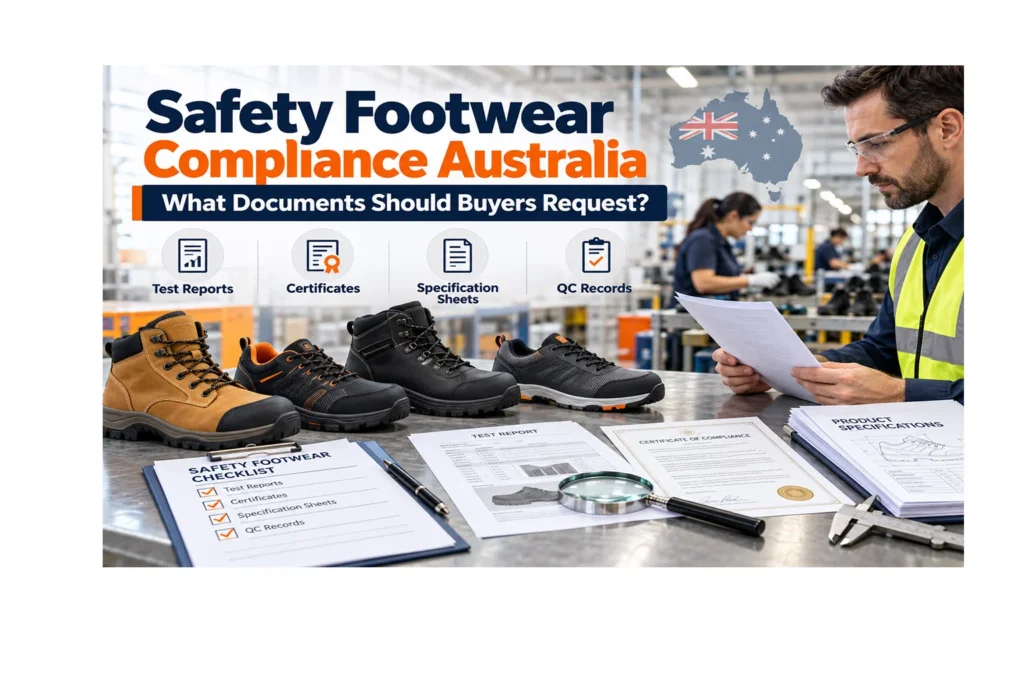
When sourcing safety footwear for the Australian market, requesting the right documentation is an essential step in supplier evaluation. PPE distributors, safety equipment wholesalers, importers, and industrial procurement teams need to verify that products meet the requirements of their intended applications before committing to bulk orders.
For businesses focused on safety footwear compliance Australia, a manufacturer’s quotation and product catalogue are not enough. Buyers should review relevant Australian safety footwear standards, product-specific test reports, declarations or certificates where applicable, and quality control records that support the supplier’s claims.
Missing or unsuitable documentation can create purchasing risks, delay customer approvals, and make it difficult to demonstrate that a product is appropriate for a particular workplace.
This guide explains which documents Australian buyers should request from a safety shoe manufacturer, how to evaluate the evidence, and what to check before approving samples or placing a wholesale order.
It is designed for:
- Safety footwear distributors and wholesalers
- PPE importers and industrial suppliers
- Construction and manufacturing procurement teams
- Workwear retailers and private-label brands
- Businesses sourcing OEM safety shoes from overseas manufacturers
The objective is to help B2B buyers make informed sourcing decisions, verify product claims, and build a more reliable safety footwear supply chain.
Which Safety Footwear Standards Should Australian Buyers Check?
Before requesting certificates or test reports, identify the standard relevant to the footwear and its intended application.
AS 2210.3:2019 — Safety Footwear
AS 2210.3:2019 is a key Australian standard covering general-purpose safety footwear. Its requirements address areas such as mechanical risks, slip resistance, thermal risks, and ergonomic performance.
When asking a manufacturer about this standard, confirm:
- Whether the specific model has been tested against the relevant requirements
- Which edition of the standard was used
- Which protective features were assessed
- Whether the test evidence covers the exact model being quoted
Do not assume that a product complies simply because a supplier mentions AS 2210.3 in a catalogue.
AS/NZS 2210.1:2025 — Selection, Care and Use
AS/NZS 2210.1:2025 provides guidance on selecting, caring for, and using safety and occupational footwear across different environments and occupations. It is listed as current in the Standards Australia Store.
For procurement teams, this guidance reinforces the importance of selecting footwear according to workplace conditions rather than relying on a product’s general marketing description.
Are Australian Standards Always Legally Mandatory?
Australian Standards are not automatically laws. Safe Work Australia explains that compliance becomes mandatory where legislation requires a particular standard, although standards may also be relevant when assessing workplace health and safety duties.
For this reason, Australian buyers should check the applicable state or territory requirements, workplace risk assessment, customer specifications, and contractual obligations before deciding which evidence is necessary.
1. Product Specification Sheet
The first document to request from a safety shoe manufacturer is a detailed product specification sheet.
This document establishes exactly what the supplier is offering and provides a reference for checking samples, test reports, quotations, and production orders.
Ask the manufacturer to include:
- Product name, model number, and SKU
- Upper, lining, insole, and outsole materials
- Toe protection type
- Puncture-resistant midsole details, where applicable
- Slip-resistance claims
- Water-resistance or waterproof claims, where applicable
- Electrical or thermal properties, where relevant
- Available sizes and colours
- Applicable standards and claimed protection categories
For example, a supplier may offer two visually similar safety shoes, but one may have a steel toe and the other a composite toe. Their protective properties and supporting test evidence may differ.
The specification sheet helps ensure that your quotation, sample, and final production order refer to the same product.
What to check: Every model number and product description should be consistent across the specification sheet, test reports, labels, and other relevant documents.
2. Product-Specific Test Reports
Test reports provide evidence of how a product performed under specified testing conditions. For B2B procurement, they are among the most useful documents to review.
When evaluating safety footwear compliance Australia requirements, ask the manufacturer for relevant reports supporting its safety and performance claims.
What Should a Test Report Include?
A useful report should identify:
- The testing laboratory
- The report number and issue date
- The product name and model
- The standard or test method used
- The tested characteristics
- The test results
- Any limitations or exclusions
- The relationship between the tested sample and the product being supplied
Where appropriate, ask whether the laboratory is accredited for the specific tests performed and verify the accreditation scope with the relevant accreditation body.
Which Performance Tests Matter?
The required tests depend on the intended workplace hazards and the product’s claims.
| Performance area | Evidence to request |
|---|---|
| Toe protection | Relevant impact and compression test results |
| Puncture resistance | Test evidence for the specified protective midsole |
| Slip resistance | Results for the applicable test method and conditions |
| Water resistance | Evidence supporting the claimed water-resistant performance |
| Heat resistance | Relevant test results if heat resistance is claimed |
| Electrical properties | Test results for the specific electrical or antistatic claim |
| Additional protection | Evidence for any claimed specialised protective feature |
Not every model needs every test. Buyers should request evidence relevant to the product specification and the hazards the footwear is intended to address.
Important: A test report for one model does not automatically prove that every shoe in the manufacturer’s catalogue has the same performance.
3. Certificate or Declaration of Conformity, Where Applicable
Australian buyers frequently ask manufacturers for safety shoes certification Australia documentation. The key is understanding what the document actually establishes.
Depending on the applicable requirements and the supplier’s certification arrangements, you may receive a product certificate, a manufacturer’s declaration, or another conformity document.
What Should You Verify?
Check whether the document identifies:
- The manufacturer or responsible organisation
- The exact product model or clearly defined product family
- The standard and edition claimed
- The certification body, if applicable
- The relevant report or certificate number
- The scope and validity of the document
If a supplier provides a certificate issued under a third-party certification scheme, verify it with the issuing organisation where possible.
If the manufacturer provides a declaration, establish who signed it and what evidence supports the declaration.
Does a Certificate Guarantee Compliance?
No document should be accepted without checking its scope and relevance.
A certificate might cover a different product family, an earlier model, or a particular configuration that differs from your intended order.
Similarly, a manufacturer’s declaration is not automatically equivalent to independent third-party certification.
Australian buyers should determine what evidence is required by the relevant law, customer specification, procurement contract, or workplace policy.
4. Manufacturer’s Declaration and Compliance Statement
A written declaration can help clarify the manufacturer’s claims and responsibilities.
Where applicable, request a signed statement identifying the product, the standard or requirements claimed, and the supporting evidence.
The document should specify:
- Product name and model
- Manufacturer’s legal name
- Applicable standard and edition
- Relevant test report references
- Protective features covered by the statement
- Name and position of the authorised signatory
- Issue date
Ask the manufacturer to explain any exclusions or limitations.
For example, a statement may cover toe protection and specified slip-resistance performance but not establish suitability for chemical exposure or electrical work.
A declaration should support your evaluation rather than replace the underlying test evidence.
5. Quality Control and Manufacturing Records
Safety footwear documentation should not stop at initial product testing.
Wholesale buyers also need confidence that products manufactured in later production runs will remain consistent with the approved sample.
Request information about the manufacturer’s quality control process, including:
- Incoming material inspections
- In-process production checks
- Finished-product inspections
- Defect classification and corrective actions
- Batch or production-lot identification
- Procedures for handling non-conforming products
Where available, review sample inspection reports and records from previous production runs.
For importers, these records can help establish whether the manufacturer has a repeatable process for maintaining product quality.
Why Batch Traceability Matters
Batch traceability can help buyers identify which production run supplied a particular order.
This becomes useful if a quality issue is reported after products have been distributed to customers.
Ask the supplier how it identifies production batches and how it would investigate a complaint involving a specific shipment.
A manufacturer with a clear traceability process can make product investigations and corrective actions easier to manage.
6. Product Labelling, Packaging and User Instructions
Labels and packaging help buyers identify the product and communicate relevant information to customers.
Before bulk production, request examples of the proposed labels, shoe-box markings, and user instructions.
Check that they accurately reflect the approved product and do not make unsupported claims.
Depending on the product and applicable requirements, useful information may include:
- Manufacturer or supplier identification
- Product model and size
- Relevant protective markings
- Applicable standard references
- Care and maintenance instructions
- Intended applications and limitations
- Product identification or batch information
Confirm that any standard references or protection symbols are appropriate for the actual product.
If you are purchasing private-label safety shoes, review the final artwork before production. Changing the branding should not result in inaccurate or misleading safety claims.
7. Material Information and Specialised Performance Evidence
For certain applications, buyers may need additional documents beyond standard safety footwear test reports.
The requirements depend on the environment and the claims being made.
For example, industrial customers may ask for information about:
- Chemical exposure suitability
- Heat-resistant outsole performance
- Cold-temperature applications
- Antistatic properties
- Water resistance
- Specialised workplace hazards
Do not assume that general safety footwear compliance automatically establishes suitability for every specialised environment.
If your customer operates in mining, manufacturing, food processing, construction, or another demanding sector, identify the hazards and request evidence relevant to those conditions.
For products with specialised material or chemical-related claims, ask for appropriate technical documentation and testing evidence.
8. Sample Approval and Purchase Order Records
Although these documents are not substitutes for safety test evidence, they are important for controlling bulk purchases.
Before approving production, keep a record of the sample and specifications accepted by your team.
Your purchasing file should include:
- Final product specification
- Approved sample reference or photographs
- Confirmed model and size range
- Agreed branding and packaging
- Quotation and purchase order
- Production and delivery schedule
- Written approval of any changes
This record helps resolve disputes if the delivered products differ from what was agreed.
For OEM and private-label projects, obtain written approval before the manufacturer changes materials, protective components, construction, or other important specifications.
If a change could affect safety performance, ask whether additional assessment or testing is required before accepting the revised product.
How to Evaluate Documents from a Safety Shoes Supplier Australia Buyers Consider
When comparing a local distributor with an overseas manufacturer, use the same evidence checklist for both.
| Evaluation area | Questions to ask |
|---|---|
| Product identity | Does every document identify the correct model? |
| Standards | Is the stated standard relevant and is the edition clear? |
| Testing | Are the reports relevant to the claimed protective features? |
| Certification | Is the scope clear, and can the document be verified? |
| Quality control | Does the supplier inspect production consistently? |
| Traceability | Can the supplier identify the relevant production batch? |
| Documentation updates | Will the supplier notify you of material or product changes? |
| After-sales support | Can the supplier investigate quality complaints? |
A safety footwear supplier Australia buyers can rely on should be able to explain its product documentation clearly and identify the evidence supporting its claims.
Do not select a supplier based solely on the number of certificates it provides. Relevance, validity, scope, and consistency with the actual product are more important.
Common Documentation Red Flags
Watch for the following warning signs when reviewing supplier documents.
The Certificate Does Not Identify the Product
A generic certificate without a clear model number or product scope may not establish that the shoe you intend to purchase has been assessed.
The Test Report Covers a Different Model
Similar-looking products may use different materials, components, or construction methods. Request clarification if the report and quotation do not match.
The Supplier Cannot Explain the Standard
If a manufacturer claims compliance but cannot identify the standard, edition, or relevant testing, ask for clarification before proceeding.
Documents Contain Inconsistent Information
Differences in model numbers, manufacturer names, test dates, or protective markings should be resolved before placing a bulk order.
Product Changes Are Not Documented
If a manufacturer changes the outsole, toe cap, midsole, or another safety-related component, ask whether the existing evidence remains applicable.
Unresolved discrepancies should be treated as a reason to pause approval until the supplier provides satisfactory evidence.
Safety Footwear Compliance Checklist for Australian Buyers
Use this checklist before approving a new manufacturer or product.
- Confirm the intended application and required protective features.
- Identify the relevant Australian safety footwear standard and edition.
- Obtain the complete product specification sheet.
- Request product-specific test reports.
- Verify certificates or declarations where applicable.
- Check the scope and validity of supporting documents.
- Review quality control and traceability procedures.
- Confirm that labels and packaging match the approved specifications.
- Approve a sample before bulk production.
- Document any product changes and reassess their impact.
- Keep the final documents with the purchase order and shipment records.
Safe Work Australia advises businesses to select PPE that suits the task and hazards, fits properly, and is reasonably comfortable. It also notes that businesses should periodically assess whether PPE remains effective. Documentation is therefore one part of the purchasing process, alongside workplace risk assessment and product suitability.
Frequently Asked Questions
What documents should Australian buyers request from a safety shoe manufacturer?
Start with a product specification sheet, relevant test reports, and applicable certificates or declarations. Depending on the product and purchasing requirements, also request quality control records, traceability information, labelling samples, and user instructions.
Which safety footwear standards are relevant in Australia?
AS 2210.3:2019 is a key standard for general-purpose safety footwear, while AS/NZS 2210.1:2025 provides guidance on selection, care, and use. Buyers should confirm the current and applicable requirements for their specific product and workplace.
Is third-party safety shoes certification always mandatory in Australia?
Not universally. Standards are not automatically laws, and the applicable obligations depend on legislation, workplace requirements, contracts, and the product’s intended use. Buyers should establish what evidence is required for their particular application.
Can an overseas manufacturer’s test report be accepted?
It may be useful if it covers the exact product, uses a relevant test method, and provides credible results. Buyers should verify the laboratory’s capabilities and determine whether the report meets the evidence requirements of their customer, workplace, or procurement process.
What should I do if the supplier’s certificate and product label do not match?
Pause approval and request written clarification. Ask the manufacturer to identify the correct model, explain the discrepancy, and provide supporting evidence before the product is accepted for bulk production or distribution.
How can distributors maintain compliance across repeat orders?
Keep approved specifications and supporting documents on file, establish a process for notifying buyers about product changes, and verify that repeat orders match the approved product. Reassess the documentation when safety-related components or construction change.
Conclusion
For Australian distributors, importers, and procurement teams, obtaining the right documents from a safety shoe manufacturer is an important part of responsible sourcing.
The most useful evidence includes product specifications, relevant test reports, applicable certificates or declarations, and quality control records that help establish product identity, performance, and manufacturing consistency.
A systematic approach to safety footwear compliance Australia buyers need can reduce sourcing risks, support customer evaluations, and improve confidence in long-term supplier relationships.
Remember that no single document automatically proves suitability for every workplace. The product, supporting evidence, applicable requirements, and actual working conditions must be considered together.
Source Safety Footwear for the Australian Market
Ocean Safety Shoes provides safety footwear manufacturing solutions for distributors, wholesalers, importers, and private-label brands.
Explore the Ocean Safety Shoes product range to review available footwear styles and discuss your product requirements.
When requesting a quotation, specify your intended application, required protective features, target standard, expected order quantity, and branding requirements. You can also request relevant product specifications and supporting test documentation for evaluation before approving samples or placing a bulk order.