
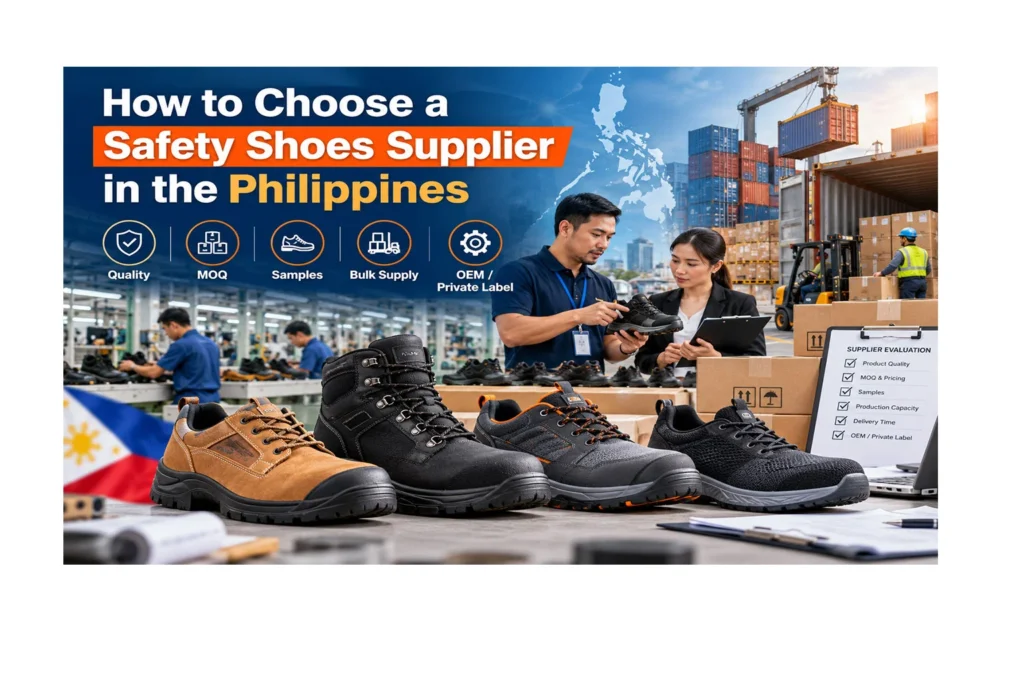
Choosing the right safety shoes supplier Philippines businesses can rely on is an important decision for PPE distributors, industrial equipment wholesalers, workwear retailers, and procurement teams. A supplier must offer more than competitive prices. Product consistency, reliable delivery, appropriate safety documentation, and the ability to support repeat orders are equally important for long-term business success.
The Philippine market serves a wide range of industries, including construction, manufacturing, warehousing, logistics, and infrastructure. These sectors have different footwear requirements, creating opportunities for distributors that can source suitable products and maintain a dependable supply chain.
For B2B buyers, the challenge is identifying a supplier that matches their product requirements, target pricing, order quantities, and growth plans.
This guide explains how to evaluate safety footwear suppliers, compare local and overseas sourcing options, assess samples, and establish a reliable purchasing process. It is designed to help Philippine businesses make informed sourcing decisions and develop sustainable supplier relationships.
Why Choosing the Right Safety Shoes Supplier Matters
For distributors and importers, supplier selection directly affects inventory planning, customer satisfaction, and profitability.
A supplier that consistently delivers the agreed products helps businesses maintain customer confidence. Conversely, inconsistent quality or unexpected delays can disrupt orders and increase operating costs.
When evaluating potential safety shoes Philippines suppliers, consider these business priorities:
| Purchasing priority | Why it matters to B2B buyers |
|---|---|
| Product consistency | Helps maintain customer satisfaction across repeat orders |
| Competitive pricing | Supports wholesale margins and market positioning |
| Reliable production | Reduces the risk of stock shortages |
| Suitable product range | Allows distributors to serve different industries |
| Safety documentation | Helps buyers verify product claims and suitability |
| Flexible order options | Supports inventory planning and business growth |
| Customisation | Creates opportunities for private-label products |
The right supplier should meet your current purchasing needs while having the capability to support future demand.
Step 1: Define Your Target Market and Product Requirements
Before contacting suppliers, identify the customers you intend to serve and the types of footwear they need.
A clear product strategy helps you avoid purchasing unsuitable inventory or offering too many products with similar features.
Identify the Industries You Want to Serve
Different industries face different workplace hazards and purchasing priorities.
| Customer segment | Potential footwear requirements |
|---|---|
| Construction companies | Protective toe caps, durable construction, suitable outsole grip |
| Manufacturing facilities | Reliable protection and consistent product availability |
| Warehouses and logistics companies | Lightweight designs, comfort, and suitable slip resistance |
| Mining-related businesses | Footwear matched to demanding environmental and workplace hazards |
| Food processing and commercial kitchens | Appropriate slip resistance and application-specific materials |
| Industrial equipment distributors | A balanced range of products for different customer requirements |
These are general examples rather than universal specifications. Buyers should establish the actual hazards and protective requirements for each intended application.
Decide Which Product Categories to Stock
A practical purchasing strategy might include several product categories:
- General-purpose safety shoes
- Safety boots for demanding work environments
- Lightweight safety sneakers
- Composite-toe footwear
- Water-resistant or waterproof models
- Specialised industrial safety footwear
For distributors, the goal is to create a product range that meets customer demand without tying up excessive working capital in slow-moving inventory.
Start with your main customer segments, estimate expected sales, and select products that serve clearly defined applications.
Step 2: Evaluate the Supplier’s Manufacturing Capability
Once your product requirements are clear, assess whether potential suppliers can consistently produce or source the products you need.
Manufacturer vs Trading Company
A manufacturer and a trading company may both be suitable partners, but their capabilities and responsibilities can differ.
| Evaluation factor | Direct manufacturer | Trading company |
|---|---|---|
| Production control | May have direct control over manufacturing | Usually relies on manufacturing partners |
| Product development | May offer direct engineering and sample support | Depends on partner factories |
| Product range | Depends on factory specialisation | May offer products from multiple factories |
| Communication | Can provide direct production information | May coordinate communication between parties |
| Order flexibility | Depends on production capacity and MOQ | Depends on supplier relationships |
| Quality oversight | Ask how production and inspections are managed | Ask how partner factories are selected and monitored |
Neither category guarantees better quality or lower costs. The important question is whether the supplier can demonstrate the capabilities required for your order.
Questions to Ask a Potential Manufacturer
When evaluating a China safety shoes manufacturer or another overseas supplier, ask:
- Which product categories do you manufacture?
- Can you provide detailed product specifications?
- What quality control procedures are used?
- What are your standard production lead times?
- Can you support repeat orders with consistent specifications?
- What is your minimum order quantity?
- Can you develop samples or private-label products?
- What documentation is available for the products offered?
Request clear answers rather than relying exclusively on catalogue descriptions or general claims about factory capability.
Step 3: Verify Product Quality and Safety Documentation
A competitive quotation does not prove that a product is appropriate for its intended workplace.
Before committing to bulk purchasing, establish the required protective features and request evidence that supports the supplier’s claims.
Request Product-Specific Documentation
Depending on the product and intended market, relevant documents may include:
- Product specification sheets
- Test reports for claimed protective features
- Applicable certificates or declarations
- Material specifications
- Quality inspection records
- Product labelling and user instructions
Check that documents identify the correct model and that the tested configuration matches the product being quoted.
For Philippine buyers, requirements should be confirmed according to the intended application, customer specifications, and any applicable local regulations. Do not assume that a document referring to a general footwear standard automatically establishes suitability for every industrial environment.
Establish a Quality Inspection Process
Before approving an order, agree on what will be checked during production and before shipment.
A useful inspection plan may cover:
- Material and component consistency
- Stitching and construction quality
- Outsole attachment and appearance
- Product dimensions and size assortment
- Protective components specified in the purchase order
- Packaging and labelling
- Visible defects and quantity discrepancies
For larger orders, consider an independent inspection where appropriate.
The inspection criteria should be agreed in advance so that the supplier and buyer share the same expectations.
Step 4: Request Samples Before Placing Bulk Orders
Samples help buyers evaluate whether the product matches the agreed specifications before making a larger financial commitment.
What to Check During Sample Evaluation
Inspect each sample against the intended application and purchasing requirements.
Construction and materials: Review stitching, material quality, outsole construction, and overall workmanship.
Fit and comfort: Check the available sizes, fit, heel security, and suitability for the intended work environment.
Protective features: Confirm the specified components and review the relevant supporting documentation.
Consistency: If several sizes or models are being considered, verify that each matches the agreed specification.
Packaging: Check whether product labels, shoe boxes, and other packaging meet your requirements.
A visual inspection cannot independently establish impact protection, puncture resistance, or other tested safety performance. Use the appropriate documentation and testing evidence for those claims.
Approve the Sample in Writing
Once a sample is accepted, record the approved product details.
Your approval record should identify the model, materials, colours, protective features, size range, and packaging requirements.
Ask the supplier to confirm that mass production will follow the approved specifications. Any significant change should be disclosed and reviewed before production continues.
This process is particularly important for distributors selling products under their own brands.
Step 5: Compare Wholesale Pricing and Minimum Order Quantities
Price comparison is essential when evaluating bulk safety shoes Philippines purchasing options. However, buyers should compare equivalent products and consider the full cost of obtaining the goods.
Request Comparable Quotations
Send the same product specifications to each supplier and ask for quotations at commercially relevant quantities.
For example, compare several order volumes to understand how unit pricing changes as quantity increases.
| Quotation item | What to confirm |
|---|---|
| Unit price | Price for the specified model and quantity |
| MOQ | Minimum order quantity per model or design |
| Sample cost | Whether samples are charged separately |
| Customisation | Costs for logos, colours, or packaging |
| Production lead time | Estimated time before shipment |
| Shipping terms | Named delivery location and agreed Incoterms |
| Payment terms | Deposit, balance, and payment conditions |
| Repeat-order pricing | Whether future orders use the same pricing structure |
A lower unit price may not represent better value if it requires an impractically large order or excludes significant delivery expenses.
Calculate the Total Purchasing Cost
For imported footwear, include the costs relevant to your shipment, such as:
- Product purchase value
- International freight and insurance
- Customs duties and applicable taxes
- Customs clearance and handling
- Inspection expenses
- Local delivery and storage
Confirm applicable charges with your logistics provider or customs broker before finalising the purchase.
For wholesale businesses, landed cost per pair provides a more useful comparison than the factory price alone.
Step 6: Assess Communication and Order Management
Good communication is especially important when sourcing products internationally.
A supplier should provide clear answers, accurate quotations, and timely updates throughout the order process.
Evaluate Responsiveness Before Ordering
Pay attention to how the supplier handles your initial enquiries.
A reliable business partner should be able to explain product specifications, clarify commercial terms, identify documentation gaps, and communicate realistic production schedules.
Be cautious if the supplier repeatedly avoids specific questions or makes promises without providing supporting information.
Agree on Key Milestones
Before production begins, establish the main stages of the order:
- Product specifications and quotation approval
- Sample development and confirmation
- Purchase order and payment arrangements
- Production and quality checks
- Final inspection and shipment approval
- Shipping documentation and delivery coordination
Written milestones help both parties track progress and address problems before they affect customer commitments.
Step 7: Evaluate OEM and Private-Label Opportunities
For distributors seeking to build a distinctive brand, OEM and private-label sourcing may provide additional commercial opportunities.
A suitable manufacturer may offer options such as:
- Custom logo application
- Branded packaging
- Selected colour combinations
- Product design adjustments
- Custom product development
- Packaging and labelling support
Availability depends on the manufacturer’s capabilities, order quantity, and development requirements.
Understand the Costs and Requirements
Before launching a private-label product, ask about:
- Minimum order quantities
- Sample development charges
- Branding and packaging costs
- Production lead times
- Ownership and use of custom designs
- Approval procedures for product changes
- Documentation for the final product configuration
Start with a defined customer need and realistic sales forecast. Customisation can help differentiate your business, but unnecessary changes may increase costs and complicate replenishment.
Step 8: Check Shipping, Delivery, and Repeat-Order Reliability
A supplier’s responsibility does not end when production is complete. Buyers also need a workable plan for shipment and future inventory replenishment.
Confirm Shipping Responsibilities
For imported products, clarify who arranges transport, who handles export documentation, and who is responsible for the specified shipping costs under the agreed Incoterms.
Ask for realistic estimates covering production, international transit, customs clearance, and local delivery.
Do not treat the manufacturer’s production lead time as the complete delivery timeline.
Assess Repeat-Order Capability
Before establishing a long-term relationship, discuss how the supplier manages:
- Repeat production runs
- Material availability
- Size and colour consistency
- Changes in specifications
- Production scheduling
- Quality complaints and corrective actions
For distributors supplying business customers, predictable replenishment can be more valuable than a small discount on the initial order.
Common Warning Signs When Choosing a Supplier
Some warning signs deserve further investigation before you commit to a commercial order.
Prices That Are Unusually Low
A very low quotation may reflect different specifications, omitted costs, or unsupported product claims. Compare the complete offer before deciding.
Inconsistent Product Documentation
If model numbers, test reports, or product descriptions do not match, request clarification before approving the order.
No Clear Sample Approval Process
A supplier should be willing to document the agreed specifications and explain how mass production will follow the approved sample.
Unclear Commercial Terms
Missing information about MOQ, payment terms, lead times, and shipping responsibilities can lead to avoidable disputes.
No Defined Quality Issue Procedure
Ask how the supplier investigates defects, documents findings, and agrees on corrective actions.
A professional sourcing process should make responsibilities clear before problems occur.
Safety Shoes Supplier Evaluation Checklist
Use this checklist to compare shortlisted suppliers.
- Confirm the supplier’s manufacturing or sourcing capabilities.
- Define your target customers and product specifications.
- Request relevant product documentation.
- Evaluate samples before approving bulk production.
- Compare quotations using equivalent specifications.
- Confirm MOQ, payment terms, and production lead times.
- Calculate total purchasing or landed cost.
- Establish quality inspection criteria.
- Agree on shipping responsibilities and documentation.
- Confirm the process for repeat orders and product changes.
- Review OEM and private-label options if relevant.
For a more objective decision, assign scores to each category and compare suppliers against the same criteria rather than relying on price alone.
Frequently Asked Questions
How do I choose a reliable safety shoes supplier in the Philippines?
Define your product requirements, verify supplier capabilities, review relevant safety documentation, evaluate samples, compare complete quotations, and confirm production and delivery arrangements before placing a bulk order.
Should Philippine distributors buy directly from a China safety shoes manufacturer?
Direct sourcing can be suitable for distributors seeking bulk quantities, customisation, or private-label development. Local wholesalers may be preferable when smaller quantities or faster domestic replenishment are more important. Compare the complete cost and service requirements before deciding.
What is the most important document to request from a safety footwear supplier?
Start with a product specification sheet and relevant product-specific test reports. Request applicable certificates or declarations where required, and check that the documents relate to the exact model you intend to purchase.
How can I reduce risks when ordering bulk safety shoes Philippines businesses need?
Approve samples, document specifications, establish quality inspection criteria, verify the supplier’s capacity, and confirm the delivery schedule and commercial terms before production.
Can I order wholesale safety shoes Philippines distributors can sell under their own brands?
Many manufacturers offer OEM or private-label options. Confirm the available customisation, MOQ, sample approval process, branding costs, and documentation requirements before committing to the project.
How often should I review a safety footwear supplier?
Review performance after initial orders and periodically thereafter. Reassess the supplier when product specifications, production arrangements, quality performance, or customer requirements change.
Conclusion
Choosing the right safety shoes supplier Philippines businesses can depend on requires a structured evaluation of product quality, manufacturing capability, commercial terms, and supply reliability.
For distributors, wholesalers, importers, and industrial procurement teams, the most effective approach is to define product requirements, verify documentation, approve samples, compare total costs, and establish clear procedures for production and repeat orders.
A supplier that meets these requirements can help your business maintain product consistency, manage inventory, and develop stronger customer relationships.
Find a Safety Footwear Manufacturing Partner for Your Business
Ocean Safety Shoes provides safety footwear manufacturing solutions for B2B buyers, including distributors, wholesalers, importers, and businesses interested in OEM and private-label development.
Explore the Ocean Safety Shoes product range to review available styles and discuss your sourcing requirements.
When requesting a quotation, provide your target applications, required protective features, estimated order quantity, size assortment, and branding requirements. This information helps establish a clearer basis for product selection, sampling, and pricing.