
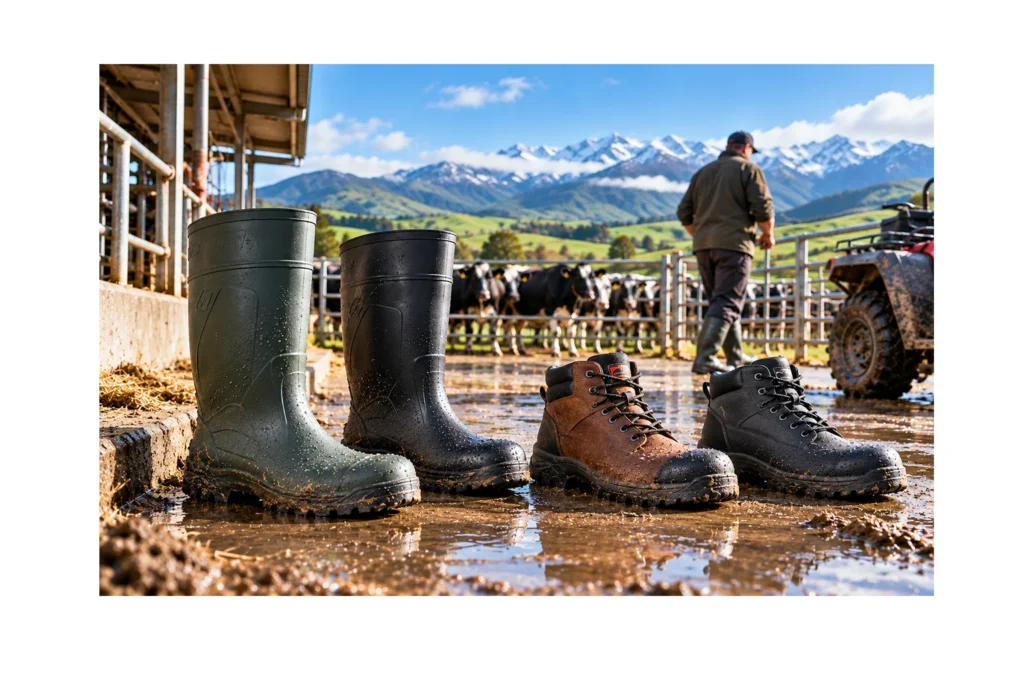
Finding the right waterproof safety boots NZ agricultural businesses need involves more than choosing footwear that keeps water out. New Zealand farm workers regularly encounter wet paddocks, muddy yards, livestock, irrigation systems, and uneven rural terrain. These conditions demand footwear that provides suitable protection, reliable traction, and comfort throughout the working day.
For dairy farmers, agricultural contractors, rural supply stores, PPE distributors, and safety footwear importers, the challenge is selecting boots that match different farming activities while remaining practical for long-term use.
Should farm workers choose waterproof leather boots or safety gumboots? Which outsole designs are suitable for muddy environments? How should agricultural businesses evaluate protective features, product durability, and replacement costs?
This guide explains how to choose waterproof safety boots for New Zealand farming and agriculture, compare footwear styles, evaluate suppliers, and make better bulk purchasing decisions.
Why Waterproof Safety Boots Matter on New Zealand Farms
Agricultural work exposes footwear to conditions that differ significantly from indoor industrial environments.
New Zealand farms may include wet grass, muddy tracks, concrete milking yards, uneven paddocks, and areas where workers frequently move between indoor and outdoor tasks.
These conditions create several footwear-related challenges.
| Farm condition | Footwear consideration |
|---|---|
| Wet paddocks and grass | Water resistance and suitable traction |
| Muddy livestock yards | Deep tread, stability, and easy cleaning |
| Dairy sheds | Wet-floor grip and hygiene requirements |
| Irrigation work | Waterproof construction and comfortable fit |
| Uneven rural terrain | Foot retention, stability, and support |
| Machinery maintenance | Protection based on mechanical hazards |
| Extended outdoor work | Comfort, moisture management, and durability |
Waterproof footwear helps reduce water entering the boot during appropriate use. However, waterproof construction alone does not ensure workplace safety.
A suitable farm boot should also address the hazards associated with the task, including slipping, impact, compression, and sharp objects where relevant.
New Zealand’s agricultural safety organisation, Safer Farms, has highlighted the importance of appropriate footwear in preventing slips, trips, and falls. Its guidance encourages farmers to consider the condition of boot tread, foot support, and suitability for the work being performed.
For agricultural employers, purchasing decisions should therefore begin with a practical assessment of working conditions.
Waterproof Safety Boots vs Safety Gumboots NZ: Which Is Better?
One of the most important decisions for agricultural buyers is whether to choose waterproof leather work boots or waterproof safety gumboots.
Both have useful applications, but their suitability depends on the environment and the work being performed.
Waterproof Leather Safety Boots
Waterproof leather safety boots may be appropriate for workers who move between paddocks, workshops, machinery, and general outdoor agricultural areas.
Depending on their design, they may provide:
- Adjustable fastening
- Secure foot retention
- Suitable cushioning
- Support for walking on uneven surfaces
- Water-resistant or waterproof construction
A waterproof membrane or another tested waterproof system may be used to limit water penetration.
However, not every leather safety boot is completely waterproof. Buyers should check the specific product’s performance claims and supporting information.
Leather boots also require appropriate cleaning and maintenance to preserve their condition.
Waterproof Safety Gumboots
Safety gumboots NZ farmers purchase are commonly considered for consistently wet, muddy, or wash-down environments.
Depending on their construction, waterproof polymer or rubber gumboots may offer:
- Waterproof upper construction
- Easy-to-clean exterior surfaces
- Higher shaft coverage
- Practical use in muddy areas
- Options with protective toe caps and penetration-resistant midsoles
Safety gumboots can be useful around dairy sheds, livestock yards, and irrigation work.
However, not every gumboot provides safety toe protection, and not every model offers the same support or traction.
Buyers should verify the product’s protective specifications rather than assuming that all waterproof gumboots are safety footwear.
Comparison: Waterproof Farm Boots vs Safety Gumboots
| Buying consideration | Waterproof leather boots | Safety gumboots |
|---|---|---|
| Wet grass and occasional mud | May be suitable | May be suitable |
| Repeated wash-down work | Depends on construction | Often practical |
| Extended walking | Depends on fit and design | Depends on fit and design |
| Adjustable fastening | Commonly available | Less common |
| Deep muddy conditions | Depends on shaft height | Higher-leg options available |
| Cleaning convenience | Requires material-appropriate care | Many models are easy to rinse |
| Protective toe options | Available | Available on safety-rated models |
The best choice depends on the task. Farms may benefit from stocking more than one approved footwear type rather than relying on a single model for every worker.
Choosing Agricultural Safety Boots for Different Farming Activities
Different agricultural operations create different demands on footwear.
For suppliers and procurement teams, understanding these differences helps identify suitable products for specific customers.
Dairy Farming and Milking Sheds
Dairy farming involves frequent exposure to water, wet concrete, livestock areas, and cleaning procedures.
Workers may move between milking facilities, holding yards, and outdoor paddocks.
Important purchasing considerations include:
- Waterproof construction
- Suitable wet-surface traction
- Easy cleaning
- Secure fit
- Appropriate toe protection where required
- Material compatibility with cleaning products
For regularly washed areas, moulded waterproof gumboots may be practical.
However, buyers must assess actual floor conditions and cleaning chemicals. A general claim of chemical resistance does not establish suitability for every cleaning or sanitising product.
Sheep and Beef Farming
Sheep and beef farm workers may spend significant time walking over uneven ground, grass, gravel tracks, and muddy paddocks.
For these activities, consider:
- Stable foot retention
- Outsole traction suited to uneven terrain
- Comfortable cushioning
- Adequate waterproof performance
- Appropriate ankle and foot support
A boot that performs well in a dairy shed may not be the most comfortable option for prolonged movement across rough paddocks.
Workers should evaluate footwear during representative activities before making a large purchasing commitment.
Horticulture and Orchard Work
Horticultural workers may encounter wet vegetation, irrigation water, soil, and repetitive walking.
The best farm work boots NZ growers choose should account for the actual tasks being performed.
For example, orchard workers may need flexible footwear for regular walking, while workers operating machinery or handling heavy materials may require additional protective features.
Where pesticides or other agricultural chemicals are involved, footwear should be selected according to the chemical hazards and relevant manufacturer compatibility information.
Waterproof footwear must not automatically be treated as chemical-resistant protective footwear.
Agricultural Machinery and Equipment Maintenance
Farm maintenance work may involve tools, machinery parts, sharp objects, and hard workshop surfaces.
In these environments, buyers may need to consider:
- Protective toe caps
- Penetration-resistant midsoles
- Outsole grip
- Durability
- Secure fit
The required protection should be established through the workplace risk assessment.
Boots intended mainly for wet paddock work may not provide every protective feature needed for machinery maintenance.
Key Features to Check When Buying Waterproof Safety Boots NZ
When comparing products, agricultural buyers should evaluate the complete footwear design.
Waterproof Construction
Waterproof performance depends on the materials and construction of the entire boot.
Possible designs include moulded polymer uppers, rubber construction, and leather boots incorporating waterproof systems.
Ask suppliers:
- Is the complete footwear claimed to be waterproof?
- What test evidence supports the claim?
- How is water entry through seams or closures addressed?
- What care and maintenance are recommended?
- Are there limitations on water depth or exposure?
A water-resistant upper is not necessarily equivalent to a fully waterproof boot.
Outsole Grip and Mud Release
Traction is especially important in agricultural environments.
Wet concrete, mud, grass, and uneven ground can affect footwear grip differently.
Buyers should evaluate outsole design, relevant slip-resistance testing, and suitability for the intended surface.
Deep tread may help with some muddy conditions, but tread patterns should also be assessed for their tendency to retain mud.
No outsole guarantees slip prevention on every surface.
Protective Toe and Midsole Requirements
Some farm activities involve risks from falling objects, machinery, livestock handling, or sharp ground hazards.
Where appropriate, footwear may require:
- Safety toe protection
- Penetration-resistant midsoles
- Additional protection relevant to the task
Check that the stated performance is supported by documentation for the exact product model.
The presence of a steel or composite toe does not establish the performance of other protective features.
Comfort and Fit
Farm workers may wear boots for long periods while walking, standing, climbing, and working on uneven surfaces.
Important considerations include:
- Correct sizing
- Heel retention
- Toe room
- Cushioning
- Footbed support
- Internal moisture management
- Fit with appropriate work socks
Poorly fitting waterproof boots may cause discomfort even when they provide adequate water protection.
For large agricultural employers, representative wearer trials can help identify practical problems before bulk ordering.
New Zealand Safety Footwear Requirements
Agricultural buyers should verify the protective requirements relevant to their workplace rather than assuming that any waterproof boot qualifies as safety footwear.
In New Zealand, the AS/NZS 2210 series and relevant Australian safety footwear standards are important references for occupational protective footwear.
Buyers may encounter products tested or certified against AS 2210.3:2019 or other applicable standards and editions.
When evaluating safety footwear NZ suppliers offer, request:
- Detailed product specifications
- Relevant test reports
- Applicable certificates or declarations
- Information about protective features
- Product labels and user instructions
Check that the supporting documentation corresponds to the exact model being ordered.
WorkSafe New Zealand identifies different forms of protective footwear, including rubber boots, insulated boots, safety boots with protective toe caps, and footwear designed for specific hazards.
This reinforces the importance of matching the footwear to the risks involved.
Employers should assess hazards, engage workers when selecting appropriate PPE, and ensure that the protective equipment is suitable for its intended use.
For further information, consult WorkSafe New Zealand’s protective clothing guidance.
How to Evaluate Waterproof Safety Boots for Bulk Agricultural Purchasing
For farm supply distributors, PPE wholesalers, and agricultural procurement teams, product suitability must be considered alongside commercial reliability.
Define Your Customer Segments
Before ordering, identify the main agricultural customers you intend to serve.
A supplier serving dairy farms may require a different product range from one supplying sheep stations or horticultural businesses.
Consider creating a purchasing matrix.
| Customer group | Main sourcing priority |
|---|---|
| Dairy farms | Waterproof footwear and cleaning suitability |
| Sheep and beef farms | Traction, fit, and uneven-ground comfort |
| Horticulture | Water protection and movement |
| Agricultural contractors | Versatility and repeat availability |
| Farm machinery services | Task-specific mechanical protection |
| Rural workwear retailers | Size availability and product range |
This approach can help buyers select a practical range without stocking unnecessary variations.
Review Product Samples
Before placing a bulk order, request samples representing the proposed product range.
Evaluate the samples against:
- Required protective specifications
- Waterproof claims
- Outsole suitability
- Fit and comfort
- Construction quality
- Cleaning and maintenance requirements
A controlled wearer trial may help establish whether the footwear is practical for the intended agricultural activities.
Confirm Supplier Reliability
Ask prospective suppliers about:
- Available size ranges
- Minimum order quantities
- Production lead times
- Repeat-order capability
- Quality control procedures
- Product documentation
- Replacement arrangements
For distributors serving remote agricultural customers, consistent replenishment can be an important competitive advantage.
Inventory Planning for New Zealand Agricultural Footwear Suppliers
Agricultural footwear purchasing can be affected by seasonal conditions, workforce requirements, and changes in farming activity.
Distributors should review historical sales and customer demand rather than relying exclusively on general industry assumptions.
Plan Stock by Product Type
A distributor serving mixed agricultural customers may consider maintaining separate forecasts for:
- Waterproof safety gumboots
- General waterproof work boots
- Protective footwear for machinery-related tasks
- Specialist agricultural footwear
The appropriate product mix should reflect actual customer demand.
Monitor Size Distribution
Accurate size planning helps reduce unsold inventory and customer shortages.
Use sales records, customer orders, and workforce sizing information to identify frequently requested sizes.
Do not assume that one manufacturer’s sizing system will match another manufacturer’s fit exactly.
Establish Reorder Points
A simple reorder calculation can help buyers decide when additional stock is needed.
Reorder point = Expected demand during replenishment lead time + Safety stock
For example, suppose a distributor sells 40 pairs per month, the replenishment lead time is two months, and the business chooses to hold 20 additional pairs as safety stock.
The illustrative reorder point would be:
40 × 2 + 20 = 100 pairs
This is a simplified example. Actual reorder points should account for individual sizes, seasonal variation, demand uncertainty, and supplier lead times.
How to Choose a Waterproof Safety Boots Manufacturer for New Zealand
A suitable manufacturing partner should provide products that match the intended application and support consistent wholesale supply.
Evaluate Product Development Capability
For importers and private-label brands, product development may involve:
- Selecting appropriate waterproof constructions
- Confirming outsole requirements
- Specifying protective components
- Adjusting colours and branding
- Developing packaging
- Establishing product testing requirements
Buyers should document all agreed specifications before approving samples.
Check Quality Consistency
Ask how the manufacturer controls product quality during production.
Relevant areas include:
- Incoming material inspection
- Manufacturing process monitoring
- Finished-product inspection
- Product traceability
- Corrective actions for defects
For waterproof products, manufacturing consistency is important because changes in materials or construction may affect protective performance.
Confirm OEM and Private-Label Options
Agricultural equipment suppliers and rural workwear brands may wish to develop their own footwear ranges.
OEM development can offer opportunities for differentiated branding and product positioning.
However, buyers should confirm minimum order quantities, sample approval procedures, production costs, and responsibilities for testing any modified product.
A change in materials or protective construction may require renewed evaluation.
Common Mistakes When Buying Agricultural Safety Boots
Assuming Every Waterproof Boot Is a Safety Boot
A waterproof gumboot may protect against water but may not provide certified impact or penetration protection.
Verify the required safety properties separately.
Selecting Footwear Based Only on Appearance
A rugged outsole or high-cut design does not prove that the footwear is suitable for muddy paddocks, slippery concrete, or specialised agricultural tasks.
Review product performance and workplace conditions.
Ignoring Worker Fit
Waterproof boots still need to fit correctly. Poor fit can affect comfort, stability, and worker acceptance.
Overlooking Cleaning Chemical Compatibility
Farm footwear may be exposed to detergents, disinfectants, or agricultural chemicals.
Confirm material compatibility for the specific substances and exposure conditions rather than relying on a general chemical-resistance claim.
Failing to Plan Replacement Stock
Agricultural footwear is subject to wear.
Distributors and employers should monitor product condition, replace unsuitable footwear promptly, and maintain access to approved replacement models.
Frequently Asked Questions About Waterproof Safety Boots NZ
What Are the Best Waterproof Safety Boots for New Zealand Farming?
The best waterproof safety boots depend on the intended farm tasks, working surfaces, hazards, and required protective features. Dairy shed workers may prefer suitable safety gumboots, while employees walking across uneven paddocks may benefit from appropriately designed waterproof lace-up boots.
Are Safety Gumboots Better Than Leather Farm Boots?
Neither option is universally better. Safety gumboots can be practical for consistently wet and muddy environments, while waterproof leather boots may provide different fit and support characteristics. The final selection should reflect the work being performed.
Do New Zealand Farm Workers Need Steel Toe Boots?
Protective toe footwear may be necessary where the workplace risk assessment identifies impact or compression hazards. The exact protection requirements depend on the task and applicable workplace obligations.
Are Waterproof Boots Suitable for Dairy Farming?
Waterproof boots can be suitable for dairy farming when they also meet the required traction, hygiene, mechanical protection, and chemical compatibility requirements.
Can Agricultural Businesses Purchase Waterproof Safety Boots Wholesale?
Yes. Farms, agricultural contractors, distributors, and rural workwear businesses can source suitable safety footwear in bulk from wholesalers or manufacturers. Buyers should verify specifications, documentation, size availability, MOQ, and delivery arrangements.
Can Manufacturers Produce Private-Label Agricultural Safety Boots?
Manufacturers offering OEM services may support private-label agricultural footwear, including selected material, colour, branding, and packaging options. Any protective performance claims should be verified for the finished product.
Conclusion
Selecting the right waterproof safety boots NZ farmers and agricultural workers need requires careful consideration of weather exposure, surface conditions, protective requirements, comfort, and product durability.
For dairy farms, sheep and beef operations, horticultural businesses, and agricultural contractors, footwear should be selected according to the actual work environment rather than relying on a single general-purpose design.
For PPE distributors and rural workwear suppliers, successful purchasing also depends on quality consistency, accurate size planning, reliable delivery, and long-term replacement availability.
By comparing suitable waterproof boots and safety gumboots, reviewing relevant documentation, and working with reliable suppliers, New Zealand agricultural businesses can make more informed footwear purchasing decisions.
Source Waterproof Safety Boots and Agricultural Footwear With Ocean Safety Shoes
Ocean Safety Shoes supports international PPE distributors, importers, wholesalers, and private-label brands with safety footwear manufacturing and product development services.
For New Zealand agricultural buyers, sourcing options may include waterproof safety boots, industrial safety gumboots, and other protective footwear suitable for defined workplace applications.
Explore our gum boots range or review our safety footwear products to identify possible options for your target market.
For wholesale or OEM enquiries, provide your intended agricultural applications, required protective features, estimated order quantities, size range, and branding requirements.
Looking for a safety footwear manufacturing partner for the New Zealand agricultural market?
Contact Ocean Safety Shoes to discuss wholesale sourcing, samples, and private-label development for your business.