
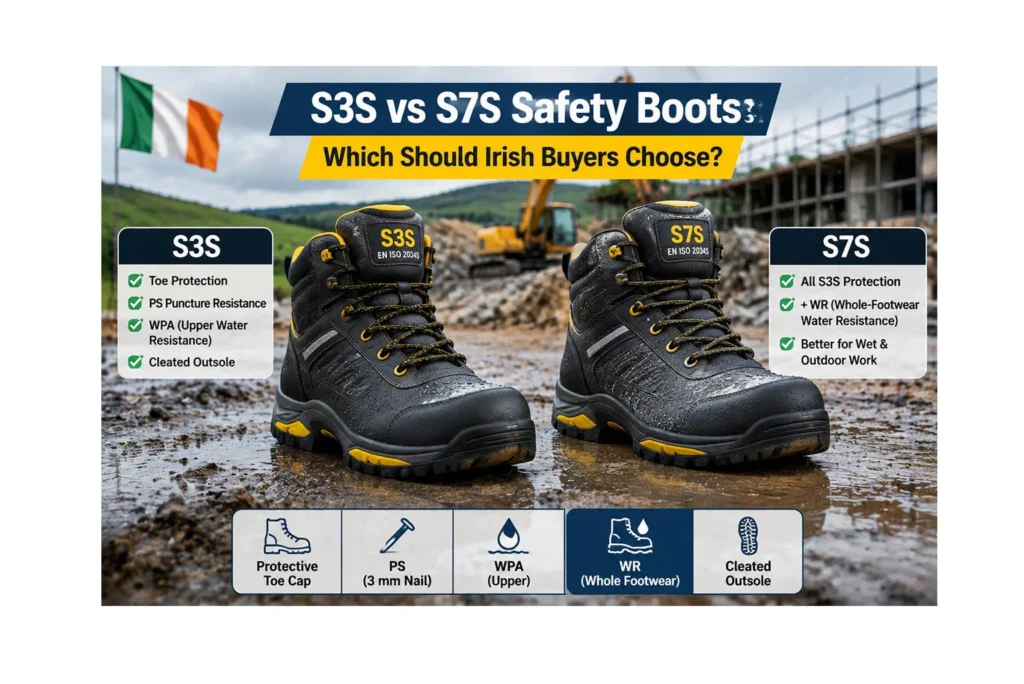
Choosing between S3S vs S7S safety boots is an important decision for Irish PPE distributors, safety footwear wholesalers, construction companies, and industrial procurement teams.
Both classifications are based on the EN ISO 20345:2022 safety footwear standard and provide protective features designed for demanding working environments. However, there is one important difference: S7S adds whole-footwear water resistance (WR), while S3S does not require this additional feature.
For workers in Ireland who regularly operate outdoors, walk through wet grass, work on muddy construction sites, or face prolonged exposure to rain, this difference can influence product selection.
For importers and distributors, understanding these classifications is equally important when developing a safety footwear range for different customer groups.
This guide compares S3S and S7S safety footwear, explains their technical differences, and helps Irish buyers determine which classification is more suitable for construction, agriculture, warehousing, and outdoor industrial applications.
Who should read this guide?
- Irish safety footwear importers
- PPE distributors and wholesalers
- Construction and industrial procurement managers
- Agricultural equipment suppliers
- Workwear retailers
- Safety footwear private-label brands
- Businesses sourcing S3S and S7S safety boots from manufacturers
Table of Contents
- What Are S3S and S7S Safety Boots?
- S3S vs S7S: Key Differences Explained
- Understanding PS, WPA and WR Protection
- S3S Safety Boots: Features and Applications
- S7S Safety Footwear: Features and Applications
- S3S or S7S Safety Boots for Wet Environments?
- Which Safety Boots Should Irish Buyers Choose?
- Additional Safety Features to Consider
- What Should Importers and Distributors Check?
- Frequently Asked Questions
1. What Are S3S and S7S Safety Boots?
S3S and S7S are safety footwear classifications under EN ISO 20345:2022.
They indicate different combinations of protective properties, including toe protection, antistatic performance, heel energy absorption, water-related protection, and penetration resistance.
Understanding the classification helps buyers compare products based on their actual protective capabilities rather than relying on general descriptions such as waterproof work boots or heavy-duty safety shoes.
What Does S3S Mean?
S3S safety footwear combines the core S3 protection requirements with a type PS non-metallic penetration-resistant insert.
Its main characteristics include:
- Protective toe cap
- Closed heel area
- Antistatic properties
- Energy absorption in the heel
- Water penetration and absorption resistance of the upper (WPA)
- Penetration-resistant non-metallic insert tested using a 3 mm test nail (PS)
- Cleated outsole
S3S footwear is designed for applications requiring toe protection, underfoot penetration resistance, and resistance to water penetration and absorption of the upper material.
What Does S7S Mean?
S7S safety footwear builds on the S3S protection requirements and adds whole-footwear water resistance (WR).
Its main characteristics include:
- Protective toe cap
- Closed heel area
- Antistatic properties
- Energy absorption in the heel
- Water penetration and absorption resistance of the upper (WPA)
- PS non-metallic penetration-resistant insert
- Cleated outsole
- Whole-footwear water resistance (WR)
The additional WR requirement makes S7S particularly relevant to workplaces where workers experience regular rain, wet ground, and prolonged exposure to damp conditions.
Important Difference
The difference is not that S7S has a stronger toe cap or a more advanced penetration-resistant insert than S3S.
Both classifications include the same PS penetration-resistance designation.
The defining difference is the additional WR requirement for the complete footwear.
This distinction is important when choosing between standard outdoor safety footwear and footwear intended for more demanding wet environments.
2. S3S vs S7S: Key Differences Explained
The following comparison highlights the main differences between the two classifications.
| Protection feature | S3S | S7S |
|---|---|---|
| Protective toe cap | Yes | Yes |
| Closed heel | Yes | Yes |
| Antistatic properties | Yes | Yes |
| Heel energy absorption | Yes | Yes |
| Upper water resistance (WPA) | Yes | Yes |
| Non-metallic penetration resistance (PS) | Yes | Yes |
| 3 mm nail test | Yes | Yes |
| Cleated outsole | Yes | Yes |
| Whole-footwear water resistance (WR) | No additional WR requirement | Yes |
| Typical application | General outdoor and industrial work | Regularly wet outdoor environments |
uvex safety+1
What Is the Most Important Difference?
The main difference is the level of water resistance required by the classification.
S3S: Provides water penetration and absorption resistance for the upper, but does not require the complete footwear to pass the WR test.
S7S: Includes the S3S protection features and additional whole-footwear water resistance.
This means S7S is generally a more appropriate classification when workers regularly encounter wet ground, rainfall, and demanding outdoor conditions.
However, S7S is not automatically better for every workplace. If employees work mainly indoors or in relatively dry environments, S3S may provide the required protection without the additional WR feature.
Are S7S Boots More Puncture-Resistant Than S3S?
No. Both classifications use the PS penetration-resistant insert.
The PS designation indicates a non-metallic insert tested using a 3 mm test nail. This differs from PL, which uses a 4.5 mm test nail.
Both S3S and S7S therefore provide the same specified PS penetration-resistance category. uvex safety+1
3. Understanding PS, WPA and WR Protection
To select the right safety footwear, buyers should understand three important technical markings.
PS: Non-Metallic Penetration Resistance
PS indicates that the footwear contains a non-metallic penetration-resistant insert tested using a 3 mm test nail.
This is important for workers who may encounter:
- Nails
- Sharp metal fragments
- Construction debris
- Other pointed objects
The PS test uses a smaller nail than the PL test, providing a more demanding penetration-resistance assessment under the specified test conditions.
For buyers comparing S3S and S7S, both have this PS requirement.
WPA: Water Penetration and Absorption
WPA relates to the water penetration and absorption performance of the footwear upper.
It does not mean that the entire boot is waterproof.
This distinction is important because water may enter through seams, construction joints, or other areas even when the upper material itself meets the WPA requirement.
S3S and S7S both include WPA.
WR: Whole-Footwear Water Resistance
WR refers to the water resistance of the complete footwear rather than only the upper material.
This is the additional requirement that distinguishes S7S from S3S.
A WR-rated product undergoes a more comprehensive water-resistance assessment.
However, buyers should understand that WR is a tested performance classification, not a guarantee that footwear will remain waterproof indefinitely under every working condition.
Wear, damage, poor maintenance, and water entering above the boot opening can all affect real-world performance. uvex safety+1
4. S3S Safety Boots: Features and Applications
S3S safety boots are suitable for many construction, manufacturing, logistics, and general industrial environments.
They combine toe protection, penetration resistance, a cleated outsole, and WPA-rated upper performance.
Main Advantages of S3S Safety Boots
Suitable for general outdoor work
S3S footwear can be a practical option for workplaces where employees encounter occasional moisture but do not require the additional whole-footwear WR classification.
Non-metallic penetration-resistant protection
The PS insert offers a specified level of underfoot protection while avoiding a traditional metal penetration-resistant plate.
Product design flexibility
Manufacturers can incorporate S3S protection into different styles, including:
- Leather safety boots
- Mid-cut work boots
- Lightweight safety shoes
- Composite toe safety footwear
- Industrial work footwear
Potentially lower product cost
Depending on construction and materials, an S3S model may have a lower manufacturing cost than an otherwise comparable S7S product.
However, actual pricing depends on the upper, outsole, membrane or construction method, protective components, and order quantity.
Where Are S3S Boots Suitable?
| Industry | Potential applications |
|---|---|
| Construction | General building and installation work |
| Warehousing | Loading and outdoor handling |
| Manufacturing | General industrial operations |
| Engineering | Maintenance and workshop activities |
| Transport | Distribution and delivery operations |
| Light outdoor work | Sites with occasional moisture exposure |
For Irish buyers, S3S can be a useful product category for customers who need penetration-resistant footwear but do not regularly work in conditions requiring WR-rated footwear.
5. S7S Safety Footwear: Features and Applications
S7S safety footwear is designed for more demanding wet working conditions.
It combines the S3S protection package with additional whole-footwear water resistance.
This makes it particularly relevant for businesses supplying outdoor workers in Ireland.
Main Advantages of S7S Safety Footwear
Additional water resistance
The complete footwear is tested for WR performance, making it more suitable for regular exposure to wet conditions.
Same PS penetration protection as S3S
S7S includes the same non-metallic PS penetration-resistant insert requirement.
Suitable for demanding outdoor applications
Depending on the specific product design, S7S boots can be suitable for construction, utilities, maintenance, and other outdoor work.
Useful for wet-weather footwear ranges
Distributors can offer S7S products to customers who need more comprehensive water protection than WPA-rated upper construction alone.
Where Are S7S Safety Boots for Outdoor Workers Suitable?
| Industry | Potential applications |
|---|---|
| Outdoor construction | Rain-exposed construction sites |
| Civil engineering | Wet ground and outdoor infrastructure |
| Agriculture | Farm maintenance and outdoor operations |
| Utilities | Outdoor maintenance and fieldwork |
| Landscaping | Regular exposure to damp ground |
| Road maintenance | Outdoor work in variable weather |
| Industrial maintenance | Wet external work areas |
For Irish distributors, S7S may be especially relevant to customers whose employees regularly work outdoors throughout the year.
However, the appropriate product still depends on the actual workplace risk assessment and the complete footwear specification.
6. S3S or S7S Safety Boots for Wet Environments?
This is one of the most important purchasing questions for Irish buyers.
Ireland’s climate makes water resistance a relevant consideration for many outdoor industries. However, not all workplaces have the same exposure to rain, standing water, or wet surfaces.
When Is S3S Sufficient?
S3S may be appropriate when:
- Employees mainly work indoors.
- Workers occasionally encounter damp floors.
- Outdoor exposure is limited.
- Full-footwear WR performance is not required by the risk assessment.
- The selected model meets all other relevant workplace protection requirements.
For example, an employee working in a covered warehouse with occasional outdoor loading duties may not necessarily need S7S footwear.
When Should Buyers Choose S7S?
S7S is worth considering when:
- Employees work outdoors for extended periods.
- Workers regularly experience rainfall.
- Footwear is exposed to wet grass and damp ground.
- Construction sites remain wet for long periods.
- The complete footwear requires additional water resistance.
Important: WR Does Not Replace Slip Resistance
A water-resistant boot is not automatically suitable for every wet or slippery surface.
Buyers should separately evaluate outsole performance.
For example, additional SR testing may be relevant where employees work on particular slippery surfaces.
The actual grip performance depends on the outsole design, material, contamination, and floor conditions.
The Irish Health and Safety Authority also emphasises that footwear selection should reflect the workplace risk assessment. hsa.ie+1
S3S vs S7S: Wet Environment Selection Guide
| Working condition | Suggested classification to evaluate |
|---|---|
| Dry indoor warehouse | S3S, if the full risk assessment supports it |
| Covered loading area | S3S or S7S depending on exposure |
| Occasional outdoor rain | S3S or S7S depending on duration and conditions |
| Regular outdoor rainfall | S7S |
| Wet construction site | S7S |
| Muddy outdoor work | S7S, with suitable outsole design |
| Prolonged exposure to wet ground | S7S |
These are purchasing guidelines, not automatic PPE prescriptions. The final selection must match the hazards and conditions of the workplace.
7. Which Safety Boots Should Irish Buyers Choose?
For Irish importers and PPE distributors, the decision should be based on customer demand, industry applications, product specifications, and purchasing budgets.
Construction and Civil Engineering
Construction companies often require footwear that combines toe protection, penetration resistance, and suitable grip.
For general construction work with limited water exposure, S3S may be appropriate.
For sites where workers regularly operate in wet conditions, S7S is worth prioritising.
Agriculture and Outdoor Maintenance
Agricultural workers may encounter wet grass, mud, rain, and uneven terrain.
S7S can be a more suitable category when whole-footwear water resistance is required.
Buyers should also assess outsole traction, boot height, material durability, and any additional chemical or environmental hazards.
Warehousing and Logistics
Warehouse workers often operate indoors on relatively dry surfaces.
S3S may be sufficient where penetration protection is required and whole-footwear WR performance is unnecessary.
Lightweight construction and comfort may also be important purchasing considerations.
Utilities and Infrastructure
Utilities workers frequently operate outdoors, including in exposed locations.
S7S may be attractive where wet-weather protection is a key requirement.
Depending on the job, additional features such as cold insulation, heat-resistant outsoles, or ladder grip may also need to be considered.
Recommended Product Range for Irish Distributors
Rather than stocking only one classification, distributors may benefit from offering both.
| Customer segment | Product category to consider | Main selling point |
|---|---|---|
| Indoor industrial workers | S3S | Penetration protection |
| Construction workers | S3S / S7S | Application-dependent protection |
| Outdoor contractors | S7S | Whole-footwear WR |
| Agricultural customers | S7S | Wet-weather applications |
| Utilities workers | S7S | Outdoor protection |
| General PPE retailers | Both | Wider customer coverage |
Offering both classifications allows distributors to serve different workplace requirements without assuming that every customer needs the same level of water resistance.
8. Additional Safety Features to Consider
S3S and S7S are primary footwear classifications, but buyers should also check additional markings where relevant.
SR: Additional Slip Resistance
SR indicates that footwear has passed an additional slip-resistance test under the standard.
It can be relevant for workplaces with particular slippery surface conditions.
However, SR does not guarantee slip prevention on every floor or contaminant.
FO: Fuel and Oil Resistance
FO indicates additional outsole resistance to fuel oil.
This may be relevant for certain engineering, vehicle maintenance, and industrial applications.
CI: Cold Insulation
CI indicates cold insulation of the sole complex.
It may be useful for workers operating in cold outdoor environments.
HRO: Heat-Resistant Outsole
HRO indicates that the outsole has passed the applicable hot-contact resistance test.
It may be relevant for certain industrial and specialist working environments.
LG: Ladder Grip
LG identifies footwear that meets the additional ladder-grip requirements.
This may be relevant to maintenance, utilities, and construction workers who regularly use ladders.
Additional Markings Comparison
| Marking | Meaning | Potential application |
|---|---|---|
| SR | Additional slip resistance | Selected slippery surfaces |
| FO | Fuel oil resistance | Automotive and industrial environments |
| CI | Cold insulation | Cold outdoor work |
| HRO | Heat-resistant outsole | Hot working surfaces |
| LG | Ladder grip | Maintenance and construction |
These additional properties should be selected according to the workplace hazards rather than added simply to make a product specification appear more comprehensive.
9. What Should Importers and Distributors Check?
For Irish B2B buyers sourcing S3S or S7S safety boots, technical verification is essential.
Verify EN ISO 20345 Documentation
Ask the manufacturer for:
- EU Declaration of Conformity
- Relevant EU type-examination certificate
- Product-specific test reports
- Technical product specifications
- User instructions
- Product identification and labelling information
Check that the documentation identifies the exact product model and classification.
The Irish National Standards Authority of Ireland (NSAI) lists I.S. EN ISO 20345:2022/A1:2024 as a current standard. Buyers should also verify the applicable harmonised standard references in the European Commission’s current official publications. NSAI+1
Understand EU PPE Regulation
Safety footwear placed on the Irish market must meet the applicable requirements of Regulation (EU) 2016/425.
Importers should verify that the manufacturer has completed the appropriate conformity assessment and prepared the required documentation.
A CE logo or a general factory certificate alone is not sufficient evidence that a specific model complies.
Official reference:
EU Regulation 2016/425 – Personal Protective Equipment
Check Product Samples
Before confirming a bulk order, request physical samples of the selected models.
Inspect:
- Upper material
- Toe cap construction
- PS penetration-resistant insert
- Outsole design
- Stitching and bonding
- Boot weight
- Internal comfort
- Water-resistant construction
- Size consistency
For S7S products, pay particular attention to the whole-footwear WR documentation rather than relying on claims that the upper is waterproof.
Republic of Ireland vs Northern Ireland
The Republic of Ireland follows EU PPE Regulation 2016/425.
Northern Ireland also applies the EU PPE framework under the Windsor Framework, with specific UK enforcement and conformity-marking rules.
Where a UK notified body is used for conformity assessment for Northern Ireland, CE and UKNI marking requirements may apply. Products bearing CE and UKNI markings cannot be placed on the EU market.
Distributors selling across both jurisdictions should confirm that their documentation and marking arrangements are suitable for each market. GOV.UK+1
10. Frequently Asked Questions
What Is the Main Difference Between S3S and S7S Safety Boots?
S7S includes all the core S3S requirements and adds whole-footwear water resistance (WR). S3S requires WPA-rated upper performance but does not require the additional WR classification.
Are S7S Boots More Waterproof Than S3S Boots?
S7S footwear must meet the additional WR requirement for the complete footwear. S3S only requires WPA performance for the upper. However, WR is a standardised test classification, not a guarantee of permanent waterproof performance under every condition.
Do S3S and S7S Have the Same Puncture Protection?
Yes. Both classifications use a PS non-metallic penetration-resistant insert tested with a 3 mm nail.
Are S7S Safety Boots Better for Outdoor Workers in Ireland?
They may be more suitable for outdoor workers who regularly encounter rain and wet ground because S7S includes whole-footwear WR performance. Other features, including grip, cold insulation, and fit, should also be evaluated.
Are S3S Safety Boots Suitable for Construction?
Yes. S3S can be suitable for construction work where its protective features match the workplace risk assessment. For construction sites with regular wet exposure, S7S may be a better option.
Does S7S Mean the Boots Are Completely Waterproof?
No. S7S indicates that the complete footwear has passed the relevant WR test. It does not guarantee that boots will remain waterproof indefinitely or under all conditions, particularly when damaged or exposed to water above the opening.
What Is the Difference Between PS and PL?
PS indicates a non-metallic penetration-resistant insert tested with a 3 mm nail, while PL uses a 4.5 mm test nail. Both are recognised penetration-resistance options under EN ISO 20345:2022.
Can I Import S3S and S7S Safety Boots From China to Ireland?
Yes. Irish importers can source these products from Chinese manufacturers, provided the products meet applicable EU PPE requirements and the importers fulfil their regulatory and customs responsibilities.
Should PPE Distributors Stock Both S3S and S7S?
Offering both can help distributors serve customers with different workplace conditions. S3S can cover many general industrial applications, while S7S can address demand for additional whole-footwear water resistance.
What Documents Should I Request From a Safety Boots Manufacturer?
Request the EU Declaration of Conformity, relevant type-examination certificate, product-specific test reports, technical documentation, user instructions, and product identification details. Verify that all documents correspond to the exact model being purchased.
Conclusion
Choosing between S3S and S7S safety boots requires understanding the difference between upper water resistance and whole-footwear water resistance.
Both classifications provide protective toe caps, PS penetration resistance, antistatic properties, heel energy absorption, and cleated outsoles.
The main distinction is the additional WR requirement included in S7S.
For Irish buyers:
- Choose S3S when the workplace requires the relevant S3S protection features but does not require whole-footwear WR performance.
- Consider S7S when workers regularly experience rain, wet ground, and prolonged outdoor exposure.
- Evaluate slip resistance, comfort, durability, and additional protective features separately.
- Verify product-specific certification and conformity documentation before purchasing.
For importers and PPE distributors, offering both classifications can provide a more flexible product range for construction, agriculture, utilities, warehousing, and industrial customers.
The best purchasing decision is not necessarily the highest classification. It is the product that provides the appropriate protection for the actual working environment.
Source S3S and S7S Safety Boots From Ocean Safety Shoes
Ocean Safety Shoes is a professional safety footwear manufacturer serving international B2B customers, including importers, distributors, wholesalers, PPE suppliers, and private-label brands.
We provide manufacturing and product development solutions covering:
- S3S safety boots
- S7S safety footwear
- Composite toe safety shoes
- Steel toe work boots
- Waterproof safety boots
- Lightweight industrial footwear
- OEM and ODM manufacturing
- Custom logos and packaging
- Private-label safety footwear development
For Irish distributors and importers, selecting the right product specifications is an important part of developing a competitive safety footwear range.
When requesting a quotation, provide:
- Required safety classification (S3S or S7S)
- Toe cap preference
- Upper material requirements
- PS penetration-resistant insert requirements
- Outsole specifications
- Additional features such as SR, FO, CI or HRO
- Estimated order quantity
- Size assortment
- Branding and packaging requirements
- Required EU compliance documentation
These details help establish a clearer basis for product selection, sampling, and manufacturing quotations.
Explore the Ocean Safety Shoes product range to review available models and manufacturing options.
Looking for a reliable S3S or S7S safety boots manufacturer for your Irish wholesale business?
Contact Ocean Safety Shoes to discuss product samples, bulk orders, and OEM or private-label manufacturing opportunities.