
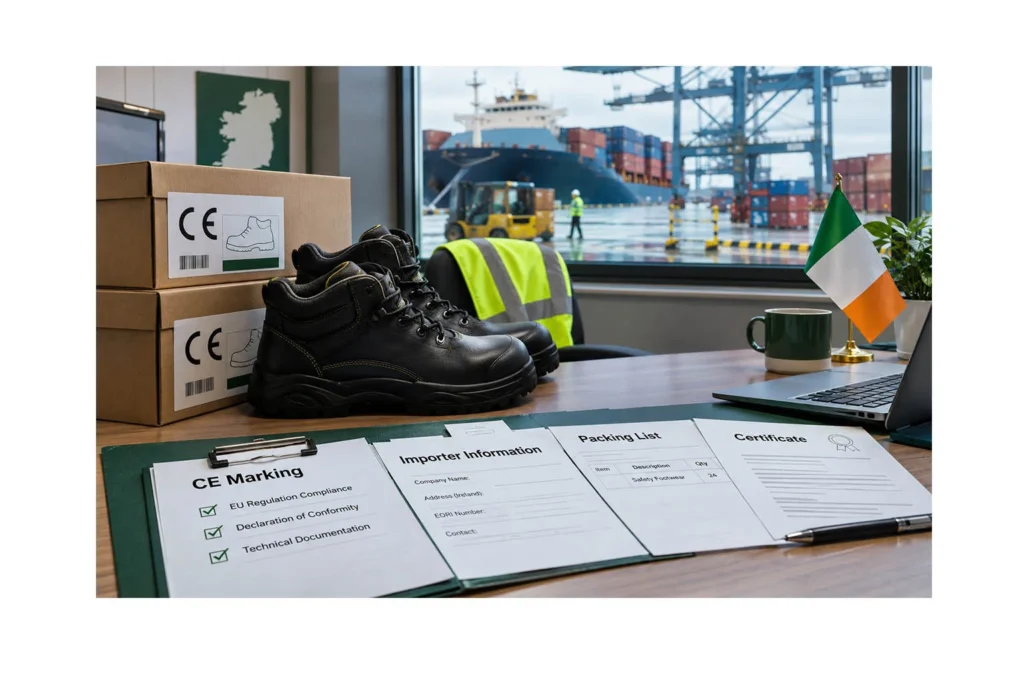
Importing CE marked safety footwear documents is an essential part of the purchasing and compliance process for Irish safety footwear distributors, PPE wholesalers, and industrial equipment suppliers.
When importing safety shoes from China or other non-EU countries, businesses must ensure that the products comply with European Union personal protective equipment (PPE) legislation before placing them on the Irish market.
A CE logo on a safety shoe is not enough to demonstrate compliance. Importers need to verify the relevant conformity assessment, EU Declaration of Conformity, EU type-examination certificate, product testing information, technical documentation, and product identification.
For businesses purchasing wholesale safety footwear, missing, outdated, or incorrect documentation can create serious commercial risks, including customs delays, market surveillance investigations, product withdrawals, and potential financial losses.
This guide explains which documents Irish importers should request from safety footwear manufacturers, how to verify their authenticity, and what compliance checks should be completed before placing bulk orders.
It is particularly relevant to:
- Safety footwear importers in Ireland
- PPE distributors and wholesalers
- Workwear retailers
- Industrial footwear suppliers
- Construction and manufacturing procurement teams
- Private-label safety footwear brands
- Businesses sourcing CE-marked safety shoes from China
Table of Contents
- Why CE Documentation Matters for Irish Safety Footwear Importers
- Understanding EU PPE Regulation 2016/425
- Essential CE Marked Safety Footwear Documents
- Understanding EN ISO 20345 Test Reports
- How to Verify an EU Type-Examination Certificate
- CE Marking and Safety Footwear Labelling Requirements
- PPE Importer Compliance Responsibilities in Ireland
- Additional Customs Documents for Importing Safety Shoes
- Common CE Documentation Mistakes to Avoid
- Checklist Before Ordering Safety Footwear From China
- Frequently Asked Questions
1. Why CE Documentation Matters for Irish Safety Footwear Importers
CE documentation is an important consideration when sourcing safety footwear for the Irish market.
Safety shoes are classified as personal protective equipment because they are designed to protect workers against occupational hazards such as falling objects, compression, and sharp objects penetrating the sole.
For Irish importers, compliance documentation serves several important purposes.
Demonstrating Product Compliance
Before placing safety footwear on the EU market, importers must ensure that the manufacturer has completed the appropriate conformity assessment procedure.
The supporting documentation helps establish that the footwear has been assessed against the applicable essential health and safety requirements.
Reducing Import Risks
Products imported from outside the EU may be subject to customs and market surveillance checks.
Authorities may request documentation to verify that imported footwear complies with the applicable PPE requirements.
Missing or inconsistent documents can lead to additional checks, delays, corrective actions, or restrictions on placing products on the market.
Protecting Distributor Reputation
PPE distributors are responsible for exercising due care when supplying protective footwear.
Working with manufacturers that provide reliable product documentation helps distributors manage compliance risks and respond to customer requests.
Supporting Long-Term Wholesale Cooperation
For businesses purchasing safety footwear in bulk, product documentation should be part of the supplier evaluation process.
A professional manufacturer should be able to provide product-specific conformity documents and explain how its products are tested and controlled during production.
2. Understanding EU PPE Regulation 2016/425
The main legislation governing safety footwear placed on the Irish and wider EU markets is Regulation (EU) 2016/425 on personal protective equipment.
It establishes requirements relating to:
- Product design and manufacture
- Essential health and safety requirements
- Conformity assessment procedures
- CE marking
- Manufacturer responsibilities
- Importer responsibilities
- Technical documentation
- Product traceability
Official legislation:
Regulation (EU) 2016/425 – Personal Protective Equipment
What PPE Category Applies to Safety Footwear?
Most general-purpose protective safety footwear is classified as Category II PPE because it protects against risks that are neither minimal nor extremely serious.
Under Article 19 of Regulation (EU) 2016/425, Category II PPE requires:
- Module B – EU Type-Examination.
- Module C – Conformity to Type Based on Internal Production Control.
This means a Notified Body examines the product type and issues an EU type-examination certificate. The manufacturer must then ensure that mass-produced footwear remains consistent with the approved type.
This distinction is important when evaluating manufacturers.
A supplier should not simply provide a generic CE certificate. It should be able to demonstrate the correct conformity assessment for the exact footwear model.
Understanding the Role of Harmonised Standards
EN ISO 20345 is the principal European standard for general-purpose safety footwear.
It covers requirements such as:
- Protective toe caps
- Mechanical protection
- Slip resistance
- Penetration resistance
- Water-related performance
- Additional protective properties
Compliance with a harmonised standard whose reference is published in the Official Journal of the European Union provides a presumption of conformity with the essential requirements covered by that standard.
However, using a standard does not replace the required conformity assessment and EU Declaration of Conformity.
The European Commission maintains the official list of harmonised PPE standards:
European Commission – Harmonised Standards for PPE
3. Essential CE Marked Safety Footwear Documents
When sourcing safety footwear from China, Irish importers should request and verify several important documents.
The following table provides a practical overview.
| Document | Main purpose | Importance |
|---|---|---|
| EU Declaration of Conformity | Declares compliance with applicable EU legislation | Essential |
| EU Type-Examination Certificate | Confirms assessment of the PPE type by a Notified Body | Essential for Category II footwear |
| EN ISO 20345 Test Reports | Provides supporting evidence of product performance | Important verification evidence |
| Technical Documentation | Records product design, risk assessment and conformity evidence | Must be maintained and available |
| User Instructions | Explains safe use, limitations and maintenance | Required accompanying information |
| Product Identification and Labelling | Supports identification and traceability | Required |
3.1 EU Declaration of Conformity (DoC)
The EU Declaration of Conformity is one of the most important documents Irish importers should obtain.
It is issued by the manufacturer and confirms that the identified footwear model complies with the applicable EU legislation.
A valid declaration should contain information such as:
- Manufacturer’s name and full address
- Product model or type identification
- Description of the PPE
- Statement of sole responsibility
- Applicable EU legislation
- Applied harmonised standards and editions, where relevant
- Notified Body information and certificate reference, where applicable
- Name and position of the authorised signatory
- Place and date of issue
- Signature
The document should identify the exact product model being purchased.
For example, a declaration covering one S3S safety shoe should not automatically be accepted as evidence for a different S7S boot.
What should importers check?
Confirm that:
- The manufacturer’s details are consistent.
- The product model matches the quotation and sample.
- The applicable regulation is correctly identified.
- The standard references are appropriate.
- The relevant type-examination certificate is identifiable.
- The declaration is signed and dated.
3.2 EU Type-Examination Certificate
The EU type-examination certificate is issued by a Notified Body following the Module B conformity assessment.
It confirms that the examined PPE type meets the applicable essential health and safety requirements.
For safety footwear, the certificate should identify:
- Notified Body name and identification number
- Manufacturer details
- Product model or type
- Applicable PPE requirements
- Applied standards
- Protection classification, where applicable
- Certificate number
- Issue date
- Expiry date or validity conditions, where applicable
This is particularly important when importing safety shoes from overseas manufacturers.
A certificate should correspond to the exact model or product type being purchased.
If the supplier provides a certificate for a visually similar shoe, do not assume that it covers your selected product.
3.3 Technical Documentation
Technical documentation is prepared and maintained by the manufacturer.
It supports the conformity assessment and demonstrates how the product meets the applicable safety requirements.
It may include:
- Product drawings
- Design specifications
- Material descriptions
- Component information
- Risk assessments
- Manufacturing information
- Product test results
- Applied standards
- Quality control procedures
- Information supporting conformity assessment
Importers should ensure that the manufacturer has prepared the required technical documentation and that it can be made available to market surveillance authorities when requested.
A complete technical file may contain commercially sensitive information, so importers do not necessarily need an unrestricted copy of every internal manufacturing record.
However, they should have a clear arrangement for obtaining the necessary compliance evidence.
3.4 Product User Instructions
Safety footwear must be accompanied by appropriate instructions and information.
For products placed on the Irish market, buyers should ensure that the instructions are understandable to the intended users, normally including English-language information.
The instructions should explain:
- Intended applications
- Protective classifications
- Safety symbols
- Limitations of protection
- Correct fitting and wearing
- Cleaning and maintenance
- Storage conditions
- Inspection procedures
- Replacement recommendations
User instructions are important because even correctly certified footwear may provide inadequate protection if it is used outside its intended application.
3.5 Product Identification and Traceability Information
Product identification helps importers and distributors connect the physical footwear with its supporting documents.
Check that the product or its packaging includes relevant information such as:
- Manufacturer name
- Product model
- Size
- Batch or serial identification, where applicable
- CE marking
- Safety classification
- Relevant protective symbols
The importer must also provide its own name and postal contact address on the PPE, its packaging, or an accompanying document where marking directly on the product is not possible.
4. Understanding EN ISO 20345 Test Reports
EN ISO 20345 test reports are important when evaluating the performance of safety footwear.
However, buyers should understand that a test report and an EU type-examination certificate are not the same document.
What Is EN ISO 20345?
EN ISO 20345 specifies requirements for general-purpose safety footwear.
Depending on the product classification, testing can cover:
- Toe cap impact resistance
- Toe cap compression resistance
- Penetration resistance
- Slip resistance
- Water penetration and absorption
- Outsole performance
- Additional protective properties
The applicable tests depend on the footwear classification and claimed additional features.
Which Standard Edition Should Importers Check?
Buyers should pay attention to the exact edition identified in the product documentation.
The EN ISO 20345:2022 edition, including its A1:2024 amendment, is an important reference for modern safety footwear.
However, the applicable harmonised reference and any relevant restrictions or withdrawal dates should always be checked against the European Commission’s current Official Journal publications.
The Commission’s 2026 PPE harmonised-standards framework is set out in Implementing Decision (EU) 2026/1279, together with subsequent amendments.
What Should a Test Report Contain?
| Information | What to verify |
|---|---|
| Testing laboratory | Name and identification |
| Report number | Unique reference |
| Product identification | Exact model tested |
| Standard | Applicable EN ISO 20345 edition |
| Test items | Relevant protective properties |
| Test results | Pass/fail or measured results |
| Test date | Date of assessment |
| Authorisation | Laboratory approval or signature |
Why Are Test Reports Important?
Test reports help importers evaluate whether the product’s claimed features are supported by technical evidence.
For example, if a manufacturer offers S3S safety shoes, buyers should check the relevant evidence for the required toe protection, PS penetration resistance, and other applicable properties.
A test report for another model or construction should not automatically be treated as valid evidence for the product being purchased.
5. How to Verify an EU Type-Examination Certificate
Requesting a certificate is only the first step. Importers should also check whether the document is genuine and relevant.
Step 1: Identify the Notified Body
Find the name and identification number of the organisation that issued the certificate.
Step 2: Check the Notified Body’s Authorisation
Use the European Commission’s NANDO database to verify that the organisation is notified for the relevant PPE conformity assessment activities.
NANDO – New Approach Notified and Designated Organisations
Do not assume that an organisation is authorised for PPE simply because it is an accredited testing laboratory.
Testing laboratory accreditation and Notified Body status are different.
Step 3: Match the Product Model
Compare the certificate with:
- Product name
- Model number
- Product construction
- Toe cap type
- Outsole specification
- Protective classification
Any differences should be explained and checked with the issuing Notified Body where necessary.
Step 4: Check Certificate Status
Review:
- Issue date
- Expiry date, where applicable
- Certificate conditions
- Amendments
- Suspension or withdrawal status
If anything is unclear, contact the issuing Notified Body directly.
Step 5: Check the EU Declaration of Conformity
Confirm that the Declaration of Conformity refers to the appropriate product and conformity assessment documentation.
The certificate and declaration should tell a consistent technical story.
Beware of Generic CE Certificates
Some suppliers may provide documents described as:
- CE Certificate
- Certificate of Compliance
- Quality Certificate
- Factory CE Certificate
These documents are not automatically proof of compliance with the PPE Regulation.
The European Commission specifically warns that voluntary certificates which are not issued under the applicable conformity assessment procedure do not establish legal compliance.
Importers should distinguish genuine Notified Body certification from voluntary commercial certificates.
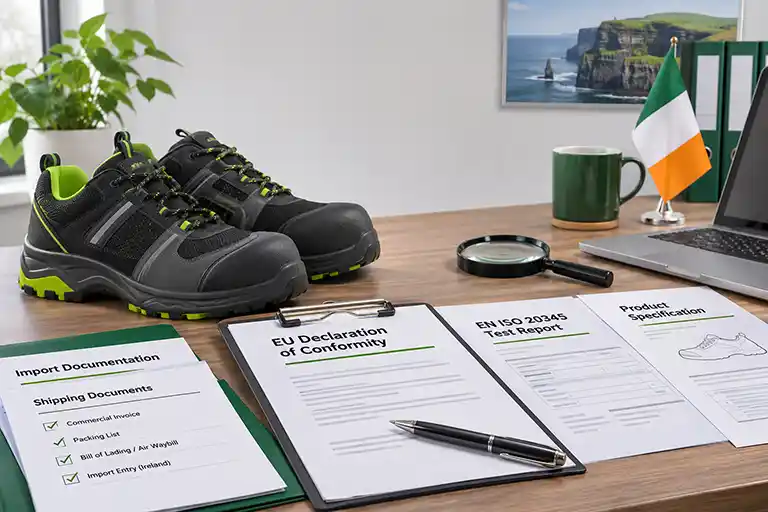
6. CE Marking and Safety Footwear Labelling Requirements
CE marking is the manufacturer’s declaration that the product complies with the applicable EU harmonisation legislation.
Under Regulation (EU) 2016/425, the CE marking must be visible, legible, and indelible.
What Should Importers Check on the Footwear?
Inspect the physical product and its packaging.
| Marking or information | Purpose |
|---|---|
| CE marking | Indicates conformity with applicable EU legislation |
| Manufacturer identification | Identifies the responsible manufacturer |
| Model or type | Connects product to technical documents |
| Size | Identifies footwear size |
| Safety classification | Indicates the protection category |
| Protective symbols | Explains additional protective properties |
| Batch or serial information | Supports traceability |
| Importer identification | Provides EU importer contact details |
Does Every Safety Shoe Need a Notified Body Number Next to the CE Mark?
No.
Most general-purpose safety footwear is Category II PPE.
For Category II, the conformity assessment involves Module B followed by Module C.
The requirement to place the Notified Body identification number immediately after the CE marking applies to Category III PPE under the relevant conformity assessment procedures.
Therefore, importers should not automatically reject a Category II safety shoe simply because the CE logo is not followed by a four-digit Notified Body number.
However, the relevant EU type-examination certificate must still be available.
Check the Physical Product Against Its Documentation
A certified sample does not guarantee that every subsequent production batch has identical specifications.
Before accepting bulk orders, compare the product with the approved technical information and agreed purchase specifications.
Any significant design or material change should be evaluated to determine whether it affects the product’s conformity.
7. PPE Importer Compliance Responsibilities in Ireland
When an Irish business imports safety footwear from outside the EU and first places it on the EU market, it assumes specific legal responsibilities under the PPE Regulation.
An importer cannot simply rely on the manufacturer’s assurance that the footwear is CE compliant.
Main Responsibilities of Irish Importers
Under Article 10 of Regulation (EU) 2016/425, importers must:
- Place only compliant PPE on the market.
- Verify that the manufacturer has completed the appropriate conformity assessment.
- Ensure that the technical documentation has been prepared.
- Ensure that the footwear bears the required CE marking.
- Ensure that the product is accompanied by the required documentation.
- Provide their own name and contact address on the product, packaging, or accompanying document as permitted.
- Ensure that storage and transportation do not compromise product conformity.
- Keep a copy of the EU Declaration of Conformity for 10 years.
- Ensure technical documentation can be made available to market surveillance authorities.
- Take corrective action and cooperate with authorities if non-compliance is identified.
The Irish Health and Safety Authority (HSA) provides guidance on importer and distributor responsibilities.
HSA – Selling Goods on the EU Single Market
Importer vs Distributor Responsibilities
| Responsibility | Importer | Distributor |
|---|---|---|
| Check CE marking | Yes | Yes |
| Verify required conformity assessment | Yes | Exercise due care and verify required documentation |
| Check product instructions | Yes | Yes |
| Add importer identification | Yes | No, unless also acting as importer |
| Maintain DoC records | Yes | Yes, under applicable obligations |
| Maintain technical documentation availability | Ensure availability | Cooperate with relevant obligations |
| Respond to product safety concerns | Yes | Yes |
| Support corrective actions | Yes | Yes |
What If You Sell Safety Footwear Under Your Own Brand?
This is particularly important for Irish private-label businesses.
If an importer or distributor places PPE on the market under its own name or trademark, it may be considered the manufacturer under Article 12 of the PPE Regulation.
This means it assumes the manufacturer’s responsibilities, including conformity assessment, technical documentation, and the EU Declaration of Conformity.
Simply adding a private-label logo to an existing certified product should not be treated as an automatic transfer of the original manufacturer’s compliance responsibilities.
8. Additional Customs Documents for Importing Safety Shoes
CE compliance documents and customs documents serve different purposes.
Irish businesses importing safety footwear from China should prepare both.
Common Customs Documents
| Document | Purpose |
|---|---|
| Commercial Invoice | Declares product value and transaction details |
| Packing List | Shows quantities, carton details and packing information |
| Bill of Lading | Shipping document for sea freight |
| Air Waybill | Shipping document for air freight |
| Certificate of Origin | Provides origin information where required |
| Customs Declaration | Declares imported goods to Irish Revenue |
| EORI Number | Identifies the importer for customs purposes |
Do You Need an EORI Number?
Businesses importing goods from outside the EU generally need an Economic Operators Registration and Identification (EORI) number.
The EORI number is used for customs interactions throughout the EU.
Official guidance:
Irish Revenue – EORI Registration
Can Customs Request CE Documentation?
Yes.
Imported products may be subject to customs and market surveillance checks.
Authorities can request documentation to establish product compliance and may take appropriate action where products do not meet the applicable requirements.
Irish importers should therefore prepare their compliance documents before the shipment arrives rather than waiting until a customs issue occurs.
9. Common CE Documentation Mistakes to Avoid
Accepting a CE Logo Without Supporting Documents
A CE logo alone does not demonstrate that the required conformity assessment has been completed.
Always request the EU Declaration of Conformity and relevant type-examination documentation.
Using One Certificate for Multiple Unrelated Models
Different safety footwear models may have different materials, toe caps, outsoles, and protective classifications.
Check that the certificate scope covers the exact product.
Ignoring Standard Editions
A document referencing an older standard may require further evaluation.
Check the relevant standard edition and its status in the European Commission’s official harmonised standards publications.
Confusing Test Reports With Certificates
A laboratory test report provides test evidence.
An EU type-examination certificate is issued through the relevant conformity assessment process by a Notified Body.
They are related but not interchangeable.
Failing to Check Certificate Authenticity
Do not rely solely on a PDF supplied by a salesperson.
Verify the issuing Notified Body and contact it if the document appears inconsistent.
Ignoring Product Changes
Changing an upper material, outsole, toe cap, or penetration-resistant insert may affect conformity.
Manufacturers should evaluate whether product modifications require additional testing or updated certification.
Forgetting Importer Responsibilities
Importers must take responsibility for the products they place on the EU market.
A supplier’s statement that the products are CE certified does not remove the importer’s legal obligations.
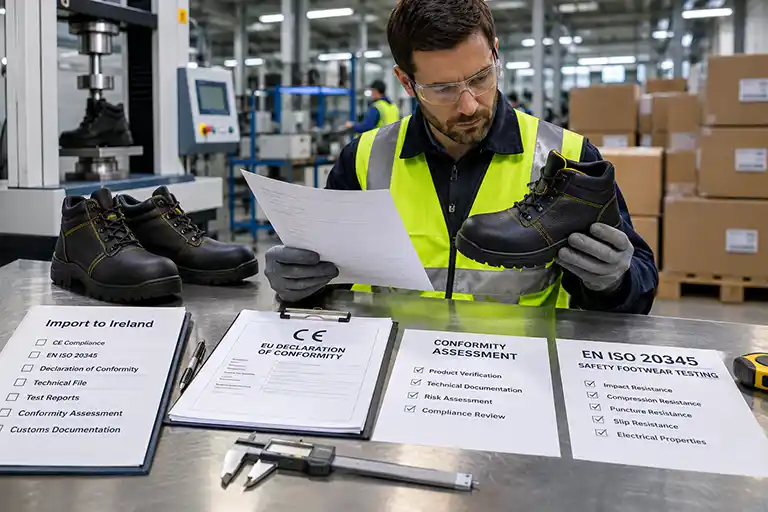
10. Checklist Before Ordering Safety Footwear From China
Before confirming a wholesale order, Irish importers should complete the following checks.
Product Compliance Checklist
- Obtain the EU Declaration of Conformity.
- Obtain the EU type-examination certificate.
- Verify the issuing Notified Body.
- Check the product model against the certificate.
- Request relevant EN ISO 20345 test reports.
- Check the applicable standard edition.
- Confirm that the technical documentation is available.
- Obtain English-language user instructions.
- Check CE marking and product identification.
- Confirm importer identification arrangements.
- Verify the manufacturer’s quality control procedures.
- Arrange product sample evaluation.
Import Preparation Checklist
- Obtain an EORI number.
- Confirm the commodity code.
- Obtain a commercial invoice.
- Obtain a packing list.
- Confirm shipping documents.
- Check country-of-origin information.
- Arrange customs clearance.
- Maintain compliance and traceability records.
Completing these checks before production or shipment can help prevent avoidable compliance problems.
11. Frequently Asked Questions
What Documents Do Irish Importers Need for CE-Marked Safety Footwear?
Key documents include the EU Declaration of Conformity, EU type-examination certificate, relevant product test reports, technical documentation, and user instructions. Importers should also verify product markings and traceability information.
Is an EU Declaration of Conformity Mandatory for Safety Shoes?
Yes. Manufacturers must draw up an EU Declaration of Conformity for PPE that has completed the required conformity assessment. Importers must ensure that the required declaration is available before placing the product on the EU market.
Is a CE Certificate the Same as an EU Declaration of Conformity?
No. The EU Declaration of Conformity is issued by the manufacturer, while the EU type-examination certificate is issued by a Notified Body following the Module B assessment. Both serve different purposes.
Do EN ISO 20345 Test Reports Prove CE Compliance?
Test reports provide technical evidence of product performance, but they do not replace the required conformity assessment or EU Declaration of Conformity.
How Can I Check Whether a CE Certificate Is Genuine?
Check the issuing Notified Body through the European Commission’s NANDO database, verify the certificate reference, and contact the issuing organisation if necessary.
Which EN ISO 20345 Standard Should Irish Importers Check?
Buyers should check the standard edition referenced in the product documentation and verify its current harmonised status through the European Commission’s official PPE standards publications.
How Long Should Irish Importers Keep CE Documentation?
Importers must retain a copy of the EU Declaration of Conformity for 10 years and ensure that technical documentation can be made available to market surveillance authorities. The Irish HSA also advises importers and distributors to keep relevant conformity documentation for 10 years.
Do Chinese Safety Shoes Need CE Marking to Be Sold in Ireland?
Yes. Safety footwear imported from China and placed on the Irish market must comply with the applicable EU PPE legislation and undergo the required conformity assessment.
Can I Import Private-Label Safety Shoes From China?
Yes, but businesses selling PPE under their own name or trademark may assume manufacturer responsibilities under the PPE Regulation. Compliance documentation and conformity assessment arrangements must therefore be properly established.
Can Customs Stop a Shipment of Safety Shoes Without CE Documents?
Imported products may be subject to compliance checks. If authorities identify missing documentation or non-compliance, they may take appropriate action, including preventing products from being released or placed on the market.
Conclusion
Understanding CE marked safety footwear documents is essential for Irish importers, PPE wholesalers, and safety footwear distributors.
Before purchasing safety shoes from overseas manufacturers, businesses should verify the product’s conformity assessment, technical documentation, and supporting test evidence.
The most important documents and checks include:
- EU Declaration of Conformity
- EU Type-Examination Certificate
- EN ISO 20345 Test Reports
- Technical Documentation
- Product User Instructions
- CE Marking and Product Identification
- Importer Identification
- Traceability Information
A reliable manufacturer should be able to explain the documentation associated with each product model and provide appropriate evidence for the footwear being supplied.
For Irish distributors, checking compliance before placing bulk orders is more effective than trying to resolve documentation problems after products have arrived.
A structured verification process helps reduce import risks, protect customer relationships, and establish a more reliable safety footwear supply chain.
Source CE-Marked Safety Footwear From Ocean Safety Shoes
Ocean Safety Shoes is a professional safety footwear manufacturer serving international B2B customers, including importers, distributors, wholesalers, PPE suppliers, and private-label brands.
Our product range and manufacturing solutions cover:
- CE safety shoes
- Steel toe safety boots
- Composite toe safety sneakers
- Lightweight industrial safety footwear
- Waterproof safety boots
- Heavy-duty industrial footwear
- OEM and ODM manufacturing
- Custom logos and packaging
- Private-label product development
For Irish importers and distributors, product specifications and conformity documentation are important parts of the sourcing process.
When requesting a quotation, provide:
- Required footwear models
- Target safety classification
- Applicable EN ISO 20345 requirements
- Toe cap and penetration-resistant insert preferences
- Upper and outsole materials
- Estimated order quantity
- Size assortment
- Branding and packaging requirements
- Required compliance documentation
This information helps establish a clearer basis for product selection, sample evaluation, and manufacturing quotations.
Explore the Ocean Safety Shoes product range to review available safety footwear styles.
Looking for a reliable safety footwear manufacturer for your Irish import business?
Contact Ocean Safety Shoes to discuss product samples, wholesale orders, and OEM or private-label manufacturing opportunities.