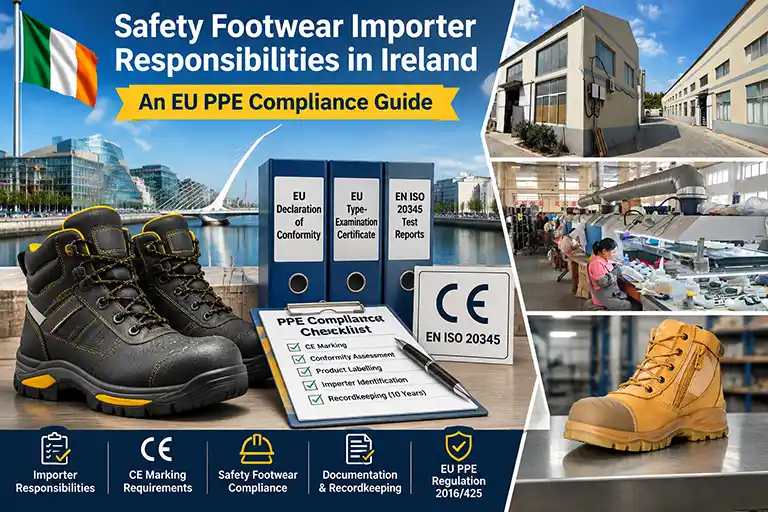
Understanding PPE importer requirements is essential for Irish businesses sourcing safety footwear from China and other non-EU countries. Importers must ensure that products comply with applicable European Union legislation before placing them on the Irish market.
Safety footwear is classified as personal protective equipment (PPE) because it protects workers against occupational hazards such as falling objects, compression, sharp objects, and other workplace risks.
For Irish safety footwear importers, wholesalers, PPE distributors, and private-label brands, compliance involves more than checking whether a product carries a CE mark. Businesses must understand their legal responsibilities, verify the manufacturer’s conformity assessment, maintain product traceability, and take appropriate action if non-compliant footwear is identified.
The main legal framework is Regulation (EU) 2016/425 on Personal Protective Equipment, supported by Ireland’s European Union (Personal Protective Equipment) Regulations 2018 (S.I. No. 136/2018).
This guide explains the main responsibilities of Irish PPE importers, including CE marking requirements, product compliance, documentation, labelling, recordkeeping, and corrective actions.
It is particularly relevant to:
- Safety footwear importers in Ireland
- PPE wholesalers and distributors
- Workwear retailers
- Industrial equipment suppliers
- Construction and manufacturing procurement teams
- Businesses importing safety shoes from China
- Private-label safety footwear brands
Table of Contents
- Understanding PPE Importer Requirements in Ireland
- EU PPE Regulation 2016/425: The Legal Framework
- Importer vs Distributor: Understanding Your Legal Role
- CE Marking Requirements for Safety Footwear
- Verifying Safety Footwear Compliance Before Importing
- Product Labelling and Importer Identification Requirements
- Recordkeeping and Product Traceability Responsibilities
- Monitoring Product Safety and Handling Non-Compliance
- Private Label Safety Footwear: When Importers Become Manufacturers
- Customs and Additional Import Requirements in Ireland
- PPE Importer Compliance Checklist
- Frequently Asked Questions
1. Understanding PPE Importer Requirements in Ireland
Irish businesses importing safety footwear from outside the European Union must understand their responsibilities under EU product safety legislation.
An importer is not simply a company that purchases products from an overseas supplier. Under the PPE Regulation, an importer is an economic operator established within the EU that places PPE from a third country on the EU market for the first time.
For example, an Irish company purchasing safety shoes directly from a Chinese manufacturer and placing them on the Irish market generally acts as the importer.
This role carries specific legal responsibilities.
Why Importer Compliance Matters
Importer compliance helps ensure that safety footwear:
- Meets applicable EU essential health and safety requirements.
- Has undergone the appropriate conformity assessment.
- Carries the required CE marking.
- Is accompanied by the required instructions and documentation.
- Can be traced through the supply chain.
- Remains compliant during storage and transportation.
Importers must also respond appropriately if they discover that products are unsafe or do not comply with the applicable legislation.
Which Authority Oversees PPE Compliance in Ireland?
The Health and Safety Authority (HSA) is Ireland’s designated market surveillance authority for personal protective equipment under the Irish PPE Regulations.
The HSA can investigate products, request compliance documentation, and take appropriate market surveillance measures.
For businesses importing professional safety footwear, understanding the HSA’s requirements is particularly important.
Official resource: HSA – Selling Goods on the EU Single Market.
2. EU PPE Regulation 2016/425: The Legal Framework
The primary legislation governing safety footwear placed on the Irish and wider EU markets is Regulation (EU) 2016/425.
It establishes the requirements for manufacturers, authorised representatives, importers, and distributors.
What Does the PPE Regulation Cover?
The regulation addresses:
- Essential health and safety requirements
- Product design and manufacturing
- Risk classification
- Conformity assessment procedures
- CE marking
- EU Declarations of Conformity
- Technical documentation
- Economic operator responsibilities
- Product traceability
Official legislation: Regulation (EU) 2016/425.
What PPE Category Applies to Safety Footwear?
Most general-purpose safety footwear is classified as Category II PPE.
Category II PPE requires a two-stage conformity assessment:
- Module B – EU Type-Examination.
- Module C – Conformity to Type Based on Internal Production Control.
Under Module B, a Notified Body examines the product type and issues an EU type-examination certificate.
Under Module C, the manufacturer must ensure that production remains consistent with the approved type.
This is important because importers should not assume that a factory’s general CE certificate proves that every footwear model is compliant.
The relevant conformity assessment must cover the actual product being imported.
Understanding EN ISO 20345
EN ISO 20345 is the main European standard for general-purpose safety footwear.
Depending on the applicable edition and product classification, it addresses:
- Toe protection
- Compression and impact resistance
- Penetration resistance
- Slip resistance
- Water-related performance
- Additional protective properties
Importers should verify the exact standard edition and its current harmonised status through the European Commission’s official publications.
Compliance with an applicable harmonised standard provides a presumption of conformity with the essential health and safety requirements covered by that standard.
3. Importer vs Distributor: Understanding Your Legal Role
One of the most important PPE importer requirements is understanding whether your business legally acts as an importer or distributor.
These roles have different responsibilities.
When Is an Irish Business an Importer?
Your business generally acts as an importer when:
- You purchase safety footwear directly from a manufacturer outside the EU.
- You bring the products into the EU for the first time.
- You place the imported products on the Irish or another EU market.
For example, an Irish PPE wholesaler ordering 2,000 pairs of safety boots directly from a Chinese factory will generally be the importer.
When Is Your Business a Distributor?
Your business generally acts as a distributor when it purchases products that have already been placed on the EU market by another manufacturer or importer.
For example, if an Irish workwear retailer purchases CE-marked safety shoes from an established French or German wholesaler, it generally acts as a distributor rather than the importer.
Importer vs Distributor Responsibilities
| Responsibility | Importer | Distributor |
|---|---|---|
| Check CE marking | Yes | Yes |
| Verify conformity assessment | Yes | Exercise due care and verify required information |
| Check product documentation | Yes | Yes |
| Add importer identification | Yes | Only if also acting as importer |
| Maintain product traceability | Yes | Yes |
| Check storage and transportation | Yes | Yes |
| Take corrective action | Yes | Yes |
| Cooperate with authorities | Yes | Yes |
Both importers and distributors must exercise appropriate care when supplying PPE.
A business should not assume that it is only a distributor simply because a freight forwarder or customs agent handles its shipping arrangements.
The legal role depends on the actual supply-chain arrangements.
4. CE Marking Requirements for Safety Footwear
CE marking is a fundamental requirement for safety footwear placed on the EU market.
It indicates that the manufacturer declares the product complies with applicable EU harmonisation legislation.
However, CE marking is not a quality award or a general certificate issued to every factory.
What Must Importers Check?
Before placing safety footwear on the market, importers should verify:
- The CE marking is present.
- The correct conformity assessment has been completed.
- The EU Declaration of Conformity is available.
- The relevant EU type-examination certificate is available.
- Product identification matches the supporting documents.
- Required instructions accompany the footwear.
- Manufacturer information is correctly displayed.
Does CE Marking Need a Four-Digit Notified Body Number?
Not necessarily.
Most general-purpose safety footwear is Category II PPE and follows Module B plus Module C.
For Category II PPE, the CE marking does not normally need to be followed by the four-digit identification number of a Notified Body.
That additional number is relevant to Category III PPE conformity assessment procedures involving ongoing production surveillance.
Importers should therefore verify the correct product category and conformity assessment procedure rather than assuming that every CE-marked safety shoe must display a four-digit number.
Is CE Marking Enough to Prove Compliance?
No.
A CE logo alone is insufficient evidence.
Importers should verify the underlying conformity assessment and ensure that the product’s technical specifications correspond to the approved footwear model.
This is especially important when sourcing different safety shoe models from the same manufacturer.
5. Verifying Safety Footwear Compliance Before Importing
Before confirming a bulk order, Irish importers should evaluate the manufacturer’s product compliance arrangements.
5.1 Request the EU Declaration of Conformity
The EU Declaration of Conformity is prepared by the manufacturer.
It should identify:
- Manufacturer’s name and address
- Product model or type
- Product description
- Applicable EU legislation
- Relevant standards, where applicable
- Notified Body information where required
- Authorised signatory
- Date and place of issue
Check that the declaration covers the exact footwear model being purchased.
5.2 Verify the EU Type-Examination Certificate
For Category II safety footwear, the EU type-examination certificate is an essential part of the conformity assessment.
Check:
- Issuing Notified Body
- Certificate reference
- Manufacturer information
- Product identification
- Applicable standards
- Certificate validity and conditions
You can verify the organisation’s notification status through the European Commission’s NANDO database.
5.3 Review Product Test Reports
Ask the manufacturer for relevant EN ISO 20345 test reports.
Depending on the product classification, these may cover:
- Toe cap impact and compression resistance
- Penetration-resistant inserts
- Slip resistance
- Water-related performance
- Outsole properties
- Other claimed protective features
Test reports should identify the actual model tested.
5.4 Check Product Specifications
Compare the technical documents with the physical product.
Important details include:
- Upper material
- Toe cap material
- Penetration-resistant insert
- Outsole construction
- Protective classification
- Additional protective features
Any significant material or construction change should be assessed to determine whether it affects conformity.
5.5 Evaluate Production Quality
Importers should also consider factory quality management.
Ask the manufacturer about:
- Incoming material inspection
- Production quality checks
- Final product inspection
- Batch identification
- Sample approval procedures
- Handling of defective products
A reliable manufacturing process helps maintain consistency between the tested product and mass-produced footwear.
6. Product Labelling and Importer Identification Requirements
Importer identification is another important legal obligation under Article 10 of Regulation (EU) 2016/425.
What Information Must the Importer Provide?
Importers must indicate their:
- Name
- Registered trade name or registered trademark
- Postal address at which they can be contacted
This information should normally appear on the PPE itself.
Where this is not possible, it may be placed on the packaging or in a document accompanying the footwear.
The information must be provided in a language easily understood by end-users and market surveillance authorities.
What About Manufacturer Information?
The manufacturer’s name, registered trade name or trademark, and contact address must also be provided.
The manufacturer’s product identification should include a type, batch, serial number, or another element allowing the product to be identified.
Where the size or nature of the footwear makes this impractical, the identification information may be provided on its packaging or accompanying documentation.
What About Product Instructions?
Importers must ensure that safety footwear is accompanied by the instructions and information required under the PPE Regulation.
For the Irish market, clear English-language instructions should be provided so that customers and end-users can understand:
- Intended use
- Protective classification
- Limitations of protection
- Correct fitting
- Maintenance
- Cleaning
- Storage
- Inspection and replacement
The requirements should be checked against the relevant Irish market language rules.
7. Recordkeeping and Product Traceability Responsibilities
Maintaining accurate records is essential for PPE importer compliance in Ireland.
Records help businesses respond to customer complaints, product safety investigations, and market surveillance requests.
Keep the EU Declaration of Conformity for 10 Years
Under Article 10 of Regulation (EU) 2016/425, importers must keep a copy of the EU Declaration of Conformity at the disposal of market surveillance authorities for 10 years after the PPE has been placed on the market.
Importers must also ensure that the technical documentation can be made available to authorities upon request.
The HSA’s Irish guidance also advises businesses to maintain copies of conformity documentation and technical information for 10 years.
Maintain Supply Chain Traceability
Article 13 of the PPE Regulation requires economic operators to identify:
- The business that supplied them with the PPE.
- The business to which they supplied the PPE.
This information must be available for 10 years after the business has been supplied with the PPE and for 10 years after it has supplied the PPE.
For safety footwear distributors, useful records include:
- Manufacturer name
- Supplier details
- Product model
- Purchase order number
- Batch identification
- Quantity purchased
- Delivery date
- Customer information
- Sales invoice references
Recommended Recordkeeping System
| Record | Why it matters |
|---|---|
| EU Declaration of Conformity | Demonstrates declared conformity |
| Type-examination certificate | Supports conformity assessment verification |
| Product test reports | Provides performance evidence |
| Purchase orders | Links products to suppliers |
| Batch records | Supports product identification |
| Sales invoices | Supports downstream traceability |
| Complaint records | Helps identify product problems |
| Recall records | Documents corrective actions |
An electronic document management system can help importers organise records by product model and production batch.
8. Monitoring Product Safety and Handling Non-Compliance
Importer responsibilities do not end when the goods arrive in Ireland.
Businesses must also respond appropriately when they have reason to believe that footwear already placed on the market does not comply with the applicable requirements.
Monitor Product Quality
Importers should establish procedures for reviewing:
- Customer complaints
- Product returns
- Manufacturing defects
- Reports of premature product failure
- Changes in product specifications
- Potential safety incidents
Article 10 also provides for sample testing and complaint investigation where appropriate in light of the risks presented by the PPE.
A complaint register can help identify repeated problems and support corrective action.
What Should You Do If Non-Compliance Is Identified?
If an importer believes that safety footwear does not comply with the PPE Regulation, it must take appropriate action.
The process may include:
- Stop placing affected products on the market.
- Identify the affected models and batches.
- Inform the manufacturer.
- Investigate the nature of the non-compliance.
- Take corrective measures.
- Withdraw or recall products where appropriate.
- Notify the competent authorities immediately where the product presents a risk.
- Keep records of the actions taken.
Withdrawal vs Recall
These terms have different meanings.
| Action | Meaning |
|---|---|
| Withdrawal | Prevents products already in the supply chain from being made available on the market |
| Recall | Seeks the return of products that have already reached end-users |
The appropriate response depends on the nature and seriousness of the product risk.
The Role of the Irish HSA
The HSA is the designated market surveillance authority for PPE in Ireland.
Importers should cooperate with the HSA when requested and provide relevant information about product conformity and corrective actions.
Official resource: HSA – Market Surveillance.
9. Private Label Safety Footwear: When Importers Become Manufacturers
Private-label safety footwear is an attractive business opportunity for Irish PPE distributors.
However, businesses should understand the additional legal responsibilities associated with selling protective footwear under their own brand.
What Does Article 12 of the PPE Regulation Say?
Under Article 12 of Regulation (EU) 2016/425, an importer or distributor is considered the manufacturer and assumes the manufacturer’s obligations if it:
- Places PPE on the market under its own name or trademark; or
- Modifies PPE already placed on the market in a way that may affect its compliance.
This is an important distinction for private-label brands.
Does Adding a Custom Logo Change Your Legal Responsibilities?
It depends on how the product is marketed and the applicable circumstances.
If a business places PPE on the market under its own trademark, it may assume the full manufacturer responsibilities even if another factory physically produces the footwear.
These responsibilities include:
- Product conformity
- Technical documentation
- Conformity assessment
- EU Declaration of Conformity
- CE marking
- Production conformity controls
- Corrective actions
A distributor should therefore discuss private-label compliance responsibilities with the manufacturer before approving custom branding.
What Should Private-Label Buyers Agree With Manufacturers?
| Item | What to confirm |
|---|---|
| Product ownership | Who controls the product design? |
| Certification | Which entity is responsible for conformity assessment? |
| Product testing | Which exact model has been tested? |
| Technical documentation | Who prepares and maintains it? |
| CE marking | Who is responsible for correct marking? |
| Branding | Whose name or trademark appears on the product? |
| Design changes | How are modifications assessed? |
| Quality control | How is production consistency maintained? |
For Irish PPE brands, these arrangements should be clarified before commercial production.
10. Customs and Additional Import Requirements in Ireland
PPE compliance and customs compliance are separate responsibilities.
A shipment may have all the required customs documents but still fail to meet EU product safety requirements.
Similarly, CE-compliant footwear still needs the appropriate customs formalities when imported from outside the EU.
Obtain an EORI Number
Irish businesses importing goods from outside the EU generally need an Economic Operators Registration and Identification (EORI) number.
This number is used when interacting with EU customs authorities.
Official resource: Irish Revenue – EORI Registration.
Prepare Import Customs Documentation
Common documents include:
- Commercial invoice
- Packing list
- Bill of lading or air waybill
- Customs declaration
- Country-of-origin information
- Applicable certificates or supporting documents
Businesses must also ensure that the correct customs commodity code and customs value are declared.
Understand the Role of Customs Agents
An Irish importer may appoint a customs agent to submit declarations on its behalf.
However, appointing a customs agent does not automatically transfer the importer’s PPE compliance responsibilities.
The importer should ensure that customs information is accurate and that the products meet the applicable EU market requirements.
Official resource: Irish Revenue – Importing Goods.
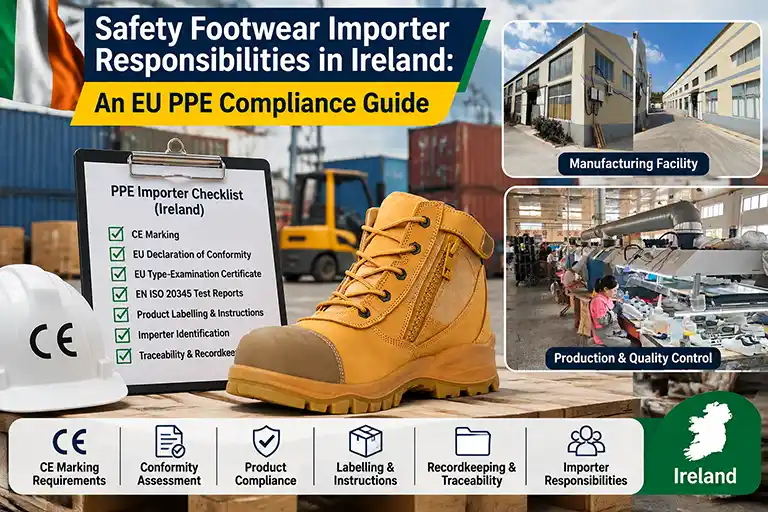
11. PPE Importer Compliance Checklist
The following checklist can help Irish businesses review their responsibilities before importing safety footwear.
Before Placing an Order
- Confirm whether your business acts as importer or distributor.
- Identify the applicable PPE classification.
- Verify the manufacturer’s conformity assessment.
- Request the EU Declaration of Conformity.
- Request the EU type-examination certificate.
- Review relevant EN ISO 20345 test reports.
- Verify the issuing Notified Body where applicable.
- Check product specifications against the documents.
- Confirm manufacturer identification and product traceability.
- Agree on importer identification arrangements.
Before Products Enter the Market
- Check CE marking.
- Check required product labels.
- Confirm importer name and postal address.
- Confirm English-language user instructions.
- Review product samples.
- Check batch identification.
- Verify customs documentation.
- Ensure appropriate storage and transport conditions.
After Products Are Placed on the Market
- Keep the EU Declaration of Conformity available for 10 years.
- Ensure technical documentation can be provided to authorities.
- Maintain supply-chain traceability records.
- Maintain a product complaint register.
- Monitor product quality and customer feedback.
- Keep distributors informed of relevant safety issues.
- Establish withdrawal and recall procedures.
- Cooperate with the HSA when required.
12. Frequently Asked Questions
What Are the Main PPE Importer Requirements in Ireland?
Irish PPE importers must ensure that products comply with Regulation (EU) 2016/425 before placing them on the market. They must verify the conformity assessment, CE marking, technical documentation, required instructions, and manufacturer identification. They must also provide importer identification, maintain records, and take corrective action when necessary.
Who Is Legally Responsible for CE Marking on Imported Safety Shoes?
The manufacturer is responsible for carrying out the conformity assessment and affixing the CE marking. However, the importer must verify that the required assessment has been completed and that the footwear carries the correct CE marking before placing it on the market.
Do Irish Importers Need to Keep CE Documentation?
Yes. Importers must keep a copy of the EU Declaration of Conformity available to market surveillance authorities for 10 years and ensure that the technical documentation can be provided upon request.
What Happens If Imported Safety Shoes Do Not Meet EU Requirements?
Importers must not place non-compliant footwear on the market until it has been brought into conformity. If products already placed on the market are found to be non-compliant, appropriate corrective measures, withdrawal, or recall may be required. Where a product presents a risk, the competent authorities must be informed immediately.
Does an Irish Distributor Have the Same Responsibilities as an Importer?
No. Importers have additional obligations, including verifying the manufacturer’s conformity assessment and providing importer identification. Distributors must exercise due care, check required markings and documents, maintain appropriate handling conditions, and cooperate with corrective actions.
Can I Import Safety Shoes From China Without CE Marking?
Safety footwear subject to the PPE Regulation cannot be placed on the EU market without completing the applicable conformity assessment and CE marking requirements. Importers should verify compliance before shipment rather than attempting to resolve missing documentation after arrival.
Do Private-Label Safety Shoes Require Separate Compliance Arrangements?
Yes. If a distributor or importer places PPE on the market under its own name or trademark, it may be considered the manufacturer under Article 12 and assume the manufacturer’s legal obligations.
Which Authority Handles PPE Compliance in Ireland?
The Health and Safety Authority (HSA) is Ireland’s designated market surveillance authority for PPE under the national implementation of Regulation (EU) 2016/425.
Is an EORI Number the Same as a CE Certificate?
No. An EORI number identifies a business for customs purposes. CE marking and the associated conformity assessment concern product compliance under EU legislation. They serve completely different purposes.
Can a Customs Agent Take Responsibility for PPE Compliance?
A customs agent can assist with customs declarations and clearance. However, appointing an agent does not automatically remove the legal responsibilities of the business acting as the PPE importer.
Conclusion
Understanding PPE importer requirements is essential for Irish businesses sourcing safety footwear from China and other non-EU countries.
Importers must take responsibility for ensuring that products comply with EU PPE legislation before placing them on the Irish market.
The main responsibilities include:
- Verifying the manufacturer’s conformity assessment.
- Checking CE marking and product documentation.
- Ensuring appropriate importer identification.
- Maintaining product traceability.
- Keeping conformity records for the required period.
- Monitoring product safety.
- Taking corrective action when non-compliance is identified.
- Cooperating with the Irish market surveillance authority.
For businesses purchasing wholesale safety footwear, compliance should be treated as an essential part of supplier evaluation and purchasing management rather than a final administrative check.
A reliable manufacturing partner, combined with a clear importer compliance process, can help Irish distributors build a more dependable safety footwear supply chain.
Source Safety Footwear From Ocean Safety Shoes
Ocean Safety Shoes is a professional safety footwear manufacturer serving international B2B customers, including importers, distributors, wholesalers, PPE suppliers, and private-label brands.
Our manufacturing solutions cover:
- CE safety shoes
- Steel toe safety boots
- Composite toe safety sneakers
- Lightweight industrial footwear
- Waterproof safety boots
- Heavy-duty industrial footwear
- OEM and ODM manufacturing
- Custom logos and packaging
- Private-label safety footwear development
For Irish importers and distributors, product specifications, conformity documentation, and manufacturing consistency are important considerations when selecting a supplier.
When requesting a quotation, provide:
- Required safety footwear models
- Target safety classifications
- Applicable EN ISO 20345 requirements
- Toe cap and penetration-resistant insert preferences
- Upper and outsole materials
- Estimated order quantity
- Size assortment
- Branding and packaging requirements
- Required compliance documentation
These details help establish a clear basis for product selection, sample evaluation, and manufacturing quotations.
Explore the Ocean Safety Shoes product range to review available footwear models.
Looking for a reliable safety footwear manufacturer for your Irish import business?
Contact Ocean Safety Shoes to discuss product samples, wholesale orders, and OEM or private-label manufacturing opportunities.