
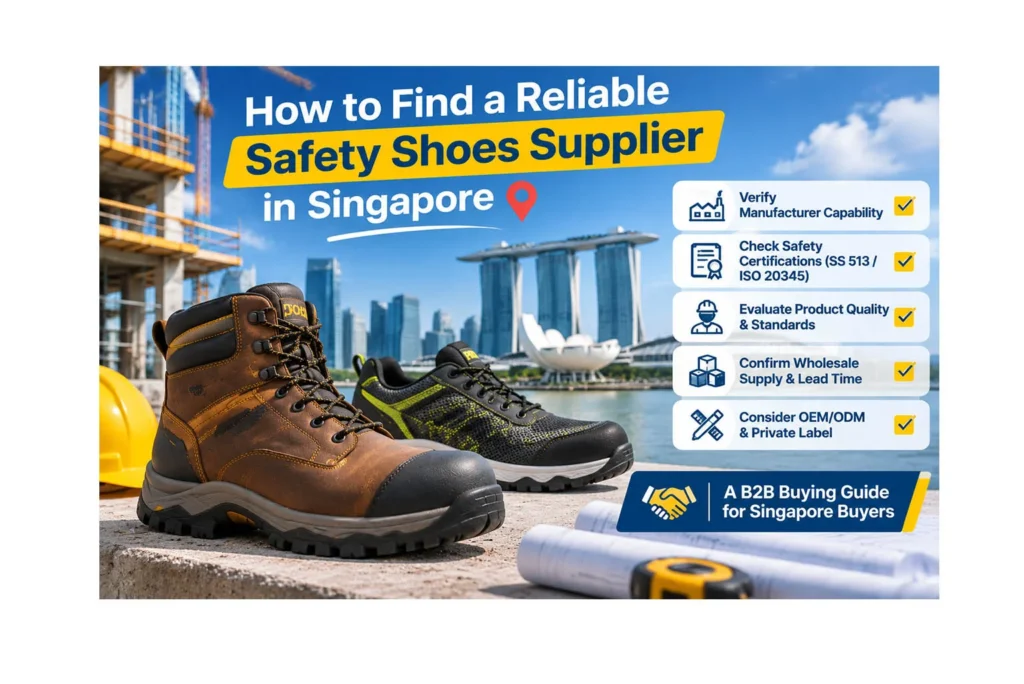
Finding reliable safety shoes suppliers Singapore is an important step for businesses that need consistent product quality, dependable supply, and compliant protective footwear.
Singapore has a diverse industrial market covering construction, manufacturing, logistics, marine engineering, transportation, and infrastructure development. Companies operating in these sectors need safety footwear that matches workplace hazards while providing comfort and durability for daily use.
For PPE distributors, wholesalers, importers, and corporate procurement teams, choosing a supplier involves more than comparing product prices. Buyers should evaluate product certifications, manufacturing capabilities, quality control procedures, stock availability, delivery arrangements, and after-sales support.
Some businesses prefer purchasing from local safety footwear distributors for faster delivery and easier communication. Others consider sourcing directly from overseas manufacturers to obtain competitive wholesale pricing, customised products, and private-label development.
This guide explains how to identify a reliable safety footwear supplier in Singapore, compare local distributors with direct manufacturers, verify product documentation, and make better bulk purchasing decisions.
Table of Contents
- Why Choosing the Right Safety Shoes Supplier Matters
- Types of Safety Shoes Suppliers in Singapore
- Where to Find Safety Shoes Suppliers in Singapore
- How to Evaluate a Reliable Safety Footwear Supplier
- Safety Footwear Standards and Certification in Singapore
- Local Distributor vs Direct Manufacturer: Which Is Better?
- What Products Should a Professional Safety Footwear Supplier Offer?
- Safety Shoes Wholesale Singapore: What Buyers Should Check
- Questions to Ask Before Choosing a Safety Shoes Supplier
- Common Mistakes When Selecting a Safety Shoes Supplier
- Frequently Asked Questions
1. Why Choosing the Right Safety Shoes Supplier Matters
Safety footwear is an essential part of personal protective equipment for many industrial workplaces.
In Singapore, construction workers, factory employees, warehouse operators, and engineering technicians may encounter hazards such as falling objects, sharp materials, slippery floors, and heavy equipment.
A reliable supplier helps businesses obtain footwear that matches these working conditions.
1.1 Product Quality and Workplace Protection
Safety shoes should provide the protective features required by the workplace risk assessment.
Depending on the application, these may include:
- Protective toe caps
- Penetration-resistant inserts
- Slip-resistant outsoles
- Antistatic properties
- Water resistance
- Heat-resistant outsole performance
- Comfortable footbeds
A professional supplier should be able to explain the specifications of each model and provide relevant product documentation.
1.2 Consistent Supply for Bulk Orders
For construction companies and PPE distributors, product availability is an important purchasing consideration.
A supplier should be able to explain:
- Available inventory
- Minimum order quantities
- Size availability
- Replenishment arrangements
- Delivery lead times
- Repeat-order capacity
Inconsistent supply can create difficulties for businesses managing multiple construction projects or corporate PPE programmes.
1.3 Better Long-Term Purchasing Costs
The lowest quotation does not necessarily represent the lowest total purchasing cost.
Poor-quality footwear may require more frequent replacement, create additional inspection work, and increase procurement costs.
Buyers should compare product durability, service life under intended conditions, warranty arrangements, and total landed cost.
1.4 Reliable Documentation
Safety footwear procurement involves technical and compliance documentation.
A professional supplier should be able to provide relevant information for the exact footwear model being purchased.
This is particularly important for importers, PPE distributors, and companies purchasing footwear for regulated workplace environments.
2. Types of Safety Shoes Suppliers in Singapore
Before searching for suppliers, understand the different business models available in the Singapore market.
2.1 Local Safety Footwear Distributors
Local distributors purchase products from manufacturers and supply them to businesses, contractors, retailers, and industrial customers.
Their advantages may include:
- Local communication
- Faster access to stocked products
- Easier sample collection
- Local delivery arrangements
- Assistance with product selection
- Convenient repeat purchasing
This option is particularly useful for companies requiring relatively small orders or urgent replenishment.
2.2 Safety Shoes Wholesalers
Wholesalers generally focus on supplying products in larger quantities.
They may offer:
- Bulk purchasing arrangements
- Multiple footwear brands
- Different safety classifications
- Competitive volume pricing
- Corporate and contractor supply
For retailers and smaller PPE distributors, wholesalers can provide access to products without requiring direct factory purchasing.
2.3 Safety Shoes Manufacturers
A manufacturer produces safety footwear and may offer direct supply to overseas customers.
Depending on its capabilities, a manufacturer may provide:
- Product development
- Material selection
- Toe cap and outsole options
- Bulk manufacturing
- OEM and ODM services
- Custom logos
- Private-label packaging
Direct manufacturers can be particularly relevant for importers and distributors planning regular bulk purchases.
However, buyers must verify that the company actually operates manufacturing facilities rather than functioning only as a trading company.
2.4 OEM and ODM Safety Footwear Suppliers
OEM and ODM suppliers support businesses that want to sell safety footwear under their own brands.
Potential services include:
- Custom product designs
- Logo application
- Upper material selection
- Outsole customisation
- Colour development
- Packaging design
- Product sampling
- Mass production
This option may be attractive to Singapore distributors seeking to differentiate their product range.
3. Where to Find Safety Shoes Suppliers in Singapore
There are several practical ways to identify potential safety footwear distributors and suppliers.
3.1 Google Search and Supplier Websites
Search using specific commercial keywords rather than general terms.
Examples include:
- safety shoes suppliers Singapore
- safety footwear supplier Singapore
- safety shoes wholesale Singapore
- industrial safety footwear distributor Singapore
- construction safety shoes supplier Singapore
- safety shoes manufacturer Singapore
Visit supplier websites and check:
- Product categories
- Brand portfolio
- Technical specifications
- Certification information
- Company background
- Contact details
- Wholesale enquiry options
A professional website alone does not prove supplier reliability. Treat it as an initial screening tool.
3.2 Singapore Industrial Supplier Directories
Industrial supplier directories and manufacturer websites can help identify companies selling protective footwear.
Useful starting points include:
These resources serve different purposes. They should not be treated as a single official directory of certified safety footwear suppliers.
3.3 Trade Shows and Industrial Exhibitions
Trade shows can help buyers meet suppliers, inspect product samples, and discuss purchasing arrangements.
When attending an industrial or safety-related exhibition, consider asking potential suppliers about:
- Available safety footwear ranges
- Product testing
- Manufacturing locations
- Distribution arrangements
- OEM and ODM services
- Bulk pricing
- Sample availability
Meeting suppliers directly can help buyers understand their product knowledge and communication capabilities.
3.4 Referrals from Industrial Buyers
Recommendations from existing business contacts can also help identify potential suppliers.
Ask other PPE distributors, contractors, warehouse operators, and procurement managers about their purchasing experience.
However, always conduct your own product and documentation checks before placing an order.
3.5 Examples of Singapore Safety Footwear Suppliers and Distribution Channels
The following companies and channels provide starting points for supplier research. This is not a ranking, certification endorsement, or independent assessment of product quality.
| Company | Publicly Described Offering | Website |
|---|---|---|
| A.C.T. Hardware | Singapore wholesale distributor for Nitti safety footwear | Website |
| Ocean Safety | Safety footwear supplier with industrial product offerings | Website |
| PSE Safety Corporation | Safety shoes and industrial safety equipment | Website |
| SafetyCare | Workplace safety products and safety footwear | Website |
| Safetyware / RHINO SHOE | Industrial safety footwear and regional procurement support | Website |
| S-Team / Safety Jogger Singapore | Local Safety Jogger distribution and footwear sales | Website |
When contacting these suppliers, ask for current product catalogues, model-specific certificates, available sizes, minimum order quantities, and quotation terms.
4. How to Evaluate a Reliable Safety Footwear Supplier
Finding potential suppliers is only the first step. The next step is to assess whether they can meet your purchasing requirements consistently.
4.1 Check Company Background
Start by understanding the supplier’s business model.
Questions to consider:
- How long has the company operated?
- Does it manufacture or distribute footwear?
- Where are its production facilities?
- Which industries does it serve?
- Does it supply local or international customers?
- Can it provide verifiable business information?
If you are purchasing directly from a manufacturer, ask for evidence of its manufacturing operations and production capabilities.
4.2 Verify Product Certifications
Product compliance should be one of the most important evaluation criteria.
Request documentation for the exact footwear model, including applicable test reports and conformity documents.
Check whether:
- The model number matches the product.
- The manufacturer details are consistent.
- The tested construction matches the supplied product.
- The standard edition is identified.
- The certification or test documentation can be verified with the issuing organisation where applicable.
Do not rely solely on a supplier’s statement that all its safety shoes are certified.
4.3 Review Manufacturing Capabilities
For businesses purchasing directly from a factory, assess its production capabilities.
Important areas include:
- Upper material preparation
- Stitching and lasting
- Toe cap installation
- Midsole construction
- Outsole injection or bonding
- Finished footwear inspection
- Packaging and shipment preparation
A supplier with established production processes may be better equipped to handle repeat orders and customised projects.
4.4 Evaluate Quality Control Procedures
A reliable supplier should have defined quality control procedures.
Ask how it manages:
| Quality Control Stage | What Buyers Should Check |
|---|---|
| Incoming material inspection | Upper, lining, outsole and protective components |
| Upper production | Stitching and material consistency |
| Toe cap installation | Correct positioning and construction |
| Outsole production | Material quality and construction |
| Bonding inspection | Sole attachment and workmanship |
| Finished product inspection | Appearance, sizing and defects |
| Batch inspection | Consistency across production quantities |
For large orders, buyers should consider pre-shipment inspections and clearly defined acceptance criteria.
4.5 Request Physical Samples
Product samples allow buyers to assess actual footwear performance and workmanship.
Check:
- Overall weight
- Upper material quality
- Toe-box space
- Footbed comfort
- Outsole flexibility
- Stitching quality
- Sole bonding
- Product finish
- Size consistency
For new product development, approve a final sample before mass production.
4.6 Evaluate Communication and After-Sales Support
Good communication is important for long-term B2B relationships.
A reliable supplier should be able to respond clearly to questions about:
- Product specifications
- Certification documents
- Quotations
- Samples
- Production schedules
- Shipping arrangements
- Quality issues
- Repeat orders
Clear communication reduces misunderstandings during bulk purchasing.
5. Safety Footwear Standards and Certification in Singapore
Singapore buyers should understand the applicable local safety footwear standards before selecting a supplier.
5.1 SS 513-1:2024
SS 513-1:2024 is Singapore’s current standard for general-purpose safety footwear.
It is an identical adoption of ISO 20345:2021.
The standard specifies basic and additional optional requirements covering:
- Mechanical risks
- Toe protection
- Slip resistance
- Thermal risks
- Ergonomic behaviour
- Additional protective features
It should be considered when evaluating safety footwear for the Singapore market.
5.2 SS 513-2:2024
SS 513-2:2024 covers test methods for footwear and is an identical adoption of ISO 20344:2021, including the applicable amendment.
It should be considered alongside SS 513-1 when reviewing footwear test documentation.
5.3 Common Safety Footwear Classifications
| Classification | General Protection Features |
|---|---|
| SB | Basic toe protection |
| S1 | Basic safety protection and antistatic properties |
| S2 | S1-type features plus water penetration and absorption resistance of the upper |
| S3 | S2-type features plus penetration resistance and cleated outsole |
| S3L | S3-type features with non-metallic penetration-resistant insert tested using a 4.5 mm nail |
| S3S | S3-type features with non-metallic penetration-resistant insert tested using a 3 mm nail |
| S7 | S3-type protection plus whole-footwear water resistance |
Buyers should check the exact standard edition and product markings rather than assuming classifications are interchangeable across different editions.
5.4 What Documents Should Buyers Request?
Depending on the product and applicable requirements, request:
- Product-specific test reports
- Applicable certificates
- Declaration of Conformity where relevant
- Manufacturer identification
- Technical data sheets
- User instructions
- Product classification and markings
The exact documentation required depends on the product, its intended market, and the applicable conformity requirements.
For official reference, consult:
- Singapore Standards – SS 513-1:2024
- Singapore Standards – SS 513-2:2024
- Singapore Workplace Safety and Health Council
6. Local Distributor vs Direct Manufacturer: Which Is Better?
Singapore buyers can purchase safety footwear through local distributors or directly from overseas manufacturers.
Both options have advantages, depending on order volume and business objectives.
6.1 Purchasing from a Local Safety Footwear Distributor
Local distributors can be suitable for companies that require quick access to stocked products.
Advantages may include:
- Local communication
- Convenient product inspection
- Smaller purchasing quantities
- Faster replenishment from local stock
- Easier local delivery arrangements
Potential limitations include:
- Less flexibility in product customisation
- Distributor pricing
- Limited control over manufacturing specifications
- Dependence on the distributor’s available product range
6.2 Purchasing Directly from a Safety Shoes Manufacturer
Direct factory sourcing can be useful for importers, wholesalers, and private-label brands.
Potential advantages include:
- Direct communication with the production team
- More product development options
- OEM and ODM services
- Custom branding
- Flexible material and design selection
- Potentially more competitive unit costs for suitable order volumes
Buyers must also consider:
- Minimum order quantities
- International shipping
- Production lead times
- Import procedures
- Supplier verification
- Product compliance documentation
- Quality inspection arrangements
6.3 Comparison Table
| Purchasing Factor | Local Distributor | Direct Manufacturer |
|---|---|---|
| Communication | Local | International |
| Stock availability | Depends on local inventory | Depends on production and inventory |
| Small orders | Often more convenient | May involve MOQ |
| Customisation | Depends on distributor | Often more flexible |
| OEM/ODM | Usually limited | Often available |
| Product development | Depends on product portfolio | Can be discussed directly |
| Unit pricing | Includes distribution costs | Factory quotation |
| Shipping | Usually local delivery | International logistics required |
| Repeat bulk orders | Depends on stock and supply arrangements | Can be arranged through production planning |
Which Sourcing Model Should You Choose?
Consider a local distributor if you need:
- Urgent replenishment
- Small quantities
- Existing branded footwear
- Local delivery
- Convenient product inspection
Consider a direct manufacturer if you need:
- Regular bulk purchasing
- Private-label products
- Customised footwear
- Product development
- Direct factory communication
- Long-term wholesale supply arrangements
For some businesses, using both channels can provide greater sourcing flexibility.
7. What Products Should a Professional Safety Footwear Supplier Offer?
A professional supplier should be able to provide footwear suited to different industrial applications.
For Singapore buyers, product selection should consider both workplace hazards and the local climate.
7.1 Steel Toe Safety Shoes
Steel toe footwear is widely used in construction and manufacturing.
It may be suitable for applications requiring protective toe caps and robust footwear construction.
7.2 Composite Toe Safety Shoes
Composite toe footwear uses non-metallic protective toe caps.
Potential advantages include:
- Non-metallic construction
- Potentially lighter footwear designs
- Lower thermal conductivity than steel
- Suitability for metal-free workplace requirements
The complete footwear must still meet the relevant protective performance requirements.
7.3 S3 Safety Footwear
S3 footwear may be suitable for many construction and industrial applications where toe protection, penetration resistance, and additional water-related protection are required.
7.4 Lightweight Safety Sneakers
Lightweight safety sneakers are worth considering for:
- Warehousing
- Logistics
- Indoor manufacturing
- Transportation
- General industrial work
They often combine protective components with sports-inspired styling.
7.5 Waterproof Safety Boots
Waterproof footwear may be required for work involving regular exposure to water, rain, or wet surfaces.
Buyers should distinguish between upper water resistance and whole-footwear water resistance.
7.6 Heavy-Duty Industrial Boots
Heavy-duty boots may be appropriate for:
- Construction
- Mining
- Engineering
- Marine operations
- Heavy manufacturing
The product should be selected according to the actual worksite hazards.
8. Safety Shoes Wholesale Singapore: What Buyers Should Check
Wholesale purchasing requires careful planning, particularly when orders involve multiple sizes, models, and delivery schedules.
8.1 Minimum Order Quantity
Ask suppliers about:
- MOQ per model
- MOQ per colour
- MOQ per size
- Mixed-size orders
- Sample order quantities
- Repeat-order requirements
Do not assume that the supplier’s advertised MOQ applies to every customised product.
8.2 Wholesale Pricing
The price of safety footwear depends on several factors.
| Cost Factor | Description |
|---|---|
| Upper materials | Leather, microfibre, mesh and other textiles |
| Toe cap | Steel or composite construction |
| Penetration insert | Metallic or non-metallic |
| Outsole | PU, PU/PU, rubber or PU/rubber |
| Safety classification | Required protective features |
| Customisation | Logos, colours and packaging |
| Order quantity | Production volume |
| Shipping | Freight, insurance and delivery |
| Inspection | Testing and quality inspection arrangements |
Compare quotations using the same product specification.
8.3 Delivery and Production Lead Time
Confirm the difference between:
- Sample development time
- Bulk production time
- Quality inspection time
- Shipment preparation
- International transit time
- Local delivery time
For ongoing supply, ask whether the supplier can support repeat orders with consistent product specifications.
8.4 Warranty and Quality Claims
Clarify the supplier’s procedures for:
- Manufacturing defects
- Damaged products
- Incorrect sizes
- Product inconsistencies
- Missing quantities
- Replacement arrangements
These details should be agreed upon before placing a large order.
8.5 Total Landed Cost
For imported footwear, calculate the complete landed cost rather than comparing only the factory price.
Consider:
- Product cost
- Packaging
- Freight
- Insurance
- Customs-related charges
- Applicable import GST
- Local handling and delivery
This gives buyers a more realistic understanding of the final cost per pair.
9. Questions to Ask Before Choosing a Safety Shoes Supplier
Before confirming a supplier, prepare a structured enquiry.
Supplier Background
- Are you a manufacturer, distributor, or trading company?
- Where are your manufacturing facilities located?
- Which countries do you currently supply?
- Can you provide company and factory information?
Product and Certification
- What safety footwear classifications do you offer?
- Can you provide product-specific test reports?
- Are your products tested to SS 513 or the applicable ISO 20345 edition?
- Can you provide steel and composite toe options?
- Do you offer waterproof and lightweight models?
Wholesale and Manufacturing
- What is your minimum order quantity?
- Can you accept mixed-size orders?
- Do you provide OEM and ODM services?
- Can you customise logos and packaging?
- What is your sample and production lead time?
Quality and Delivery
- What quality control procedures do you follow?
- Can you arrange pre-shipment inspection?
- How do you handle defective products?
- Can you support regular repeat orders?
The supplier’s ability to answer these questions clearly can help buyers identify potential risks before committing to a purchase.
10. Common Mistakes When Selecting a Safety Shoes Supplier
Mistake 1: Choosing Only Based on Price
A low quotation may not include the same materials, protection level, or quality standards as a competing offer.
Always compare equivalent specifications.
Mistake 2: Ignoring Product Certification
A supplier’s product description is not a replacement for relevant test reports and conformity documentation.
Verify the exact model before purchasing.
Mistake 3: Confusing Manufacturers with Trading Companies
Some suppliers describe themselves as factories without directly operating production facilities.
Buyers should ask about manufacturing locations, production processes, and factory verification.
Mistake 4: Skipping Sample Evaluation
Photographs and catalogues cannot fully demonstrate footwear comfort, workmanship, or construction quality.
Request samples before large orders.
Mistake 5: Ignoring Long-Term Supply Capability
A supplier may be able to fulfil one small order but struggle with repeated bulk orders.
Check production capacity, raw material availability, and order planning.
Mistake 6: Not Defining Product Specifications
Unclear specifications can create disagreements over materials, colours, protection levels, and product performance.
Prepare a written specification before requesting quotations.
11. Frequently Asked Questions
How Can I Find Reliable Safety Shoes Suppliers in Singapore?
Start by searching local industrial distributors, safety footwear wholesalers, and overseas manufacturers supplying Singapore. Review their product ranges, business backgrounds, certification documentation, customer service, and bulk supply capabilities before requesting samples and quotations.
Who Are the Safety Footwear Distributors in Singapore?
Singapore has several companies selling or distributing safety footwear, including A.C.T. Hardware, SafetyFit, PSE Safety, SafetyCare, and local Safety Jogger distribution channels. Their product ranges, supply arrangements, and current availability should be confirmed directly.
What Is the Difference Between a Safety Shoes Supplier and a Manufacturer?
A supplier may manufacture, distribute, or resell safety footwear. A manufacturer directly produces the footwear and may offer production, product development, OEM, and ODM services.
Can I Buy Safety Shoes Wholesale in Singapore?
Yes. Businesses can purchase through local wholesalers and distributors or contact overseas manufacturers directly. MOQ, available sizes, product certification, and delivery arrangements vary by supplier.
What Safety Footwear Standard Should Singapore Buyers Check?
SS 513-1:2024 is Singapore’s current general-purpose safety footwear standard. It is an identical adoption of ISO 20345:2021. Buyers should verify the exact product documentation and applicable workplace requirements.
Should I Buy Safety Shoes from a Local Distributor or a Chinese Manufacturer?
A local distributor may be more convenient for urgent or smaller purchases. A Chinese manufacturer may be more suitable for regular bulk purchasing, OEM/ODM development, and private-label projects. The right choice depends on your order quantity and sourcing objectives.
Can a Safety Footwear Manufacturer Produce Private-Label Shoes?
Manufacturers offering OEM and ODM services may customise logos, colours, materials, outsole designs, and packaging. Product changes that affect safety performance must be appropriately tested and documented.
What Should I Check Before Placing a Bulk Safety Shoes Order?
Confirm the product specification, applicable certification, sample quality, MOQ, pricing, delivery schedule, inspection procedures, and warranty arrangements before approving production.
Are Chinese Safety Shoes Manufacturers Suitable for Singapore Distributors?
They can be suitable sourcing partners if they have verifiable manufacturing capabilities, consistent quality control, relevant product testing, and the ability to meet Singapore buyers’ applicable product requirements.
Conclusion
Finding reliable safety shoes suppliers Singapore requires a structured approach to supplier research, product evaluation, and purchasing management.
Local distributors can provide convenient access to stocked footwear and local delivery, while direct manufacturers may offer greater flexibility for bulk purchasing, product development, and private-label manufacturing.
For Singapore PPE distributors, construction companies, importers, and procurement teams, the most important evaluation criteria include:
- Verifiable company background
- Genuine manufacturing or distribution capabilities
- Product-specific certification documentation
- Suitable footwear classifications
- Consistent product quality
- Sample availability
- Transparent wholesale pricing
- Reliable production and delivery arrangements
- OEM and ODM capabilities where required
The right supplier should not only provide competitive quotations but also support consistent product quality and dependable long-term supply.
Source Safety Shoes From Ocean Safety Shoes
Ocean Safety Shoes is a professional safety footwear manufacturer serving international B2B customers, including importers, distributors, wholesalers, retailers, construction companies, and private-label brands.
Our manufacturing range covers different industrial and workplace footwear requirements, including:
- Steel toe safety shoes
- Composite toe safety sneakers
- S3 safety footwear
- Lightweight industrial safety shoes
- Waterproof safety boots
- Heavy-duty work boots
- Industrial non-slip safety shoes
- OEM and ODM safety footwear
For Singapore buyers, we can discuss product specifications and manufacturing options according to your intended workplace applications and purchasing requirements.
Our OEM and ODM services can include:
- Custom upper materials
- Steel or composite toe cap options
- Outsole material selection
- Custom colours
- Logo application
- Private-label packaging
- Product sample development
- Bulk production
When requesting a quotation, buyers can provide the required safety classification, target product design, estimated quantity, size assortment, and customisation requirements.
Explore our safety shoes product range to review available footwear options.
Looking for a reliable safety shoes manufacturer for your Singapore distribution business?
Contact Ocean Safety Shoes to discuss wholesale orders, product samples, and OEM/ODM manufacturing opportunities.