
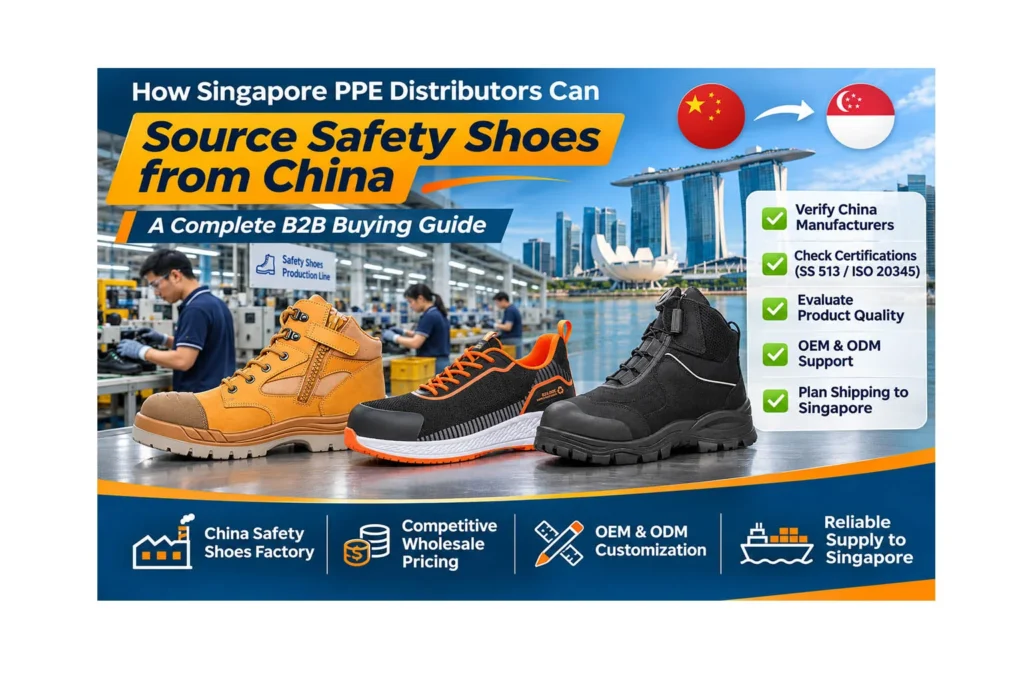
China has become an important sourcing destination for businesses looking for competitive safety footwear manufacturing, product customisation, and large-volume production. For Singapore PPE distributors, wholesalers, importers, and private-label brands, sourcing safety shoes from China can provide access to a wide range of industrial footwear designs and manufacturing capabilities.
However, finding the right supplier requires more than comparing factory quotations. Buyers need to evaluate manufacturing experience, product certification, quality control, production capacity, shipping arrangements, and long-term supply reliability.
Singapore has a diverse industrial market covering construction, manufacturing, logistics, marine engineering, transportation, and infrastructure. Each industry may require different safety footwear specifications, including steel toe protection, composite toe caps, penetration-resistant midsoles, slip-resistant outsoles, and waterproof construction.
For distributors planning to import safety footwear, working with a reliable Chinese manufacturer can help build a competitive product portfolio while supporting long-term business growth.
This guide explains how Singapore PPE distributors can source safety shoes from China, evaluate manufacturers, verify product documentation, manage bulk orders, and reduce sourcing risks.
It is designed for:
- PPE distributors in Singapore
- Safety footwear wholesalers
- Industrial equipment importers
- Construction safety suppliers
- Corporate procurement managers
- Retailers and footwear distributors
- Private-label safety footwear brands
Table of Contents
- Why Singapore PPE Distributors Source Safety Shoes from China
- What Types of Safety Shoes Can You Source from China?
- How to Find Safety Shoes Manufacturers in China
- How to Verify a China Safety Shoes Factory
- How to Check Safety Footwear Certifications for Singapore
- How to Evaluate Safety Shoes Quality Before Bulk Purchasing
- OEM and ODM Safety Shoes Manufacturing in China
- How to Calculate the Total Cost of Importing Safety Shoes into Singapore
- Shipping Safety Shoes from China to Singapore
- Common Mistakes When Sourcing Safety Shoes from China
- Frequently Asked Questions
1. Why Singapore PPE Distributors Source Safety Shoes from China
China is an established manufacturing base for industrial footwear, offering a broad range of product designs, materials, and manufacturing options.
For Singapore distributors, sourcing directly from Chinese manufacturers can provide several business advantages.
1.1 Competitive Manufacturing Costs
Chinese manufacturers can offer different price levels depending on materials, production processes, safety classifications, and order quantities.
Buyers can compare:
- Steel toe safety shoes
- Composite toe safety sneakers
- S3 industrial safety boots
- Waterproof work boots
- Lightweight safety footwear
- Heavy-duty construction boots
Direct factory purchasing may also reduce intermediary distribution costs, particularly for regular bulk orders.
However, the final price depends on product specifications, order volume, customisation, and shipping arrangements.
1.2 Wide Product Selection
Chinese safety footwear manufacturers often produce multiple product categories for different industries.
Singapore PPE distributors can develop product portfolios covering:
- Construction
- Manufacturing
- Warehousing
- Logistics
- Transportation
- Engineering
- Marine applications
- Outdoor industrial work
This makes it possible to source multiple footwear styles from a suitable manufacturing partner.
1.3 OEM and ODM Customisation
For distributors interested in building their own brands, Chinese factories may offer OEM and ODM services.
Possible customisation options include:
- Custom logos
- Upper materials
- Shoe colours
- Outsole designs
- Toe cap materials
- Footbed construction
- Packaging
- Private-label development
These options allow distributors to differentiate their products instead of competing exclusively on price.
1.4 Flexible Production and Product Development
An experienced manufacturer may support product development from initial design through sample approval and mass production.
This is particularly useful for distributors seeking lightweight safety sneakers, waterproof work boots, or footwear designed for specific industrial applications.
1.5 Long-Term Wholesale Supply
For businesses with recurring demand, direct manufacturing relationships can support production planning and repeat purchasing.
However, buyers should evaluate actual production capacity, raw material availability, quality control, and delivery performance before committing to a long-term agreement.
2. What Types of Safety Shoes Can You Source from China?
Before contacting manufacturers, define the product categories that match your Singapore customers’ requirements.
2.1 Steel Toe Safety Shoes
Steel toe safety shoes are widely used in construction, manufacturing, and heavy industrial environments.
Typical features include:
- Protective steel toe cap
- Durable leather or synthetic upper
- Penetration-resistant midsole where specified
- Industrial outsole
- Reinforced heel construction
They are a common option for distributors serving demanding industrial applications.
2.2 Composite Toe Safety Shoes
Composite toe safety shoes use non-metallic protective toe caps.
Potential advantages include:
- Non-metallic construction
- Potentially lighter footwear designs
- Lower thermal conductivity than steel
- Suitability for metal-free workplace requirements
Composite toe models are worth considering for distributors targeting workers who prioritise lighter footwear.
2.3 S3 Safety Footwear
S3 safety footwear is commonly considered for construction and industrial applications.
Depending on the applicable standard edition, S3 footwear generally includes:
- Protective toe cap
- Antistatic properties
- Heel energy absorption
- Water penetration and absorption resistance of the upper
- Penetration-resistant insert
- Cleated outsole
Buyers should verify the exact product classification and test documentation.
2.4 Lightweight Safety Sneakers
Lightweight safety sneakers combine sports-inspired designs with industrial protection.
They may be suitable for:
- Warehouses
- Logistics centres
- Manufacturing facilities
- Transportation
- Indoor industrial applications
Popular design features include breathable mesh uppers, composite toe caps, lightweight midsoles, and rubber outsoles.
2.5 Waterproof Safety Boots
Waterproof safety boots are designed for working environments where water exposure is an important concern.
Potential applications include:
- Outdoor construction
- Wet industrial environments
- Agricultural work
- Infrastructure maintenance
- Rain-exposed operations
Buyers should distinguish between water-resistant uppers and certified whole-footwear water resistance.
2.6 Heavy-Duty Industrial Safety Boots
Heavy-duty safety boots may feature reinforced uppers, durable outsoles, protective toe caps, and penetration-resistant inserts.
They are suitable for distributors serving demanding industries such as construction, mining, and heavy manufacturing.
Product Selection Checklist
| Product Type | Target Application | Important Features |
|---|---|---|
| Steel toe safety shoes | Construction and manufacturing | Toe protection and durability |
| Composite toe safety shoes | General industrial work | Non-metallic toe protection |
| S3 safety footwear | Construction and industrial applications | Penetration resistance and water-related upper protection |
| Lightweight safety sneakers | Warehouse and logistics | Breathability and lightweight construction |
| Waterproof safety boots | Wet outdoor environments | Appropriate water protection |
| Heavy-duty work boots | Demanding industrial applications | Durable materials and robust outsole |
3. How to Find Safety Shoes Manufacturers in China
Finding potential suppliers is the first stage of the sourcing process.
Singapore PPE distributors can use several channels to identify Chinese safety footwear manufacturers.
3.1 B2B Sourcing Platforms
Online B2B platforms allow buyers to compare suppliers, product ranges, and manufacturing capabilities.
Common starting points include:
- Alibaba
- Made-in-China
- Global Sources
When searching, use specific commercial keywords such as:
- safety shoes manufacturers in China
- safety footwear suppliers China
- China safety shoes factory
- safety shoes OEM manufacturer China
- S3 safety shoes manufacturer
- composite toe safety shoes factory
Do not assume that a supplier listed as a manufacturer actually operates its own factory. Further verification is necessary.
3.2 Google Search
Google can help buyers discover independent factory websites and manufacturers that may not appear prominently on B2B platforms.
Try searches such as:
- China safety footwear manufacturer
- safety shoes factory China
- OEM safety footwear manufacturer China
- industrial safety boots manufacturer
Review the supplier’s website for:
- Factory information
- Product catalogues
- Manufacturing processes
- Quality control capabilities
- Product certifications
- Contact information
- OEM and ODM services
A professional website is useful for initial screening but does not prove manufacturing capability.
3.3 Trade Shows and Industry Exhibitions
Trade exhibitions provide opportunities to meet manufacturers, compare samples, and discuss production requirements.
Buyers can use these events to evaluate:
- Product quality
- Manufacturing experience
- New footwear designs
- Materials and outsole options
- Customisation services
- Wholesale pricing
Meeting suppliers directly can also help establish long-term business relationships.
3.4 Direct Factory Enquiries
Once you identify potential manufacturers, contact them directly.
A professional enquiry should include:
- Required footwear categories
- Target safety classifications
- Intended applications
- Estimated order quantity
- Upper material preferences
- Toe cap requirements
- Outsole preferences
- Branding requirements
- Required product documentation
Providing clear specifications helps manufacturers prepare more accurate quotations.
4. How to Verify a China Safety Shoes Factory
One of the biggest sourcing risks is confusing genuine manufacturers with trading companies.
Both business models can supply safety footwear, but their production capabilities and customisation services may differ.
4.1 Confirm the Manufacturing Address
Ask the supplier for:
- Registered company name
- Factory address
- Business registration information
- Manufacturing facility photographs
- Production line photographs
- Factory introduction
If possible, arrange a video factory tour or an independent factory inspection.
4.2 Evaluate Production Equipment
A professional safety footwear manufacturer should be able to explain its production processes.
Depending on its product range, manufacturing facilities may include:
- Cutting equipment
- Stitching machines
- Lasting equipment
- Toe cap installation stations
- Outsole injection machines
- Sole bonding equipment
- Finishing equipment
- Quality inspection stations
Not every factory uses the same production methods. Ask how the supplier manufactures the specific product you intend to purchase.
4.3 Check Production Capacity
For wholesale purchasing, ask about:
- Monthly production capacity
- Production lines
- Available workforce
- Material sourcing
- Current production schedule
- Peak-season capacity
- Repeat-order arrangements
Do not rely only on a supplier’s estimated production capacity. Request evidence and discuss realistic delivery schedules.
4.4 Review Existing Product Experience
Ask whether the manufacturer has experience producing:
- Steel toe safety shoes
- Composite toe safety sneakers
- S3 safety boots
- Waterproof safety footwear
- Lightweight industrial shoes
- OEM and private-label products
Manufacturers with relevant product experience may be better equipped to understand your technical requirements.
4.5 Compare Multiple Manufacturers
Do not select a supplier based on a single quotation.
A useful comparison framework is:
| Evaluation Criteria | What to Check |
|---|---|
| Factory capability | Actual production facilities |
| Product range | Relevant safety footwear categories |
| Certification | Model-specific documentation |
| Quality control | Inspection procedures |
| MOQ | Minimum order quantity |
| Pricing | Equivalent product specifications |
| Customisation | OEM and ODM capabilities |
| Delivery | Production and shipment schedules |
| Communication | Technical response and follow-up |
A balanced evaluation is more reliable than selecting the cheapest supplier.
5. How to Check Safety Footwear Certifications for Singapore
Product certification and documentation are particularly important for Singapore PPE distributors.
Buyers should understand the applicable safety footwear standards and verify that the product documentation matches the actual footwear being supplied.
5.1 Understand SS 513-1:2024
SS 513-1:2024 is Singapore’s current general-purpose safety footwear standard.
It is an identical adoption of ISO 20345:2021.
The standard covers basic and additional requirements involving:
- Mechanical risks
- Toe protection
- Slip resistance
- Thermal risks
- Ergonomic performance
- Other protective properties
Singapore buyers should consider this standard when evaluating safety footwear for the local market.
5.2 Check SS 513-2:2024
SS 513-2:2024 specifies test methods for footwear.
It is an identical adoption of ISO 20344:2021, including the applicable amendment.
Buyers should understand the relationship between the product requirements and the relevant footwear testing methods.
5.3 Request Product-Specific Documentation
When sourcing from China, ask manufacturers for:
- Product-specific test reports.
- Applicable conformity certificates.
- Technical product specifications.
- Manufacturer and model identification.
- Safety classification and product markings.
- User instructions.
- Documentation showing the applicable standard edition.
Check that the product model in the documents matches the actual sample and bulk production specification.
A certificate covering one footwear model should not automatically be treated as evidence that every model from the same factory has identical certification.
5.4 Verify the Testing Organisation
Where applicable, contact the issuing certification or testing organisation to verify the documentation.
Check:
- Certificate number
- Issue and expiry dates
- Manufacturer name
- Product model
- Tested standard
- Scope of certification
- Referenced test reports
Buyers should also confirm whether any product changes require further assessment or testing.
5.5 Ask for Samples Before Bulk Purchasing
Certification documents are important, but physical samples are also necessary.
Compare the sample’s:
- Toe cap construction
- Outsole material
- Upper material
- Stitching
- Size and fit
- General workmanship
Ensure that the approved sample and final production specifications remain consistent.
For further reference:
6. How to Evaluate Safety Shoes Quality Before Bulk Purchasing
Product quality should be evaluated before placing a large order.
A sample inspection and documented quality control plan can help reduce purchasing risks.
6.1 Upper Material Inspection
Check:
- Material thickness
- Surface finish
- Stitching quality
- Colour consistency
- Abrasion resistance
- Flexibility
- Reinforcement construction
Different materials are suitable for different applications.
For example, leather may be considered for demanding industrial environments, while breathable mesh may be preferred for lightweight footwear.
6.2 Toe Cap Inspection
Check whether the footwear uses the specified steel or composite toe cap.
Confirm:
- Toe cap material
- Product construction
- Positioning
- Relevant impact and compression test documentation
Do not attempt to determine certified protective performance through appearance alone.
6.3 Outsole Inspection
The outsole plays an important role in footwear durability and workplace traction.
Common materials include:
- PU
- PU/PU
- Rubber
- PU/Rubber
Evaluate:
- Outsole bonding
- Tread design
- Flexibility
- Abrasion resistance
- Relevant slip-resistance test results
6.4 Footwear Comfort
Comfort is important for workers who spend long hours standing or walking.
Consider:
- Footbed cushioning
- Shoe weight
- Toe-box space
- Breathability
- Lining materials
- Fit consistency
- Flexibility
For Singapore’s hot and humid climate, breathable materials and suitable moisture management can be valuable product features.
6.5 Establish a Quality Control Process
A practical quality control process may include:
| Production Stage | Inspection Focus |
|---|---|
| Raw material inspection | Upper, lining, toe cap and outsole materials |
| Upper production | Stitching and construction |
| Lasting and assembly | Shape and component positioning |
| Outsole attachment | Bonding and alignment |
| Finished product inspection | Appearance and workmanship |
| Size inspection | Size consistency |
| Pre-shipment inspection | Quantity, packaging and agreed specifications |
For larger orders, consider an independent pre-shipment inspection based on agreed acceptance criteria.
7. OEM and ODM Safety Shoes Manufacturing in China
For Singapore distributors interested in building their own brands, OEM and ODM manufacturing can provide additional business opportunities.
7.1 What Is OEM Safety Footwear Manufacturing?
OEM refers to manufacturing products according to the buyer’s specifications.
A Singapore distributor may provide:
- Product design
- Required materials
- Branding guidelines
- Product specifications
- Packaging requirements
The manufacturer then produces footwear according to the agreed specifications.
7.2 What Is ODM Safety Footwear Manufacturing?
ODM generally involves a manufacturer offering existing designs or product development options that buyers can adapt to their own brand.
This may help distributors develop product ranges without creating every design from the beginning.
7.3 Common Customisation Options
| Component | Possible Customisation |
|---|---|
| Upper | Leather, microfibre, mesh or textile |
| Toe cap | Steel or composite |
| Midsole | Steel or non-metallic penetration-resistant insert |
| Outsole | PU, rubber or PU/rubber |
| Colour | Custom colour combinations |
| Logo | Tongue, side panel or insole branding |
| Footbed | Custom materials and cushioning |
| Packaging | Private-label boxes and printed packaging |
Any changes that affect protective performance must be properly assessed, tested, and reflected in the applicable product documentation.
7.4 OEM Development Process
A typical private-label development project follows these steps:
- Discuss the target market and product requirements.
- Select a suitable existing design or develop a new one.
- Confirm upper materials and protective components.
- Prepare the first sample.
- Review appearance, fit, and construction.
- Complete applicable product testing.
- Approve the final production sample.
- Confirm packaging and branding.
- Start mass production.
- Conduct final quality inspection.
A clear development process helps reduce misunderstandings and unnecessary sample revisions.
8. How to Calculate the Total Cost of Importing Safety Shoes into Singapore
When sourcing safety shoes from China, buyers should calculate the complete landed cost rather than comparing factory quotations alone.
8.1 Product Cost
The factory price depends on:
- Upper materials
- Toe cap type
- Midsole construction
- Outsole material
- Safety classification
- Customisation
- Order quantity
Always compare quotations based on the same product specifications.
8.2 Shipping Cost
Shipping costs depend on:
- Shipment volume
- Gross weight
- Shipping method
- Freight arrangements
- Cargo handling
- Delivery destination
Air freight may be suitable for samples or urgent smaller shipments, while sea freight may be more economical for larger orders.
8.3 Import GST and Customs Charges
Singapore Customs requires importers to obtain the applicable customs permit and account for import GST.
Singapore Customs identifies liquor, tobacco products, motor vehicles, and petroleum products as the main dutiable categories. Other goods are generally non-dutiable but subject to GST.
For safety footwear imports, buyers should confirm the correct HS classification and applicable customs treatment before shipment.
Import GST is generally calculated using the relevant customs value or last selling price, as applicable, and duties where relevant.
8.4 Customs Documentation
Prepare the necessary import documentation, which may include:
- Commercial invoice
- Packing list
- Bill of lading or air waybill
- Customs import permit
- Product documentation where relevant
Singapore importers generally need a UEN and an activated Customs Account. Import permits are submitted through TradeNet, either directly by an eligible trader or through an appointed declaring agent.
8.5 Example of a Landed Cost Calculation
The following is an illustrative example, not a supplier quotation.
| Cost Item | Example Amount |
|---|---|
| 1,000 pairs of safety shoes at US$12 | US$12,000 |
| International freight and insurance | US$1,000 |
| Illustrative customs value | US$13,000 |
| Import GST | Calculated at the prevailing rate on the applicable taxable value |
| Local handling and delivery | Additional |
| Total landed cost | Product cost + applicable taxes and logistics |
To calculate the final landed cost per pair:
Total Landed Cost ÷ Total Imported Pairs = Landed Cost per Pair
For current import requirements, refer to Singapore Customs – Import Procedures and Obtain a Customs Import Permit.
9. Shipping Safety Shoes from China to Singapore
Shipping arrangements should be discussed with the manufacturer before confirming the purchase order.
9.1 Sea Freight
Sea freight is often considered for larger wholesale orders.
Potential advantages include:
- Suitable for larger cargo volumes
- Lower transportation cost per unit in suitable shipments
- Flexible container arrangements
Buyers should consider transit time, cargo handling, insurance, and delivery arrangements.
9.2 Air Freight
Air freight may be useful for:
- Product samples
- Urgent replenishment
- Smaller shipments
- Time-sensitive orders
However, air freight is generally more expensive than sea freight for large-volume footwear shipments.
9.3 Choose Suitable Incoterms
Common Incoterms to discuss include:
| Incoterm | General Meaning | Buyer Consideration |
|---|---|---|
| EXW | Seller makes goods available at its premises | Buyer arranges most transportation and export logistics |
| FOB | Seller delivers goods on board the nominated vessel at the named port | Buyer arranges main carriage and subsequent logistics |
| CIF | Seller pays cost, insurance and freight to the named destination port | Buyer handles destination import clearance and applicable charges |
| DAP | Seller arranges delivery to the named destination, ready for unloading | Buyer generally handles import clearance and import taxes |
The exact responsibilities depend on the named place or port and the agreed Incoterms version.
For Singapore distributors, the most important point is to understand which party is responsible for export clearance, freight, insurance, import clearance, and final delivery.
9.4 Confirm Delivery Schedules
Before confirming an order, agree on:
- Sample approval date
- Production start date
- Expected production completion
- Pre-shipment inspection
- Cargo handover date
- Estimated arrival
- Final delivery arrangements
Avoid relying on vague delivery promises.
10. Common Mistakes When Sourcing Safety Shoes from China
Mistake 1: Choosing Only the Cheapest Factory
A low quotation may involve different materials, specifications, or quality standards.
Compare equivalent product specifications before making a decision.
Mistake 2: Ignoring Certification Verification
Do not accept generic certificates that do not clearly identify the supplied product model.
Verify the applicable standard, model, manufacturer, and testing documentation.
Mistake 3: Not Checking Factory Capabilities
A trading company may provide good sourcing services, but it should not be confused with a manufacturer.
Understand who actually produces the footwear and who controls quality.
Mistake 4: Skipping Sample Approval
Never rely exclusively on catalogue photographs when purchasing a large quantity.
Evaluate physical samples before approving production.
Mistake 5: Failing to Confirm Bulk Specifications
The final production must match the approved specifications.
Document the upper materials, toe cap, outsole, classification, size range, logo, and packaging requirements.
Mistake 6: Underestimating Import Costs
Factory prices do not include every cost associated with bringing products into Singapore.
Consider freight, insurance, import GST, customs declarations, handling, and local delivery.
Mistake 7: Ignoring Repeat-Order Capability
For distributors, long-term supply consistency is essential.
Evaluate production capacity, material availability, quality control, and communication before establishing a long-term relationship.
11. Frequently Asked Questions
Can Singapore PPE Distributors Source Safety Shoes Directly from China?
Yes. Singapore businesses can purchase safety footwear directly from Chinese manufacturers or through trading companies. Buyers should verify product specifications, supplier capabilities, documentation, and import requirements before placing orders.
How Can I Find Reliable Safety Shoes Manufacturers in China?
Use B2B sourcing platforms, Google searches, trade exhibitions, and direct factory enquiries. Compare manufacturing capabilities, product experience, certifications, samples, quality control procedures, and wholesale terms.
What Is the Difference Between a China Safety Shoes Factory and a Trading Company?
A factory directly manufactures footwear, while a trading company generally sources products from manufacturers and resells them. Both may be suitable depending on purchasing requirements, but buyers should understand the supplier’s actual role.
Can Chinese Manufacturers Produce SS 513-Compliant Safety Shoes?
Manufacturers can develop and produce footwear for the relevant requirements, but buyers must verify the exact product’s testing and conformity documentation. Ask for documentation demonstrating the applicable SS 513-1:2024 or relevant equivalent standard requirements.
What Is the MOQ for Safety Shoes from China?
MOQ varies according to the manufacturer, product design, materials, colour, and customisation requirements. Existing models may have different minimum quantities from fully customised OEM products.
Can I Customise Safety Shoes with My Own Brand?
Yes. Manufacturers offering OEM and ODM services may provide custom logos, colours, materials, outsole designs, and private-label packaging.
How Long Does It Take to Manufacture Safety Shoes in China?
Production time depends on the product design, sample approval, raw material availability, order quantity, and factory schedule. Ask the manufacturer to confirm a realistic production timeline before placing an order.
Is It Cheaper to Import Safety Shoes Directly from China?
Direct sourcing may provide competitive factory pricing, particularly for suitable bulk orders. However, buyers should compare the complete landed cost, including shipping, insurance, import GST, handling, and inspection.
What Documents Are Required to Import Safety Shoes into Singapore?
Depending on the shipment and product, documents may include a commercial invoice, packing list, bill of lading or air waybill, and customs import permit. Product-specific testing and conformity documentation should also be obtained for procurement and compliance verification.
Should I Choose a Local Singapore Supplier or a Chinese Manufacturer?
Local suppliers may offer convenient stock availability and delivery. Chinese manufacturers may provide greater flexibility for bulk purchasing, OEM/ODM manufacturing, and private-label development. Your order volume and business model should determine the most suitable option.
Conclusion
Sourcing safety shoes from China can provide Singapore PPE distributors with opportunities to expand product selections, develop private-label brands, and establish long-term manufacturing partnerships.
However, successful sourcing depends on more than finding a competitive factory quotation.
Buyers should focus on:
- Verifying genuine manufacturing capabilities
- Comparing product specifications
- Checking applicable SS 513 and ISO 20345 documentation
- Requesting physical samples
- Evaluating quality control procedures
- Confirming MOQ and production capacity
- Calculating total landed costs
- Arranging reliable international shipping
- Establishing clear repeat-order arrangements
A reliable manufacturing partner should be able to support product development, consistent quality, transparent communication, and long-term supply requirements.
For Singapore PPE distributors planning to grow their safety footwear business, choosing the right Chinese manufacturer is an important step toward building a competitive product portfolio.
Source Safety Shoes from Ocean Safety Shoes
Ocean Safety Shoes is a professional safety footwear manufacturer serving international B2B customers, including PPE distributors, wholesalers, importers, retailers, construction companies, and private-label brands.
Our product range covers different industrial and workplace applications, including:
- Steel toe safety shoes
- Composite toe safety sneakers
- S3 safety footwear
- Lightweight industrial safety shoes
- Waterproof safety boots
- Heavy-duty construction boots
- Slip-resistant industrial footwear
- OEM and ODM safety footwear
We understand that Singapore PPE distributors need more than competitive product pricing. Consistent manufacturing quality, suitable product specifications, reliable documentation, and dependable production arrangements are also important.
Our manufacturing services can support:
OEM and ODM Development
- Custom upper materials
- Steel or composite toe cap options
- Different outsole constructions
- Custom colours and logos
- Private-label packaging
- Product sample development
Wholesale Manufacturing
- Multiple industrial footwear categories
- Bulk production arrangements
- Product specification discussions
- Quality control procedures
- Repeat-order planning
When contacting us, please provide your target footwear category, required safety classification, estimated order quantity, material preferences, and branding requirements.
Explore the Ocean Safety Shoes product catalogue to review our available industrial footwear range.
Looking for a reliable China safety shoes factory for your Singapore distribution business?
Contact Ocean Safety Shoes to discuss product samples, wholesale pricing, and OEM/ODM manufacturing opportunities.