
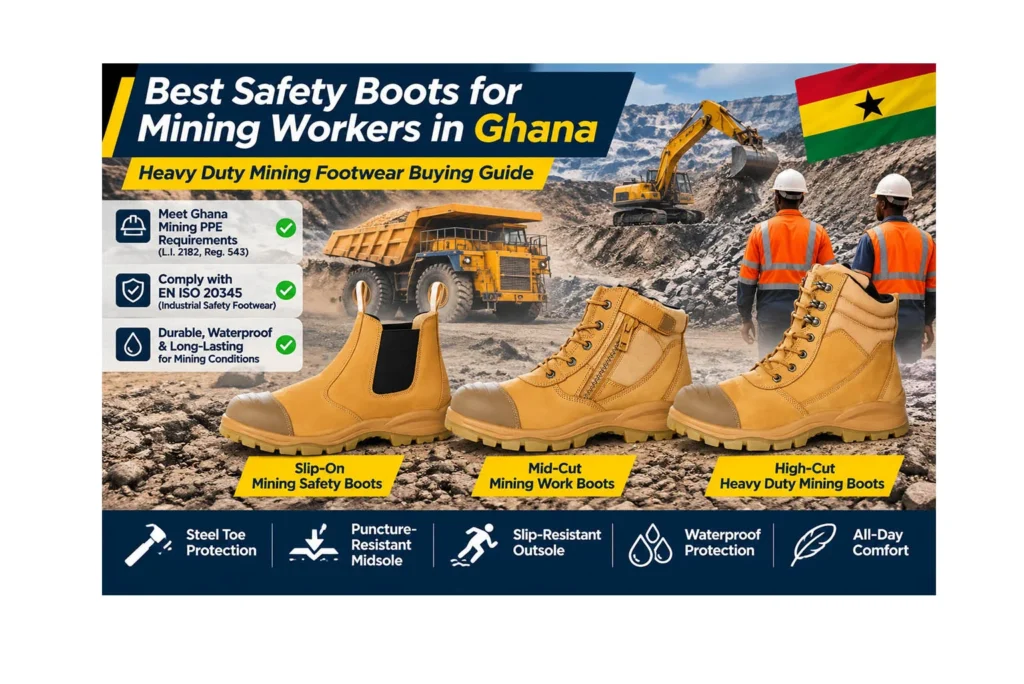
Mining is one of Ghana’s important industrial sectors, creating demand for reliable personal protective equipment (PPE), including durable mining safety footwear. From large-scale gold mining operations to mineral processing facilities and mining support services, workers face demanding conditions that require appropriate foot protection.
Choosing the right mining safety boots Ghana suppliers and products is important for mining companies, PPE distributors, wholesalers, and procurement managers. Mining environments can expose workers to falling objects, sharp rocks, uneven ground, slippery surfaces, heavy machinery, and wet working conditions.
Ordinary work boots may not provide the protection required for these applications. Professional mining footwear should combine protective toe caps, penetration-resistant midsoles, durable outsoles, and suitable upper materials to meet the hazards identified through workplace risk assessments.
For Ghanaian mining businesses and PPE distributors, sourcing from an experienced safety footwear manufacturer can also provide opportunities for bulk purchasing, customised products, and long-term supply arrangements.
This guide explains how to choose mining work boots in Ghana, compare different safety features, evaluate manufacturers, and identify suitable heavy-duty footwear for mining applications.
Table of Contents
- Why Mining Workers in Ghana Need Specialised Safety Boots
- Common Foot Hazards in Ghana’s Mining Industry
- Essential Features of Mining Safety Boots
- Best Types of Mining Safety Boots for Different Applications
- Steel Toe vs Composite Toe Mining Safety Boots
- How to Choose Heavy Duty Mining Boots
- Mining Safety Footwear Standards and Certification
- How Ghanaian Mining Companies Can Source Safety Boots
- Mining Safety Boots Wholesale Ghana: What Buyers Should Check
- Common Mistakes When Purchasing Mining Safety Boots
- Frequently Asked Questions
1. Why Mining Workers in Ghana Need Specialised Safety Boots
Ghana has an established mining industry, particularly in gold production. Mining operations involve a wide range of activities, including excavation, drilling, blasting, mineral processing, equipment maintenance, and transportation.
These activities expose workers to different occupational hazards.
Mining safety footwear should therefore be selected according to the specific working environment rather than choosing products based only on appearance or price.
1.1 Protection Against Falling Objects
Mining workers may operate near heavy machinery, mineral handling equipment, and materials that can fall or shift unexpectedly.
Protective toe caps help reduce the risk of injuries caused by impact and compression.
Steel toe and composite toe footwear are common options for industrial applications.
1.2 Protection Against Sharp Objects
Mining sites often contain sharp rocks, metal fragments, and other materials that may damage footwear or penetrate the sole.
A penetration-resistant midsole can provide additional protection against underfoot hazards.
Depending on the workplace requirements, buyers may consider footwear with metallic or non-metallic penetration-resistant inserts.
1.3 Better Traction on Uneven Ground
Mining workers frequently move across gravel, rocky surfaces, muddy areas, and industrial floors.
A suitable outsole should provide traction appropriate to the surface conditions.
Slip-resistant and abrasion-resistant outsole designs are important considerations when evaluating mining work boots.
1.4 Durability in Demanding Environments
Mining footwear is exposed to repeated walking, bending, abrasion, dust, moisture, and contact with industrial materials.
Heavy-duty mining boots should use suitable upper materials, reliable stitching, durable outsole construction, and strong sole attachment.
1.5 Comfort During Long Working Hours
Mining employees may spend extended periods standing, walking, or operating equipment.
Uncomfortable footwear can affect worker satisfaction and may lead to premature replacement.
Important comfort considerations include:
- Appropriate shoe weight
- Cushioned footbeds
- Breathable linings
- Suitable toe-box space
- Secure ankle support
- Proper sizing
2. Common Foot Hazards in Ghana’s Mining Industry
Different mining activities create different footwear requirements.
Understanding these hazards helps procurement teams choose suitable products.
| Mining Activity | Potential Foot Hazards | Recommended Footwear Features |
|---|---|---|
| Open-pit mining | Falling rocks, sharp stones and uneven ground | Protective toe cap and penetration-resistant midsole |
| Underground mining | Low visibility, uneven surfaces and moisture | Durable construction, suitable traction and protective toe |
| Drilling operations | Heavy equipment and falling materials | Impact protection and reinforced construction |
| Mineral processing | Wet floors and industrial materials | Suitable slip resistance and chemical compatibility where required |
| Mining transportation | Heavy equipment and repeated movement | Durable outsole and comfortable fit |
| Equipment maintenance | Sharp components and mechanical hazards | Protective toe and penetration resistance |
| Outdoor mine operations | Rain, mud and water exposure | Appropriate water protection and traction |
2.1 Open-Pit Mining
Open-pit mining involves working around excavation areas, haul roads, rocky surfaces, and heavy equipment.
Workers may encounter sharp rocks, uneven terrain, and falling materials.
Recommended footwear considerations include:
- Protective toe caps
- Penetration-resistant midsoles
- Durable uppers
- Deep outsole tread
- Reinforced construction
2.2 Underground Mining
Underground mining environments can involve confined spaces, uneven ground, moisture, and limited visibility.
Footwear should be selected according to the mine’s specific hazards and operational requirements.
Important considerations include:
- Secure fit
- Appropriate ankle coverage
- Durable construction
- Suitable slip resistance
- Water protection where required
2.3 Mineral Processing Facilities
Workers in mineral processing facilities may spend considerable time around machinery, conveyors, and wet industrial floors.
Depending on the process, they may need:
- Protective toe caps
- Slip-resistant outsoles
- Oil-resistant outsole materials where required
- Comfortable footbeds
- Durable uppers
Where workers may encounter chemicals, the footwear material must be assessed for compatibility with the specific substances.
3. Essential Features of Mining Safety Boots
When evaluating mining safety boots Ghana suppliers, buyers should pay attention to several important product features.
3.1 Protective Toe Caps
Toe protection is one of the most important requirements for mining footwear.
Two common options are:
Steel toe caps
Steel toe caps provide impact and compression protection when incorporated into appropriately tested safety footwear.
They are widely used in demanding industrial applications.
Composite toe caps
Composite toe caps use non-metallic protective materials.
Potential advantages include:
- Non-metallic construction
- Lower thermal conductivity than steel
- Potentially lighter footwear designs
- Suitability for metal-free workplace requirements
Both options should be evaluated based on certified product performance rather than material preference alone.
3.2 Penetration-Resistant Midsoles
Sharp objects on mining sites can create underfoot injury risks.
Penetration-resistant inserts help protect workers against these hazards.
Common options include:
- Steel midsoles
- Non-metallic textile inserts
The choice depends on the required protection level, footwear flexibility, and workplace conditions.
3.3 Heavy-Duty Outsoles
The outsole should withstand the demands of the intended mining environment.
Common outsole materials include:
| Outsole Material | Potential Characteristics |
|---|---|
| PU | Lightweight construction and cushioning |
| PU/PU | Different density layers for comfort and durability |
| Rubber | Suitable for demanding industrial applications |
| PU/Rubber | Combines cushioning with rubber outsole performance |
Buyers should evaluate abrasion resistance, slip resistance, heat resistance, and oil resistance according to the intended application.
3.4 Waterproof or Water-Resistant Construction
Water exposure is an important consideration for mining operations, particularly during outdoor work and rainy conditions.
However, buyers should distinguish between:
- Water-resistant upper materials
- Water penetration and absorption resistance
- Whole-footwear water resistance
These properties are not interchangeable.
For workers exposed to prolonged water or wet environments, select footwear with the appropriate tested water protection.
3.5 Ankle Support and Reinforced Uppers
Mining boots commonly feature mid-cut or high-cut designs.
Higher-cut footwear may provide additional ankle coverage, while reinforced uppers can improve durability.
Consider:
- Collar padding
- Heel reinforcement
- Strong stitching
- Upper abrasion resistance
- Secure fastening systems
3.6 Comfortable Footbeds and Breathable Linings
Comfort is important for workers who spend long hours on their feet.
A suitable footbed and lining can improve the wearing experience.
For Ghana’s warm climate, breathable materials and effective moisture management are worth considering, provided they do not compromise the required protective features.
4. Best Types of Mining Safety Boots for Different Applications
Not every mining worker needs the same footwear.
The best mining work boots Ghana buyers should consider depend on the worker’s role and the risks identified at the worksite.
4.1 Heavy Duty Steel Toe Mining Boots
<text>Recommended applications: </text>
- Open-pit mining
- Heavy equipment operations
- Drilling activities
- Mining construction
- General heavy industrial work
Important features:
- Steel protective toe cap
- Penetration-resistant midsole where required
- Durable leather or synthetic upper
- Reinforced heel
- Heavy-duty outsole
- Suitable slip resistance
These boots are worth considering for applications where impact, compression, and underfoot hazards are significant.
4.2 Waterproof Mining Safety Boots
<text>Recommended applications: </text>
- Outdoor mining operations
- Wet work areas
- Rain-exposed operations
- Water-related industrial activities
Important features:
- Appropriate water protection
- Protective toe cap
- Durable outsole
- Secure upper construction
- Suitable slip resistance
Buyers should confirm whether the footwear provides upper water resistance or tested whole-footwear water resistance.
4.3 Composite Toe Mining Work Boots
<text>Recommended applications: </text>
- General mining operations
- Equipment maintenance
- Industrial support services
- Workers who prefer non-metallic toe protection
Important features:
- Composite protective toe cap
- Suitable penetration-resistant insert
- Durable upper
- Comfortable footbed
- Appropriate outsole
4.4 High-Cut Heavy Duty Work Boots
<text>Recommended applications: </text>
- Uneven terrain
- Outdoor industrial operations
- General mining work
- Sites requiring higher ankle coverage
Important features:
- Higher-cut design
- Secure fastening
- Reinforced heel
- Durable outsole
- Comfortable ankle collar
Product Comparison
| Boot Type | Main Advantage | Suitable Application |
|---|---|---|
| Steel toe mining boots | Protective toe construction | Heavy-duty mining |
| Waterproof mining boots | Water protection | Wet and outdoor operations |
| Composite toe mining boots | Non-metallic toe protection | General industrial mining |
| High-cut mining boots | Additional ankle coverage | Uneven terrain |
| Heavy-duty industrial boots | Robust construction | Demanding work environments |
5. Steel Toe vs Composite Toe Mining Safety Boots
One common purchasing decision is whether to choose steel toe or composite toe mining boots.
Both can provide protective toe performance when tested and certified to the applicable standard.
The correct option depends on workplace requirements, worker preferences, and purchasing objectives.
| Comparison | Steel Toe | Composite Toe |
|---|---|---|
| Material | Steel | Non-metallic materials |
| Weight | Generally heavier | Potentially lighter |
| Thermal conductivity | Higher | Lower |
| Metal content | Contains metal | Non-metallic toe cap |
| Impact protection | Available in tested footwear | Available in tested footwear |
| Typical applications | Heavy industrial environments | General industrial applications |
| Purchasing consideration | Durability and established construction | Weight and metal-free requirements |
When Should Mining Buyers Choose Steel Toe Boots?
Steel toe mining boots may be appropriate when:
- The worksite requires steel toe protection.
- Heavy-duty industrial footwear is preferred.
- The selected model meets the required impact and compression performance.
- The footwear is suitable for the worksite environment.
When Should Mining Buyers Choose Composite Toe Boots?
Composite toe mining boots may be considered when:
- Workers prefer non-metallic footwear.
- Weight is an important purchasing consideration.
- The worksite has metal-free requirements.
- The selected model meets the required protective standard.
The toe cap material alone does not determine overall footwear quality. Buyers should also examine the midsole, outsole, upper, and complete product certification.
6. How to Choose Heavy Duty Mining Boots
Selecting heavy duty mining boots requires a structured purchasing process.
The following checklist can help Ghanaian mining companies and PPE distributors evaluate products.
6.1 Identify the Worksite Hazards
Start with the actual mining activities.
Consider:
- Falling objects
- Sharp rocks
- Heavy machinery
- Wet surfaces
- Uneven ground
- Oil exposure
- Chemical exposure
- Electrical hazards
- Heat exposure
A workplace risk assessment should determine the required footwear protection.
6.2 Select the Appropriate Protection Level
Once the hazards are identified, determine the required footwear classification.
For example, some applications may require:
- Toe protection
- Penetration resistance
- Slip resistance
- Antistatic properties
- Water resistance
- Heat-resistant outsole performance
Do not assume that one footwear classification is suitable for every mining application.
6.3 Check Material Durability
Evaluate the upper, lining, outsole, and reinforcement materials.
For heavy-duty mining applications, buyers should pay particular attention to abrasion resistance and sole attachment.
6.4 Evaluate Comfort
Request samples and assess:
- Overall weight
- Footbed cushioning
- Toe-box space
- Ankle support
- Breathability
- Size consistency
Where possible, conduct a controlled wearer trial before approving large orders.
6.5 Review Product Testing
Ask the manufacturer for product-specific test reports and certification documentation.
Ensure the documents match the exact footwear model and construction being purchased.
6.6 Consider Replacement and Supply Planning
Mining companies often purchase footwear in multiple sizes and require regular replacement.
A supplier should be able to discuss:
- Available size ranges
- Bulk order quantities
- Repeat-order arrangements
- Production capacity
- Delivery schedules
- Warranty procedures
7. Mining Safety Footwear Standards and Certification
Product compliance is particularly important when supplying mining companies in Ghana.
Buyers should understand both local mining regulations and relevant international footwear standards.
7.1 Ghana Mining PPE Requirements
Ghana’s Minerals and Mining (Health, Safety and Technical) Regulations, 2012, L.I. 2182, address PPE requirements for mining operations.
Regulation 543 states that mine managers or holders of small-scale mining licences must provide PPE for employees.
It also requires persons working in or entering mines to wear boots or shoes with protective toes approved by the Chief Inspector of Mines.
This is an important requirement for mining companies and PPE suppliers evaluating footwear for the Ghanaian mining market.
Buyers should confirm the applicable approval and documentation requirements with the relevant Ghanaian mining authorities.
7.2 EN ISO 20345 Safety Footwear
EN ISO 20345 is an internationally recognised safety footwear standard.
It specifies basic and additional requirements for safety footwear, including:
- Toe protection
- Mechanical risks
- Slip resistance
- Thermal risks
- Ergonomic requirements
- Other protective properties
For mining applications, buyers should review the specific product classification and test results.
7.3 Common Safety Footwear Classifications
| Classification | General Protection Features |
|---|---|
| SB | Basic toe protection |
| S1 | Basic safety features, antistatic properties and heel energy absorption |
| S2 | S1-type features plus water penetration and absorption resistance of the upper |
| S3 | S2-type features plus penetration resistance and cleated outsole |
| S3L | S3-type features with non-metallic penetration-resistant insert tested using a 4.5 mm nail |
| S3S | S3-type features with non-metallic penetration-resistant insert tested using a 3 mm nail |
| S7 | S3-type protection plus whole-footwear water resistance |
The actual suitability of each classification depends on the mine’s hazards and the applicable standard edition.
For particularly demanding applications, additional requirements may be necessary.
7.4 ASTM F2413 Safety Footwear
Some mining companies and international procurement organisations may specify ASTM F2413 footwear requirements.
ASTM F2413 covers protective footwear performance requirements, including impact and compression protection and other specified protective properties.
Buyers should check the actual marking and applicable performance designation rather than assuming all ASTM footwear offers identical protection.
7.5 Documents Mining Buyers Should Request
Before approving a bulk purchase, request:
- Product-specific test reports
- Applicable safety footwear certificates
- Manufacturer identification
- Model number and product specifications
- Toe protection information
- Penetration resistance documentation where applicable
- User instructions
- Product markings
The documents should correspond to the exact footwear model being supplied.
8. How Ghanaian Mining Companies Can Source Safety Boots
Mining companies and PPE distributors can source mining footwear through local suppliers or international manufacturers.
Each option has different purchasing advantages.
8.1 Local PPE Suppliers in Ghana
Local suppliers may provide:
- Existing product inventory
- Local delivery
- Smaller order quantities
- Easier sample collection
- Local customer service
This option can be useful for companies requiring urgent replacements or relatively small orders.
However, buyers should still verify product quality, documentation, and supplier reliability.
8.2 Directly from Chinese Manufacturers
Direct sourcing from China may be suitable for:
- Mining PPE distributors
- Large mining contractors
- Industrial footwear wholesalers
- Mining equipment suppliers
- Private-label footwear brands
Potential advantages include:
- Competitive factory pricing
- Multiple product categories
- OEM and ODM manufacturing
- Custom branding
- Product development
- Bulk production arrangements
Buyers should evaluate the manufacturer’s actual production facilities and quality control procedures.
8.3 How to Evaluate a Mining Safety Boots Manufacturer
Before choosing a supplier, check:
| Evaluation Area | What to Verify |
|---|---|
| Factory experience | Experience producing industrial safety footwear |
| Product range | Steel toe, composite toe and heavy-duty boots |
| Testing | Applicable product-specific test reports |
| Manufacturing | Actual production capabilities |
| Quality control | Material and finished-product inspection |
| MOQ | Minimum order quantity |
| Samples | Availability of physical samples |
| Customisation | OEM and ODM services |
| Delivery | Production and shipping arrangements |
| After-sales | Defective product and replacement procedures |
8.4 Request Samples Before Bulk Orders
Samples allow mining buyers to evaluate actual footwear construction.
Inspect:
- Toe cap construction
- Upper material quality
- Outsole bonding
- Tread design
- Footbed comfort
- Stitching
- Size consistency
- General workmanship
Where possible, compare multiple models before selecting a supplier.
9. Mining Safety Boots Wholesale Ghana: What Buyers Should Check
For Ghanaian PPE distributors and mining procurement departments, wholesale purchasing requires careful planning.
9.1 Minimum Order Quantity
Ask suppliers about:
- MOQ per model
- MOQ per colour
- Size assortment
- Mixed-model orders
- Sample order quantities
- Repeat-order requirements
For distributors, flexibility in size combinations can be important.
9.2 Wholesale Pricing
The price of mining safety boots depends on several factors.
| Cost Factor | Description |
|---|---|
| Upper materials | Leather, microfibre or synthetic materials |
| Toe cap | Steel or composite |
| Midsole | Metallic or non-metallic insert |
| Outsole | PU, rubber or PU/rubber |
| Protection level | Required safety classification |
| Customisation | Logos, colours and packaging |
| Order quantity | Total production volume |
| Shipping | Freight, insurance and handling |
Compare quotations using equivalent specifications.
9.3 Quality Control for Bulk Orders
Mining companies should establish clear quality requirements before production.
A suitable inspection process may include:
- Incoming raw material inspection.
- Upper material and stitching inspection.
- Toe cap and midsole construction checks.
- Outsole bonding inspection.
- Finished footwear inspection.
- Size and quantity verification.
- Pre-shipment inspection.
9.4 Shipping and Delivery to Ghana
When importing mining footwear, buyers should consider:
- Production lead time
- Sample approval
- Export documentation
- International freight
- Cargo insurance
- Customs clearance
- Local transportation
- Final delivery
Sea freight may be appropriate for larger orders, while air freight can be considered for urgent samples or smaller shipments.
Confirm the agreed Incoterms, responsibilities, and destination charges before placing the purchase order.
9.5 Calculate Total Landed Cost
Do not compare only the factory price.
The total purchasing cost may include:
- Product cost
- Packaging
- Freight
- Insurance
- Customs duties where applicable
- Import taxes
- Customs clearance
- Local handling and delivery
Calculating the landed cost per pair helps distributors establish more accurate wholesale and resale prices.
10. Common Mistakes When Purchasing Mining Safety Boots
Mistake 1: Choosing Ordinary Work Boots for Mining
General work boots may not provide the required toe protection or penetration resistance.
Select footwear according to the mining worksite risk assessment.
Mistake 2: Focusing Only on Steel Toe Protection
Toe protection is important, but mining footwear may also need penetration resistance, suitable traction, water protection, and abrasion resistance.
Evaluate the complete footwear construction.
Mistake 3: Ignoring Outsole Performance
A durable outsole should match the ground conditions and industrial hazards.
Consider slip resistance, abrasion resistance, and resistance to relevant workplace substances.
Mistake 4: Purchasing Without Checking Certification
Do not rely only on product descriptions or supplier assurances.
Request and verify relevant product documentation.
Mistake 5: Skipping Physical Samples
Photographs cannot demonstrate actual comfort, fit, construction, or workmanship.
Evaluate samples before approving large quantities.
Mistake 6: Choosing the Cheapest Supplier
A low price may involve different materials, specifications, or manufacturing quality.
Compare the full product specification and total landed cost.
Mistake 7: Ignoring Long-Term Supply Capacity
Mining companies and PPE distributors may require regular replenishment.
Choose suppliers that can support consistent specifications, production planning, and repeat orders.
11. Frequently Asked Questions
What Are the Best Safety Boots for Mining Workers in Ghana?
The best mining safety boots depend on the worksite hazards. Heavy-duty steel toe boots with penetration-resistant midsoles and suitable slip-resistant outsoles may be appropriate for many mining applications. Waterproof and composite toe options should also be considered where the working conditions require them.
What Type of Safety Boots Do Gold Mine Workers Need?
Gold mine workers may require protective toe caps, penetration-resistant midsoles, durable uppers, and suitable outsole traction. The exact footwear specification should be determined by the mining company’s risk assessment and applicable requirements.
Are Steel Toe Mining Boots Better Than Composite Toe Boots?
Neither is universally better. Steel toe boots offer established metal toe protection, while composite toe boots provide non-metallic protection and may offer weight and thermal advantages. Both should meet the required performance standard.
Do Mining Safety Boots Need Puncture-Resistant Soles?
Where workers face sharp rocks, metal fragments, or other penetration hazards, penetration-resistant midsoles may be required. The appropriate specification should be confirmed through a worksite risk assessment.
Are Waterproof Mining Safety Boots Necessary in Ghana?
Waterproof or water-resistant footwear may be appropriate for outdoor mining, wet working areas, and operations exposed to rain. Buyers should distinguish between water-resistant uppers and whole-footwear water resistance.
What Safety Footwear Standard Should Ghanaian Mining Buyers Check?
Buyers should review the Ghana Minerals and Mining (Health, Safety and Technical) Regulations, 2012, L.I. 2182, particularly Regulation 543. They should also evaluate applicable international footwear standards such as EN ISO 20345 and verify any product approval requirements with the Chief Inspector of Mines.
Where Can Ghanaian Companies Buy Heavy Duty Mining Boots?
Companies can purchase through local PPE suppliers, industrial footwear distributors, wholesalers, or direct manufacturers in countries such as China. Before ordering, verify manufacturing capabilities, product documentation, samples, and bulk supply arrangements.
Can Chinese Manufacturers Produce Custom Mining Safety Boots?
Yes. Manufacturers offering OEM and ODM services may customise upper materials, toe caps, midsoles, outsole constructions, colours, logos, and packaging. Any changes affecting protective performance should be appropriately assessed and tested.
What Should Mining PPE Distributors Check Before Ordering Wholesale Safety Boots?
Distributors should check product specifications, safety classifications, certificates, sample quality, MOQ, wholesale pricing, size availability, quality control, shipping arrangements, and repeat-order capabilities.
Conclusion
Choosing the right mining safety boots Ghana buyers need requires careful consideration of workplace hazards, footwear protection, product quality, and supplier reliability.
Mining operations place demanding requirements on protective footwear. Steel toe protection, penetration-resistant midsoles, durable outsoles, suitable water protection, and comfortable construction can all play important roles in selecting the right product.
For Ghanaian mining companies, PPE distributors, wholesalers, and importers, a structured purchasing process should include:
- Identifying actual mining hazards
- Selecting appropriate footwear protection
- Checking applicable certification and documentation
- Evaluating samples
- Comparing manufacturing capabilities
- Reviewing quality control procedures
- Calculating total landed costs
- Establishing reliable long-term supply arrangements
Working with an experienced safety footwear manufacturer can help buyers develop a product range suited to different mining applications while supporting consistent bulk purchasing.
Source Mining Safety Boots from Ocean Safety Shoes
Ocean Safety Shoes is a professional safety footwear manufacturer serving international B2B customers, including mining equipment suppliers, PPE distributors, wholesalers, importers, industrial retailers, and private-label brands.
Our manufacturing range covers different industrial footwear requirements, including:
- Heavy-duty mining safety boots
- Steel toe safety boots
- Composite toe safety footwear
- Waterproof safety boots
- S3 industrial safety footwear
- Heavy-duty construction boots
- Industrial non-slip safety shoes
- OEM and ODM safety footwear
We understand that mining footwear buyers require products with appropriate protective construction, durable materials, and consistent manufacturing quality.
Our OEM and ODM services can support:
Product Development
- Custom upper materials
- Steel or composite toe cap options
- Penetration-resistant midsole options
- Different outsole constructions
- Custom colours and designs
Private-Label Manufacturing
- Custom logos
- Branding development
- Packaging customisation
- Product sample development
- Bulk production arrangements
Wholesale Supply
- Multiple industrial footwear categories
- Product specification discussions
- Quality control procedures
- Repeat-order planning
- International B2B supply
When requesting a quotation, please provide your preferred boot style, required protection level, target application, estimated order quantity, size range, and branding requirements.
Explore our safety boots and industrial footwear product range to review available models.
Looking for a reliable mining safety boots manufacturer for your Ghana distribution business?
Contact Ocean Safety Shoes to discuss product samples, wholesale pricing, and OEM/ODM manufacturing opportunities.