
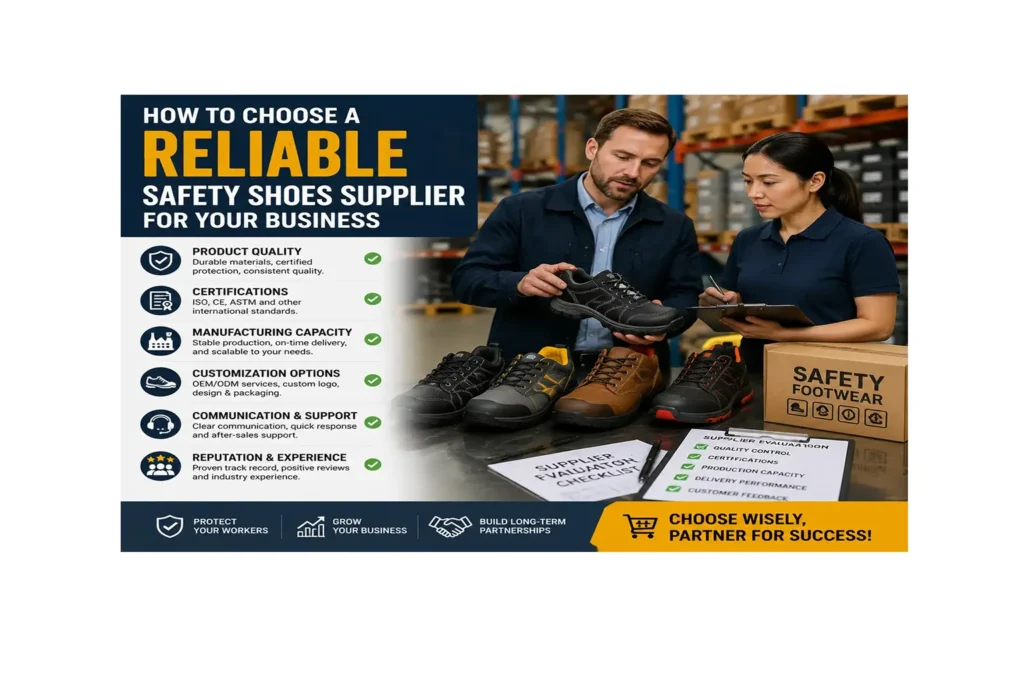
Quick Outline
- Why choosing the right safety shoes supplier matters more than ever
- What separates a reliable supplier from an average one
- 12 factors every PPE buyer should evaluate
- Common sourcing mistakes that cost businesses money
- Questions to ask before placing a bulk order
- Final checklist for importers and distributors
- FAQs
How to Choose a Reliable Safety Shoes Supplier for Your Business
Finding a safety shoes supplier sounds straightforward.They usually include the following steps:
- Search online.
- Compare prices.
- Request samples.
- Place an order.
If only it were that simple.
For safety shoes purchasing managers, PPE distributors, wholesalers, retailers, and product development teams, choosing a supplier isn’t just another purchasing task. It’s a business decision that affects product quality, customer satisfaction, inventory planning, and, ultimately, your reputation.
Here’s the thing.
A supplier who offers the lowest quotation today can easily become the most expensive supplier six months later if shipments are delayed, product quality becomes inconsistent, or warranty claims start piling up.
Experienced buyers know this already.
They’re not simply buying work boots. They’re buying consistency.
That’s a very different purchase.
We, Ocean Safety Shoes, as a professional manufacturer engaged in the production of safety footwear for over 25 years, have always attached great importance to our customers’ concerns regarding these issues. We have always regarded product quality as the lifeline of our factory. Therefore, we have established a quality control system covering everything from procurement, to mass production, to shipment, in order to meet our customers’ requirements for consistency between samples and mass production, on-time delivery, and after-sales service.
We take your concerns very seriously and deeply value both your reputation and that of our factory. Please rest assured that we stake our reputation on this, and we dare not conceal anything.
Why Your Supplier Matters More Than the Product
Many people focus entirely on the safety shoe itself.
Steel toe?
Check.
Slip-resistant outsole?
Check.
CE certification?
Check.
Those things are important. Very important.
But they only tell part of the story.
A reliable supplier controls something buyers often overlook:
- Production consistency
- Delivery performance
- Material traceability
- Quality control
- Communication
- Product development
- After-sales support
Think about it like building a house.
The bricks matter.
The builder matters even more.
We, Ocean Safety Shoes, only procure materials that are identical to the confirmed samples approved by our customers. Moreover, we adhere to standard production processes without cutting any corners, in order to guarantee quality. To this end, we have established an independent QC department.
What Does a Reliable Safety Shoes Supplier Actually Look Like?
A trustworthy supplier doesn’t simply manufacture footwear.
They help reduce your business risk.
That sounds dramatic.
It isn’t.
Every shipment that arrives late affects inventory planning.
Every quality complaint affects customer confidence.
Every production mistake affects your profit.
Reliable suppliers understand that they are part of your supply chain—not merely a factory making shoes.
Yes, at Ocean Safety Shoes, we know that we are not only making safety shoes, but also serving as a part of your supply chain. We hope to become your partner in the supply chain.
1. Industry Experience Matters More Than Factory Size
Many buyers immediately ask one question:
“How large is your factory?”
Honestly, that’s rarely the most useful question.
A medium-sized manufacturer with fifteen years of safety footwear experience often performs better than a massive factory producing dozens of unrelated products.
Experience usually means the supplier understands:
- Different international safety standards
- Material selection
- Construction techniques
- Testing requirements
- Market preferences
More importantly, experienced factories recognize problems before they become expensive.
That knowledge isn’t easy to copy.
For example, when we serve the Australian market, we,Ocean Safety Shoes,have a thorough understanding of the foot width of Australians, and we select the appropriate LASTs accordingly for production.
2. Check Safety Certifications Carefully
This sounds obvious, yet it’s still one of the biggest sourcing mistakes.
Don’t simply ask:
“Do you have CE?”
Ask:
- Which standard?
- Which model?
- Which certificate?
- Which testing laboratory?
- Is the certificate still valid?
For European markets, buyers commonly request compliance with standards such as EN ISO 20345:2022 or EN ISO 20345:2022+A1:2024, depending on customer requirements.
If your target market differs, verify the applicable local standards before production begins.
Good suppliers are comfortable sharing certification documents.
Poor suppliers often become surprisingly vague.
In our factory, we hold the following certificates:
- AS 2210.3:2019:Class I SB FO SRA
- AS 2210.3:2019:Class I SBP FO SRA
- EN ISO 20345:2022+A1:2024:S3 SR
- EN ISO 20347:2022+A1:2024:O3L SR HRO
- South Korea KCS certificate
- BSCI Certificate
- ISO 9001:2015 Certificate
3. Quality Control Starts Before Production
Many buyers think inspection happens only after the shoes are finished.
Actually, the opposite works better.
Reliable manufacturers inspect materials before production even starts.
For leather, this may include:
- Thickness
- Color consistency
- Tensile strength
- Surface defects
- Hidden damage
Other incoming materials—such as toe caps, midsoles, eyelets, laces, and outsole compounds—should also be checked before entering production.
You know what?
Preventing defects always costs less than fixing them later.
In our factory, we,Ocean Safety Shoes, have established a complete quality inspection process to control the quality of our shoes, covering everything from incoming material inspection, leather tensile testing to detect hidden defects, cutting piece inspection, sewing guidance, upper inspection, to various process checks during mass production, and finally packaging inspection. This has formed an integrated system that has been instilled into every position and every worker’s daily operations.
4. Ask About Production Equipment
Modern equipment doesn’t automatically guarantee better shoes.
But outdated equipment often creates inconsistent quality.
Reliable safety footwear manufacturers usually invest in machinery that improves precision and repeatability.
Examples include(Our factory,Ocean Safety Shoes,is also equipped with the following advanced machines:):
- Automatic leather cutting machines
- Leather tensile testing machine
- Automatic line marking machine
- Computerized stitching equipment
- Heel shaping machines
- Lasting upper machine
- PU injection production lines
Automation also helps reduce differences between production batches.
That’s especially important for repeat orders.
5. Product Development Shouldn’t Stop After Sampling
Some factories produce exactly what buyers request.
Great.
Better suppliers also suggest improvements.
Perhaps a stronger outsole compound.
Perhaps better cushioning.
Perhaps a lighter composite toe cap.
Perhaps a waterproof membrane that’s more suitable for your market.
Product development should feel like a conversation—not a one-time transaction.
The best factories ask questions.
Sometimes lots of questions.
That’s usually a good sign.
At Ocean Safety Shoes,we carefully examine the materials, design, and workmanship of the samples. If we identify any potential quality risks that may arise during mass production, we will promptly notify our customers and suggest improvements, and we will continue to do so until production can proceed smoothly and without issues.
6. Communication Says More Than You Think
Here’s a surprisingly accurate sourcing test.
Send the supplier several technical questions.
Then watch how they respond.
Do they answer clearly?
Do they explain why?
Do they provide photos?
Do they share test reports?
Do they reply consistently?
Communication problems rarely disappear after the purchase order arrives.
They usually become larger.
Much larger.
We,Ocean Safety Shoes,have a team of dedicated international trade professionals who understand shoe production and are responsible for communicating with customers, handling various customer issues, and meeting their requirements.
7. Stable Material Supply Reduces Business Risk
One shipment may look perfect.
The second shipment?
Completely different leather.
Different outsole color.
Different lining.
Different comfort level.
That’s often a supply chain problem rather than a manufacturing problem.
Reliable suppliers usually maintain stable relationships with qualified material vendors.
That helps maintain consistency across future production.
Consistency keeps distributors happy.
Retailers too.
At Ocean Safety Shoes, we have established strong and stable partnerships with our material suppliers, allowing us to guarantee consistent quality across all materials.
8. Don’t Ignore Factory Audits
Not every buyer visits every factory.
That’s understandable.
Still, whenever possible, factory audits reveal valuable information.
Pay attention to:
- Production organization
- Cleanliness
- Material storage
- Finished goods handling
- Quality inspection procedures
- Employee training
- Traceability systems
Even a virtual factory tour can provide useful insights.
Sometimes you notice things nobody mentioned during video meetings.
At Ocean Safety Shoes, we warmly welcome customers worldwide to visit our factory and explore opportunities for collaboration.
9. Delivery Performance Is Part of Product Quality
Late delivery isn’t simply a logistics issue.
It affects:
- Inventory
- Customer relationships
- Promotional schedules
- Seasonal sales
- Cash flow
Reliable suppliers don’t promise impossible delivery dates.
Instead, they provide realistic production schedules—and keep buyers informed if circumstances change.
Honestly, buyers appreciate honest delays more than unrealistic promises.
At Ocean Safety Shoes,the lead time for initial orders is typically 60 days, while for repeat orders, it can be reduced to 45 days.
10. After-Sales Support Separates Good Suppliers from Great Ones
Problems occasionally happen.
Even excellent factories experience unexpected issues.
The difference lies in the response.
Ask potential suppliers:
How do you handle quality claims?
How quickly do you investigate?
Do you provide replacement products?
How do you prevent the same issue from happening again?
Their answers often reveal their company culture.
At Ocean Safety Shoes, our 24/7 after-sales service team stands ready to assist with any concerns and ensure that every customer issue is fully resolved to their satisfaction.
11. OEM and ODM Capability Adds Long-Term Value
Many distributors eventually develop their own brands.
That changes supplier expectations.
A reliable OEM or ODM partner should be able to support(Our factory offers both OEM and ODM services):
- Logo customization
- Packaging design
- Mold development
- New outsole development
- Material recommendations
- Product testing
- Technical documentation
The earlier a supplier supports product development, the smoother future launches usually become.
12. Price Should Never Be the Only Decision
Let’s be honest.
Everyone compares quotations.
That’s normal.
But experienced purchasing managers rarely choose the cheapest supplier immediately.
Instead, they calculate total cost.
That includes:
- Warranty claims
- Shipping accuracy
- Production consistency
- Customer complaints
- Product lifespan
- Delivery reliability
A slightly higher unit price often produces a lower overall business cost.
That’s one of the oldest lessons in sourcing.
And it’s still true.
Ocean Safety Shoes is committed to offering high-quality products, competitive pricing, and reliable delivery schedules. In doing so, we uphold our corporate reputation and have earned the lasting trust of our customers.
Common Mistakes Buyers Still Make
Even experienced procurement teams occasionally fall into familiar traps.
Choosing only by price
Cheap quotations sometimes hide expensive surprises.
Skipping sample wear testing
Laboratory testing is valuable.
Real workers provide another layer of useful feedback.
Ignoring communication quality
Poor communication rarely improves after production begins.
Assuming every certificate covers every product
Certificates apply to specific tested models—not necessarily every shoe in a catalog.
Forgetting future orders
The first shipment is important.
The fifth shipment is usually more important.
Consistency builds brands.
Questions Every Buyer Should Ask
Before confirming a supplier, consider asking:
- How long have you specialized in safety footwear?
- Which markets do you export to?
- Which safety standards do your products comply with?
- Can you provide current test reports?
- What quality inspections happen before production?
- What inspections happen during production?
- What inspections happen before shipment?
- Can you support OEM and ODM projects?
- What is your daily production capacity?
- How do you handle quality claims?
Simple questions.
Very revealing answers.
Before our customers place orders with us, they usually ask about the above issues.
A Practical Evaluation Checklist
When comparing suppliers, score each category rather than focusing only on price.
| Evaluation Area | Why It Matters |
|---|---|
| Industry experience | Reduces technical mistakes |
| Product certifications | Supports market compliance |
| Quality control | Improves consistency |
| Material sourcing | Maintains stable quality |
| Communication | Prevents misunderstandings |
| Production equipment | Improves manufacturing accuracy |
| OEM capability | Supports brand growth |
| Delivery reliability | Protects inventory planning |
| After-sales support | Reduces commercial risk |
| Product development | Helps future expansion |
Final Thoughts
Choosing a reliable safety shoes supplier isn’t about finding the lowest quotation or the biggest factory.
It’s about finding a partner that consistently delivers safe, compliant, and dependable products—shipment after shipment.
The strongest suppliers don’t simply manufacture safety shoes.
They help buyers reduce risk, improve customer satisfaction, and build stronger brands over time.
For safety shoes purchasing managers, distributors, wholesalers, and PPE companies, that’s often the difference between steady business growth and constant sourcing headaches.
The right supplier won’t solve every challenge.
But they can prevent many of them before they ever reach your customer.
That’s worth far more than a small saving on the purchase price.
FAQs
1. How do I choose a reliable safety shoes supplier for wholesale business?
Look for a supplier with proven manufacturing experience, valid safety certifications, consistent quality control, OEM or ODM capability, stable delivery performance, and responsive communication. These factors reduce long-term sourcing risks far more than price alone.
2. What certifications should a safety shoes supplier provide?
Depending on your target market, suppliers should provide valid product certificates such as EN ISO 20345:2022 or other applicable national standards, along with supporting test reports from recognized testing laboratories.
3. Why is factory quality control important when buying safety shoes?
Quality control helps identify material defects before production, monitors workmanship during manufacturing, and verifies finished products before shipment. This reduces warranty claims, product returns, and customer complaints.
4. What should I ask an OEM safety shoes manufacturer before placing a bulk order?
Ask about production capacity, quality inspection procedures, export experience, certification status, product development capability, delivery timelines, after-sales service, and previous OEM or private-label projects.
5. Why shouldn’t I choose the cheapest safety shoes supplier?
The lowest quotation can lead to higher costs through inconsistent quality, delayed deliveries, warranty claims, and customer dissatisfaction. Evaluating total business cost—including product reliability and service—usually leads to better long-term results.
Are you looking for a reliable safety footwear supplier? With over 25 years of experience in safety shoe production, advanced equipment, skilled workers, a comprehensive quality control system, and 24/7 after-sales service, we,Ocean Safety Shoes, are the perfect match for your needs. If you are interested in our factory, please feel free to contact us.