
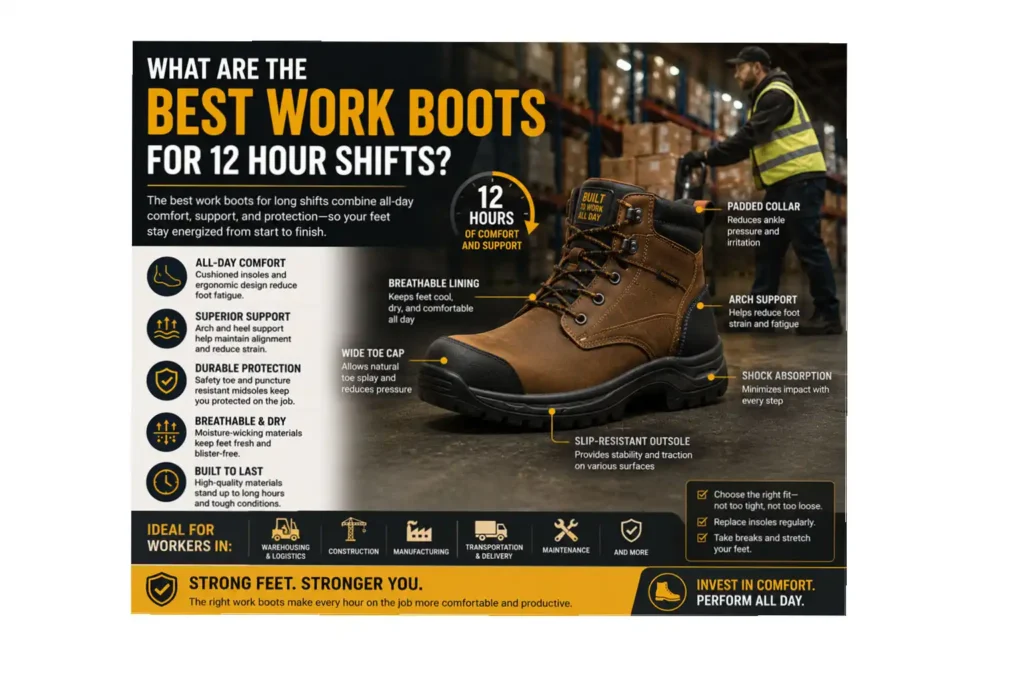
Brief Article Outline
- The direct answer: what type of work boot is best for standing all day?
- Why standing on concrete causes foot and leg fatigue
- The most important comfort and safety features
- How cushioning, support, weight, fit, and outsole design work together
- Choosing boots for warehouses, construction, workshops, and outdoor sites
- A practical evaluation guide for PPE buyers and distributors
- Common buying mistakes
- Buyer-focused CTA
- Five SEO FAQs
What Is the Best Work Boot for Standing All Day?
The best work boot for standing all day is a properly fitted, lightweight safety boot with supportive cushioning, a stable midsole, enough toe room, and an outsole suited to the work surface.
That answer may sound less exciting than naming one magical boot. Still, it’s the honest answer.
A warehouse worker standing on smooth concrete for ten hours has different needs from a construction worker moving between ladders, gravel, mud, and unfinished floors. A food-processing employee may need stronger slip resistance and water protection. An electrician may need footwear selected for electrical hazards.
So there isn’t one perfect boot for every worker.
There is, however, a clear formula for a good all-day work boot: correct protection, correct fit, and steady support without unnecessary weight.
Here’s the thing. A thick, soft footbed can feel wonderful during a two-minute fitting, yet become unstable halfway through a shift. A very hard boot may provide structure but leave the worker feeling as if they’ve spent the day standing on timber blocks.
The sweet spot sits between those extremes.
That’s what safety footwear agents, distributors, wholesalers, product managers, and purchasing directors should be looking for.
At Ocean Safety Shoes, we always ask our customers these questions in advance, such as: What is the workers’ working environment? Which parts of the body need protection? For example, do they need steel toe or non-metallic composite toe? Do they need antistatic or ESD protection? Does the floor require slip resistance? One of the key points is whether they need very comfortable shoes to get through a full day of work. If so, we usually recommend features such as padded collar, comfortable PU footbed, and foamed EVA midsole to provide long-lasting comfort.
Why Standing All Day Is Harder Than It Looks
Standing doesn’t appear strenuous. You’re not lifting a steel beam or pushing a loaded pallet jack, after all.
Yet static standing asks the same muscles to keep working for long periods. It may also contribute to blood pooling in the lower legs, muscle fatigue, and discomfort. Hard surfaces such as concrete can add contact stress to the feet.
Good footwear helps, but footwear isn’t the whole solution.
That’s worth repeating.
The best work boot can reduce pressure and improve comfort, but it can’t completely cancel out ten or twelve hours of static posture. Task rotation, anti-fatigue mats, short breaks, sit-stand arrangements, and movement still matter. OSHA guidance also points toward cushioned shoes, insoles, anti-fatigue mats, and posture changes for jobs that involve prolonged standing.
For a PPE buyer, this changes the question slightly.
Don’t only ask, “Which boot is softest?”
Ask, “Which boot helps this workforce remain supported, stable, protected, and comfortable through the full shift?”
Much better question.
At Ocean Safety Shoes, we provide our customers with a complete footwear solution that ensures comfort and durability—from the collar, footbed, and midsole, all the way down to the outsole. It is an integrated system.
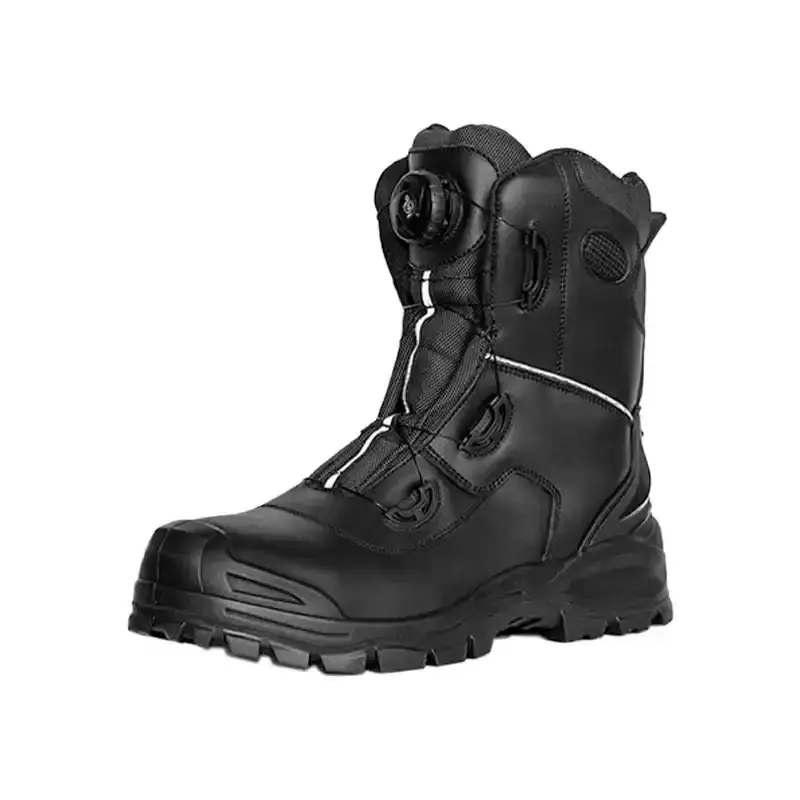
So, What Should the Best Work Boot Feel Like?
A good all-day work boot should feel secure but not cramped.
The heel shouldn’t lift with every step. The toes shouldn’t touch the front. The widest part of the foot should sit naturally inside the widest part of the boot. There should be enough room for normal foot swelling later in the day, but not so much room that the foot slides around.
The boot should also bend in the right place—near the ball of the foot rather than through the middle of the arch.
When the worker stands still, the boot should feel stable. When the worker walks, it should move naturally.
Sounds simple.
Getting all of those details into one product is where good footwear development begins.
1. Start With Fit—Because Cushioning Can’t Fix the Wrong Size
Fit is the first filter.
Not the toe cap material. Not the leather finish. Not even the price.
A beautifully made work boot in the wrong size is still the wrong boot.
For standing-all-day footwear, buyers should consider both length and width. Some workers need standard lasts, while others need wide or extra-wide fittings. A narrow toe box may create pressure around the toes and forefoot. An overly loose heel area can cause rubbing and instability.
And foot shape varies more than many bulk-purchasing programs allow for.
One size scale and one width may look tidy on a spreadsheet, yet it can create a messy fitting experience across a large workforce.
A sensible fit check should cover:
- Toe clearance
- Forefoot width
- Heel hold
- Instep pressure
- Ankle comfort
- Flex point
- Room for work socks
Testing should also happen later in the day when feet may be slightly larger.
You know what? This small timing detail can prevent a surprising number of returns.
For distributors, consistent sizing between production batches matters just as much as the initial fit. A size 9 from the first shipment should not feel like a size 8.5 in the next one.
That sounds obvious. It isn’t always achieved.
At Ocean Safety Shoes,we offer lasts tailored to the foot shapes of different markets. For example, we use wider lasts to meet the needs of the Australian market.
2. Cushioning Matters, but More Foam Isn’t Always Better
Workers standing on concrete usually appreciate cushioning. OSHA specifically advises well-cushioned insteps and soles for prolonged standing, while other workplace guidance suggests footwear or insoles designed for long periods on hard surfaces.
Still, buyers should be careful with the phrase “maximum cushioning.”
Too little cushioning feels harsh.
Too much soft cushioning may compress, wobble, or lose its shape. The worker feels comfortable at first, then less stable as the shift continues.
A well-designed comfort system often uses several layers(Ocean Safety Shoes can offer below cushions):
- A removable PU, memory foam, or multi-density footbed
- A midsole that absorbs impact without collapsing
- A supportive heel area
- An outsole that protects the foot from hard ground
Polyurethane footbeds are popular in work footwear because they can offer resilient cushioning and good recovery. Memory foam can feel pleasant, though its long-term support depends on density and construction. EVA can reduce weight, but different formulations behave very differently.
The material name alone doesn’t tell the full story.
Density, thickness, shape, compression resistance, and placement matter too.
A thin, well-shaped insole can sometimes support the foot better than a thick slab of soft foam.
3. Look for Support, Not Just Softness
Softness sells during a quick fitting.
Support earns appreciation at 4:30 p.m.
A supportive work boot helps keep the foot stable and spreads pressure more evenly. It shouldn’t force every worker into an aggressive arch shape, though. Overbuilt arch support can be just as uncomfortable as no support at all.
For general workforce programs, a contoured removable footbed is usually more useful than a completely flat sock liner. Removal also matters because workers may need:
- Orthotic insoles
- Different arch profiles
- Replacement footbeds
- Extra-depth fitting
- Faster drying after wet work
A stable heel cup can also reduce unwanted movement inside the boot. Combine that with a secure lacing or dial-based fitting system, and the foot is less likely to slide forward during walking.
Honestly, the upper and closure system don’t get enough attention in comfort discussions.
The underfoot package matters, yes. But if the heel floats and the forefoot slides, even an excellent footbed will struggle.
4. Keep the Weight Under Control
A heavy boot can feel reassuring in the hand.
Solid. Tough. Built like a tank.
Then someone has to wear it for twelve hours.
Extra weight makes each step more demanding, especially for workers who walk several kilometres across warehouses, airports, factories, or large construction sites. The effect of a few hundred extra grams may seem small, but it repeats with every step.
That doesn’t mean the lightest work boot is automatically the best.
Very lightweight footwear may not provide enough durability, support, insulation, or underfoot protection for demanding tasks. The goal is to remove unnecessary weight without removing necessary protection.
Useful weight-saving choices can include:
- Composite or glass-fibre toe caps
- Non-metallic puncture-resistant inserts
- Engineered lightweight midsoles
- Strong but less bulky upper materials
- Carefully designed outsole lugs
- Athletic-inspired constructions for suitable workplaces
For warehouses and light manufacturing, a low-cut or mid-cut safety shoe may reduce weight and heat. For heavy construction, mining, utilities, and uneven outdoor terrain, a more supportive boot may still make sense.
There’s the contradiction: lighter often feels better, but lighter isn’t always safer or more suitable.
Job risk decides.
5. Match the Outsole to the Floor
The best work boot for standing all day must also suit the surface under it.
Concrete is unforgiving. Wet tile can be slippery. Steel grating creates different pressure points. Outdoor sites add mud, gravel, ladders, and uneven ground.
Outsole selection should consider:
- Slip resistance
- Flexibility
- Contact area
- Lug depth
- Abrasion resistance
- Heat resistance
- Fuel and oil resistance
- Floor contamination
OSHA advises slip-resistant soles for slippery surfaces and appropriate waterproof, non-slip footwear for wet tasks. It also notes that chemical-resistant boots may be required where workers face corrosive or reactive materials.
Deep, aggressive lugs may perform well on loose soil but feel less comfortable on smooth indoor floors. A broad, flatter contact pattern may feel steadier on warehouse concrete, yet it may clog in mud.
This is why one outsole can’t serve every industry equally well.
For PPE category managers, surface mapping is a useful exercise. List where the footwear will be worn, what contaminates the floor, and whether workers mainly stand, walk, climb, kneel, or drive.
The boot should follow the job—not the other way around.
6. Don’t Let a Safety Toe Ruin the Fit
A protective toe cap must provide the required impact and compression protection, but it should not press against the toes.
The best safety toe is the one the worker barely notices during the shift.
Steel toe caps remain common because they provide dependable protection in a compact construction. Composite and glass-fibre caps can reduce metal content and, depending on the design, lower weight. Aluminium caps may also be used in some footwear.
Yet material is only part of the comfort story.
Toe-cap shape matters enormously.
A short, narrow cap may pinch the little toe. A low cap can press against the top of the toes. Poorly positioned toe-cap edges may create discomfort near the flex line.
A well-designed last gives the cap enough internal room while keeping the boot from looking or feeling oversized.
Safety footwear covered by ISO 20345 includes general requirements related to mechanical risks, slip resistance, thermal risks, and ergonomic behaviour. Buyers must still match the exact certification and optional protections to their own market and workplace requirements.
7. Breathability Can Decide Whether Workers Keep Wearing the Boot
Comfort is not only about pressure.
It’s also about heat and moisture.
A waterproof membrane can be useful for wet outdoor work. Yet a fully waterproof construction may feel warmer than a breathable non-waterproof shoe, especially inside a hot warehouse or factory.
So which is better?
Again, the workplace decides.
For dry indoor work
Breathable lining, moisture management, perforated components where permitted, and lighter uppers may improve comfort.
For rain, mud, or wet vegetation
Waterproof construction can help keep socks dry and reduce the discomfort caused by repeated moisture exposure.
For washdown areas
Buyers may need water resistance, chemical suitability, and an easy-to-clean upper.
OSHA warns that prolonged wet and cold exposure can cause serious foot problems, which is another reminder that keeping feet dry can be a safety issue rather than a minor comfort feature.
No single upper material wins every time.
Full-grain leather offers durability and structure. Nubuck can provide a softer, casual look. Microfibre may reduce weight and support easier cleaning in some industries. Textile constructions may feel more breathable but must still match abrasion, liquid, and environmental risks.
The correct material is the one that survives the job while keeping the worker reasonably comfortable.
8. Ankle Height Should Follow the Work, Not Fashion
Low-cut safety shoes can feel light and flexible. Mid-cut boots may provide a more secure fit around the ankle. Higher boots can offer more coverage in rough, dirty, or wet environments.
But height alone does not guarantee ankle support.
A tall boot made from soft material may provide less lateral stability than a lower boot with a firm heel counter and secure fitting system.
For workers standing mostly in one place on level floors, a low-cut or mid-cut design may feel less restrictive. For people moving across uneven ground, carrying materials, or working around debris, a supportive mid-cut boot may be more suitable.
Buyers should also consider entry and removal.
Side zips, elastic panels, speed hooks, and dial-based closures can make footwear easier to use. However, every added component must be durable enough for the workplace.
Convenience is valuable.
A broken zip in month two? Not so much.
9. The Footbed Must Survive More Than the Sample Room
A fresh sample tells you how the boot feels on day one.
It says much less about day sixty.
For a real evaluation, buyers should examine footbed compression and recovery after repeated wear. Ask whether the footbed remains supportive or becomes flat under the heel and forefoot.
Also check:
- Moisture absorption
- Drying time
- Odour control
- Surface friction
- Edge curling
- Delamination
- Replacement availability
A removable breathable PU footbed can be a strong feature for standing-all-day footwear, particularly when it includes a shaped heel cup and targeted cushioning.
Still, don’t write “anti-fatigue” on a product page without evidence.
Comfort claims should be supported through wear trials, material data, test methods where available, and honest wording. “Designed for long-shift comfort” is not the same as promising to eliminate pain.
Trust grows from careful language.
Which Work Boot Is Best for Each Workplace?
The phrase “standing all day” covers many jobs. Let’s make it more specific.
Warehouses and Logistics Centres
A good warehouse boot should usually feel light, flexible, and stable on concrete.
Useful features may include:
- Low or mid-cut construction
- Responsive cushioning
- Broad outsole contact
- Suitable slip resistance
- Breathable lining
- Composite toe protection where approved
- Non-metallic puncture protection where required
Workers may walk as much as they stand, so weight and flex matter.
Manufacturing and Assembly Lines
These workers often stay near one workstation for long periods.
Look for a stable base, cushioned footbed, secure heel fit, and outsole suited to the floor contamination. Anti-fatigue mats and task rotation should support the footwear program, not be treated as unrelated extras. OSHA and NIOSH guidance both point toward combining footwear or inserts with workplace changes and regular movement.
Construction Sites
Construction footwear needs more than softness.
Uneven surfaces, sharp objects, falling materials, ladders, and wet conditions may call for stronger toe protection, puncture resistance, outsole grip, ankle coverage, and water-resistant or waterproof construction.
A warehouse-style safety trainer may feel comfortable but still be wrong for the hazard.
Workshops and Automotive Sites
Workers may encounter oil, fuel, metal swarf, tools, and hard concrete.
A stable outsole, appropriate slip performance, toe protection, and resistance suited to the contaminants should take priority. The footbed must also be easy to remove or clean, because workshop dust has a habit of travelling everywhere.
Retail, Hospitality, and Food Service
These jobs may not always require a heavy industrial boot, but workers still stand for long shifts and may face wet or greasy floors.
Lightweight, slip-resistant footwear with supportive cushioning can be more useful than a bulky work boot. OSHA specifically recommends sturdy slip-resistant footwear and shoes designed for prolonged standing on hard surfaces in relevant food-service environments.
Outdoor Utilities and Maintenance
Weather protection, underfoot grip, support, and durability become more important. Waterproof performance may help, though breathability still needs attention during warm months.
A mid-cut boot with balanced cushioning and a stable outsole often works well—provided it carries the protection required for the task.
How PPE Buyers Should Test Boots for All-Day Standing
A five-minute office fitting isn’t enough.
For a meaningful wear trial, recruit workers from different roles and include different foot widths and sizes. Have them wear the boots during real shifts, not around a meeting room.
A useful trial may assess:
- Initial fit
- Comfort after two hours
- Comfort near the end of the shift
- Heel movement
- Toe pressure
- Heat and moisture
- Underfoot fatigue
- Grip confidence
- Boot weight
- Ease of cleaning
- Comfort after several weeks
Ask specific questions.
“Do you like the boot?” produces vague answers.
“Where do you feel pressure after six hours?” produces usable information.
Also separate personal fit issues from general design problems. One worker may need a wider size. Ten workers reporting the same toe-cap pressure suggests a product issue.
That distinction matters before a bulk order.
Our customers typically request trial samples before ordering. Size preferences vary by market—e.g., Chile usually wears size 41, while Poland prefers EU 43 or 45. They test the samples for 1 to 3 months. Positive results lead to order placement; otherwise, we make further improvements.
A Buyer’s Feature Checklist
| Feature | What to Look For | Why It Matters |
|---|---|---|
| Fit | Correct length, width, heel hold, and toe room | Reduces pressure and rubbing |
| Footbed | Removable, shaped, resilient cushioning | Supports long-shift comfort |
| Midsole | Stable impact absorption | Helps reduce harsh ground feel |
| Weight | No unnecessary bulk | May reduce walking fatigue |
| Outsole | Surface-specific grip and flexibility | Supports stability and safety |
| Toe cap | Protective but roomy | Prevents toe pressure |
| Upper | Suitable breathability and durability | Helps control heat and wear |
| Closure | Secure and adjustable | Limits unwanted foot movement |
| Certification | Correct standard and protection class | Matches the workplace hazard |
| Consistency | Stable sizing and materials | Reduces returns and complaints |
Common Mistakes When Buying Comfort Work Boots
Choosing the softest boot in the room
Softness can feel impressive during sampling, but long-term comfort needs structure too.
Buying one width for everyone
A large workforce contains narrow, standard, and wide feet. Ignoring width creates avoidable discomfort.
Treating “lightweight” as the only goal
Lower weight helps, but not when it removes required protection or durability.
Using outdoor lugs on smooth indoor floors
An aggressive outsole isn’t automatically a comfortable outsole. Match the tread to the surface.
Ignoring worker movement
A person who stands at a bench has different needs from a picker walking across a large distribution centre.
Making medical-style promises
A work boot may support comfort, but it should not be marketed as curing foot, knee, or back pain. Persistent pain needs assessment by an appropriate healthcare professional.
Testing only one new pair
Quality consistency matters across sizes, colours, batches, and repeat orders.
The first sample can be brilliant.
The third container needs to be brilliant too.
Is an Aftermarket Insole the Answer?
Sometimes.
A suitable insole may improve cushioning, support, or fit for an individual worker. OSHA materials also identify shoe inserts as one measure used to reduce discomfort from standing on hard surfaces.
But adding an insole changes the internal volume of the boot.
A thick replacement insole may lift the foot upward, reduce toe-cap clearance, create instep pressure, or change heel fit. For certified safety footwear, buyers should also confirm whether replacement or customised insocks are permitted under the product’s instructions and certification.
ISO 20345 includes provisions concerning safety footwear with customised insocks and individually manufactured customised footwear, which shows that insole changes deserve proper attention rather than guesswork.
For workforce programs, removable factory footbeds make controlled replacement easier.
For individual pain or foot conditions, professional advice may be more useful than experimenting with random inserts.
The Best Work Boot Is Part of a Bigger Comfort System
Let’s circle back to something important.
A great boot helps.
It doesn’t make static standing harmless.
NIOSH found that movement appears to be particularly useful for reducing risks associated with prolonged standing. Workplace measures such as mats, sit-stand stations, chairs, inserts, task changes, and breaks may also help, depending on the job.
For employers and PPE managers, the strongest plan combines:
- Suitable footwear
- Anti-fatigue flooring where appropriate
- Regular position changes
- Task rotation
- Short rest opportunities
- Correct workstation height
- Early reporting of discomfort
Think of it like a safety boot construction.
The toe cap alone doesn’t make the whole boot. Every layer contributes.
Worker comfort works the same way.
Final Answer: What Is the Best Work Boot for Standing All Day?
The best work boot for standing all day is a lightweight, correctly fitted boot with flexible cushioning, stable arch and heel support, enough toe room, a removable footbed, and an outsole matched to the floor and workplace hazards.
For indoor concrete floors, a lighter low-cut or mid-cut design with broad surface contact and responsive cushioning may work well.
For construction and outdoor work, choose stronger underfoot protection, suitable tread, weather resistance, and the ankle coverage needed for the task.
For wet, oily, electrical, chemical, or puncture-risk environments, comfort must sit alongside the correct certified protection. Never trade away a required safety feature merely to make the boot feel softer.
Good work boots shouldn’t demand attention all day.
They should quietly support the worker while the worker gets on with the job.
That’s the real goal.
Looking for Comfortable Work Boots for Your Market?
Are you developing a work boot range for employees who stand and walk through long shifts?
We support safety footwear distributors, wholesalers, retailers, importers, and private-label brands with OEM and ODM work boot development, including wide-fit lasts, lightweight toe-cap choices, cushioned PU footbeds, supportive midsole systems, slip-resistant outsoles, material selection, packaging, and certification support.
FAQs About the Best Work Boots for Standing All Day
1. What are the most comfortable work boots for standing on concrete all day?
The most comfortable work boots for standing on concrete all day usually combine resilient cushioning, a supportive removable footbed, stable heel control, low overall weight, and an outsole designed for hard indoor floors.
2. Are steel-toe boots comfortable enough for 12-hour shifts?
Steel-toe boots can be comfortable for 12-hour shifts when the toe cap has enough internal room, the boot fits correctly, and the midsole and footbed provide balanced support. Toe-cap material alone does not decide comfort.
3. Are soft work boots better for standing all day?
Not always. Very soft work boots may feel pleasant at first but can lack stability as the cushioning compresses. The best work boots for long periods of standing balance cushioning with firm heel and midfoot support.
4. Should all-day work boots have removable insoles?
Removable insoles are useful because they can be cleaned, replaced, or exchanged for suitable orthotic products. Any replacement must maintain correct fit and toe clearance and should follow the footwear manufacturer’s instructions.
5. How should businesses test safety boots for workers who stand all day?
Businesses should conduct real-shift wear trials with workers from several job roles, sizes, and foot widths. Feedback should cover fit, heat, pressure points, grip, weight, and comfort near the end of the working day.
If you’re looking for comfortable safety shoes that last all day, please feel free to contact Ocean Safety Shoes. We’ll design the perfect fit for you—comfortable, safe, and lightweight.