
Quick Outline
- Why 12-hour shifts are especially demanding on your feet
- What makes a work boot comfortable for long shifts
- The key features to look for
- Choosing the right boot for different industries
- Common mistakes buyers make
- A practical checklist for PPE buyers and distributors
- Call to Action
- FAQs
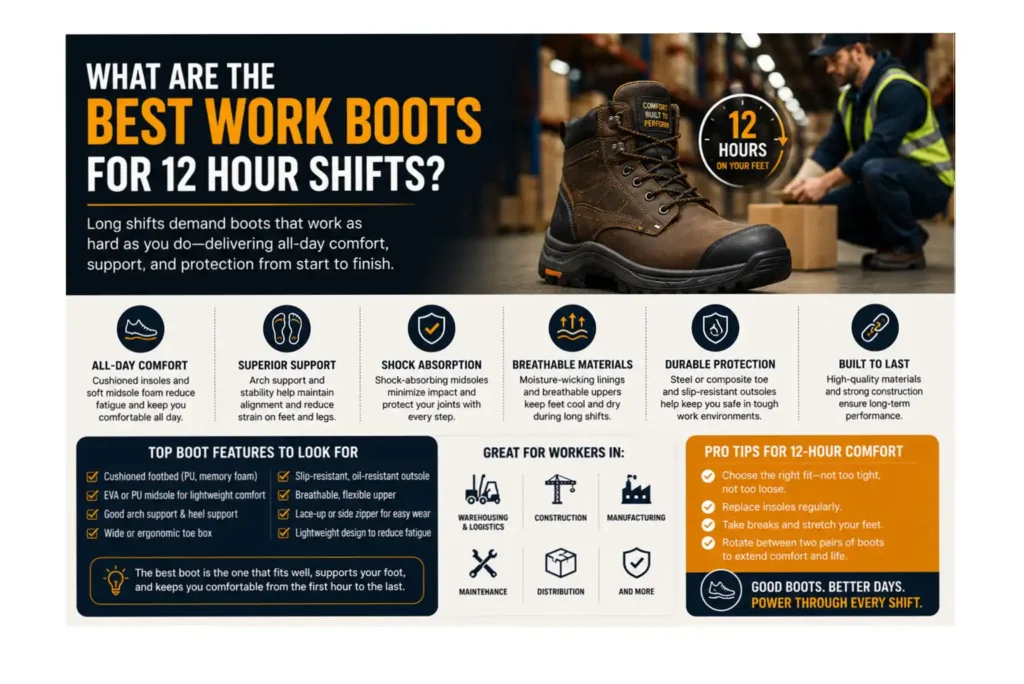
What Are the Best Work Boots for 12 Hour Shifts?
A 12-hour shift is a different challenge from a typical workday.
Whether you’re walking through a warehouse, standing at an assembly line, climbing scaffolding, or moving around a mining site, your work boots become more than protective equipment. They become part of your body’s support system.
That’s why the best work boots for 12 hour shifts aren’t necessarily the heaviest, the most expensive, or even the ones with the thickest soles.
The best work boots combine comfort, stability, lightweight construction, proper fit, and certified protection that matches the working environment.
Here’s the thing.
Many workers blame long hours for sore feet, aching knees, or tired legs. Sometimes the shift is part of the reason. But surprisingly often, poorly designed work boots make those problems much worse.
For safety footwear distributors, PPE purchasing managers, wholesalers, retailers, and importers, understanding what workers actually need during a 12-hour shift helps build stronger product lines and happier customers.
Our factory,Ocean Safety Shoes, has professional designers who specialize in designing and manufacturing safety shoes according to customer requirements. To ensure they can withstand up to 12 hours of work, these safety shoes must be fitting, comfortable, stable, supportive, and durable.
Why 12-Hour Shifts Are So Demanding
Working twelve hours isn’t simply working “a bit longer.”
Everything changes.
Feet naturally swell during the day. Muscles become tired. Small pressure points that seemed harmless at 8:00 a.m. can become painful before the evening shift ends.
Concrete floors don’t help either.
Hard surfaces return impact with every step. Standing still isn’t much easier. Unlike walking, prolonged standing keeps the same muscles working continuously, increasing fatigue over time.
That’s why experienced PPE buyers focus on comfort systems rather than marketing slogans.
A boot should support the worker from the first hour until the last—not only during the fitting.
Fitting is very important, but there are also many other features such as comfort, durability, support, and reliability,Ocean Safety Shoes can design for you as per your requirements.
What Makes the Best Work Boots for 12 Hour Shifts?
There isn’t one perfect boot for every job.
A warehouse picker has different needs from an electrician.
A construction worker faces different hazards than someone working inside a distribution center.
Still, great long-shift work boots usually share the same foundation.
They provide(Ocean Safety Shoes can supply):
- Proper fit
- Lightweight construction
- Stable cushioning
- Excellent heel support
- Breathable materials
- Slip-resistant outsole
- Appropriate safety certification
- Long-lasting durability
Miss one of these, and workers notice.
Usually before lunch.
1. Proper Fit Comes Before Everything Else
Let’s start with something simple.
If the boot doesn’t fit properly, nothing else matters.
Not the leather.
Not the outsole.
Not the certification.
Not the price.
Workers spending twelve hours on their feet need enough room for natural foot expansion without allowing excessive movement inside the boot.
A properly fitted work boot should provide:
- Comfortable toe space
- Secure heel lock
- Adequate width
- Even pressure across the foot
- No rubbing around the ankle
Good fit also reduces blister risk and improves stability during long shifts.
Many experienced distributors now offer multiple width options because one standard width simply doesn’t fit every workforce.
2. Cushioning Should Feel Balanced
Workers often assume softer means better.
Not necessarily.
Very soft cushioning may feel wonderful during the first hour.
After eight hours?
Not always.
Good long-shift boots use cushioning that absorbs repeated impact while maintaining structural support.
Quality comfort systems often include:
- Breathable PU footbeds
- Dual-density midsoles
- Heel shock absorption
- Flexible forefoot cushioning
Instead of feeling like walking on pillows, good work boots should feel stable and controlled.
That’s a big difference.
3. Lightweight Construction Reduces Fatigue
Every extra gram matters.
Not much during one step.
But after thousands of steps across a twelve-hour shift?
Absolutely.
Modern work boots increasingly use:
- Composite toe caps
- Lightweight PU midsoles
- Non-metallic puncture-resistant midsoles
- Engineered textile linings
- Optimized outsole designs
Reducing unnecessary weight helps workers move more naturally without sacrificing protection.
Of course, lightweight doesn’t mean weak.
Reliable safety footwear still needs to meet the required safety standards such as EN ISO 20345:2022+A1:2024,AS 2210.3:2019,ASTM F2413-24,etc
4. Heel Support Makes Long Days Easier
The heel absorbs enormous pressure during every shift.
Without adequate support, workers often begin feeling discomfort in:
- Heels
- Ankles
- Calves
- Knees
- Lower back
A supportive heel cup keeps the foot centered while reducing unnecessary movement inside the boot.
Combined with quality cushioning, this creates much better comfort throughout long working hours.
Small detail.
Big difference.
5. Breathability Is More Important Than Many Buyers Realize
Feet generate heat.
Lots of it.
During twelve-hour shifts, poor ventilation creates moisture buildup, making boots feel heavier and less comfortable.
Quality work boots often use:
- Moisture-wicking lining
- Breathable mesh
- Premium leather
- Airflow channels
- Ventilated footbeds
For outdoor wet environments, waterproof membranes become more important.
For indoor warehouses, breathability usually becomes the priority.
Again, workplace conditions determine the ideal solution.
6. Slip Resistance Protects Workers All Day
Long shifts naturally increase fatigue.
Fatigue increases the likelihood of slips and trips.
That’s why outsole performance deserves careful attention.
Depending on the workplace, buyers should consider:
- Concrete grip
- Wet floor performance
- Oil resistance
- Abrasion resistance
- Heat resistance
- Flexibility
Warehouse floors require different tread patterns than muddy construction sites.
Matching the outsole to the work environment improves both safety and comfort.
Choosing Work Boots for Different Industries
Warehousing
Warehouse workers often walk several kilometers during a shift.
Ideal features include:
- Lightweight design
- Breathable lining
- Flexible outsole
- Composite toe
- Excellent cushioning
Manufacturing
Workers often alternate between standing and walking.
Look for:
- Stable midsole
- Comfortable footbed
- Slip resistance
- Durable leather upper
Construction
Construction sites demand stronger protection.
Good choices include:
- Steel or composite toe
- Mid-cut support
- Puncture-resistant midsole
- Rugged outsole
- Water-resistant leather
Comfort still matters.
Protection simply becomes a bigger priority.
Mining
Mining environments place enormous stress on footwear.
Important features include:
- Heavy-duty outsole
- High abrasion resistance
- Waterproof construction
- Heat resistance
- Long-term durability
Workers cannot afford equipment failure in these environments.
Logistics
Logistics workers spend much of the day walking.
Lightweight comfort becomes extremely valuable.
Many buyers now prioritize:
- Composite toe
- Athletic-inspired construction
- Flexible outsole
- PU footbed
- Breathable lining
Materials Matter More Than Marketing
A product brochure can list dozens of features.
The materials determine whether those features actually perform.
Premium work boots commonly use:
Upper
- Full-grain leather
- Nubuck leather
- Microfiber
- Water-resistant leather
Footbed
- PU footbed
- Memory foam
- EVA comfort layer
Midsole
- PU
- EVA
- Popcorn
Outsole
- PU/PU
- PU/TPU
- PU/Rubber
- EVA/Rubber
- Nitrile rubber
We, Ocean Safety Shoes, can supply all the above materials, depending on the different working environments.
Each combination serves different industries.
There isn’t one universal solution.
Mistakes Buyers Still Make
Even experienced buyers occasionally focus on the wrong things.
Choosing by price alone
Lower purchase cost often leads to higher warranty costs.
Ignoring worker feedback
Laboratory testing matters.
Real workers provide valuable information that testing machines cannot.
Buying one boot for every department
Warehouse workers and welders shouldn’t necessarily wear identical footwear.
Different jobs require different solutions.
Forgetting replacement cycles
Even premium work boots eventually wear out.
Planning replacement schedules improves both safety and budgeting.
How PPE Buyers Should Evaluate Work Boots
Before approving a product, ask:
- Does it fit consistently?
- Is it lightweight enough?
- Does the cushioning remain supportive after months of use?
- Does the outsole suit the workplace?
- Are materials durable?
- Can the supplier maintain quality across production batches?
- Does the product meet required safety standards?
Those questions reveal much more than a product brochure ever will.
Practical Buying Checklist
| Feature | Why It Matters |
|---|---|
| Proper fit | Prevents fatigue and blisters |
| Lightweight design | Reduces walking effort |
| Cushioned footbed | Improves long-shift comfort |
| Stable heel support | Enhances balance |
| Breathable lining | Controls heat and moisture |
| Slip-resistant outsole | Improves workplace safety |
| Durable materials | Extends product life |
| Certified protection | Meets workplace regulations |
| Consistent quality | Reduces warranty claims |
| Reliable supplier | Ensures long-term success |
Final Thoughts
The best work boots for 12 hour shifts aren’t defined by one feature.
They succeed because every part of the boot works together.
Proper fit.
Balanced cushioning.
Reliable grip.
Breathable materials.
Stable support.
Certified protection.
For safety footwear distributors, wholesalers, importers, and purchasing managers, selecting boots with these qualities leads to happier workers, fewer returns, and stronger customer loyalty.
After all, a worker may forget the brand name on the box.
They won’t forget how their feet felt after twelve hours.
Looking for OEM & ODM Work Boots Designed for Long Shifts?
If you’re developing a new range of work boots for warehouses, construction, logistics, mining, or industrial workplaces, choosing the right manufacturing partner is just as important as choosing the right design.
We,Ocean Safety Shoes,specialize in OEM and ODM safety footwear for distributors, importers, wholesalers, retailers, and PPE brands worldwide. From lightweight work boots with breathable PU footbeds to heavy-duty waterproof safety boots with composite or steel toe protection, we help you build products that workers can wear comfortably through long 12-hour shifts.
FAQs
1. What are the best work boots for 12-hour shifts on concrete floors?
The best work boots for concrete floors combine lightweight construction, cushioned PU footbeds, stable midsoles, supportive heel cups, and slip-resistant outsoles. Proper fit is equally important for reducing foot fatigue during long shifts.
2. Are composite toe work boots better than steel toe boots for long shifts?
Composite toe work boots are often lighter and provide better thermal insulation, making them a popular choice for long shifts. Steel toe boots remain an excellent option where maximum durability and impact protection are required. The best choice depends on the workplace hazards and applicable safety standards.
3. How often should work boots used for 12-hour shifts be replaced?
Replacement depends on the working environment, walking distance, maintenance, and wear patterns. Boots should be replaced when the outsole is worn, cushioning has lost support, the upper is damaged, or the footwear no longer provides the required level of protection.
4. What features should PPE buyers look for when sourcing work boots for long shifts?
PPE buyers should evaluate fit consistency, cushioning performance, outsole durability, slip resistance, breathable materials, certified safety protection, production quality, and the supplier’s ability to maintain consistent manufacturing standards across repeat orders.
5. Can the right work boots reduce worker fatigue during 12-hour shifts?
Well-designed work boots cannot eliminate fatigue, but they can help reduce discomfort by providing better cushioning, support, stability, and pressure distribution. When combined with proper workplace ergonomics and regular breaks, comfortable safety footwear contributes to improved worker comfort and productivity.
We,Ocean Safety Shoes,has long-term supply partnerships with well-known Australian safety shoe brands including Master,K-mart and Bata Industrials. If you are looking for a reliable safety shoe manufacturer and supplier, feel free to contact us anytime.