How to Choose a Reliable Safety Shoes Manufacturer in China: A Buyer’s Guide
Finding a reliable safety shoes manufacturer in China is not difficult because there are too few suppliers. The challenge is that there are so many.
Search online and you will find factories, trading companies, sourcing agents, and suppliers offering similar-looking safety footwear at very different prices. A product photo may look professional, but it tells you very little about the leather quality, toe cap, outsole bonding, fit, production consistency, or whether the certification actually applies to the shoe being quoted.
For importers, PPE distributors, wholesalers, safety footwear brands, and industrial buyers, choosing a supplier therefore requires more than comparing catalogues and FOB prices.
You need to know who actually makes the shoes, how they control production, whether they understand your market, and whether they can repeatedly manufacture the approved product after the first sample.
This guide explains what we believe buyers should check before choosing a safety footwear factory in China, based on practical manufacturing and export experience.
1. First, Confirm That You Are Dealing With the Actual Manufacturer
One of the first questions to ask is simple:
Are you a safety shoes factory or a trading company?
There is nothing inherently wrong with working with a trading company. Some provide excellent sourcing and communication services. But buyers should know who controls the production.
Ask a potential supplier for information such as:
- Factory location and business information
- Production-line photos and videos
- Main manufacturing equipment
- Number and type of production lines
- Normal production capacity
- In-house and outsourced processes
- Quality-control procedures
- Testing facilities
- Factory audit reports, if available
For an important project, consider a factory visit, live video inspection, or independent third-party audit.
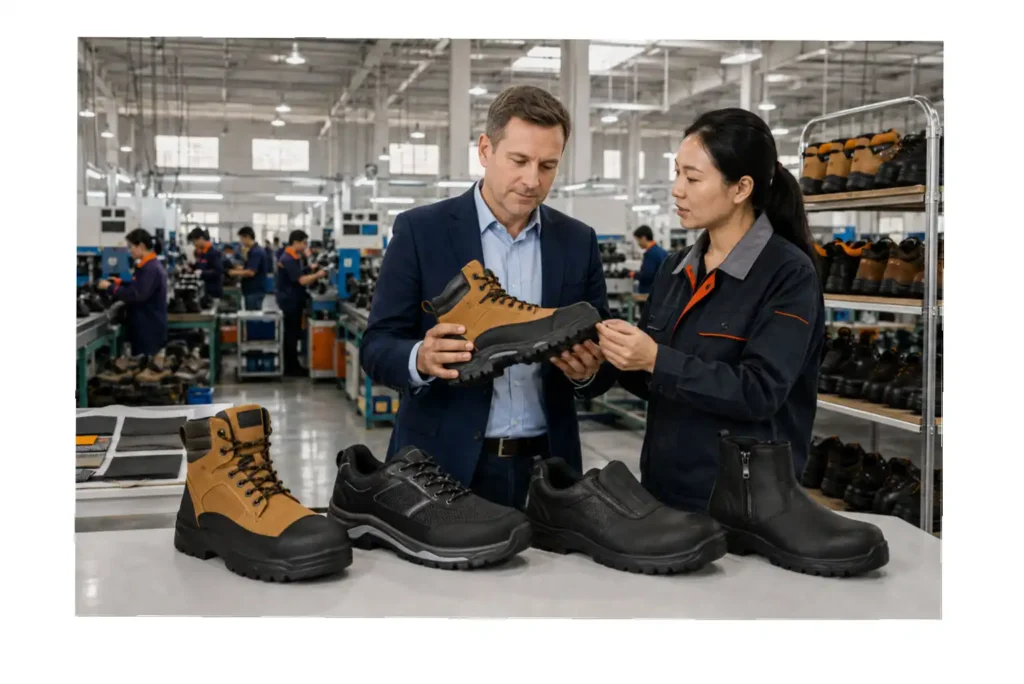
A useful factory tour should show more than a showroom. Ask to see the material warehouse, cutting department, stitching workshop, lasting line, sole production or attachment process, inspection area and finished-goods warehouse.
These areas tell you much more about the supplier than a catalogue does.
2. Look for Safety Footwear Experience, Not Just Shoemaking Experience
Making casual shoes and making certified industrial safety footwear are not the same thing.
Safety shoes may contain steel or composite toe caps, penetration-resistant midsoles, waterproof membranes, specialized outsole compounds and other protective components. Small changes in construction can influence both comfort and compliance.
A manufacturer should understand issues such as:
- Correct positioning of steel and composite toe caps
- Steel and textile penetration-resistant midsoles
- PU direct injection
- PU/TPU constructions
- Cemented EVA/rubber and PU/rubber constructions
- Waterproof bootie systems
- Antistatic requirements
- Slip-resistant outsole design
- Wide-fit safety footwear
- Market-specific sizing and lasts
More importantly, ask about the markets the factory already serves.
A factory experienced with Australian work boots, for example, is more likely to understand the demand for wider fitting, heavy-duty leather uppers, side zippers and PU/TPU outsoles. European buyers may have different styling, certification and product-category requirements.
Relevant experience reduces the amount of trial and error during product development.
3. Verify Safety Shoe Certification Carefully
Certification should never be checked by simply looking for a CE logo or a standard number printed on a product page.
Depending on the destination market, buyers may need footwear designed and tested according to standards such as:
- EN ISO 20345 for safety footwear
- ASTM F2413 for protective footwear in the United States
- AS 2210.3 for safety footwear in Australia
- Other national or market-specific requirements
Before placing an order, request the actual documentation.
Check the product model, manufacturer, standard edition, protection classification, testing or certification body, and relationship between the certificate and the footwear you intend to purchase.
One particularly important question is:
Was the complete shoe tested, or is the supplier only showing you a component test report?
A tested toe cap does not automatically make the completed shoe certified.
The same principle applies when production materials change. Replacing a toe cap, penetration-resistant midsole, outsole compound or other critical component may affect the approved construction.
For OEM buyers, certification should therefore be discussed early in product development—not after production is ready to ship.
4. Inspect the Factory’s Production Capability
Machines alone do not make a good safety shoe, but they reveal what processes a factory can control internally.
Depending on the footwear construction, useful production equipment may include computerized cutting machines, stitching machines, pattern sewing equipment, heel-forming machines, lasting equipment, roughing and cementing equipment, injection machines and sole presses.
A manufacturer with different production methods can usually support a wider product range.
For example:
Direct-injected PU/PU or PU/TPU construction is widely used for industrial footwear and can provide efficient mass production and strong upper-to-sole integration.
Cold-cemented construction provides greater flexibility for combinations such as EVA/rubber and PU/rubber and is commonly used for lightweight, athletic-style safety footwear.
But do not evaluate machinery without evaluating people.
Experienced technicians remain important in leather selection, stitching, lasting, cementing, injection control and final inspection. A modern machine operated without proper process control will not guarantee a consistent product.
5. Ask How Quality Is Controlled Before the Final Inspection
A common sourcing mistake is to think quality control means checking finished shoes before shipment.
By then, many problems are expensive—or impossible—to correct.
A better safety footwear factory controls quality throughout production.
Incoming Material Inspection
Before production starts, critical materials should be checked against approved specifications.
For leather, this can include:
- Thickness
- Color consistency
- Surface defects
- Tensile and tear properties
- Water resistance where required
Toe caps, midsoles, outsoles, zippers, laces, eyelets, adhesives, footbeds and packaging should also match the approved specifications.
In-Process Quality Control
During production, inspectors and operators should monitor critical points such as cutting accuracy, stitching, toe-cap position, lasting, midsole placement, roughing, adhesive application, sole alignment and injection conditions.
For cold-cemented safety shoes in particular, surface preparation, treatment agent, adhesive quantity, drying time, heat activation, pressing and curing can all influence bonding performance.
Final Inspection
Finished shoes should be checked for appearance, sizing, pair matching, stitching, bonding, zipper function, internal defects, labels, packaging and other agreed requirements.
The key question to ask your supplier is therefore not:
“Do you have QC?”
Ask:
“Please show me your QC checkpoints from raw materials to finished shoes.”
The answer will tell you much more.
6. Check Whether Production Capacity Matches Your Business
A factory claiming a large daily capacity is not necessarily the best supplier.
What matters is whether it has the right capacity for your orders.
Ask:
- How many production lines do you operate?
- Which lines can produce my construction?
- What is the normal output for this type of shoe?
- What happens during peak season?
- Can you handle repeat orders?
- Can you support small trial orders?
- What is the normal production lead time?
This becomes particularly important for brands and distributors carrying multiple styles.
A supplier optimized only for very large orders may struggle with smaller seasonal collections. On the other hand, a small workshop may produce an excellent sample but have difficulty maintaining consistency when an order grows substantially.
Look for capacity that fits both your current volume and expected growth.
7. Do Not Approve a Safety Shoe From Photos Alone
For a new OEM safety shoe project, we recommend a structured development process:
Technical brief → Material selection → Prototype → Fitting review → Testing → Wear trial → Revised sample → Pre-production sample → Mass production
The fitting stage deserves particular attention.
A safety shoe can meet laboratory requirements and still become a poor commercial product if workers find it too narrow, heavy, stiff or uncomfortable.
When testing samples, evaluate:
- Toe room
- Width
- Heel fit
- Flex point
- Shoe weight
- Cushioning
- Breathability
- Grip
- Ankle movement
- Comfort after extended wear
For large purchasing programs, wear trials should involve people performing realistic work rather than evaluating the shoe for a few minutes in an office.
This is especially important when developing footwear for a new country because foot shapes, size expectations and preferred fitting can differ between markets.
8. Evaluate the Factory’s OEM and ODM Capability
If you are developing a private-label safety footwear range, determine what the supplier can actually customize.
OEM and ODM capability may include:
- Upper design and materials
- Leather colors and grades
- Steel or composite toe protection
- Penetration-resistant midsoles
- Outsole materials and colors
- Waterproof construction
- Wide-fit lasts
- Zippers and fastening systems
- Footbeds
- Branding and labels
- Packaging
- Market-specific certification
Ask about MOQ before development begins.
A factory may accept a relatively small footwear order but still face minimum quantities from leather, outsole, packaging or component suppliers.
If you require a completely new outsole mold, custom material or special color, the MOQ and development cost will naturally differ from choosing an existing outsole and modifying the upper.
A transparent manufacturer should explain these limitations before you spend money on samples.
9. Watch for These Warning Signs
Price matters, but an unusually low quotation should lead to more questions rather than an immediate purchase order.
Be cautious when a supplier:
- Refuses to show its production facilities
- Cannot explain where the shoes are actually made
- Provides certificates for unrelated models
- Cannot clearly identify material specifications
- Changes components without approval
- Gives unrealistic lead times
- Cannot explain its QC process
- Produces an excellent sample but cannot document bulk-production controls
Another warning sign is a quotation with very little technical detail.
Two factories may quote a “nubuck leather steel toe boot,” while one uses thicker Grade A leather, a proven zipper and a certified outsole construction, and the other uses significantly cheaper components.
Compare specifications—not just product names.
10. What We Have Learned at Ocean Safety Shoes
At Ocean Safety Shoes, many of the buyers we work with are not simply looking for another catalogue. They are trying to solve practical sourcing problems: fitting for a particular market, meeting a required standard, developing a private-label model, improving an existing construction, or controlling quality across repeat orders.
Our factory supports OEM and ODM safety footwear development for overseas brands, importers, wholesalers and distributors, with experience supplying markets including Australia, Europe, South Korea and Latin America.
Our manufacturing setup includes four injection production lines and two cold-cement production lines, supported by computerized cutting, upper-making equipment, lasting, forming and other footwear-production processes.
This combination allows us to manufacture traditional industrial work boots as well as lighter athletic-style safety footwear.
We currently have production capacity of approximately 5,000 pairs per day, while flexible production planning allows us to support selected smaller OEM projects from around 300 pairs, depending on the materials, outsole, colors and customization involved.
Quality control begins before assembly. Incoming materials such as leather are inspected before cutting, followed by checks through upper making, lasting, sole production or attachment, finishing and packing.
For us, the objective is not simply to make the approved sample look good.
The more difficult—and more important—job is making sure that bulk production continues to match what the buyer approved.
11. A Practical Factory Evaluation Checklist
Before selecting a safety shoes manufacturer in China, ask yourself:
Can I verify the factory?
You should know where and how your footwear is being produced.
Does the supplier have relevant safety footwear experience?
Look for experience with your construction, target market and required standards.
Can the certification be verified?
The documents should correspond to the actual product being purchased.
Is there a clear QC system?
Quality should be controlled throughout production, not only before shipment.
Can the factory support my order volume?
Consider both initial trial orders and future repeat business.
Has the fitting been properly tested?
Certification alone does not guarantee worker comfort.
Are material specifications documented?
Approved components should not be replaced without authorization.
Can the supplier communicate technical problems clearly?
Good factories do not simply say “yes” to every request. They identify risks before those risks become expensive problems.
Frequently Asked Questions
How do I verify a safety shoes manufacturer in China?
Request factory information, production photos or videos, machinery details, certification documents and QC procedures. For important projects, arrange a factory visit, live video audit or independent third-party inspection.
What certifications should I request from a safety footwear supplier?
This depends on your destination market. Common standards include EN ISO 20345, ASTM F2413 and AS 2210.3. Always verify that the documentation applies to the exact footwear model and required protection classification.
Can Chinese safety shoe factories produce private-label footwear?
Yes. Experienced OEM and ODM factories can customize materials, colors, protective components, logos, packaging, fitting and other features. The available customization and MOQ depend on the construction and components.
What is the MOQ for OEM safety shoes?
There is no universal MOQ. Existing constructions with standard materials usually allow greater flexibility than completely new molds or custom components. Ocean Safety Shoes can support selected projects from approximately 300 pairs, subject to the design and materials.
Should I inspect safety shoes before shipment?
For new suppliers, new models or significant orders, pre-shipment inspection is strongly recommended. Buyers may also use material inspections and during-production inspections for higher-risk projects.
Final Thoughts
Choosing a reliable safety shoes manufacturer in China is ultimately about reducing uncertainty.
Do not select a supplier because its website has the largest catalogue or because its quotation is the lowest. Look behind the product photo and evaluate the factory, people, materials, certification, production process, quality system and ability to reproduce the approved product consistently.
A good manufacturing relationship should become easier over time. Specifications become clearer, fitting improves, quality problems decrease and repeat orders become more predictable.
If you are sourcing industrial safety footwear for your own brand, wholesale business or distribution network, Ocean Safety Shoes can support product development, sampling, certification requirements, OEM/ODM customization and bulk manufacturing.
Contact Ocean Safety Shoes to discuss your target market, required safety standard, product design and expected order quantity. We can review your project and recommend a practical manufacturing solution before sampling begins.