
A worker arrives at a construction project wearing boots marked “steel toe,” while another employee wears lightweight composite toe safety shoes carrying an EN ISO marking. A third pair has a CSA label, and the purchasing manager has been told that all three products are “MOM approved safety shoes.”
Do these markings mean the same thing?
No.
“MOM approved safety shoes” is a common search phrase, particularly among companies supplying projects in Singapore. However, Singapore’s Ministry of Manpower does not generally publish a simple list of approved safety shoe brands or individually endorse every footwear model.
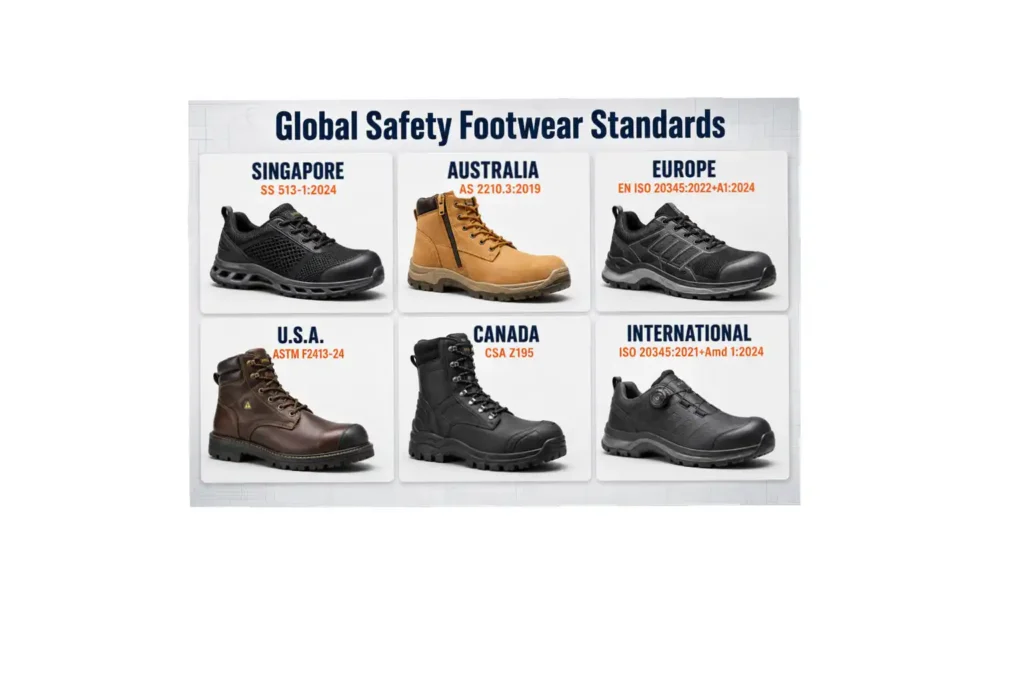
Employers must assess workplace hazards and provide suitable personal protective equipment. In Singapore, the principal general-purpose safety footwear specification is SS 513-1:2024. Other markets use their own standards and conformity systems, including:
- AS 2210.3:2019 in Australia
- EN ISO 20345:2022 in Europe
- CSA Z195 in Canada
- ASTM F2413 in the United States
- ISO 20345 in many international markets
A pair of protective work shoes accepted in one country may not automatically satisfy the regulatory, certification, marking, or contractual requirements of another.
This guide explains what MOM approved safety shoes really means and compares the major safety footwear standards used in Singapore, Australia, Europe, Canada, the United States, and other representative markets. It also covers safety shoe types, protection features, purchasing methods, common mistakes, maintenance, and supplier evaluation.
What Does “MOM Approved Safety Shoes” Really Mean?
MOM stands for Singapore’s Ministry of Manpower, the government body responsible for workplace safety and health administration and enforcement.
The Workplace Safety and Health Act places responsibilities on employers, occupiers, principals, manufacturers, suppliers, workers, and other stakeholders who have control over workplace risks. It focuses on effective risk management and safety outcomes rather than relying on a product advertisement or approval slogan.
Therefore, “MOM approved” should not be treated as a complete footwear specification.
When a supplier uses this term, buyers should ask:
- Which Singapore Standard does the footwear meet?
- What is the exact standard edition?
- What is the footwear classification?
- Which optional protections were tested?
- Is there a model-specific test report?
- Who conducted the testing?
- Does the documentation match the production model?
- Is the footwear suitable for the identified workplace hazards?
A more technically accurate purchasing description would be:
Safety footwear complying with SS 513-1:2024 and providing the protection required by the workplace risk assessment.
This identifies both the standard and the intended use.
Singapore Standard: SS 513-1:2024
Singapore’s current general-purpose safety footwear specification is SS 513-1:2024, Specification for Personal Protective Equipment—Footwear—Part 1: Safety Footwear.
It covers basic and additional requirements associated with:
- Mechanical hazards
- Protective toe caps
- Slip resistance
- Thermal risks
- Ergonomic behaviour
- Water-related performance
- Antistatic properties
- Energy absorption
- Penetration resistance
- Outsole performance
The related standard, SS 513-2:2024, covers test methods for PPE footwear and adopts ISO 20344:2021 as its technical basis.
Singapore’s Workplace Safety and Health Council included SS 513-1:2024 and SS 513-2:2024 in the updated Approved Codes of Practice framework effective from 1 January 2025. The Singapore Standards eShop identifies SS 513-1:2024 as the current edition.
This does not mean every shoe displaying “SS 513” has been independently verified by MOM. Buyers still need to examine the documentation and confirm that the certified construction matches the delivered footwear.
Major Safety Footwear Standards Around the World
| Market | Representative standard | Main points for buyers |
|---|---|---|
| Singapore | SS 513-1:2024 | Current general-purpose safety footwear specification; selection should follow workplace risk assessment |
| Australia | AS 2210.3:2019 | Australian safety footwear requirements based on ISO 20345:2011 with modifications |
| European Union | EN ISO 20345:2022+A1:2024 | Current European safety footwear standard; PPE conformity assessment and CE requirements also apply |
| United Kingdom | BS EN ISO 20345:2022 | UK adoption of the European/ISO technical standard; confirm current UK product-marking rules |
| United States | ASTM F2413-24 | Performance requirements for protective toe-cap footwear; OSHA also sets employer obligations |
| Canada | CSA Z195 | Protective footwear standard used across Canadian jurisdictions; certified footwear carries CSA markings |
| International | ISO 20345:2021+Amd 1:2024 | International general-purpose safety footwear requirements |
| South Africa | SANS/ISO 20345 | South African adoption of ISO safety footwear requirements; verify current edition and tender conditions |
| Japan | JIS T 8101 | Japanese standard for protective footwear; domestic certification and marking expectations may apply |
Standards change over time. Importers should always verify the current edition and destination-market requirements before production or shipment.
Australian Safety Footwear Standard: AS 2210.3:2019
Australia commonly uses AS 2210.3:2019, Personal Protective Equipment—Safety Footwear. It is based on ISO 20345:2011 with Australian modifications.
Australian product markings may include categories such as:
- SB
- S1
- S1P
- S2
- S3
- S4
- S5
Additional markings can identify properties such as:
- Antistatic performance
- Energy absorption
- Fuel-oil resistance
- Water resistance
- Penetration resistance
- Heat-resistant outsole
- Slip performance
A typical Australian safety boot may be marked:
AS 2210.3:2019 Class I SB FO SRA
The marking needs to be interpreted as a complete classification. For example, SB indicates basic safety requirements, FO relates to outsole resistance to fuel oil, and SRA represents slip performance under the applicable older testing framework.
What Australian Buyers Commonly Expect
Technical compliance is only part of the purchasing decision. Australian workers and distributors often expect:
- Wide-fit lasts
- Water-resistant nubuck or full-grain leather
- Side zippers
- Strong ankle support
- Comfortable PU footbeds
- Durable PU/TPU outsoles
- Toe scuff protection
- All-day cushioning
- Strong upper-to-sole bonding
Standards Australia explains that Australian Standards are generally voluntary documents but may become mandatory when legislation, contracts, tenders, or workplace rules refer to them. Buyers should therefore review both the footwear standard and the requirements of the specific state, employer, project, or industry.
European Safety Footwear Standard: EN ISO 20345:2022+A1:2024
The principal European safety footwear standard is EN ISO 20345:2022, updated by A1:2024.
It is based on ISO 20345:2021, which specifies basic and optional requirements for general-purpose safety footwear. ISO identifies mechanical risks, slip resistance, thermal risks, and ergonomic behaviour among its main areas of coverage. ISO 20345:2021
A defining feature is a protective toe cap tested at:
- 200 joules of impact energy
- 15 kilonewtons of compression force
The standard does not require the toe cap to be made from steel. Steel, aluminum, fiberglass, composite, or other materials may be used if the finished footwear meets the applicable requirements.
European Safety Categories
SB
SB provides the basic safety requirements, including the protective toe cap.
S1
S1 is generally used for dry indoor environments and includes features such as:
- Closed heel area
- Antistatic properties
- Heel energy absorption
S1P, S1PL, and S1PS
These categories add penetration resistance to S1 footwear.
- P normally identifies a metallic penetration-resistant insert.
- PL identifies a non-metallic insert tested using the applicable larger nail.
- PS identifies a non-metallic insert evaluated with a smaller nail and additional performance criteria.
S2
S2 builds on S1 and adds water penetration and absorption performance for the upper.
S3, S3L, and S3S
These categories combine S2-type protection with penetration resistance and a cleated outsole.
They are widely specified for construction, utilities, transport, agriculture, engineering, and outdoor industrial work.
S6 and S7
S6 and S7-series footwear include whole-footwear water resistance.
S7, S7L, and S7S also include penetration resistance, with the final letter identifying the type of insert.
Important Optional Markings
- SR: Additional slip resistance
- FO: Outsole resistance to fuel oil
- HRO: Resistance of the outsole to hot contact
- WR: Water resistance of the whole footwear
- WPA: Water penetration and absorption performance of the upper
- SC: Scuff-cap abrasion resistance
- LG: Ladder grip
- CI: Cold insulation
- HI: Heat insulation
- A: Antistatic properties
- E: Heel energy absorption
CE Marking Is Not the Same as EN ISO Testing
The standard defines technical performance, while the European PPE conformity process addresses legal market access.
A manufacturer or responsible economic operator must complete the required conformity assessment, maintain technical documentation, issue the appropriate declaration, and apply the correct marking when legally required.
An EN ISO test report alone should not automatically be treated as a complete European market-access file.
United States Standard: ASTM F2413-24
The active United States specification is ASTM F2413-24, Standard Specification for Performance Requirements for Protective (Safety) Toe Cap Footwear.
It covers minimum design, testing, performance, and classification requirements for hazards including:
- Toe impact
- Toe compression
- Metatarsal impact
- Electrical hazard
- Static dissipation
- Electrical conductivity
- Puncture resistance
- Chainsaw cutting
- Dielectric insulation
The related ASTM F2412-24 standard provides the test methods.
ASTM makes clear that laboratory compliance does not establish suitability for every workplace. The employer must still identify hazards and select appropriate footwear. ASTM F2413-24
Common ASTM Markings
A typical marking may look like:
ASTM F2413-24 M/I/C EH PR
The symbols may indicate:
- M: Male footwear
- F: Female footwear
- I: Impact resistance
- C: Compression resistance
- EH: Electrical hazard protection
- PR: Puncture resistance
- Mt: Metatarsal protection
- SD: Static dissipative
- Cd: Conductive
The exact format must match the applicable edition.
OSHA Requirements
OSHA is the workplace safety regulator, while ASTM develops the technical footwear standard.
OSHA requires employers to ensure that affected workers use protective footwear where there is a danger from falling or rolling objects, objects piercing the sole, or applicable electrical hazards that remain after other protective measures have been taken. OSHA 29 CFR 1910.136
Therefore, calling a product “OSHA approved” can be misleading. OSHA establishes employer duties; the footwear is normally evaluated against recognized technical standards such as ASTM F2413.
Canadian Safety Footwear Standard: CSA Z195
Canada commonly uses CSA Z195, Protective Footwear.
Canadian safety footwear is recognizable through CSA labels and symbols showing specific protection. These may communicate:
- Toe protection
- Sole puncture protection
- Electrical shock resistance
- Static-dissipative properties
- Conductive properties
- Metatarsal protection
- Chainsaw protection
The familiar green CSA triangle generally identifies Grade 1 protective toe and puncture-resistant sole protection. Other symbols are used for electrical, static, metatarsal, and chainsaw-related properties.
However, requirements can vary by province, territory, industry, and employer. Buyers should confirm the standard edition accepted by the relevant Canadian jurisdiction.
The Canadian Centre for Occupational Health and Safety recommends selecting footwear according to the hazard and establishing a complete foot-protection program covering selection, fit testing, training, maintenance, and inspection. CCOHS Safety Footwear Guidance
Other Representative International Standards
United Kingdom
The United Kingdom commonly uses BS EN ISO 20345:2022 for safety footwear performance.
UK buyers must also consider the applicable PPE legislation, conformity assessment, declaration requirements, and current CE or UKCA marking rules. These arrangements have changed since Brexit and may continue to develop, so exporters should check official guidance before shipment.
New Zealand
New Zealand workplaces commonly refer to adopted ISO- or AS/NZS-based safety footwear requirements. The exact standard, edition, and project requirement should be confirmed with the employer, tender authority, or local regulator.
South Africa
South African buyers often specify SANS/ISO 20345 or related tender requirements. Mining, construction, and public procurement contracts may add their own conditions for sole construction, ankle height, water resistance, metatarsal protection, or certification.
Middle East
Many Gulf and Middle Eastern buyers use EN ISO 20345 as a technical reference, but national conformity programs and import-registration rules may also apply.
Buyers should confirm requirements for:
- Saudi Arabia
- United Arab Emirates
- Qatar
- Kuwait
- Oman
- Bahrain
A CE certificate does not automatically complete every national import procedure.
Japan
Japan uses JIS T 8101 for protective footwear. Japanese buyers may require domestic testing, local certification, specific labeling, or workplace-specific approval in addition to overseas documentation.
Different Types of Safety Shoes Explained
Steel Toe Safety Shoes
Steel toe safety shoes provide established impact and compression protection.
Advantages:
- Reliable performance
- Competitive price
- Relatively thin toe-cap structure
- Wide availability
Best applications:
- Construction
- Manufacturing
- Engineering
- Warehousing
- Heavy industry
Composite Toe Safety Shoes
Composite toe caps may use fiberglass, engineered polymers, or carbon-fiber materials.
Advantages:
- Lower weight
- Metal-free construction
- Reduced temperature transfer
- Suitability for security-controlled sites
Best applications:
- Logistics
- Airports
- Electronics
- Indoor manufacturing
- Workers walking long distances
Neither steel nor composite is automatically better. Compliance depends on the performance of the finished footwear.
Slip Resistant Safety Shoes
Slip resistance depends on:
- Outsole compound
- Tread pattern
- Contact area
- Floor material
- Contaminant
- Wear condition
A shoe that performs well on a wet tiled floor may not perform equally well on oily steel.
The UK Health and Safety Executive recommends representative workplace trials rather than selecting footwear from brochure descriptions alone. It also notes that “oil-resistant” does not mean “slip-resistant.” HSE Slip-Resistant Footwear Guidance
Waterproof Safety Shoes
Waterproof footwear may use:
- Water-resistant leather
- Waterproof bootie
- Breathable membrane
- Sealed seams
- Gusseted tongue
- Waterproof zipper structure
A water-resistant upper does not automatically make the complete shoe waterproof.
Electrical Hazard Safety Shoes
Electrical hazard, antistatic, conductive, ESD, and electrically insulating footwear are different product types.
A metal-free composite toe shoe is not automatically electrically insulating. Electrical footwear must be selected according to a professional risk assessment and the correct regional standard.
How to Choose the Right Safety Shoes
1. Assess the Workplace
Identify:
- Falling-object risks
- Compression hazards
- Sharp ground debris
- Wet or oily floors
- Electrical hazards
- Heat
- Chemicals
- Outdoor weather
- Walking distance
- Ladder use
- Uneven ground
2. Choose the Correct Protection
Specify:
- Toe protection
- Penetration resistance
- Slip performance
- Water resistance
- Electrical properties
- Heat resistance
- Metatarsal protection
- Ankle coverage
Do not simply request the highest possible category. Unnecessary protection can increase weight, stiffness, heat, and cost.
3. Evaluate Comfort and Fit
Comfortable work shoes should provide:
- Correct length and width
- Adequate toe room
- Secure heel fit
- Breathable lining
- Effective cushioning
- Forefoot flexibility
- Appropriate weight
- Stable support
Conduct full-shift wear trials before approving large orders.
4. Review Durability
Inspect:
- Upper thickness
- Leather or textile quality
- Stitching
- Toe reinforcement
- Heel support
- Upper-to-sole bond
- Outsole abrasion resistance
- Flex performance
- Fastening durability
- Waterproof lining integrity
5. Confirm the Destination Standard
Do not ask only whether a supplier has “a safety certificate.”
Instead, state:
- Destination country
- Standard and edition
- Required classification
- Optional properties
- Product design
- Intended workplace
- Required conformity marking
- Documentation language
Common Mistakes When Buying International Safety Footwear
Using One Certificate for Every Market
An EN ISO certificate does not automatically establish compliance in Canada, the United States, Australia, or Singapore.
Solution: Create a market-specific compliance checklist.
Accepting Marketing Claims Without Reports
“Anti-smash,” “puncture-proof,” and “MOM approved” are not enough.
Solution: Request model-specific certificates, reports, and markings.
Choosing Price Over Quality
A low quotation may involve weaker materials or reduced quality control.
Solution: Compare complete specifications and expected service life.
Ignoring Comfort
Workers may avoid wearing uncomfortable PPE.
Solution: Conduct representative fit and wear trials.
Confusing Oil Resistance with Slip Resistance
These are separate properties.
Solution: Verify the relevant slip test and evaluate performance on actual workplace surfaces.
Changing Certified Components
Replacing a toe cap, midsole, outsole compound, footbed, or upper material may affect compliance.
Solution: Require written approval and technical review before substitutions.
Safety Shoes Materials and Technologies
Upper Materials
Common options include:
- Full-grain leather
- Nubuck leather
- Split suede
- Microfiber
- Mesh
- Flyknit
- Abrasion-resistant technical textile
Leather is widely used for demanding outdoor work, while mesh and engineered textiles are suitable for lightweight industrial safety shoes in dry environments.
Outsole Technologies
- PU: Lightweight, flexible, and shock absorbing
- Dual-density PU: Soft cushioning layer with a harder wearing layer
- PU/TPU: Comfortable PU midsole with durable TPU contact surface
- EVA/rubber: Lightweight cushioning with rubber grip and abrasion performance
- Nitrile rubber: Suitable for demanding heat, oil, or abrasion applications when correctly formulated
Comfort Technologies
Useful features include:
- Breathable linings
- Removable PU footbeds
- EVA midsoles
- Shock-absorbing heel zones
- Padded collars
- Ergonomic lasts
- Wide-fit options
- Moisture-management materials
How to Maintain Safety Shoes
Workers should:
- Remove dirt and mud regularly
- Clean outsole channels
- Use cleaning products suitable for the upper
- Dry wet shoes naturally
- Avoid direct heaters
- Store footwear in a ventilated area
- Condition leather when necessary
- Inspect footwear before each shift
Replace safety shoes when there is:
- Serious tread wear
- Sole separation
- Cracked outsoles
- Exposed toe protection
- Broken stitching
- Permanent deformation
- Damaged waterproof lining
- Chemical contamination
- Loss of grip
- Internal damage
There is no universal replacement period. Condition and exposure are more important than age alone.
Safety Shoes Buying Guide for Businesses
B2B buyers should prepare a technical specification covering:
- Destination market
- Applicable standard
- Safety classification
- Upper material
- Toe-cap type
- Penetration-resistant insert
- Outsole construction
- Footbed
- Size range
- Width
- Color
- Branding
- Packaging
- Testing responsibilities
- Inspection criteria
Supplier Evaluation
Ask whether the manufacturer provides:
- OEM and ODM development
- In-house designers
- Market-specific lasts
- Sample making
- Laboratory coordination
- Material traceability
- Incoming inspection
- In-process quality control
- Final inspection
- Stable bulk production
- After-sales support
Documentation Review
Request:
- Product certificate
- Full test report
- Declaration of conformity where required
- Model photographs
- Label artwork
- User instructions
- Technical specification
- Bill of materials
- Batch information
- Packaging markings
Quality Inspection
Inspect:
- Toe-cap positioning
- Midsole coverage
- Stitching
- Sole bonding
- Size consistency
- Pair matching
- Zipper or closure performance
- Product markings
- Packaging
- Carton information
Frequently Asked Questions About Global Safety Shoes
1. Does MOM approve individual safety shoe brands?
MOM does not generally maintain a simple list of individually approved brands. Singapore employers should select suitable footwear supported by the relevant SS 513 documentation and workplace risk assessment.
2. Can one safety shoe comply with multiple national standards?
Yes, but it must be tested, documented, and marked according to each applicable system. Similar technical requirements do not create automatic cross-market acceptance.
3. Are steel toe safety shoes better than composite toe shoes?
Not necessarily. Steel is proven and cost-effective, while composite protection can reduce weight and support metal-free designs.
4. What industries require safety footwear?
Construction, manufacturing, mining, logistics, warehousing, utilities, transport, oil and gas, agriculture, and many other industries use safety footwear where foot hazards exist.
5. Are safety shoes comfortable for all-day wear?
They can be when the last, width, weight, cushioning, and breathability match the worker and job.
6. How long do safety shoes usually last?
Service life depends on the workplace, materials, frequency of use, maintenance, and exposure. Replace footwear when wear may reduce protection or grip.
7. Which safety footwear standard should an importer specify?
Specify the standard required by the destination market, customer contract, workplace risk assessment, and applicable legislation.
8. Can safety shoes prevent every workplace foot injury?
No. Safety footwear reduces certain risks but must be combined with engineering controls, safe procedures, housekeeping, training, and supervision.
Conclusion
“MOM approved safety shoes” is a useful search phrase, but international buyers need a more precise approach. Singapore, Australia, Europe, Canada, the United States, and other markets use different safety footwear standards, markings, conformity procedures, and employer obligations.
Quality safety shoes are essential workplace protective equipment, but a certificate alone is not enough. Buyers must select the correct standard, safety category, materials, fit, and additional protection for the intended environment.
The most effective industrial safety shoes combine verified protection with comfort, durability, consistent manufacturing, and market-specific documentation. This approach protects workers while reducing returns, replacement costs, and compliance risks for employers, distributors, and importers.
Develop Market-Specific Safety Footwear with Ocean Safety Shoes
Looking for reliable safety shoes for your workplace, wholesale business, or international private-label range?
Ocean Safety Shoes is a professional safety footwear factory providing OEM and ODM services for importers, distributors, wholesalers, retailers, PPE brands, and industrial companies. Our range includes steel toe safety shoes, composite toe safety shoes, slip resistant safety shoes, waterproof safety boots, lightweight sport safety shoes, and Australian-style work boots.
With 15 years of experience manufacturing footwear for the Australian market, we understand wide-fit lasts, all-day comfort, durable materials, and the documentation expected by professional PPE buyers. Our team can support product development for Australia, Europe, North America, Singapore, and other international markets.
Contact Ocean Safety Shoes to discuss your destination standard, required safety classification, materials, samples, testing, branding, packaging, order quantity, and quality-control requirements.