
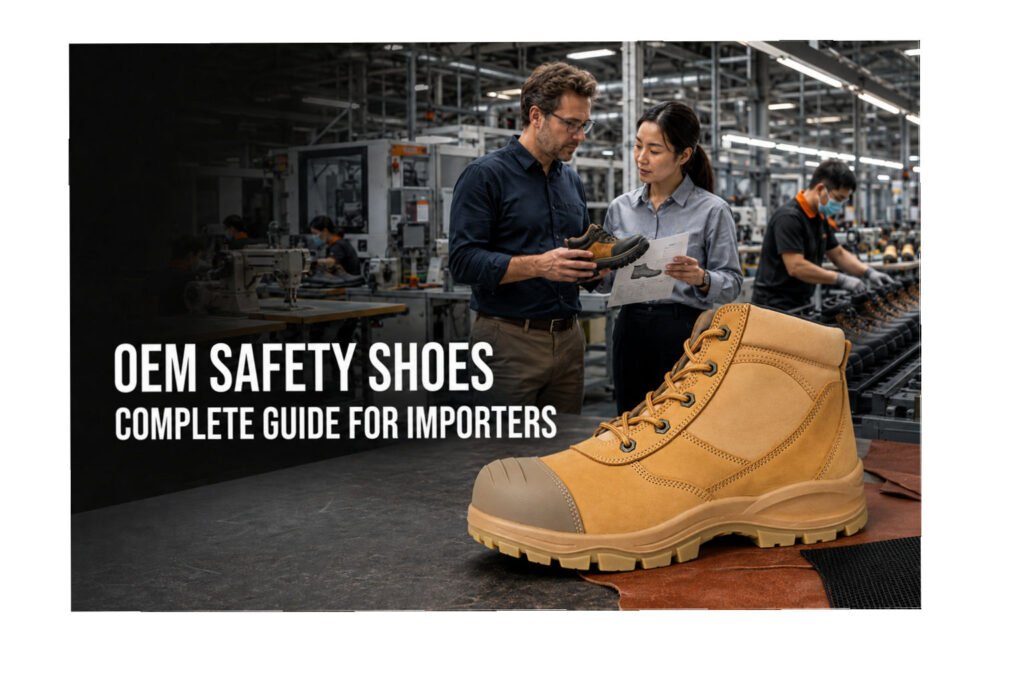
A safety shoe may look strong in a product photo but still fail in real working conditions. The outsole may not provide enough grip, the toe cap may feel too narrow, or the sole may begin separating after several weeks. For importers, these problems can result in customer complaints, product returns, and damage to the brand.
A successful OEM safety shoes project therefore involves more than selecting a design and negotiating a price. Buyers must consider workplace hazards, safety standards, materials, comfort, manufacturing processes, quality control, and target-market preferences.
Ocean Safety Shoes is a standardized OEM/ODM safety footwear factory providing customized safety shoes for customers in Australia, South Korea, Latin America, Europe, and other markets. Our customers include safety footwear brands, importers, wholesalers, distributors, and small retailers. This guide explains how to develop and purchase reliable safety footwear for your market.
What Are Safety Shoes and Why Are They Important?
Safety shoes are personal protective equipment designed to protect workers against workplace foot injuries. Unlike ordinary work shoes, certified safety footwear is tested for specific protective properties.
Depending on the product specification, safety shoes may provide:
- Impact and compression protection
- Sole penetration resistance
- Slip resistance
- Antistatic or electrical protection
- Water resistance
- Heat-resistant outsoles
- Fuel- and oil-resistant outsoles
- Ankle and metatarsal protection
These features are important in construction, manufacturing, warehousing, logistics, mining, agriculture, utilities, and oil and gas.
Importers should remember that different workplaces require different protection. A waterproof leather safety boot may be ideal for outdoor construction, while a lightweight, breathable safety shoe may be more suitable for warehouse workers who walk on concrete floors all day.
At Ocean Safety Shoes, we develop industrial safety shoes according to the working environment, target price, required standard, and customer positioning. Instead of simply adding as many features as possible, we help buyers choose the protection that is genuinely useful for the end user.
What Are OEM and ODM Safety Shoes?
OEM safety shoes are manufactured according to the buyer’s brand, specifications, colors, materials, packaging, and market requirements. Buyers can use an existing factory model or develop a more customized product.
Typical OEM services include:
- Private-label logos
- Custom colors and materials
- Steel or composite toe caps
- Steel or non-metallic penetration-resistant midsoles
- Customized outsoles
- Waterproof bootie construction
- Wide-fit or market-specific lasts
- Custom footbeds and linings
- Branded shoe boxes and labels
- Testing and certification support
ODM services include more design and development support from the factory. This is useful for importers or retailers that understand their customers but do not have an internal footwear design team.
Ocean Safety Shoes provides both OEM and ODM services. Our development team can help customers modify an existing safety shoe or create a new upper, outsole, last, color combination, and packaging system.
We also support flexible production. In addition to large orders, selected models and materials can be produced in quantities as low as approximately 300 pairs, making them suitable for new brands, small retailers, market trials, and specialized customer projects.
Different Types of Safety Footwear
Steel Toe Safety Shoes
Steel toe safety shoes provide reliable impact and compression protection. They are commonly used in construction, manufacturing, mining, engineering, logistics, and heavy maintenance.
Main advantages include:
- Strong protection
- Compact toe-cap construction
- Stable performance
- Competitive cost
Steel toe caps are heavier than many composite alternatives and may not be suitable for metal-free workplaces. The cap must also match the last correctly. A poorly fitted toe cap can cause pressure and discomfort even when the shoe passes laboratory tests.
Ocean Safety Shoes uses different toe-cap shapes for wide-fit work boots, low-cut safety shoes, sport safety footwear, and women’s styles.
Composite Toe Safety Shoes
Composite toe caps are commonly made from fiberglass or engineered plastic. They can provide certified protection without metal.
Their benefits include:
- Lightweight construction
- Metal-free design
- Lower heat and cold transfer
- Suitability for security-sensitive workplaces
- Greater flexibility for athletic designs
Composite toe safety shoes are popular in logistics, aviation, electronics, transport, and light manufacturing.
Ocean Safety Shoes can combine fiberglass toe caps with non-metallic penetration-resistant midsoles to develop completely metal-free protective work shoes.
Slip Resistant Safety Shoes
Slip resistant safety shoes are designed for wet, oily, dusty, or smooth surfaces. Outsole performance depends on both the tread pattern and the material compound.
Common outsole options include:
- Dual-density PU
- PU/TPU
- PU/rubber
- EVA/rubber
- Nitrile rubber
A deep outdoor tread may work well on soil but feel less stable on smooth warehouse floors. Ocean Safety Shoes selects or develops outsole patterns according to the customer’s workplace application and required slip-resistance standard.
Waterproof Safety Shoes
A water-resistant leather upper does not automatically make a shoe waterproof. Genuine waterproof safety footwear normally requires a waterproof membrane or bootie, sealed seams, and controlled production methods.
Waterproof models are suitable for construction, agriculture, landscaping, utilities, forestry, and outdoor transport work.
Our factory can produce safety boots with water-resistant full-grain leather, gusseted tongues, waterproof booties, membranes, and seam-sealing tape. Waterproof constructions can also be checked during development and mass production.
Electrical Protection Safety Shoes
“Antistatic,” “ESD,” “electrical hazard,” and “electrically insulating” describe different types of protection. Buyers should not treat these terms as interchangeable.
Electrical properties may be required in:
- Electrical maintenance
- Utilities
- Electronics factories
- Data centers
- Equipment assembly
- Battery production
The correct specification must be selected according to the target market and workplace risk. Ocean Safety Shoes can help customers match components and construction methods to the required test, but the final protection claim should always be verified through appropriate laboratory testing.
How to Choose the Right Safety Shoes
1. Understand the Workplace
Start with the actual working environment. Ask:
- Are falling or rolling objects present?
- Could workers step on nails or sharp metal?
- Is the floor wet, oily, or dusty?
- Will the footwear be used indoors or outdoors?
- Are electrical, chemical, or heat hazards present?
- How many hours will workers wear the shoes?
- Will they walk, climb, kneel, or drive frequently?
These answers should be included in the OEM product brief.
For example, warehouse employees may prefer lightweight and flexible safety shoes with breathable mesh uppers. Construction workers may need mid-cut leather boots with steel toes, penetration-resistant midsoles, water resistance, and rugged outsoles.
2. Confirm Protection Requirements
The product specification should define:
- Toe-cap material
- Penetration-resistant midsole
- Slip-resistance requirement
- Antistatic or electrical properties
- Water resistance or waterproofness
- Outsole heat resistance
- Fuel- and oil resistance
- Boot height and ankle support
Avoid adding unnecessary features. More components usually mean greater weight, higher cost, and more complicated production.
3. Focus on Comfort and Fit
Workers may refuse to wear uncomfortable PPE footwear correctly. Important comfort factors include:
- Correct length and width
- Enough toe-cap space
- Stable heel fit
- Padded collars and tongues
- Breathable linings
- Flexible forefoot construction
- Shock-absorbing midsoles
- Removable cushioned footbeds
- Balanced weight
Ocean Safety Shoes has extensive experience producing safety footwear for the Australian market, where buyers often require wide-fitting lasts and comfortable boots for long shifts. We recommend confirming sizes and conducting wear trials before mass production.
4. Check Durability
Product durability depends on the complete construction—not only leather thickness.
Buyers should inspect:
- Upper-to-sole bonding
- Forefoot flexing areas
- Toe and heel reinforcements
- Eyelets and lace hardware
- Side zippers
- Collar linings
- Outsole abrasion resistance
- High-stress stitching
- Waterproof seam sealing
Our factory uses automated cutting machines to improve material accuracy and reduce differences between pairs. Computerized roller sewing machines and pattern sewing machines help control stitching quality, while heel-forming machines improve the shape and stability of the rear section.
After upper production, the shoes move through professional lasting, cold-cement, or direct-injection production lines operated by experienced technicians.
Safety Standards for Different Markets
The required safety standard depends on the destination market and intended application.
Common references include:
- EN ISO 20345 for European safety footwear
- ASTM F2413 for the United States
- CSA Z195 for Canada
- AS 2210.3:2019 for Australia
For Europe, safety footwear may also need to meet the requirements of EU Regulation 2016/425, including technical documentation, product marking, user information, and conformity assessment.
Importers should verify the current standard, test classification, certificate scope, product model, size range, factory details, and approved construction before ordering.
A report for a similar-looking shoe does not necessarily cover a customized version. Changing the outsole, toe cap, penetration-resistant midsole, upper material, or construction may influence test results.
Ocean Safety Shoes can support product testing and certification preparation. Some of our safety footwear has obtained CE and Australian BSI product certification. However, every OEM project should be reviewed according to its final materials, construction, claims, and destination market.
The success of an OEM project depends heavily on the production partner behind it. Before approving samples or placing a bulk order, buyers should understand how to choose a reliable safety shoes manufacturer in China, including how to verify factory capability, certification and quality-control systems.
OEM Safety Shoes Development Process
Step 1: Prepare the Product Brief
A professional product brief should include:
- Target country
- Intended industry
- Required standard
- Product style and height
- Upper and outsole materials
- Toe and midsole protection
- Colors and logos
- Size range
- Packaging
- Order quantity
- Target price
A detailed brief helps the factory provide a more accurate quotation and sample.
Step 2: Choose the Development Method
Importers can select:
- An existing style with a private label
- An existing style with new colors and materials
- A new upper on an existing outsole
- A completely new shoe with custom molds and lasts
Using an existing outsole can reduce tooling costs and development time. Fully customized products provide greater market differentiation but normally require more sampling, testing, and investment.
Step 3: Develop and Approve Samples
A sample should be evaluated for:
- Appearance
- Fit
- Toe-cap space
- Flexibility
- Weight
- Stitching
- Bonding
- Outsole grip
- Fastener performance
- Waterproof construction
- Branding and labels
Ocean Safety Shoes uses automated and computerized equipment during cutting and upper sewing, but final quality also depends on experienced technicians. Skilled workers are especially important during lasting, sole bonding, injection molding, finishing, and final inspection.
After sample approval, the buyer and factory should confirm a complete specification sheet and keep a signed confirmation sample.
Step 4: Test the Product
Testing should begin before mass production. The testing plan may include:
- Toe impact and compression
- Penetration resistance
- Slip resistance
- Upper and outsole durability
- Flexing performance
- Bond strength
- Electrical properties
- Water penetration
- Chemical compliance
Early testing reduces the risk of discovering major problems after materials and packaging have already been ordered.
Step 5: Control Mass Production
Quality control should cover the complete production process:
- Incoming material inspection
- Cutting accuracy
- Stitching and upper inspection
- Toe-cap positioning
- Heel forming
- Lasting quality
- Adhesive and surface treatment
- Injection-molding control
- Waterproof-process checks
- Final random inspection
- Packaging verification
Ocean Safety Shoes operates professional upper-making, lasting, cold-cement, and injection production lines. This allows us to produce leather work boots, lightweight sport safety shoes, side-zip boots, Chelsea boots, waterproof footwear, and other customized styles.
Common OEM Purchasing Mistakes
Choosing the Lowest Price
A very low price may result from thinner materials, lower-grade components, limited testing, or weaker quality control.
Solution: compare the complete specification, certification scope, manufacturing process, and expected product life.
Ignoring Comfort
A certified shoe can still receive poor reviews if it is too narrow, heavy, or stiff.
Solution: conduct fitting checks and wear trials with workers from the target market.
Using the Wrong Protection Level
Heavy waterproof boots may be unnecessary for indoor warehouses, while lightweight mesh shoes may not be suitable for wet construction sites.
Solution: match the product to a real workplace risk assessment.
Accepting Unrelated Certificates
Some suppliers may present a certificate for another model or construction.
Solution: verify the model name, standard, materials, outsole, factory, size range, and certificate validity.
Allowing Unapproved Material Changes
Changing the toe cap, outsole compound, adhesive, waterproof membrane, or midsole may affect performance.
Solution: create an approved component list and require written authorization for substitutions.
Safety Shoe Materials and Manufacturing Technology
Full-grain leather provides strength and a premium appearance. Nubuck leather is widely used for Australian-style work boots, while mesh and knitted uppers are suitable for lightweight, breathable safety shoes.
Common outsole systems include:
- PU/PU for cushioning and lightweight performance
- PU/TPU for abrasion resistance and stability
- PU/rubber for grip and heat resistance
- EVA/rubber for lightweight sport-style footwear
- Nitrile rubber for demanding industrial applications
Cold-cement construction allows greater flexibility in upper and outsole design. Direct injection provides efficient, consistent bonding for large-scale production.
At Ocean Safety Shoes, modern machinery improves production accuracy, while experienced technicians control the steps that require practical footwear knowledge. Our equipment includes automated cutting machines, computerized roller sewing machines, programmable pattern sewing machines, heel-forming machines, professional lasting lines, cold-cement lines, and direct-injection lines.
This combination of advanced equipment and skilled workers allows us to support both regular mass production and flexible orders starting from approximately 300 pairs for selected projects.
How to Evaluate an OEM Safety Shoes Factory
Before placing an order, importers should check:
- Factory ownership and production location
- Main export markets
- Safety footwear experience
- Development and sampling ability
- Cold-cement and injection capabilities
- Machinery and production capacity
- Quality-control procedures
- Testing and certification experience
- Minimum order quantity
- Material traceability
- Communication and corrective-action ability
Ocean Safety Shoes serves brands, wholesalers, importers, distributors, and small retailers across Australia, South Korea, Latin America, and Europe. Our flexible manufacturing system allows customers to test new models in smaller quantities before increasing their order volumes.
Good communication is equally important. A dependable OEM factory should explain technical limitations, confirm changes in writing, provide clear material specifications, and respond quickly when a quality concern appears.
Frequently Asked Questions About OEM Safety Shoes
1. What is the minimum order quantity for customized safety shoes?
Ocean Safety Shoes can support flexible production starting from approximately 300 pairs for selected existing outsoles, materials, and constructions. The final MOQ depends on colors, components, packaging, and customization level.
2. Can Ocean Safety Shoes develop private-label products?
Yes. We provide OEM and ODM services covering product design, materials, colors, logos, safety features, insoles, packaging, and size ranges.
3. Are steel toe shoes better than composite toe shoes?
Neither option is always better. Steel toe caps are strong and economical, while composite caps are lightweight, metal-free, and less conductive to heat and cold.
4. Can you manufacture waterproof safety shoes?
Yes. We can produce safety footwear with water-resistant leather, gusseted tongues, waterproof booties, membranes, and seam-sealing tape.
5. Which markets does Ocean Safety Shoes serve?
Our main markets include Australia, South Korea, Latin America, and Europe. We work with safety footwear brands, importers, wholesalers, distributors, and smaller retailers.
6. Can small retailers order customized safety shoes?
Yes. Our flexible production system allows selected projects to begin with relatively small quantities, helping retailers and new brands test market demand.
7. What safety standards should importers request?
The standard depends on the target market. Common options include EN ISO 20345, ASTM F2413, CSA Z195, and AS 2210.3:2019.
8. How is production quality controlled?
Quality control covers incoming materials, automated cutting, upper sewing, toe-cap positioning, heel forming, lasting, sole attachment, injection molding, waterproof processing, final inspection, and packaging.
Conclusion
A successful OEM safety shoes project requires the right combination of protection, comfort, durability, certification, manufacturing control, and market knowledge. Importers should begin with workplace hazards, prepare a detailed specification, verify safety standards, approve representative samples, and inspect production carefully.
Ocean Safety Shoes is a standardized OEM/ODM safety footwear factory serving brands, importers, wholesalers, distributors, and small retailers in Australia, South Korea, Latin America, Europe, and other markets. With automated cutting equipment, computerized sewing machines, heel-forming equipment, professional lasting lines, cold-cement lines, injection lines, and experienced workers, we can support both large-volume manufacturing and flexible orders from approximately 300 pairs for selected products.
Looking for a reliable factory to develop private-label industrial safety shoes? Contact Ocean Safety Shoes to discuss your target market, safety standard, product design, materials, order quantity, certification, and customized packaging requirements.