
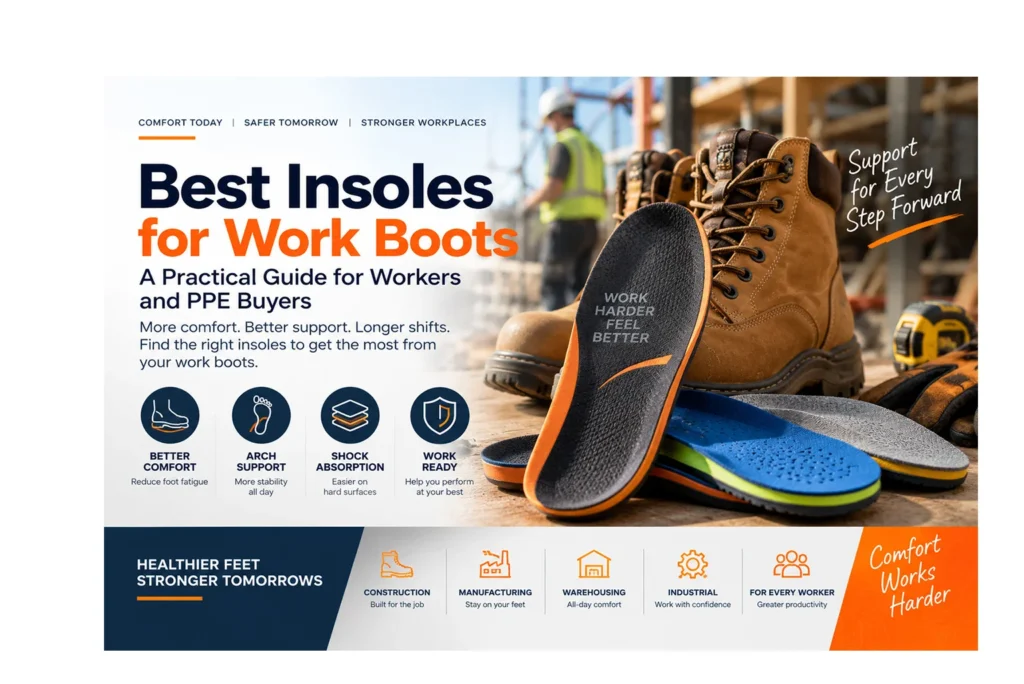
A good pair of work boots should provide protection, stability and comfort throughout the working day. But even well-made boots can become uncomfortable after hours of standing on concrete, walking through a warehouse or moving across a construction site.
Sometimes the problem is not the boot itself. It is the insole.
The best insoles for work boots can improve underfoot cushioning, provide more appropriate arch support and help a boot fit more securely. However, the softest or thickest insole is not automatically the most comfortable. The right choice depends on your foot shape, boot design, working environment and the protection your footwear must maintain.
This 2026 guide compares several current work-insole options and explains how workers and B2B buyers can choose replacements without compromising safety-footwear performance.
Quick Comparison: Best Insoles for Work Boots in 2026
| Insole | Worth considering for | Key consideration |
|---|---|---|
| Superfeet Work Cushion | Roomy boots and long shifts | Generous cushioning |
| Superfeet Work Slim-Fit Cushion | Snug boots and safety sneakers | Thinner profile |
| PowerStep Pinnacle Work | Workers seeking structured arch support | Firm but flexible support |
| Timberland PRO Anti-Fatigue Footbed | Standing and walking on hard floors | Shock absorption and energy-return design |
| Dr. Scholl’s Work Insoles | Affordable cushioning upgrades | Gel cushioning |
| Superfeet Work ESD | Compatible ESD footwear | Electrostatic-dissipative construction |
These are use-case recommendations, not an independent laboratory ranking. Individual comfort varies, and a replacement insole must be compatible with the complete safety shoe or boot.
What Makes an Insole Good for Work Boots?
Work boots place different demands on an insole than ordinary casual shoes.
A construction worker may need stable footing on uneven terrain. A warehouse employee may walk continuously on concrete. A factory worker may stand at one workstation for most of the shift.
The insole should complement the boot and the job rather than simply add softness.
Cushioning
Cushioning helps make repeated contact with hard surfaces more comfortable.
Common materials include polyurethane, EVA, gel and specialised foams. Their performance depends on the formulation, thickness and complete insole design.
Very soft cushioning can feel pleasant initially but may not provide the support or stability a particular worker needs.
Arch Support
Arch support can help some workers achieve a more comfortable fit.
However, arch height is individual. A high, rigid arch is not automatically suitable for someone with flat feet, and an aggressive support shape may create pressure rather than relieve it.
Heel Stability
A well-shaped heel cup can help position the foot inside the boot.
This is particularly useful when workers walk frequently or move over uneven surfaces. It cannot, however, correct a boot that is fundamentally the wrong size.
Thickness and Internal Space
This is especially important in safety footwear.
A thick replacement insole raises the foot inside the boot. If the original footwear has limited internal space, the replacement may cause the toes to press against the protective toe cap.
An insole that feels comfortable in a roomy boot may be unsuitable for a snug safety sneaker.
Moisture Management
Workers wearing boots for long shifts should also consider how the insole handles perspiration.
Moisture-management top covers and removable designs can help with drying and routine footwear care.
1. Superfeet Work Cushion — For Roomy Work Boots
Superfeet Work Cushion is designed for people who spend long periods standing or walking.
The manufacturer specifies it for work boots, roomy work shoes and safety-toe footwear. It combines soft cushioning with a tapered forefoot intended to improve fit around the toe area.
Why Consider It?
The main attraction is its combination of cushioning and work-specific construction.
It is worth evaluating for:
- Warehouse employees
- Construction workers
- Manufacturing staff
- Workers standing on concrete
- People whose boots have sufficient space for a fuller insole
The key limitation is volume. If your boot already feels tight across the toes or instep, a thinner replacement may be more appropriate.
2. Superfeet Work Slim-Fit Cushion — For Snug Safety Footwear
Modern safety footwear increasingly resembles athletic shoes. These designs can be lightweight and flexible, but they often have less internal space than traditional work boots.
Superfeet Work Slim-Fit Cushion addresses that problem with a lower-profile design.
Superfeet describes it as suitable for snug-fitting and athletic-style work footwear, with cushioning, light structured support and a tapered forefoot.
Why Consider It?
This is a useful option to investigate when a worker wants additional comfort but cannot accommodate a thick insert.
It may suit:
- Safety sneakers
- Lightweight warehouse footwear
- Lower-volume work boots
- Workers who find full-thickness insoles too bulky
A slim insole is not automatically the correct choice, though. The boot still needs to fit securely without excessive heel movement.
3. PowerStep Pinnacle Work — For Structured Arch Support
Some workers prefer a more supportive feel rather than maximum softness.
PowerStep Pinnacle Work uses a firm but flexible arch-support structure, a deep heel cradle and dual-layer cushioning. The manufacturer positions it for work boots and shoes, particularly for people seeking support during long periods on their feet.
Why Consider It?
This design may appeal to workers who want:
- More noticeable arch support
- A defined heel cup
- Cushioning combined with a supportive structure
- An alternative to very soft foam inserts
Arch support should feel appropriate to your foot, not force it into an uncomfortable position.
If you have persistent heel pain, arch pain, numbness or another ongoing foot problem, a qualified healthcare professional can help determine whether a particular insole is suitable. An over-the-counter insert should not be treated as a guaranteed medical solution.
4. Timberland PRO Anti-Fatigue Footbed — For Long Hours on Hard Floors
Timberland PRO’s Anti-Fatigue Technology Footbed is designed for occupations involving prolonged standing and walking.
Its construction includes molded foam, dynamic arch support and an OrthoLite top layer. Timberland describes its inverted-cone design as intended to absorb shock and return energy while keeping the footbed relatively lightweight.
Why Consider It?
This type of footbed is worth evaluating for workers who spend much of their shift on:
- Concrete
- Factory floors
- Warehouse floors
- Workshops
- Other hard surfaces
It may also be a practical replacement option for compatible Timberland PRO footwear.
Check compatibility before using it in another brand’s certified safety boot.
5. Dr. Scholl’s Work Insoles — For an Affordable Cushioning Upgrade
Not every worker needs a relatively expensive, highly structured insole.
Dr. Scholl’s Work Insoles with Massaging Gel offer a more accessible option for workers primarily seeking extra cushioning.
The product combines gel cushioning, arch support and a trim-to-fit design. Dr. Scholl’s markets it for people who experience foot and leg fatigue while working on hard surfaces.
Why Consider It?
It is worth evaluating if your existing boots fit correctly but the original footbed feels worn or insufficiently cushioned.
However, gel cushioning does not solve every fit problem. It cannot compensate for a boot that is too narrow, an unsuitable outsole or a damaged midsole.
6. Superfeet Work ESD — For Compatible ESD Footwear
Workers in electronics manufacturing and other electrostatic-sensitive environments have an additional consideration.
A conventional aftermarket insole may alter the electrical characteristics of ESD footwear.
Superfeet offers a Work ESD model made with electrostatic-dissipative materials. The manufacturer describes it as compatible with specified ESD safety footwear and designed to replace removable liners.
Why Consider It?
It is relevant to buyers who need both underfoot comfort and an ESD-compatible footwear system.
Do not assume that any insole labelled “ESD” can be installed in any ESD safety shoe without further checks. Confirm compatibility with the footwear manufacturer and applicable workplace requirements.
ESD footwear, antistatic footwear and electrical-hazard protective footwear serve different purposes. They should not be treated as interchangeable.
Which Insoles Are Best for Standing on Concrete All Day?
Concrete is a common source of discomfort for warehouse, manufacturing and construction workers.
For these jobs, look for an appropriate combination of cushioning, heel stability and fit.
Superfeet Work Cushion, Timberland PRO Anti-Fatigue and Dr. Scholl’s Work Insoles are examples of products designed with prolonged standing or hard-surface use in mind.
The right choice depends on how much space is available inside the boot and how much structure the wearer prefers.
An employee who walks continuously may have different preferences from someone standing at a fixed workstation.
What Are the Best Insoles for Construction Workers?
Construction workers need more than soft cushioning.
They may walk over gravel, climb ladders, kneel, carry materials and move across uneven ground.
A suitable insole should work with the boot’s existing support and stability.
Consider:
- Secure heel positioning
- Appropriate arch support
- Cushioning that does not feel unstable
- Durable materials
- Suitable thickness
- Compatibility with the certified boot
A thicker insole is not necessarily better for rough terrain. Excessive softness or an altered fit can make the boot feel less secure.
What Are the Best Insoles for Warehouse Workers?
Warehouse workers often spend long shifts walking on hard, relatively flat surfaces.
They may benefit from cushioning that remains comfortable over repeated steps.
For a roomy work boot, a fuller cushioned insole may be appropriate. For a lightweight safety sneaker, a slim-profile model may fit better.
Superfeet specifically distinguishes between its fuller Work Cushion design for roomier footwear and its Slim-Fit Cushion design for tighter work shoes.
The footwear’s original fit should guide the decision.
Memory Foam vs Gel vs PU Insoles
Different materials offer different underfoot sensations, but material names alone do not determine performance.
| Material | Typical characteristic | What to check |
|---|---|---|
| Memory foam | Soft, conforming feel | Whether it provides enough support |
| Gel | Localised cushioning and impact absorption | Weight, thickness and fit |
| PU foam | Can provide durable cushioning | Density and construction |
| EVA foam | Lightweight and versatile | Firmness and compression behaviour |
| Structured orthotic designs | More defined support | Arch shape and compatibility |
The complete insole matters more than any single ingredient.
For example, a well-designed PU insole may feel more comfortable than a poorly shaped memory-foam insert, even if the latter initially feels softer.
Can You Put Any Insole in Steel Toe Boots?
No.
This is one of the most important points for workers and PPE buyers.
Replacing the original footbed can change the position of the foot inside the boot. A thicker insert may reduce toe clearance or alter heel retention.
In footwear with special protective properties, an incompatible replacement may also affect the performance of the complete footwear system.
Before changing insoles:
- Check whether the original footbed is removable.
- Review the boot manufacturer’s replacement-insole guidance.
- Use an approved or confirmed-compatible replacement where required.
- Check that the toes do not press against the safety cap.
- Confirm that the heel remains secure.
- Verify any electrical, antistatic, ESD or other specialised requirements.
An aftermarket insole should not be assumed to preserve the original footwear’s tested performance simply because it fits inside the boot.
Should You Remove the Original Insole First?
Usually, if the replacement is a full-length insole designed to replace a removable footbed.
For example, Dr. Scholl’s instructs users to remove the existing removable insole before fitting its Work Insoles.
Stacking two full-length insoles can raise the foot excessively and reduce internal space.
However, always follow the instructions for the specific insert and boot. Some products have different fitting requirements.
How to Choose the Right Insole Size
A correctly sized insole should lie flat inside the footwear.
It should not:
- Curl upward at the toe
- Fold along the sides
- Slide excessively
- Create pressure under the arch
- Lift the heel out of its normal position
For trim-to-fit models, use the original removable footbed as a guide when the manufacturer recommends doing so.
Superfeet advises leaving a small gap at the front of its full-length trim-to-fit insoles so the insert does not bunch inside the shoe.
After fitting, walk around in the boots with your normal work socks. Do not judge the result while sitting down.
How Long Do Work Boot Insoles Last?
Insoles generally wear out sooner than the complete boot.
Timberland advises replacing insoles approximately every 6–12 months, while Dr. Scholl’s recommends replacing certain products every six months or at the first signs of wear. These are product guidance ranges, not universal expiry dates.
Replacement may be needed sooner if you notice:
- Flattened cushioning
- Cracked or broken support structures
- Persistent unpleasant odour despite cleaning
- Torn top covers
- Uneven wear
- A noticeable change in fit or comfort
The correct interval depends on usage, material and manufacturer instructions.
Can New Insoles Fix Uncomfortable Work Boots?
Sometimes—but only if the problem is something the insole can address.
A replacement may help when the original footbed is worn, the worker wants a different cushioning feel or the boot has enough room for an appropriate support insert.
It is unlikely to solve problems caused by:
- An incorrect boot size
- A toe cap pressing against the toes
- An excessively narrow last
- A damaged outsole
- A collapsed midsole
- A boot that is unsuitable for the working environment
If the boot itself is worn out, replacing only the insole may delay a necessary footwear replacement.
What B2B Buyers Should Look for in Work Boot Insoles
For PPE distributors and corporate buyers, insole selection is also a product-development and procurement issue.
Important questions include:
- Does the insole fit the footwear last?
- Is the thickness appropriate for the protective toe?
- Is the cushioning durable enough for the intended work?
- Is the arch shape suitable for the target market?
- Can the insole be removed for drying or replacement?
- Does it preserve required footwear performance?
- Is replacement stock available?
- Can it be supplied consistently across sizes and production batches?
For private-label safety footwear, the insole should be considered during product development—not added as an afterthought once the boot is finished.
Frequently Asked Questions About Work Boot Insoles
What are the best insoles for work boots?
Superfeet Work Cushion, PowerStep Pinnacle Work, Timberland PRO Anti-Fatigue and Dr. Scholl’s Work Insoles are worth evaluating for different comfort preferences. The best choice depends on your feet, boot fit and job requirements.
What insoles are best for standing all day?
Look for an appropriate combination of cushioning and support. A thick cushioned model may work in a roomy boot, while a slimmer insole may be necessary in snug footwear.
Are gel insoles good for work boots?
They can provide additional cushioning, especially on hard surfaces. However, gel alone does not guarantee the right arch support, stability or fit.
Are memory-foam insoles good for work boots?
They can offer a soft, conforming feel. Workers should also consider whether the insole provides enough support and remains comfortable over a full shift.
Do insoles help with foot pain?
An appropriately selected insole may improve comfort, but persistent pain has many possible causes. A healthcare professional can help identify whether footwear, an insole or another intervention is appropriate.
Can I replace the insoles in safety boots?
Often, but compatibility matters. Follow the footwear manufacturer’s guidance, particularly when the boots have specialised protective properties.
How often should I replace work boot insoles?
Many products are replaced after several months of regular use. Follow the specific manufacturer’s instructions and replace an insole sooner if its cushioning, structure or fit deteriorates.
Conclusion: What Are the Best Insoles for Work Boots?
The best insole is not necessarily the thickest, softest or most expensive.
For roomy boots, a cushioned work-specific insert may improve comfort. For snug safety sneakers, a slimmer design may be more practical. Workers seeking more structured support may prefer a contoured insole, while specialised footwear may require an approved replacement.
The most useful buying sequence is:
Boot compatibility → correct fit → required protective properties → support → cushioning → durability.
A replacement insole should make the work boot more comfortable without undermining the protection it was designed to provide.
OEM Safety Footwear with Comfort-Focused Insoles
For PPE distributors, wholesalers and private-label brands, insole design is an important part of developing comfortable safety footwear.
Ocean Safety Shoes supports OEM and ODM safety footwear development with options for cushioning, removable footbeds, different fit profiles and work-specific constructions.
The goal is to develop the boot and insole as one complete system—balancing protection, fit, comfort and durability for the intended workplace.