
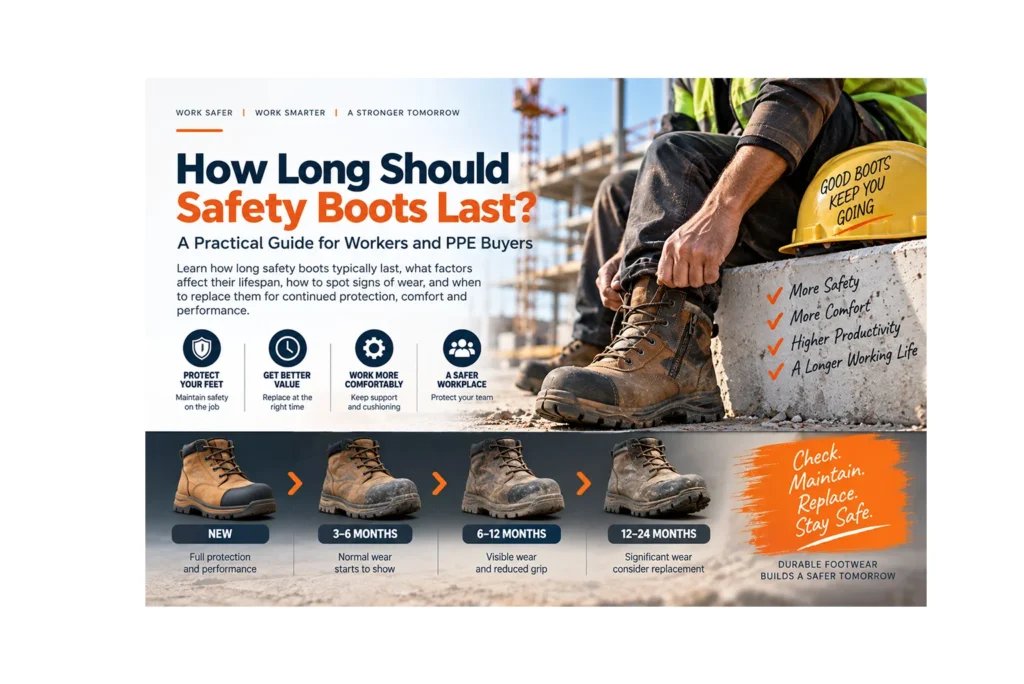
A good pair of safety boots is designed to survive demanding work.
But it is not designed to last forever.
Every shift exposes work boots to a combination of pressure, flexing, abrasion, moisture, heat, dirt, oil and impact. Over time, the outsole wears down, cushioning compresses, leather deteriorates and protective components may become damaged.
So, how long should safety boots last?
For many workers using one pair regularly, roughly 6–12 months can be a useful planning range, while good-quality boots in lighter conditions may remain serviceable for 12–24 months or longer. In severe construction, mining or industrial environments, however, boots can require replacement much sooner.
These figures should not be treated as mandatory replacement intervals.
There is no universal rule saying every safety boot must be replaced after six months or one year. OSHA, for example, explicitly notes that the expected service life of PPE depends on factors including working conditions, incidents that may damage the equipment, misuse and other workplace-specific circumstances.
The better rule is:
Replace safety boots when their condition means they can no longer reliably provide the protection, fit, traction or function required for the job—even if they have not reached an expected replacement date.
Quick Answer: How Often Should Safety Boots Be Replaced?
A practical planning guide looks like this:
| Working Environment | Possible Planning Range* |
|---|---|
| Light warehouse / indoor work | 12–24 months |
| Logistics / manufacturing | 9–18 months |
| General construction | 6–12 months |
| Heavy construction | 4–12 months |
| Mining / quarry / severe industrial use | 3–9 months |
| Occasional use | Potentially 2+ years |
*These are general planning ranges, not guaranteed lifespans or legal replacement periods. Boot construction, hours worn, worker activity, maintenance, climate and workplace hazards can dramatically change service life.
A warehouse worker wearing safety shoes five days a week on clean indoor floors might get considerably more use from footwear than a mining worker exposing boots to rocks, mud and water for 12 hours per shift.
Condition matters more than age.
Why Safety Boots Do Not Have a Fixed Lifespan
Imagine two workers who buy exactly the same safety boot on the same day.
Worker A spends eight hours per day inside a dry warehouse.
Worker B works outdoors on a construction site where the boots encounter:
- Mud
- Rain
- Concrete dust
- Gravel
- Sharp debris
- Uneven ground
- Repeated kneeling
After six months, their boots could look completely different.
That is why manufacturers, employers and PPE buyers should be careful about statements such as:
“Safety boots last exactly one year.”
They don’t.
Boot life is influenced by the interaction of the product, worker and workplace.
1. Working Environment Has a Major Effect on Boot Life
The harsher the environment, the faster footwear generally deteriorates.
Warehouses
Warehouse floors are usually relatively smooth and controlled.
The primary wear may come from:
- Continuous walking
- Heel wear
- Forefoot flexing
- Cushion compression
- Contact with pallets or equipment
A well-made safety shoe can potentially provide relatively long service in this environment.
Construction
Construction footwear faces much more variable conditions.
Boots may encounter:
- Rough concrete
- Sharp debris
- Mud
- Water
- Dust
- Timber
- Metal
- Ladders
- Repeated kneeling
Construction workers can therefore wear through outsoles and uppers much faster.
Mining and Quarrying
Mining can be extremely demanding on footwear.
Heavy-duty boots may be exposed to:
- Rock
- Mud
- Water
- Abrasive ground
- Heavy machinery
- Long shifts
- Repeated impacts
Even an expensive industrial boot will eventually deteriorate under these conditions.
Manufacturing
Manufacturing environments vary enormously.
One factory may have clean, dry floors.
Another may expose footwear to:
- Oils
- Metal swarf
- Heat
- Chemicals
- Abrasive surfaces
The workplace risk assessment should therefore influence both footwear selection and replacement planning.
2. Hours Worn Matter More Than Calendar Age
A boot that is six months old does not necessarily have six months of equivalent wear.
Consider:
Worker A: 8 hours × 5 days = approximately 40 hours per week.
Worker B: 12 hours × 6 days = approximately 72 hours per week.
Worker B is exposing the footwear to around 80% more working time each week.
Then consider another employee who wears safety boots only twice a week.
All three pairs could be one year old, but their actual usage is completely different.
For procurement teams, this is why replacing every employee’s footwear on exactly the same schedule may not always be the most efficient strategy.
3. Walking Distance Can Shorten Safety Boot Life
Job title alone is not enough.
Two warehouse employees can have dramatically different footwear wear rates.
One may operate a forklift for much of the shift.
Another may walk thousands of steps while picking orders.
The second employee repeatedly flexes and loads the footwear much more often.
This can accelerate wear in areas such as:
- Heel
- Forefoot
- Flex zone
- Midsole
- Insole
- Outsole tread
High-mobility workers may therefore benefit from safety footwear specifically engineered around lightweight construction and durable cushioning.
4. Boot Construction Makes a Difference
Not all safety boots are built the same way.
Construction methods commonly include:
- Direct injection
- Cemented construction
- Goodyear welt
- Stitch-down
- Vulcanised construction
Each has different advantages depending on the footwear design.
For example, direct-injected PU safety footwear can provide an efficient combination of cushioning, bonding and durability for many industrial applications.
Traditional welted leather work boots may offer robust construction and, depending on design, possible resoling.
Lightweight cemented safety sneakers can reduce weight but are designed around different performance priorities.
It is therefore misleading to compare lifespan without considering construction.
5. Outsole Material Affects Durability
The outsole is one of the fastest-wearing parts of safety footwear.
Common outsole systems include:
- PU
- Dual-density PU
- TPU
- Rubber
- PU/rubber
- EVA/rubber
Each can be engineered for different combinations of:
- Abrasion resistance
- Slip resistance
- Flexibility
- Weight
- Heat resistance
- Cushioning
A soft outsole may provide excellent comfort but wear differently from a harder compound.
A heavy-duty rubber outsole may offer excellent durability but add weight.
There is always a design balance.
6. Worker Weight and Movement Patterns Matter
Footwear experiences mechanical stress every time a worker:
- Walks
- Climbs
- Squats
- Kneels
- Pushes
- Carries equipment
- Changes direction
Different workers also load footwear differently.
Some wear the outside heel first.
Others create more pressure under the forefoot.
Workers who repeatedly kneel may damage the toe area quickly.
That is why one worker may get 15 months from a model while a colleague needs a replacement after eight months.
It does not necessarily mean the product is inconsistent.
7. Climate Can Affect Safety Boot Lifespan
Climate is particularly relevant for businesses buying footwear for Australia, Papua New Guinea and other hot or tropical markets.
Heat, humidity and moisture can affect:
- Leather
- Adhesives
- Linings
- Insoles
- Foam
- Metal components
Repeatedly soaking boots and then drying them improperly can also accelerate deterioration.
In tropical working environments, moisture management becomes especially important.
Workers should allow boots to dry naturally whenever possible rather than repeatedly exposing them to extreme direct heat.
What Are the Signs That Safety Boots Need Replacing?
This question is more important than asking how old the boots are.
Workers should regularly inspect their safety footwear.
Several warning signs deserve attention.
1. The Outsole Tread Is Worn Down
Look at the bottom of the boot.
Can you still clearly see the original tread pattern?
If the lugs have become significantly worn or smooth, the footwear’s original traction performance may no longer be represented by its condition when new.
This becomes especially concerning in workplaces involving:
- Wet floors
- Mud
- Oil
- Smooth industrial surfaces
- Outdoor terrain
Do not wait until the outsole is completely flat before considering replacement.
2. The Sole Is Separating From the Upper
Sole separation is a major warning sign.
Check around:
- Toe
- Heel
- Sidewalls
- Flex point
A small opening can grow as the boot repeatedly flexes.
Sole separation may also allow:
- Water
- Dirt
- Chemicals
- Sharp debris
to enter areas they should not.
A safety boot showing significant structural separation should be assessed immediately.
3. The Upper Is Cracked or Torn
Leather naturally develops creases.
That is not automatically a problem.
But deep cracks, cuts and tears deserve attention—particularly where they expose the internal construction.
Pay particular attention to damage around:
- Toe area
- Flex point
- Side panels
- Stitching
- Heel
The importance of damage depends on the footwear design and the hazards involved.
4. The Protective Toe Has Been Seriously Impacted
Suppose a heavy steel component falls directly onto a worker’s safety boot.
The worker feels fine.
The boot looks mostly normal.
Should they simply continue wearing it?
Not automatically.
A severe impact may damage the toe cap or surrounding footwear structure even if the damage is not obvious externally.
If protective footwear experiences a significant incident, it should be inspected according to workplace procedures and manufacturer guidance and replaced where its protective integrity is uncertain.
OSHA’s general PPE rule is clear that defective or damaged PPE must not be used.
5. The Penetration-Resistant Midsole May Be Damaged
The penetration-resistant component is usually hidden inside the footwear.
That makes inspection more difficult.
If a boot has experienced a serious penetration incident—such as stepping heavily onto a nail—the footwear should not simply be assumed to retain its original protective performance.
Assess the boot and replace it if there is uncertainty about its integrity.
6. The Midsole Has Lost Its Cushioning
Not all important wear is visible.
A safety boot can look fine externally while feeling completely different from when it was new.
Over time, cushioning materials can compress.
Workers may notice:
- Increased foot fatigue
- Harder impact underfoot
- Reduced cushioning
- Uneven support
This is especially relevant for warehouse and factory employees who stand or walk on concrete throughout the day.
Sometimes replacing the removable footbed can help.
But if the main midsole has significantly deteriorated, a new insole cannot fully restore the footwear.
7. The Boot No Longer Fits Properly
Fit can change as footwear ages.
Possible problems include:
- Heel slipping
- Collapsed padding
- Stretched upper
- Damaged laces
- Broken eyelets
- Failed zipper
- Worn rotary closure
- Deformed heel counter
Safety footwear should remain secure on the foot.
OSHA’s construction PPE requirements, for example, require PPE to be selected so that it properly fits the affected employee.
8. Waterproof Boots Are No Longer Keeping Feet Dry
Wet feet do not automatically mean a waterproof membrane has failed.
Water can enter from:
- Above the collar
- Damaged stitching
- Cracked upper
- Sole separation
- Membrane damage
If waterproof protection is essential to the job and the footwear can no longer provide it, replacement may be necessary.
9. Safety Markings or Structural Components Are Damaged
The safety rating of a new product reflects footwear that has been manufactured and tested according to the relevant specification.
Years of wear do not mean the product is continuously being retested.
Employers therefore need to ensure that the actual footwear being worn remains suitable.
In the United States, OSHA requires protective footwear where workers face hazards such as falling or rolling objects, objects capable of piercing the sole or specified electrical hazards.
The requirement is about protection from the hazard, not simply owning a pair of shoes that was compliant when purchased.
Should Safety Boots Be Replaced Every 6 Months?
Not necessarily.
Six months can be a sensible inspection or planning point for workers in demanding industries, but it is not a universal expiry date.
A mining worker might destroy a pair in four months.
A warehouse worker’s boots might remain serviceable for 18 months.
Replacing perfectly functional footwear every six months could create unnecessary expense and waste.
Keeping seriously worn footwear simply because it has “only been six months” can create the opposite problem.
The correct approach combines:
planned inspection + condition-based replacement.
Should Safety Boots Be Replaced Every 12 Months?
Annual replacement policies are common because they are easy to administer.
For some workplaces, a 12-month footwear allowance or replacement cycle can be practical.
But the date should not override the condition of the PPE.
If boots are damaged after five months, waiting until month twelve is inappropriate.
Conversely, if a lightly used pair remains in good condition after twelve months, whether replacement is required depends on the employer’s policy, manufacturer guidance, hazard assessment and actual condition of the footwear.
OSHA has specifically recognised that PPE service life depends on multiple factors rather than one universal timetable.
How Long Do Steel Toe Boots Last?
The steel toe itself can potentially remain structurally sound for a long time.
But that does not mean the boot remains suitable indefinitely.
The surrounding footwear can wear out first:
- Outsole
- Midsole
- Upper
- Stitching
- Lining
- Heel counter
- Penetration-resistant component
- Closure system
This is why asking “How long does a steel toe last?” misses the bigger issue.
Safety footwear functions as a complete system.
A perfectly intact steel toe inside a boot with a badly separated outsole does not make the footwear suitable for continued use.
Do Composite Toe Boots Wear Out Faster?
Not automatically.
Composite toe caps themselves are engineered protective components.
The service life of composite-toe footwear depends on the complete product and its working environment, just as it does with steel-toe footwear.
However, serious impact or structural damage should always be taken seriously.
Do not assume that a protective toe remains effective simply because no obvious crack can be seen.
How Long Do Safety Shoes Last in a Warehouse?
Warehouses can be relatively favourable environments for footwear because they are often:
- Dry
- Indoors
- Flat
- Temperature controlled
However, high walking volume changes the picture.
Order pickers and logistics workers may cover considerable distances every shift.
Their footwear may experience substantial:
- Outsole wear
- Heel wear
- Midsole compression
- Forefoot flexing
For this reason, a warehouse safety shoe could potentially remain serviceable for around 9–18 months or longer, but heavily used footwear may require replacement sooner.
Again, inspect the product rather than relying on the calendar.
How Long Do Construction Safety Boots Last?
Construction is much harder on footwear.
For boots worn daily, around 6–12 months can be a useful budgeting range, but the real lifespan can fall outside it substantially.
Workers exposed to concrete, abrasive terrain, mud, water and repeated kneeling may require replacements much sooner.
Look particularly closely at:
- Toe abrasion
- Outsole tread
- Flex-point cracking
- Sole bonding
- Stitching
- Water resistance
How Long Do Mining Safety Boots Last?
Mining can be among the harshest environments for occupational footwear.
A planning range of approximately 3–9 months may be reasonable for some heavy-use situations, but it should never be presented as a guaranteed lifespan.
Some workers will get longer service.
Others may require replacement significantly sooner.
For mining companies, frequent footwear inspection is much more useful than assuming every boot will survive a predetermined number of months.
Can Safety Boots Last Two Years?
Yes, under the right conditions.
A high-quality pair used relatively lightly, properly maintained and stored correctly may remain serviceable for two years or more.
But age creates another issue:
material deterioration.
Footwear that spends long periods unused is not necessarily preserved forever.
Certain materials can age because of:
- Heat
- Humidity
- Hydrolysis
- UV exposure
- Poor storage
Therefore, an old pair sitting in a warehouse should still be inspected before being issued.
“Unused” does not always mean “as good as new.”
Can You Extend the Life of Safety Boots?
Yes.
Maintenance cannot make safety footwear immortal, but it can significantly influence usable life.
Clean Them Regularly
Remove mud, dirt, concrete dust and other contaminants.
Do not allow heavy contamination to remain permanently attached to leather and sole materials.
Dry Wet Boots Properly
Remove the footbeds where appropriate and allow airflow.
Avoid repeatedly placing wet boots directly against extreme heat unless the manufacturer specifically permits it.
Excessive heat can damage:
- Leather
- Adhesives
- Foam
- Waterproof components
Care for Leather
Appropriate leather-care products can help maintain flexibility and water resistance.
Always follow the footwear manufacturer’s recommendations, particularly for specialised leather or waterproof products.
Replace Laces When Necessary
A damaged lace does not necessarily mean the entire boot needs replacing.
The same can apply to removable footbeds.
Replacing serviceable components can extend practical footwear life when the structural and protective elements remain sound.
Rotate Two Pairs
For workers who regularly get their boots wet, rotating two pairs can be useful.
While one pair dries, the other can be worn.
This gives footwear more time to release moisture between shifts.
It also provides backup PPE if one pair becomes unexpectedly damaged.
Can Safety Boots Be Repaired?
Sometimes.
Minor components such as:
- Laces
- Insoles
- Certain zippers
- Some closure components
may be repairable or replaceable.
Some high-quality welted work boots can also be resoled.
But safety footwear requires more caution than ordinary fashion footwear.
A repair should not compromise:
- Protective toe
- Penetration resistance
- Electrical properties
- Waterproof system
- Structural integrity
- Certified construction
For critical safety components, follow the manufacturer or competent safety professional’s guidance rather than improvising a repair.
When Should Safety Boots Be Replaced Immediately?
Do not wait for the scheduled replacement date if the footwear shows serious damage.
Immediate assessment or replacement may be appropriate when there is:
- Major sole separation
- Severely worn outsole
- Deep structural cracking
- Exposed protective components
- Serious toe-cap impact
- Penetration through the sole
- Significant chemical damage
- Heat damage
- Broken construction affecting fit
- Damage that compromises required protection
OSHA states that defective or damaged PPE must not be used.
That principle is more useful than trying to calculate an exact number of months.
Should Employers Have a Safety Boot Replacement Policy?
For businesses with large workforces, yes.
A structured footwear policy can help prevent employees from wearing safety boots far beyond their useful life.
A practical program can include:
1. Hazard assessment
Define the footwear protection required for each job.
2. Approved footwear specifications
Specify acceptable models or performance requirements.
3. Initial fitting
Ensure workers receive appropriate sizes and widths.
4. Regular inspections
Workers and supervisors should know what damage to look for.
5. Planned review intervals
For example, high-wear departments might inspect footwear more frequently.
6. Condition-based replacement
Allow early replacement when footwear is legitimately worn or damaged.
7. Record keeping
For larger companies, tracking issue and replacement dates can reveal useful procurement patterns.
OSHA also requires employees using relevant PPE to be trained in its proper care, maintenance, useful life and disposal.
What B2B Buyers Can Learn From Safety Boot Lifespan
For PPE distributors and corporate procurement teams, durability is not simply a technical issue.
It is a financial issue.
Imagine two safety boots:
Boot A: $35 wholesale and lasts six months.
Boot B: $45 wholesale and lasts ten months.
Ignoring every other factor, Boot B could provide better value even though its purchase price is 29% higher.
That is why professional buyers should think about:
cost per wear, not simply cost per pair.
For large contracts, ask manufacturers about:
- Upper material
- Leather thickness
- Outsole material
- Abrasion performance
- Flex testing
- Sole bonding
- Stitching
- Toe reinforcement
- Closure durability
- Hydrolysis resistance where relevant
These details help explain why two boots that look almost identical can perform very differently in real workplaces.
Why the Cheapest Safety Boot Can Become Expensive
Low purchase price is attractive.
But consider the wider cost of premature footwear failure:
- Replacement pairs
- Freight
- Worker complaints
- Size exchanges
- Procurement administration
- Lost confidence in PPE
- Additional inventory
For distributors, inconsistent durability can also create warranty claims and damage the reputation of a private-label brand.
A better sourcing question is therefore not:
“What is your cheapest safety boot?”
It is:
“What construction gives us the best balance of protection, comfort, durability and target price for our market?”
How Manufacturers Can Design Longer-Lasting Safety Boots
Durability begins during product development.
A safety footwear manufacturer can adjust several elements according to the intended application.
Upper Material
Heavy industrial footwear may benefit from robust full-grain or nubuck leather.
Light industrial footwear may prioritise engineered textiles and reduced weight.
Toe Reinforcement
Workers who kneel frequently can create rapid wear around the front of the boot.
Additional toe protection or abrasion-resistant materials may extend service life.
Outsole
Outsole compound should match the workplace.
An outsole for a warehouse safety sneaker should not automatically be copied onto a heavy mining boot.
Stitching
High-stress areas may require reinforcement.
Sole Construction
Direct injection, cemented and welted constructions each serve different product objectives.
Closure System
Laces, side zippers and rotary closure systems should all be selected according to expected use and cycle frequency.
Durability is therefore something that should be engineered into the product, not added as a marketing claim after production.
Frequently Asked Questions About Safety Boot Lifespan
How long should a pair of safety boots last?
For daily use, roughly 6–12 months is often a useful planning range, but safety boots can last substantially less or more depending on the environment, construction, working hours and maintenance. Condition is more important than calendar age.
Should safety boots be replaced every year?
Not universally. Annual replacement can be a convenient workplace policy, but damaged or worn footwear may need replacing sooner. Lightly used footwear may remain functional longer, subject to employer policy, hazard assessment and manufacturer guidance.
How do I know when my safety boots are worn out?
Look for worn tread, sole separation, structural cracks, damaged uppers, exposed components, loss of cushioning, failed closures and evidence of serious impact or penetration.
How long do steel toe work boots last?
The complete footwear determines usable life, not just the steel toe. A steel cap may remain intact while the outsole, upper, midsole or other components have already deteriorated.
Can safety boots last two years?
Yes. Quality footwear in lighter conditions may remain serviceable for two years or longer. Regular inspection is still necessary.
How often should construction workers replace safety boots?
For frequent construction use, 6–12 months can be a useful planning range, but workers in severe environments may need new footwear considerably sooner.
How often should mining boots be replaced?
Heavy mining environments can wear footwear rapidly. Some companies may see replacement cycles measured in months rather than years. The actual condition of each boot should determine continued use.
Can I keep wearing safety boots if the sole is worn?
If tread wear means the footwear no longer provides appropriate traction or protection for the workplace, it should be replaced. Do not wait until the sole is completely smooth.
Should safety boots be replaced after an impact?
A significant impact should trigger inspection. If there is uncertainty about the protective toe or structural integrity, the footwear should be removed from service rather than assuming it remains protective.
Do safety boots expire if they are not used?
Footwear materials can deteriorate during storage, particularly under unsuitable heat or humidity. Old stock should therefore be inspected before use rather than assuming unworn boots remain indefinitely serviceable.
Conclusion: How Long Should Safety Boots Really Last?
There is no universal expiration date for safety boots.
For many daily users, 6–12 months is a reasonable planning benchmark, while footwear in lighter environments may remain serviceable for 12–24 months or longer. Heavy mining, construction and severe industrial conditions can reduce lifespan dramatically.
But those numbers are secondary.
The most important rule is:
Replace safety boots based on their actual condition and ability to provide the required protection—not simply their birthday.
A nine-month-old boot with severe outsole wear may need replacing immediately.
A 16-month-old boot used occasionally may still be in good condition.
Workers should inspect footwear regularly, and employers should establish clear procedures for identifying damage and obtaining replacements when required. OSHA’s PPE rules reinforce this principle by prohibiting damaged or defective PPE and recognising that PPE service life varies with workplace conditions and use.
Developing Durable Safety Boots for Your Market
For PPE distributors, wholesalers, importers and private-label brands, lifespan is an important part of product positioning.
Ocean Safety Shoes manufactures occupational safety footwear for international B2B customers and supports OEM and ODM development for different industries and working environments.
A lightweight warehouse safety shoe, Australian-style work boot and heavy-duty industrial boot should not simply use the same materials with different styling.
Their durability requirements are different.
Depending on the project, product development can consider full-grain or nubuck leather, toe-area reinforcement, steel or composite toe protection, penetration-resistant midsoles, direct-injected or cemented sole constructions, slip-resistant outsoles, waterproof designs and different closure systems.
For B2B buyers, the goal should not be to make a boot that looks durable.
It should be to understand where the footwear will be used, identify the components most likely to fail, and engineer the product around the real working life expected by the customer.