
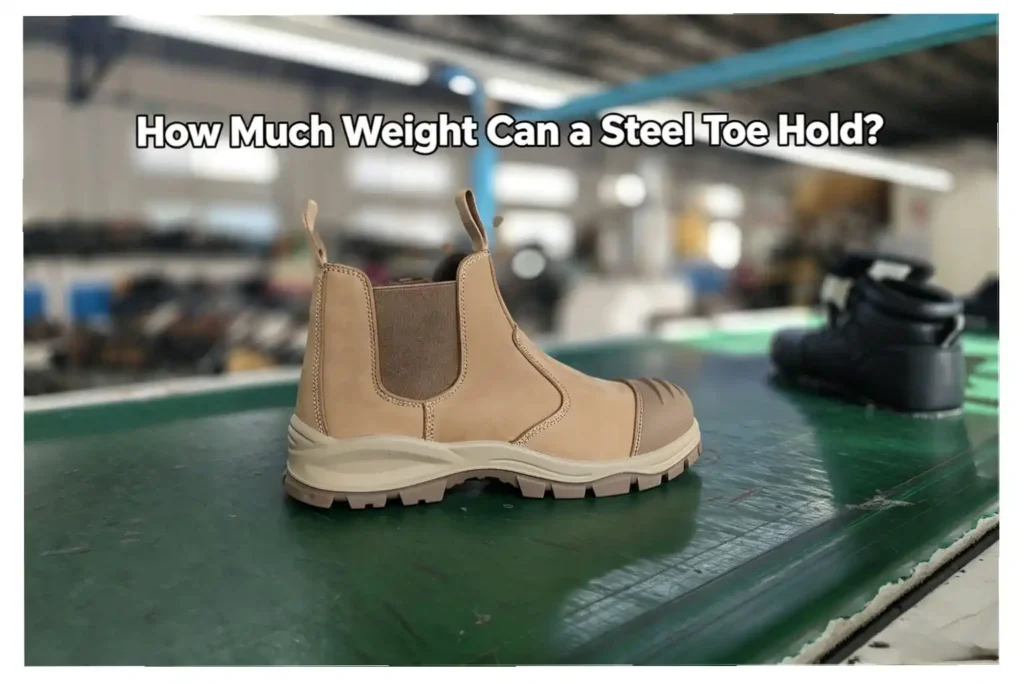
A warehouse worker is guiding a pallet into position when a heavy load shifts unexpectedly. On a construction site, a steel component slips from a workbench. In a fabrication plant, a loaded trolley rolls toward a worker’s foot.
These incidents happen quickly, and they explain why safety shoes are much more than ordinary work footwear.
One of the most common questions workers and PPE buyers ask is:
How much weight can a steel toe hold?
The short answer is that there is no single universal “weight limit” for every steel toe. Certified safety footwear is tested according to specific impact and compression requirements, rather than simply being rated as able to “hold X kilograms.”
For example, safety footwear complying with the Australian AS 2210.3:2019 framework incorporates toe protection designed for at least 200 joules of impact energy and 15 kN of compression. In the United States, ASTM F2413 is the principal performance specification for protective safety-toe footwear, covering impact, compression and other workplace hazards. (ASTM Store)
That distinction matters.
A static load sitting on a toe cap, a forklift wheel moving over a boot, and a 20 kg object falling from height are three very different mechanical events. Simply saying that a steel toe can “hold one ton” or “withstand 2,500 pounds” can therefore be misleading.
This guide explains what steel toe ratings actually mean, how steel toe safety shoes are tested, how steel compares with composite toe protection, and what workers and businesses should consider when selecting industrial safety shoes.
How Much Weight Can a Steel Toe Hold?
For buyers looking for a quick answer, here is the most useful way to understand it.
Under safety footwear requirements based on ISO 20345, including AS 2210.3:2019, a safety toe cap is designed to protect against:
- Impact energy of at least 200 J
- Compression load of at least 15 kN
AS 2210.3:2019 specifically defines safety footwear as footwear incorporating toe caps designed for protection at these levels.
A force of 15 kN is approximately equivalent to the gravitational force exerted by a stationary mass of about 1,530 kg, or 1.5 metric tonnes.
But this does not mean you should place a 1.5-tonne object on someone’s boot.
The standard specifies a controlled laboratory compression test. The test evaluates how much clearance remains beneath the toe cap while the prescribed load is applied. It is a performance test—not permission to deliberately expose footwear to a 1.5-tonne workplace load.
Australian industry guidance commonly describes the requirement as approximately the equivalent of a 20 kg mass falling from one metre for impact protection and about 1.5 tonnes for compression. (uvex-safety.com.au)
What About ASTM Steel Toe Shoes?
In the United States, the terminology is different.
The current ASTM F2413-24 standard establishes minimum performance requirements for protective safety-toe footwear, including impact and compression resistance. ASTM also makes clear that laboratory compliance tests should not be interpreted as establishing protection levels for every real-world situation. (ASTM Store)
Traditional ASTM I/75 C/75 safety-toe protection uses:
- I/75: 75 ft-lb, approximately 101.7 J, impact classification
- C/75: 2,500 lbf, approximately 11.1 kN, compression classification
OSHA has also noted that safety-toe shoes and boots commonly carry impact and compression ratings of 75.
So when somebody asks, “Can my steel toe boots hold 2,500 pounds?”, a better answer is:
Properly certified ASTM C/75 footwear is tested under a controlled compression load of 2,500 lbf, but that figure should not be interpreted as a universal safe working load for the boot.
Why “How Much Weight?” Is Not Quite the Right Question
Imagine two workplace accidents.
In the first, a heavy machine component slowly settles onto the front of a boot.
In the second, the same component falls from a significant height.
The object might have exactly the same mass in both cases, yet the forces experienced by the footwear can be dramatically different.
That is why safety standards distinguish between compression and impact.
Compression Protection
Compression occurs when the toe area is progressively squeezed.
Typical examples include:
- Heavy materials resting on the footwear
- Trolleys moving against the foot
- Material-handling equipment trapping a boot
- Pipes or drums rolling toward workers
- Machinery components pressing against the toe area
Impact Protection
Impact involves energy transferred when an object strikes the footwear.
Examples include:
- A hammer falling from a platform
- Steel stock dropping from a rack
- A heavy tool falling from a workbench
- Construction materials slipping during handling
- Mechanical parts falling during maintenance
Impact severity depends on more than mass. Falling height, object shape, velocity, angle and contact area all influence what happens.
This is why reputable workplace safety footwear is evaluated using standardized test procedures rather than informal claims such as “supports 1,000 kg.”
What Are Safety Shoes and Why Are They Important?
Safety shoes are occupational footwear engineered to reduce exposure to specific workplace hazards.
Ordinary shoes are primarily designed around walking comfort, appearance and general durability. Certified protective work shoes, by comparison, may incorporate engineered components such as:
- Protective toe caps
- Penetration-resistant midsoles
- Slip-resistant outsoles
- Heat-resistant rubber compounds
- Antistatic properties
- Electrical hazard protection
- Water-resistant or waterproof structures
- Metatarsal protection
- Reinforced toe and heel areas
OSHA requires employers to ensure affected employees use protective footwear where hazards include falling or rolling objects, objects capable of piercing the sole, or certain electrical hazards.
The important word is hazard.
Safety footwear should be selected according to what can realistically injure the worker—not simply according to occupation.
A warehouse picker and an oil-field technician may both work ten-hour shifts, but their footwear requirements can be completely different.
Steel Toe Safety Shoes: How the Protection Works
A steel toe cap is a formed piece of metal incorporated into the forepart of the footwear.
It surrounds the toe area and is engineered to create a protective space around the toes when subjected to specified impact or compression forces.
The cap works as part of an entire footwear system.
That point is frequently overlooked.
Protection doesn’t depend solely on the thickness of the steel. It also depends on:
- Toe-cap geometry
- Material properties
- Internal clearance
- Last design
- Toe-cap positioning
- Upper construction
- Insole structure
- Outsole construction
- Manufacturing consistency
A poorly constructed boot containing a piece of steel is not automatically certified safety footwear.
Certification applies to the tested footwear configuration.
ASTM explicitly warns that changes to original safety footwear components—including certain aftermarket inserts or resoling—may cause the product to stop meeting the standard and can invalidate its ASTM marking. (ASTM Store)
What Happens During a Compression Test?
A compression test doesn’t simply ask:“Did the steel cap break?”
Instead, the test examines whether sufficient space remains beneath the protective toe area when a defined compressive force is applied.
For example, AS 2210.3:2019 specifies compression testing at 15 kN, with minimum clearance requirements varying according to footwear size.
This is important because protecting toes requires more than preventing complete structural failure.
If a toe cap deforms too far inward, the toes can still be seriously injured even though the cap itself has not split apart.
For PPE procurement, therefore, the meaningful question is not:
“How strong is the piece of steel?”
It is:
“Has the complete footwear design successfully passed the required safety standard?”
Different Types of Safety Shoes Explained
Toe protection is only one component of workplace footwear selection.
A safety manager should consider the entire hazard profile.
Steel Toe Safety Shoes
Steel remains one of the most established materials for occupational toe protection.
Key features
Steel toe caps generally offer:
- High structural strength
- Excellent impact resistance
- Strong compression performance
- Relatively thin protective structures
- Long-established manufacturing technology
Best applications
Steel toe safety shoes are widely used in:
- Construction
- Heavy manufacturing
- Warehousing
- Mining
- Engineering
- Metal fabrication
- Machinery maintenance
- Logistics
- Oil and gas operations
They are particularly suitable when falling and rolling objects are significant hazards.
Composite Toe Safety Shoes
A protective toe cap does not have to be steel.
OSHA has historically recognized that protective footwear standards focus on performance rather than requiring one particular reinforcement material. Likewise, the relevant Australian standard defines performance requirements for the safety toe cap rather than requiring steel specifically.
Composite toe caps may use materials such as fiberglass or engineered polymers.
Advantages
Depending on construction, they can provide:
- Reduced footwear weight
- Metal-free designs
- Reduced thermal conductivity compared with steel
- Suitability for some metal-sensitive workplaces
- More athletic footwear designs
Applications
Composite toe footwear is particularly attractive for:
- Warehouses
- Logistics centers
- Airports
- Electronics facilities
- Light manufacturing
- Workers walking long distances
- Indoor industrial environments
However, buyers should compare certification, not simply materials.
A certified composite toe is preferable to an uncertified steel cap when compliance is required.
Slip Resistant Safety Shoes
Many workplace foot injuries have nothing to do with objects falling onto the toes.
Wet concrete, oil, coolant, grease, food residue and smooth warehouse floors can create serious slip hazards.
Slip-resistant footwear uses outsole geometry and rubber or polyurethane compounds engineered to improve traction under defined conditions.
Common applications include:
- Food processing
- Warehousing
- Manufacturing
- Automotive workshops
- Commercial kitchens
- Logistics
- Construction
Toe protection and slip resistance should therefore be treated as separate purchasing criteria.
Waterproof Safety Shoes
Workers in construction, utilities, agriculture and outdoor maintenance may spend hours exposed to rain, mud and wet surfaces.
True waterproof safety shoes typically require more than water-resistant leather.
A waterproof design may combine:
- Water-resistant upper material
- Waterproof membrane or bootie
- Sealed or taped seams
- Gusseted tongue construction
- Moisture-management lining
Buyers should distinguish between water-resistant and waterproof claims when preparing specifications.
Electrical Hazard Safety Shoes
Electrical protection requires another layer of hazard assessment.
Some footwear is designed with specific electrical characteristics, but terms such as electrical hazard, electrically insulating, conductive, antistatic and static dissipative should not be treated as interchangeable.
OSHA specifically recognizes electrical hazards as one of the circumstances that can require protective footwear.
Electrical workers should select footwear according to applicable regulations, workplace procedures and the specific electrical hazard—not simply because a product has a steel or composite toe.
How to Choose the Right Safety Shoes
1. Start With the Workplace Environment
Before choosing a shoe, examine where it will actually be worn.
Construction sites
Consider:
- Falling materials
- Nails and sharp debris
- Uneven surfaces
- Wet conditions
- Abrasion
- Concrete and mud
A durable leather boot with toe protection, penetration resistance and an appropriate outsole may be suitable.
Factories
Assess:
- Machinery
- Rolling equipment
- Oils
- Chemicals
- Hot surfaces
- Metal swarf
The outsole compound can be just as important as the toe cap.
Warehouses
Workers may walk thousands of steps during a shift.
Important characteristics can include:
- Lightweight construction
- Cushioning
- Slip resistance
- Toe protection
- Breathability
- Flexibility
Outdoor workplaces
Look at:
- Rain
- Mud
- Temperature
- Terrain
- Water exposure
- Sole durability
The “strongest” boot is not necessarily the best boot for every worker.
2. Match Protection to the Hazard
Build the specification around identified risks.
Consider whether workers need:
- Impact-resistant toe protection
- Compression protection
- Penetration-resistant midsoles
- Metatarsal guards
- Slip resistance
- Heat-resistant outsoles
- Electrical properties
- Waterproof construction
OSHA’s guidance reinforces this hazard-based approach: employers are expected to evaluate workplace conditions and determine where protective footwear is necessary.
3. Consider Comfort and Fit
Protection that workers dislike wearing can create its own practical problems.
For long shifts, examine:
Proper sizing
There should be enough internal space for the foot without excessive movement.
The toes should not continually contact the protective cap.
Breathability
Mesh linings and moisture-management structures can improve comfort in warm environments.
Cushioning
PU, EVA and other cushioning systems can reduce perceived fatigue during prolonged walking or standing.
Weight
Heavy-duty boots may be appropriate for severe industrial environments, while lightweight comfortable work shoes may be preferable for logistics or light manufacturing.
The objective is not maximum protection in every category.
It is appropriate protection with wearable comfort.
4. Evaluate Durability
For procurement teams, purchase price per pair tells only part of the story.
Check:
- Leather thickness and quality
- Upper abrasion resistance
- Stitching quality
- Toe bumper construction
- Heel reinforcement
- Outsole bonding
- Flex resistance
- Hydrolysis resistance where relevant
- Zipper and lacing components
A cheaper product replaced twice as frequently may create a higher annual PPE cost.
5. Verify Safety Standards
Certification should be part of the purchasing specification.
United States
ASTM F2413-24 is the current ASTM specification covering performance requirements for protective safety-toe footwear. (ASTM Store)
OSHA’s foot-protection rules require protective footwear where identified hazards warrant it and set criteria for acceptable protective footwear.
Europe
EN ISO 20345 is the major framework used for safety footwear intended to protect against occupational hazards. Buyers should verify the exact standard edition and protection classification applicable to the product and market.
Australia
AS 2210.3:2019 specifies requirements for safety footwear and incorporates toe caps providing at least 200 J impact and 15 kN compression protection.
International buyers should always check the applicable national regulations and current standard editions before placing an order.
Common Mistakes When Buying Safety Shoes
Mistake 1: Choosing Price Over Protection
Low unit price is attractive in a tender, particularly when thousands of pairs are involved.
But footwear should first satisfy the required protection specification.
Better approach: establish mandatory certification, construction and performance criteria before comparing prices.
Mistake 2: Ignoring Comfort
A technically impressive boot that workers find uncomfortable can result in complaints and inconsistent use.
Better approach: conduct wear trials before large-volume procurement, particularly when employees work long shifts.
Mistake 3: Assuming Every Steel Toe Has the Same Strength
“Steel toe” describes a construction feature, not a complete performance specification.
Different products can have different certifications and intended applications.
Better approach: request test reports and certification rather than relying on the phrase “steel toe.”
Mistake 4: Ignoring the Working Environment
A heavy waterproof leather boot may be excellent outdoors but unnecessarily hot and heavy for an indoor distribution center.
Conversely, lightweight mesh protective work shoes may not provide the durability required for severe construction conditions.
Better approach: match footwear construction to actual exposure.
Mistake 5: Treating Safety Shoes as Maintenance-Free
Leather dries. Outsoles wear. Stitching can fail. Toe areas become damaged.
Better approach: include footwear inspection and replacement in the PPE program.
Safety Shoes Materials and Technologies
Leather Uppers
Full-grain and nubuck cow leather remain widely used for industrial boots because they can offer a strong combination of:
- Abrasion resistance
- Structure
- Durability
- Water resistance when appropriately treated
- Premium appearance
Heavy-duty leather remains particularly useful for construction and industrial applications.
Mesh and Textile Uppers
Modern mesh and engineered textile materials make lightweight safety footwear possible.
They can provide:
- Improved ventilation
- Lower weight
- Athletic styling
- Increased flexibility
These materials are popular in warehousing, logistics and light industrial environments.
PU Outsoles
Polyurethane is widely used in occupational footwear.
Depending on formulation and construction, PU can provide useful combinations of:
- Cushioning
- Flexibility
- Low weight
- Shock absorption
Dual-density PU constructions allow manufacturers to combine a softer comfort layer with a harder wearing layer.
Rubber Outsoles
Rubber is commonly selected where buyers need strong abrasion, traction or heat-related outsole performance.
PU/rubber and EVA/rubber combinations are also common because they allow designers to balance cushioning and outsole durability.
Steel Toe vs Composite Toe Technology
The material itself should never be the only purchasing criterion.
Compare:
| Consideration | Steel Toe | Composite Toe |
|---|---|---|
| Impact/compression protection | Excellent when certified | Excellent when certified |
| Weight | Usually heavier | Often lighter |
| Metal-free design | No | Can be |
| Thermal conductivity | Higher | Generally lower |
| Heavy industrial use | Very common | Increasingly common |
| Athletic safety shoes | Less common | Very common |
The best choice is the one that passes the required standard and matches the workplace.
Benefits of Investing in Quality Safety Shoes
Reduced Exposure to Foot Injuries
Safety footwear creates an engineered barrier between the worker and workplace hazards.
It cannot prevent every accident, but appropriately selected PPE can reduce exposure to impact, compression, penetration, slipping and other specified hazards.
Better Worker Comfort
Modern industrial safety shoes no longer have to feel like rigid, oversized boots.
Ergonomic lasts, cushioning footbeds, breathable linings and lighter sole systems can make a significant difference during long shifts.
Potential Productivity Benefits
Workers who spend eight, ten or twelve hours walking and standing notice footwear.
Comfortable PPE can reduce distractions caused by hot, heavy or poorly fitting shoes.
Lower Total Replacement Costs
Procurement managers should evaluate cost per wear, not only cost per pair.
A durable product costing slightly more initially can sometimes offer better overall purchasing economics.
Stronger Safety Culture
Good PPE communicates that safety specifications are operational requirements rather than paperwork.
Workers are also more likely to accept footwear programs when products combine protection with practical comfort.
How to Maintain Safety Shoes for a Longer Lifespan
Even premium safety footwear needs routine care.
Cleaning
Remove mud, concrete dust, oils and industrial contamination regularly.
Use cleaning methods suitable for the upper and outsole materials.
Drying
Avoid aggressively drying wet leather directly against intense heat unless the manufacturer specifically permits it.
Excessive heat can damage leather, adhesives, waterproof membranes and other footwear components.
Storage
Keep footwear in a ventilated, dry environment away from unnecessary heat, chemicals and direct sunlight.
Inspection
Workers should periodically examine:
- Toe area
- Upper
- Stitching
- Outsole
- Sole bonding
- Tread
- Midsole
- Fastening system
- Waterproof structure
Replacement
There is no universal replacement date.
Replace footwear when deterioration compromises protection, traction, structural integrity or fit.
And after a serious impact or compression event, don’t assume that footwear remains safe merely because damage isn’t immediately visible. Follow the manufacturer’s inspection and replacement guidance.
Safety Shoes Buying Guide for Businesses
Purchasing 1,000 pairs for a distributor or industrial workforce is very different from buying one pair from a retail store.
Define the Specification Before Requesting Prices
Your RFQ should identify:
- Target market
- Required standard
- Safety classification
- Toe-cap type
- Penetration protection
- Upper material
- Outsole construction
- Size range
- Packaging
- Branding
- Quantity
This creates meaningful quotations between suppliers.
Evaluate the Manufacturer
For OEM and wholesale orders, examine more than a website or catalog.
Ask about:
- Factory production capability
- Quality-control procedures
- Product development capability
- Existing certification
- Testing procedures
- Material traceability
- Production lines
- Sample development
- Experience with your target market
The manufacturer should understand why a product is being constructed in a certain way—not simply reproduce its appearance.
Request Documentation
Depending on the market and product, request relevant:
- Test reports
- Certificates
- Technical specifications
- Material information
- Product markings
- User information
- Quality-control records
For regulated PPE, documentation is part of the product.
Test Samples Before Bulk Production
A sample review should examine:
- Fit
- Toe-cap position
- Flexibility
- Weight
- Stitching
- Bonding
- Appearance
- Outsole grip
- Component consistency
Where possible, conduct wear trials with workers from the intended industry.
Consider OEM and Private-Label Requirements
Distributors, importers and PPE brands may require customized:
- Leather colors
- Outsole compounds
- Safety features
- Logos
- Labels
- Insoles
- Packaging
- Size systems
- Cartons
Customization should never compromise the certified construction.
Where a change could affect compliance, confirm whether additional testing or certification is necessary.
Frequently Asked Questions About Safety Shoes
1. How long do safety shoes usually last?
There is no fixed lifespan. Usage intensity, working environment, materials, worker weight, maintenance and outsole wear all affect service life. Regular inspection is more reliable than replacing every pair according to an arbitrary number of months.
2. Are steel toe safety shoes better than composite toe shoes?
Not automatically. Steel offers excellent strength and remains widely used in heavy industry, while certified composite toe caps can provide strong protection with lower weight and metal-free construction. Compare the required certification and workplace hazards first.
3. What industries require safety shoes?
Construction, manufacturing, warehousing, logistics, engineering, mining, utilities, oil and gas, automotive and many other industries commonly use protective footwear. Requirements should ultimately be based on workplace hazard assessment rather than job title alone. OSHA likewise bases foot-protection requirements on exposure to relevant hazards.
4. Are safety shoes comfortable for all-day wear?
They can be. Proper sizing, ergonomic lasts, breathable linings, cushioning footbeds and suitable sole systems can make modern PPE footwear comfortable for extended shifts.
5. How do I choose the correct size?
Measure both foot length and width and use the manufacturer’s size chart. Safety footwear should provide sufficient toe room without allowing excessive heel movement or instability.
6. How often should safety shoes be replaced?
Replace footwear when wear or damage affects its protective function, outsole traction, structural integrity or fit. Footwear exposed to a significant impact or compression incident may also require replacement.
7. What safety standards should safety shoes meet?
That depends on the destination market and workplace. Common frameworks include ASTM F2413 in the United States, EN ISO 20345 in Europe and AS 2210.3:2019 in Australia. Buyers should confirm the current applicable standard and required protection category rather than simply requesting “certified safety shoes.” (ASTM Store)
8. Can safety shoes prevent workplace injuries?
They can reduce exposure to specified foot hazards when correctly selected, fitted and maintained, but no footwear makes a worker invulnerable. Safety footwear should form part of a broader hierarchy of controls and PPE program.
So, How Much Weight Can a Steel Toe Really Hold?
Let’s return to the original question.
If someone asks:
“How much weight can a steel toe hold?”
the technically responsible answer is:
Don’t judge certified safety footwear by a simple kilogram or pound figure. Judge it according to standardized impact and compression performance.
For safety footwear based on ISO 20345 requirements, a key benchmark is 200 J impact resistance and 15 kN compression resistance. AS 2210.3:2019 uses these values for safety toe protection.
In the U.S. system, ASTM safety-toe classifications use their own impact and compression criteria, with I/75 and C/75 commonly associated with approximately 101.7 J impact energy and a 2,500 lbf compression load. ASTM itself cautions that controlled laboratory tests should not be treated as defining protection for every real-world situation. (ASTM Store)
Most importantly, never deliberately test a steel toe while someone is wearing the footwear.
A certification test is performed under controlled laboratory conditions with specified equipment and procedures. A forklift, steel beam, pallet or machine component in the real world creates much less predictable forces.
Conclusion: Choose Safety Shoes by Tested Protection, Not Marketing Claims
Safety shoes are essential workplace protection equipment wherever employees face meaningful risks from falling objects, compression, sharp materials, slippery surfaces or other foot hazards.
But asking how much weight a steel toe can hold reveals an important lesson for both workers and PPE buyers: safety footwear cannot be evaluated by one dramatic weight figure.
Impact energy, compression force, toe clearance, product construction and certification all matter.
A steel toe may provide excellent heavy-duty protection. A composite toe may deliver certified protection with lower weight. Slip-resistant safety shoes may be more important in another workplace, while waterproof safety shoes or specially rated footwear may be required elsewhere.
The right purchasing decision therefore begins with three questions:
- What hazards exist?
- What standard and protection level are required?
- Can the supplier demonstrate that the complete footwear meets those requirements?
For businesses, that approach leads to better industrial safety shoes, more appropriate worker protection and more defensible PPE purchasing decisions.
Looking for a Reliable Safety Shoes Manufacturer?
Ocean Safety Shoes focuses on OEM and ODM safety footwear manufacturing for international PPE brands, wholesalers, distributors and importers.
With extensive experience producing safety footwear for demanding markets including Australia and Europe, our factory develops steel toe and composite toe work footwear across leather work boots, lightweight industrial shoes, waterproof designs and other occupational applications. Product development can be tailored around target-market standards, workplace conditions, materials, outsole systems and private-label requirements.
For wholesale buyers, the objective should not simply be to find the cheapest steel toe shoe. It should be to develop protective work shoes that combine verified protection, appropriate materials, consistent manufacturing and practical all-day comfort.
If you are developing a new safety footwear range or sourcing certified work shoes for your market, Ocean Safety Shoes can support product development, sampling, OEM/ODM customization and bulk production from specification through manufacturing.