
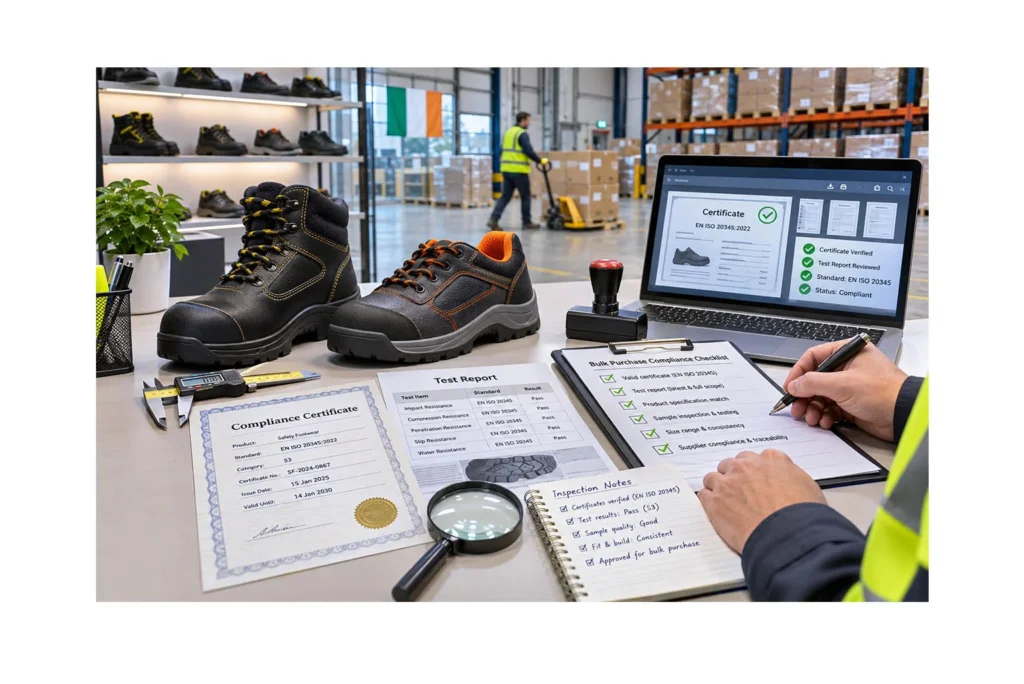
Before placing a large order with an overseas safety footwear manufacturer, Irish importers and PPE distributors should verify that the products meet applicable European safety requirements. Checking certificates is not simply an administrative task. It is an important part of supplier evaluation, product compliance, and purchasing risk management.
Safety footwear certificate verification helps buyers identify invalid documents, incorrect product classifications, expired certificates, and discrepancies between certified samples and mass-produced footwear.
For businesses sourcing safety shoes from China, the risks can be particularly significant when ordering hundreds or thousands of pairs. A supplier may provide an EU Declaration of Conformity, test reports, and an EU type-examination certificate, but buyers still need to establish whether these documents are genuine and whether they cover the exact footwear models being purchased.
In Ireland, safety footwear placed on the EU market must comply with Regulation (EU) 2016/425 on Personal Protective Equipment (PPE). General-purpose safety footwear is commonly assessed against EN ISO 20345.
This guide explains how Irish importers, wholesalers, and distributors can verify safety footwear certificates, review product testing documentation, check certification bodies, and establish a practical inspection process before confirming bulk orders.
It is particularly useful for:
- Safety footwear importers in Ireland
- PPE distributors and wholesalers
- Industrial footwear retailers
- Construction and manufacturing companies
- Procurement and purchasing managers
- Private-label safety footwear brands
- Businesses sourcing safety shoes from China
Table of Contents
- Why Safety Footwear Certificate Verification Matters
- Which Safety Footwear Certificates Should Buyers Request?
- How to Verify an EU Type-Examination Certificate
- How to Check a Notified Body in the NANDO Database
- How to Verify Safety Footwear Product Testing Reports
- How to Check EN ISO 20345 Compliance
- How to Match Certificates With Actual Safety Shoe Models
- Safety Footwear Bulk Order Inspection Before Shipment
- Common Warning Signs of Invalid Safety Footwear Certificates
- Safety Footwear Certificate Verification Checklist
- Frequently Asked Questions
1. Why Safety Footwear Certificate Verification Matters
Safety footwear protects workers against workplace hazards such as falling objects, sharp materials, compression, and slippery surfaces.
For Irish businesses purchasing footwear in bulk, product compliance should be confirmed before goods are placed on the market.
Risks of Purchasing Without Certificate Verification
Accepting documents without checking their authenticity or scope can create several problems.
Non-compliant products
A product may carry a CE logo without having completed the required conformity assessment.
Incorrect certification coverage
A certificate may cover one safety shoe model but not another model offered by the same manufacturer.
Expired or withdrawn certificates
An EU type-examination certificate may have expired, been withdrawn, or become invalid following changes to the approved product type.
Inconsistent mass production
The sample supplied for testing may differ from the footwear eventually manufactured in bulk.
Financial and commercial losses
Non-compliant products can result in shipment delays, rejected orders, product withdrawals, recalls, and reputational damage.
Why Verification Is Important for Irish Importers
Under Regulation (EU) 2016/425, importers must ensure that the appropriate conformity assessment has been completed before placing PPE on the EU market.
They must also verify that the manufacturer has prepared the required technical documentation, that the product carries the CE marking, and that the necessary documents accompany the footwear.
Therefore, certificate verification should be part of the purchasing process rather than something performed after the goods arrive in Ireland.
Official reference: Regulation (EU) 2016/425 – PPE Requirements.
2. Which Safety Footwear Certificates Should Buyers Request?
Before evaluating a supplier, buyers should understand the difference between the main compliance documents.
Not every document labelled as a certificate has the same legal meaning.
2.1 EU Declaration of Conformity
The EU Declaration of Conformity (DoC) is prepared and signed by the manufacturer.
It declares that the identified PPE product complies with the applicable EU legislation.
For safety footwear, check that it includes:
- Manufacturer’s name and full address
- Product model or type identification
- Product description
- Applicable EU PPE Regulation
- Relevant harmonised standards, where applicable
- Identification of the conformity assessment procedure
- Notified Body information where relevant
- Date and authorised signature
The declaration should identify the actual footwear model being purchased.
2.2 EU Type-Examination Certificate
The EU type-examination certificate is issued by a Notified Body following an assessment of the product design and a representative sample.
For general-purpose Category II safety footwear, EU type-examination is Module B.
The certificate should contain:
- Notified Body name and identification number
- Manufacturer information
- Approved footwear type or model
- Applicable safety requirements
- Relevant standards
- Protection class or performance information, where applicable
- Issue date and expiry date
- Any conditions attached to the certificate
Under Annex V of Regulation (EU) 2016/425, the validity period of a newly issued or renewed EU type-examination certificate cannot exceed five years.
Buyers should check the expiry date and confirm the certificate’s current status with the issuing body.
2.3 Safety Footwear Test Reports
Test reports provide evidence of the product’s performance under specified testing procedures.
Depending on the product, reports may cover:
- Toe cap impact resistance
- Toe cap compression resistance
- Penetration resistance
- Slip resistance
- Water penetration and absorption
- Whole-footwear water resistance
- Outsole abrasion resistance
- Other applicable protective properties
A test report is not the same as an EU type-examination certificate.
It should be used as supporting technical evidence and checked against the relevant certification documents.
2.4 Product Technical Specifications
Buyers should also request product specifications showing:
- Upper materials
- Toe cap material
- Penetration-resistant insert
- Outsole construction
- Protective classification
- Additional protective features
- Model number
- Available sizes
These details help establish whether the certified product corresponds to the footwear being ordered.
Document Comparison
| Document | Issued or Prepared By | Main Purpose |
|---|---|---|
| EU Declaration of Conformity | Manufacturer | Declares product conformity |
| EU Type-Examination Certificate | Notified Body | Confirms assessed product type |
| Product Test Report | Testing laboratory | Records testing results |
| Product Specifications | Manufacturer | Identifies product construction |
| Production Quality Records | Manufacturer | Supports production consistency |
Irish buyers should review these documents together rather than relying on a single certificate.
3. How to Verify an EU Type-Examination Certificate
One of the most important steps in safety footwear certificate verification is checking the EU type-examination certificate.
A genuine certificate should be issued by a Notified Body authorised to perform the relevant conformity assessment tasks under Regulation (EU) 2016/425.
Step 1: Check the Notified Body Name
Locate the issuing organisation’s name on the certificate.
Check that the organisation is an officially notified body for PPE under Regulation (EU) 2016/425.
Do not assume that a company is authorised simply because its document uses the words CE certification or European certification.
Step 2: Check the Notified Body Identification Number
Every Notified Body has an identification number.
Compare the number printed on the certificate with the organisation’s official NANDO listing.
The name and number should correspond.
Step 3: Check Manufacturer Information
Compare the certificate with the manufacturer’s details.
Verify:
- Legal company name
- Registered address
- Manufacturing entity
- Authorised representative information, where applicable
A certificate issued for a different manufacturer should not automatically be accepted.
Step 4: Check the Product Model
This is one of the most important checks for safety footwear buyers.
Confirm that the certificate identifies the actual model or product type being ordered.
For example, if you are purchasing a low-cut S3S safety shoe, a certificate covering a different high-cut S3 boot should not automatically be accepted.
Review any certificate annexes to establish which model variations are covered.
Step 5: Check Issue and Expiry Dates
EU type-examination certificates have a maximum validity period of five years for a newly issued or renewed certificate.
Check:
- Issue date
- Expiry date
- Renewal information
- Any amendments or additions
- Current status with the issuing Notified Body
Do not rely solely on an expiry date printed on a PDF. Contact the issuer if the certificate’s validity or status is uncertain.
Step 6: Contact the Issuing Notified Body
When placing a substantial order, contact the issuing organisation directly if necessary.
Provide:
- Certificate reference number
- Manufacturer name
- Product model
- Certificate issue date
- Copy of the document
Ask whether the certificate was genuinely issued by the organisation, whether it remains valid, and whether the specified product is covered.
This is particularly useful when a supplier provides unfamiliar certificates or documents that are difficult to verify online.
4. How to Check a Notified Body in the NANDO Database
The European Commission’s NANDO database is an important resource for checking notified bodies.
NANDO stands for New Approach Notified and Designated Organisations.
It provides information about organisations notified to perform conformity assessment activities under relevant EU legislation.
Official database: European Commission – NANDO Notified Bodies.
How to Use NANDO
Step 1: Open the NANDO database
Visit the European Commission’s official Notified Bodies database.
Step 2: Search for the identification number
Enter the four-digit Notified Body number displayed on the EU type-examination certificate.
Step 3: Check the applicable legislation
Confirm that the organisation is notified under Regulation (EU) 2016/425.
Step 4: Check the authorised scope
Verify that its notification covers the relevant PPE conformity assessment activities, particularly EU type-examination under Module B.
Step 5: Check the notification status
Review whether the body is currently listed and whether its notification is subject to restrictions or other relevant conditions.
Important: What NANDO Can and Cannot Verify
| Verification Item | Can NANDO Help? |
|---|---|
| Notified Body identity | Yes |
| Notified Body identification number | Yes |
| Relevant EU legislation | Yes |
| Notified assessment scope | Yes |
| Notification status | Yes |
| Authenticity of an individual certificate | Not necessarily |
| Exact footwear model covered by a certificate | Not necessarily |
| Current validity of every issued certificate | Requires confirmation from the issuing body |
NANDO verifies the organisation’s notification status and scope. It is not a public database of every EU type-examination certificate.
For individual certificate verification, contact the issuing Notified Body directly when additional confirmation is needed.
5. How to Verify Safety Footwear Product Testing Reports
Safety footwear product testing is another important part of supplier evaluation.
A manufacturer may provide test reports from an external laboratory, but buyers should examine the laboratory’s identity, testing scope, and the actual test results.
5.1 Check the Testing Laboratory
Review the following information:
- Laboratory name
- Registered address
- Report reference number
- Report issue date
- Testing standard
- Testing method
- Sample identification
- Laboratory authorisation or accreditation information
If the report carries an accreditation symbol, verify the laboratory’s accreditation and relevant testing scope.
5.2 Check ISO/IEC 17025 Accreditation
ISO/IEC 17025 is an international standard covering the competence of testing and calibration laboratories.
Accreditation to this standard can provide confidence in a laboratory’s technical competence and quality management procedures.
However, accreditation must cover the relevant testing activities.
A laboratory accredited for unrelated material tests should not automatically be assumed competent to perform every safety footwear test.
In Ireland, the Irish National Accreditation Board (INAB) provides laboratory accreditation and publishes a directory of accredited organisations.
Useful resources:
The HSA also recommends checking accreditation marks, the relevant National Accreditation Body, and whether the supplier is accredited for the specific competence and tests required.
5.3 Compare Test Results With Product Claims
Check that the test report covers the protection features advertised by the manufacturer.
For example:
| Product Claim | Supporting Test Information |
|---|---|
| Steel toe protection | Toe cap impact and compression tests |
| Composite toe protection | Relevant toe protection tests |
| Penetration resistance | Applicable penetration test |
| Slip resistance | Relevant slip-resistance testing |
| Waterproof footwear | Whole-footwear water resistance test |
| Heat-resistant outsole | Relevant outsole heat resistance test |
A report showing only one successful test should not be treated as proof that the entire footwear model meets every requirement.
5.4 Confirm the Tested Sample Matches the Ordered Model
Check the product model, sample description, materials, and construction details.
For example, a test report for a steel toe model does not automatically support a composite toe version.
Similarly, changing the outsole material or penetration-resistant insert may affect the product’s conformity.
6. How to Check EN ISO 20345 Compliance
For general-purpose safety footwear sold in Ireland, EN ISO 20345 is the principal technical standard buyers should investigate.
The current edition relevant to new purchasing projects is EN ISO 20345:2022, including Amendment 1:2024, subject to checking the latest harmonised-standard publications.
The European Commission publishes the references of harmonised PPE standards in its official publications.
Official reference: European Commission – Harmonised Standards for PPE.
Check the Protection Classification
Buyers should verify that the footwear’s classification matches the actual product specification.
Common markings include:
| Marking | Main Characteristics |
|---|---|
| S1 | Basic safety footwear protection for relatively dry environments |
| S2 | S1 protection with water penetration and absorption resistance of the upper |
| S3 | S2-type protection with penetration resistance and cleated outsole |
| S3L | S3-type protection with a non-metallic penetration-resistant insert |
| S3S | S3-type protection with a non-metallic insert tested using a 3 mm nail |
| S7 | S3-type protection with whole-footwear water resistance |
The product’s actual marking should correspond to its certification and test documentation.
Check the Standard Edition
Some suppliers may still provide documents referring to EN ISO 20345:2011.
Buyers should not assume that older and newer product classifications are interchangeable.
Check the exact edition and whether the standard reference provides a presumption of conformity under the current EU PPE framework.
Check Additional Protective Features
Depending on the intended application, buyers may also need to verify:
- P, PL or PS penetration resistance
- WPA or WR water protection
- SR additional slip resistance
- HRO heat-resistant outsole
- CI cold insulation
- FO fuel oil resistance
The final purchasing specification should reflect the workplace risk assessment.
7. How to Match Certificates With Actual Safety Shoe Models
A certificate can be genuine but still be unsuitable for a particular bulk order.
This happens when buyers accept a manufacturer’s general certification without checking the precise footwear model.
Compare the Product and Certificate Side by Side
| Product Information | What to Compare |
|---|---|
| Model number | Exact model or approved product type |
| Product category | Certified protection classification |
| Toe cap | Steel or composite |
| Penetration insert | Metallic or non-metallic |
| Outsole | Material and construction |
| Upper | Material and relevant water protection |
| Standard | Applicable EN ISO 20345 edition |
| Product marking | Corresponding protective markings |
What If the Manufacturer Changes Materials?
Changes to product materials or construction can affect the approved type.
Examples include:
- Replacing a steel toe cap with a composite toe cap
- Changing the penetration-resistant insert
- Changing the outsole construction
- Modifying important upper materials
- Altering protective features
Under Annex V of Regulation (EU) 2016/425, modifications that may affect conformity or certificate validity must be communicated to the Notified Body and may require additional approval.
Therefore, buyers should ask manufacturers to confirm that any changes have been properly assessed.
Why Sample Approval Matters
Before bulk production, request a physical sample of the actual model.
Compare the sample against:
- Product specifications
- Certification documents
- Test reports
- Approved photographs
- Labelling requirements
A physical sample helps identify differences that may not be obvious from documents alone.
8. Safety Footwear Bulk Order Inspection Before Shipment
Certificate verification should be combined with a practical safety footwear bulk order inspection.
Even when documents are valid, buyers need confidence that mass-produced footwear matches the approved model.
8.1 Pre-Production Sample Inspection
Before manufacturing begins, approve a sample covering:
- Upper material
- Toe cap
- Penetration-resistant insert
- Outsole
- Stitching
- Lining
- Footbed
- Product markings
- Packaging
Keep a record of the approved sample for comparison with the finished order.
8.2 During-Production Quality Inspection
Where appropriate, buyers can arrange production inspections to evaluate:
- Material consistency
- Component installation
- Upper stitching
- Outsole bonding
- Size consistency
- Production defects
For large orders, early inspection can help identify manufacturing problems before the entire batch is completed.
8.3 Final Random Inspection
Before shipment, conduct a final inspection based on an agreed sampling plan.
Important inspection points include:
| Inspection Area | What to Check |
|---|---|
| Appearance | Scratches, stains and visible defects |
| Upper | Material and stitching consistency |
| Toe cap | Correct type and positioning |
| Midsole | Correct penetration-resistant insert |
| Outsole | Material, tread and bonding |
| Labelling | Correct model and protection markings |
| Size | Correct size assortment |
| Packaging | Carton quantities and product identification |
| Documents | Correspondence with approved models |
Where additional performance testing is necessary, arrange suitable laboratory testing rather than relying on visual inspection alone.
8.4 Keep Batch Records
For every bulk shipment, maintain records of:
- Purchase order
- Approved sample
- Product model
- Certificate references
- Production batch
- Inspection report
- Quantity
- Shipment details
This helps importers investigate complaints and trace affected products if problems arise.
9. Common Warning Signs of Invalid Safety Footwear Certificates
During supplier evaluation, buyers should be alert to the following warning signs.
Warning Sign 1: The Notified Body Cannot Be Found in NANDO
If the certificate issuer cannot be verified under the relevant PPE legislation, request an explanation and do not treat the document as valid EU type-examination evidence.
Warning Sign 2: The Certificate Covers a Different Product
A certificate for one model cannot automatically be used for every safety shoe manufactured by the same factory.
Warning Sign 3: The Certificate Has Expired
Check the issue and expiry dates and request confirmation of any renewal.
Warning Sign 4: The Supplier Only Provides a Generic CE Certificate
A general commercial certificate or voluntary quality certificate is not a substitute for the required PPE conformity assessment.
The European Commission specifically warns that voluntary certificates are not recognised as proof of compliance with EU harmonisation legislation.
Warning Sign 5: The Test Report Does Not Identify the Product
If the report does not provide enough information to connect the tested sample with the ordered model, request clarification.
Warning Sign 6: Product Materials Differ From Certified Specifications
Changing the toe cap, outsole, or penetration-resistant insert without the appropriate conformity assessment can create serious compliance concerns.
Warning Sign 7: The Supplier Refuses to Provide Supporting Documents
A manufacturer that refuses to provide relevant compliance documentation or allow reasonable verification creates unnecessary purchasing risks.
Warning Sign 8: The Documents Contain Inconsistent Information
Differences in company names, model numbers, standard editions, dates, or certificate references should be investigated before ordering.
10. Safety Footwear Certificate Verification Checklist
Irish importers and PPE distributors can use the following checklist before confirming a bulk purchase.
Supplier Verification
- Confirm the manufacturer’s legal company name.
- Check the factory’s manufacturing capabilities.
- Review its safety footwear product range.
- Request product-specific compliance documents.
- Confirm the supplier’s experience with EU markets.
Certificate Verification
- Obtain the EU Declaration of Conformity.
- Obtain the EU type-examination certificate.
- Check the Notified Body identification number.
- Verify the organisation through NANDO.
- Confirm the relevant notification scope.
- Check certificate issue and expiry dates.
- Confirm the certificate’s current status where necessary.
- Verify the exact footwear model and its annexes.
Product Testing Verification
- Obtain relevant EN ISO 20345 test reports.
- Check the testing laboratory’s details.
- Review applicable accreditation information.
- Compare test results with product claims.
- Confirm the tested sample matches the ordered model.
Bulk Order Inspection
- Approve pre-production samples.
- Confirm materials and components.
- Check product markings and labels.
- Arrange production inspection where appropriate.
- Complete final random inspection.
- Keep batch and inspection records.
- Confirm that shipment documents match the approved order.
11. Frequently Asked Questions
How Can I Verify a Safety Footwear Certificate in Ireland?
Start by checking the EU type-examination certificate, manufacturer details, product model, and issuing Notified Body. Use the European Commission’s NANDO database to verify the organisation’s notification under Regulation (EU) 2016/425. For individual certificate authenticity and current status, contact the issuing Notified Body directly.
What Is the Difference Between an EU Declaration of Conformity and an EU Type-Examination Certificate?
The EU Declaration of Conformity is prepared and signed by the manufacturer to declare compliance. The EU type-examination certificate is issued by a Notified Body after assessing the product type. Both serve different purposes in the PPE conformity assessment process.
Is a CE Certificate the Same as CE Marking?
No. CE marking is the manufacturer’s declaration that the product meets applicable EU requirements. It is not itself a certificate. For Category II safety footwear, the conformity assessment includes EU type-examination under Module B followed by production conformity under Module C.
How Long Is an EU Type-Examination Certificate Valid?
Under Annex V of Regulation (EU) 2016/425, a newly issued or renewed EU type-examination certificate cannot have a validity period exceeding five years. Buyers should check the stated expiry date and verify the certificate’s current status.
Can I Verify a CE Certificate Online?
You can use NANDO to check the identity, notification status, and scope of the issuing Notified Body. However, NANDO does not necessarily provide a searchable record of every individual footwear certificate. Contact the issuing body for direct confirmation.
Do Safety Shoes Need EN ISO 20345 Certification?
General-purpose safety footwear with protective toe caps is commonly assessed against EN ISO 20345. The applicable conformity assessment and product documentation must comply with Regulation (EU) 2016/425 before the footwear is placed on the Irish market.
Is an ISO 17025 Test Report Enough to Prove Safety Shoe Compliance?
No. ISO/IEC 17025 accreditation relates to laboratory competence within an accredited scope. A test report provides supporting evidence of specific product performance but does not replace the required PPE conformity assessment or EU type-examination certificate.
Can One Certificate Cover Multiple Safety Shoe Models?
It can cover a defined product type or a range of models where the certificate and its annexes expressly identify the covered products and variations. Buyers should never assume that all models from one manufacturer are covered by a single certificate.
What Should I Check Before Ordering 1,000 Pairs of Safety Shoes?
Verify the EU Declaration of Conformity, EU type-examination certificate, Notified Body, test reports, product model, protective classification, and sample consistency. Also arrange appropriate bulk quality inspection and confirm that all production changes have been assessed.
Who Is Responsible for Product Compliance When Importing Safety Shoes Into Ireland?
The manufacturer is responsible for product design, conformity assessment, and the EU Declaration of Conformity. The importer must carry out the checks required under Article 10 of Regulation (EU) 2016/425 before placing the PPE on the EU market and take appropriate action if non-compliance is identified.
Conclusion
Safety footwear certificate verification is an essential step for Irish importers, wholesalers, and PPE distributors purchasing products in bulk.
A genuine certificate alone is not enough. Buyers must also confirm that the document covers the correct product, that the issuing Notified Body is properly authorised, and that mass-produced footwear matches the assessed product type.
The most important verification steps are:
- Check the EU Declaration of Conformity.
- Verify the EU type-examination certificate.
- Confirm the Notified Body through NANDO.
- Check the certificate’s issue date and expiry date.
- Review relevant safety footwear product testing.
- Compare certified specifications with physical samples.
- Arrange appropriate bulk order inspections.
- Maintain product and batch traceability records.
For Irish businesses sourcing safety footwear from China, these procedures help reduce purchasing risks and support a more reliable supply chain.
A systematic approach to supplier evaluation and product compliance can also help distributors protect their business reputation and build long-term relationships with manufacturing partners.
Work With Ocean Safety Shoes for Your Bulk Footwear Requirements
Ocean Safety Shoes is a professional safety footwear manufacturer serving international B2B customers, including importers, distributors, wholesalers, PPE suppliers, and private-label brands.
Our manufacturing capabilities cover:
- CE safety shoes
- Steel toe safety boots
- Composite toe safety sneakers
- S3 safety footwear
- Waterproof safety boots
- Industrial safety shoes
- Heavy-duty work boots
- OEM and ODM manufacturing
- Custom logos and private-label packaging
For Irish buyers, we understand that product documentation, manufacturing consistency, and quality control are important considerations when selecting a safety footwear supplier.
When evaluating a new bulk order, buyers can discuss:
- Required EN ISO 20345 classifications
- Steel or composite toe cap options
- Penetration-resistant insert specifications
- Upper and outsole materials
- Product testing and supporting compliance documentation
- Pre-production samples
- Bulk inspection arrangements
- Custom branding and packaging
Explore the Ocean Safety Shoes product range or contact our team to discuss your purchasing requirements.
Looking for a reliable safety footwear manufacturer for your Irish distribution business?
Contact Ocean Safety Shoes to discuss product samples, wholesale orders, and OEM/ODM manufacturing opportunities.