
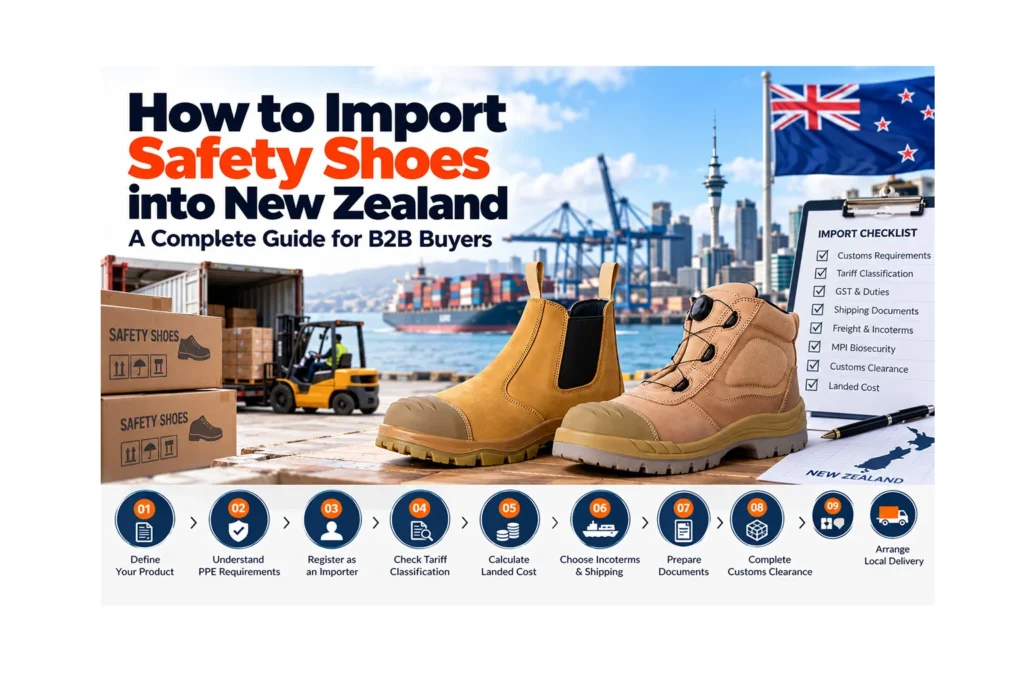
Importing safety footwear directly from overseas can help New Zealand distributors, PPE wholesalers, retailers, and industrial suppliers expand their product range and develop private-label collections.
However, learning how to import safety shoes New Zealand businesses can sell successfully involves much more than arranging transportation from a factory.
Commercial importers need to understand New Zealand Customs procedures, tariff classification, GST, border levies, freight documentation, PPE importer responsibilities, biosecurity considerations, and landed costs.
New Zealand Customs requires commercially imported goods to be cleared, with importers responsible for the appropriate entry or cargo information and applicable duties, GST, charges, and levies.
This guide follows the import process from purchase planning through customs clearance and warehouse delivery, with a particular focus on businesses importing wholesale safety shoes NZ.
Safety Shoes Import Process in New Zealand
A typical commercial safety footwear import can be divided into ten stages:
1. Define the imported product
↓
2. Check PPE requirements
↓
3. Register as a commercial importer
↓
4. Determine tariff classification
↓
5. Calculate estimated landed cost
↓
6. Confirm Incoterms and shipping method
↓
7. Prepare import documents
↓
8. Arrange international freight
↓
9. Complete Customs and border clearance
↓
10. Receive the goods in New Zealand
For new importers, understanding this complete process before placing the purchase order can prevent unexpected costs later.
Step 1: Define Exactly What You Are Importing
Before considering Customs clearance, identify the exact product you intend to import.
“Safety shoes” is too broad for an import specification.
A shipment could contain:
- Steel toe safety boots
- Composite toe safety shoes
- Waterproof work boots
- Slip-resistant work shoes
- Lightweight safety sneakers
- Pull-on safety boots
- Electrical-hazard footwear
- Private-label industrial footwear
Product construction and materials can affect tariff classification, technical requirements, freight volume, and landed cost.
Prepare a Product Import File
For each model, record:
| Information | Details to Prepare |
|---|---|
| Product name | Commercial description |
| Model number | Internal/factory code |
| Upper material | Leather, textile, synthetic, etc. |
| Outsole material | PU, rubber, TPU combination, etc. |
| Toe protection | Steel/composite/other |
| Additional protection | If applicable |
| Country of origin | Manufacturing country |
| Quantity | Total pairs |
| Unit value | Purchase price |
| Incoterm | FOB, CIF, etc. |
| Gross/net weight | Shipping information |
| Carton quantity | Number of cartons |
This information will also be useful when communicating with your freight forwarder or customs broker.
Step 2: Understand Your Responsibilities as a PPE Importer
Safety footwear intended for workplace protection falls within the broader PPE framework.
WorkSafe New Zealand states that an importer is a business or undertaking by or for whom goods are imported into New Zealand. Importers must, so far as reasonably practicable, ensure products imported for workplace use do not create health and safety risks and have been tested so they are safe for use at work.
This distinction is important.
Customs clearance answers:
“Can this shipment enter New Zealand through the border process?”
PPE due diligence addresses:
“Is this product appropriate and adequately evaluated for its intended workplace use?”
These are related but different responsibilities.
Safety Footwear Standards New Zealand Importers Should Review
WorkSafe states that ensuring PPE complies with an Australian/New Zealand standard or a comparable recognised international standard is generally sufficient to demonstrate that the PPE has been evaluated for workplace safety.
Therefore, before importing, determine the requirements relevant to the particular footwear and intended application.
Maintain a technical file containing appropriate information such as:
- Product identification
- Product specifications
- Relevant test information
- Intended use
- Instructions where applicable
- Traceability information
- Supplier/manufacturer information
WorkSafe also recommends supply-chain due diligence and traceability for businesses importing PPE.
This article will not repeat the detailed supplier-selection process; that should be completed before the import transaction reaches this stage.
Step 3: Register as a Commercial Importer
For normal B2B wholesale shipments, one of the first administrative steps is establishing the appropriate Customs identification.
New Zealand Customs currently states that businesses importing goods worth more than NZ$1,000 need a client code and supplier code.
A client code uniquely identifies a commercial importer for Customs clearance purposes.
Client Code vs Customs Number
These should not be confused.
A client code is used for commercial importers.
A Customs Number applies to private individuals importing or exporting for personal rather than commercial purposes. Customs specifically directs commercial importers to apply for a client code instead.
For a PPE distributor importing inventory for resale, the commercial-importer route is therefore the relevant one.
Do You Need Trade Single Window?
Trade Single Window, or TSW, is New Zealand’s electronic system for submitting and managing border lodgements and registrations.
However, an important practical point is that businesses using a customs broker do not necessarily need to register themselves for TSW Online. Customs states that a broker can apply for relevant codes on the importer’s behalf.
For first-time importers, discuss this with the broker before attempting to set everything up independently.
Step 4: Determine the Correct Tariff Classification
Tariff classification is one of the most important technical elements of the import process.
New Zealand Customs states that all goods imported into New Zealand must be classified within the Tariff of New Zealand. The classification determines the tariff treatment applicable to the goods.
Do not assume that every safety shoe automatically uses exactly the same classification.
Footwear classification can depend on characteristics such as:
- Upper material
- Outer sole material
- Footwear construction
- Product type
- Other classification characteristics
Why the Tariff Code Matters
The correct classification affects:
Duty Rate
Customs notes that many imported products are duty-free, while some tariff lines attract 5% or 10% duty.
Preferential Tariff Treatment
New Zealand has free trade agreements under which eligible goods from particular countries may receive preferential tariff treatment if the applicable requirements are satisfied.
Customs Declaration
The tariff classification becomes part of the import-clearance process.
Landed Cost
An incorrect duty assumption can distort the expected cost per pair.
Do Not Guess the HS/Tariff Code
A common SEO article mistake is to publish one footwear HS code and imply that it applies to every safety boot.
For B2B importers, that is risky.
If classification is uncertain, New Zealand Customs provides tariff information and a tariff-rulings service.
Step 5: Calculate Duty, GST and Border Levies
The factory invoice is not the final cost of importing safety footwear.
Before confirming the purchase, estimate the border-related costs.
Import Duty
The applicable duty depends on the correct tariff classification and whether preferential treatment or another concession applies.
Do not automatically assume:
Safety shoes = X% import duty.
Check the actual classification and current tariff treatment.
GST
New Zealand GST can represent a significant cash-flow component of an import shipment.
The exact calculation should be confirmed using current Customs guidance and, where necessary, your customs broker or accountant.
Goods Levies Changed in 2026
This is particularly important for an article targeting New Zealand buyers in 2026.
New Zealand Customs and MPI changed their goods-management levies on 1 April 2026, moving to the current levy structure.
For example, Customs currently lists the combined Customs/MPI levy excluding GST for a high-value import as:
| Import Method | Combined Levy Excluding GST |
|---|---|
| Air | NZ$51.81 |
| Sea | NZ$118.44 |
These figures apply under the structure effective from 1 April 2026 and can change in the future.
For that reason, importers should verify the current rate when each shipment is planned rather than permanently building today’s figure into product pricing.
Step 6: Build a Landed Cost Model
For a safety shoes importer NZ, landed cost is more useful than factory unit price.
A practical model is:
Purchase Cost
- Origin Charges
- International Freight
- Insurance
- Applicable Import Duty
- Customs/MPI Levies
- Customs Brokerage
- Port or Terminal Charges
- Domestic Transport
- Other Applicable Costs
= Estimated Landed Cost
Then:
Estimated Landed Cost ÷ Number of Pairs = Estimated Landed Cost per Pair
Example
Suppose an importer purchases:
3,000 pairs × US$16 FOB = US$48,000 product value
The importer would then add the actual costs for:
- International freight
- Insurance
- Applicable tariff duty
- Border levies
- Customs brokerage
- Port/terminal charges
- Domestic transport
- Other relevant costs
Only after these costs are included can the buyer meaningfully compare an imported product with locally sourced inventory.
The example should not be interpreted as a market quotation; freight and border costs vary by shipment.
Step 7: Choose the Appropriate Incoterm
Incoterms establish how certain responsibilities, risks, and costs are allocated between buyer and seller.
For international footwear purchasing, buyers frequently encounter terms such as:
- EXW
- FOB
- CIF
The lowest unit quotation may not represent the best commercial offer if the quotations use different Incoterms.
EXW
The buyer takes responsibility relatively early in the logistics process and must arrange more of the origin-side transportation.
This can suit experienced importers but may create unnecessary complexity for buyers unfamiliar with exporting procedures in the manufacturing country.
FOB
FOB is commonly encountered in containerised B2B sourcing discussions.
It can give the importer greater control over the international freight arrangement through its own forwarder.
CIF
CIF includes certain freight and insurance arrangements to the named destination port, but it does not mean that every New Zealand-side expense has been paid.
Buyers should confirm exactly what is and is not included in every quotation.
Step 8: Estimate Shipment Volume Before Booking Freight
Footwear is relatively bulky compared with its weight.
This makes carton volume important when calculating shipping costs.
Ask the exporter for:
- Pairs per carton
- Carton dimensions
- Carton gross weight
- Total carton quantity
- Total CBM
- Total gross weight
Calculate CBM
A common metric is:
Carton Length × Width × Height × Number of Cartons = Total Shipment Volume
Make sure the units are converted correctly to cubic metres.
This figure helps the freight forwarder evaluate LCL or container options.
LCL vs FCL
LCL — Less than Container Load
Can be useful when your shipment does not fill a container.
FCL — Full Container Load
Can become more efficient for larger volumes.
Do not choose purely based on the cheapest freight quotation. Consider handling, transit time, destination charges, inventory requirements, and total cost.
Step 9: Prepare the Commercial Documents
Incorrect or inconsistent documentation can delay clearance.
Before departure, cross-check the commercial documents against the actual shipment.
Commercial Invoice
Typically includes:
- Exporter
- Importer
- Product description
- Quantity
- Unit price
- Total value
- Currency
- Country of origin where relevant
- Incoterm
Packing List
Typically identifies:
- Number of cartons
- Quantity
- Product/model
- Size assortment
- Gross weight
- Net weight
- Carton dimensions or other packing information
Bill of Lading or Air Waybill
The transport document will depend on the shipping method.
Origin Documentation
Where preferential tariff treatment is being claimed, ensure the appropriate origin requirements and documentation are satisfied.
Supporting Product Records
Separately maintain the technical records relevant to the imported PPE.
This separation is useful:
Commercial documents support the import transaction.
Technical documentation supports the product and PPE due-diligence process.
Step 10: Arrange International Freight
The best shipping method depends on quantity, urgency, volume, and inventory planning.
Sea Freight
Sea freight is generally suited to larger commercial footwear orders.
It can work well for:
- Wholesale replenishment
- Private-label inventory
- Seasonal purchasing planned well in advance
- Large-volume orders
Air Freight
Air freight is more commonly practical for:
- Samples
- Urgent replenishment
- Small quantities
- Replacement items
- Launch stock
Because footwear consumes substantial space, air freight can quickly increase the landed cost per pair.
Build Buffer Time Into Your Inventory Plan
Do not calculate inventory timing based only on estimated sailing time.
Your planning should consider:
Factory Completion → Origin Handling → Vessel/Air Departure → International Transit → Arrival → Border Clearance → Domestic Delivery
Potential delays can occur at several points.
Step 11: Check New Zealand Biosecurity Requirements
New Zealand’s border system places strong emphasis on biosecurity.
MPI states that biosecurity risk goods must meet applicable import health standards. These can include plant and animal products and other goods capable of harbouring organisms, as well as certain containers and other commodities.
For safety footwear, the importer should consider the actual materials and packaging being shipped rather than assume that every shoe has identical biosecurity treatment.
Potential considerations can include:
- Natural materials
- Packaging materials
- Wood packaging
- Container cleanliness
- Contamination with soil or biological material
For commercial imports, use MPI’s commercial importing guidance rather than consumer/traveller advice.
Step 12: Submit the Import Entry and Clear the Goods
New Zealand Customs states that all imported goods must be cleared.
Before goods can receive Customs clearance, applicable import information must be lodged and relevant duties, GST, charges, and levies paid.
Commercial importers can work with customs brokers and freight forwarders to prepare the import entry.
A Typical Clearance Flow
For a commercial safety footwear shipment, the workflow may look like:
Vessel/Aircraft Approaches NZ
↓
Cargo Information Available
↓
Customs/Broker Lodgement
↓
Customs + MPI Processing Where Applicable
↓
Applicable Charges Paid
↓
Clearance/Release
↓
Port or Freight Facility Release
↓
Delivery to Importer’s Warehouse
The exact process depends on the shipment and border requirements.
Step 13: Plan Domestic Delivery Before the Shipment Arrives
The international journey does not end at Auckland or another New Zealand port.
The importer still needs to move the footwear into inventory.
Confirm:
- Delivery address
- Container delivery requirements
- Warehouse opening hours
- Forklift/unloading capability
- Pallet requirements
- Empty-container return requirements where relevant
- Transport booking
- Warehouse capacity
For a large shipment, poor delivery planning can create storage, detention, demurrage, or operational problems.
Step 14: Check the Shipment When It Reaches Your Warehouse
Receiving inspection is different from factory quality control.
The purpose is to establish whether the goods received correspond to the shipping and purchasing records and whether transportation caused obvious damage.
Warehouse Receiving Checklist
Check:
- Total carton count
- Carton condition
- Model numbers
- Size assortment
- Quantities
- Packaging
- Visible moisture damage
- Crushing or transit damage
- Random product condition
Record any significant discrepancy promptly.
Photographs, carton numbers, model details, and quantity records can make later discussions with suppliers, forwarders, or insurers much easier.
Step 15: Calculate the Actual Landed Cost per Pair
Before importing, you created an estimated landed cost.
After the shipment arrives, calculate the actual landed cost.
Replace estimates with final invoices for:
- Goods
- Freight
- Insurance
- Customs
- MPI/Customs levies
- Brokerage
- Port charges
- Domestic transport
- Other relevant expenses
Then calculate:
Actual Import Costs ÷ Saleable Pairs Received = Actual Landed Cost per Pair
This figure is valuable for:
- Wholesale pricing
- Distributor margins
- Future purchasing
- Supplier comparison
- Freight optimisation
- Product profitability
For B2B buyers, this is one of the most useful measurements from the entire import process.
Import Safety Shoes New Zealand: Pre-Shipment Checklist
Before your order leaves the manufacturing country, confirm the following:
| Import Requirement | Check |
|---|---|
| Commercial importer/client code requirements completed | ☐ |
| Product description confirmed | ☐ |
| Tariff classification reviewed | ☐ |
| Current tariff treatment checked | ☐ |
| PPE responsibilities reviewed | ☐ |
| Technical records organised | ☐ |
| Incoterm confirmed | ☐ |
| Commercial invoice checked | ☐ |
| Packing list checked | ☐ |
| Origin documentation checked if relevant | ☐ |
| Freight booking confirmed | ☐ |
| Total CBM and weight confirmed | ☐ |
| Current border levies considered | ☐ |
| MPI requirements checked where applicable | ☐ |
| Customs broker briefed | ☐ |
| Estimated landed cost calculated | ☐ |
| NZ warehouse delivery planned | ☐ |
Common Importing Mistakes NZ Buyers Should Avoid
Using Factory Price as the Final Product Cost
A US$15 factory price does not mean the footwear costs US$15 when it reaches your warehouse.
Better approach: Make purchasing decisions using estimated landed cost per pair.
Guessing the Tariff Classification
Safety footwear constructions differ.
Better approach: Classify the actual product and use current Customs tariff information.
Comparing Different Incoterms
A lower EXW price can appear attractive beside an FOB or CIF quotation even though the offers cover different costs.
Better approach: Convert quotations to a common commercial basis.
Using Last Year’s Border Charges
New Zealand’s goods levies changed on 1 April 2026.
Better approach: Recheck Customs and MPI charges when planning each shipment.
Booking Freight Without Carton Data
Footwear shipping costs are strongly affected by volume.
Better approach: Obtain carton dimensions, quantity, gross weight, and total CBM before requesting freight quotations.
Treating Customs Clearance as the Final Step
Goods still need port/facility release, domestic transport, warehouse receiving, and final cost reconciliation.
Better approach: Manage the shipment until the inventory has physically reached your warehouse.
Frequently Asked Questions About Importing Safety Shoes into New Zealand
Can a New Zealand Business Import Safety Shoes Directly From a Factory?
Yes. Commercial goods can be imported into New Zealand subject to applicable Customs, border, PPE, and other regulatory requirements. Commercial imported goods must be cleared through Customs.
Do I Need a Client Code to Import Safety Shoes?
Customs currently requires a client code for commercial imports valued at NZ$1,000 or more. A supplier code is also required for relevant import declarations.
What HS Code Should I Use for Safety Shoes in New Zealand?
There is no responsible way to assign one universal tariff code based only on the phrase “safety shoes.” Classification depends on the actual footwear characteristics. Use the current Tariff of New Zealand or obtain classification assistance where necessary.
Do I Have to Pay Import Duty on Safety Shoes?
It depends on tariff classification and any applicable preferential treatment or concession. Customs states that many tariff items are duty-free, while some attract 5% or 10% duty.
Should Safety Footwear Importers Check New Zealand Safety Requirements?
Yes. WorkSafe states that PPE importers have duties concerning the safety and testing of products imported for workplace use and must ensure relevant New Zealand regulatory requirements are met.
Is Sea Freight Better for Wholesale Safety Shoes NZ?
For large footwear orders, sea freight is often commercially practical because footwear is bulky. The best method still depends on shipment volume, urgency, inventory requirements, and total landed cost.
Do I Need a Customs Broker?
Not every importer has to manage clearance in the same way. Customs explicitly allows importers to seek assistance from customs brokers and freight forwarders for import entries.
How Do I Calculate the Real Cost of Imported Safety Shoes?
Calculate the full landed cost rather than relying on the factory price. Include the purchase cost and all relevant freight, border, brokerage, port, and domestic logistics expenses.
Conclusion
For a New Zealand B2B buyer, importing safety footwear is best treated as a complete supply-chain calculation rather than simply an overseas purchase.
The core process is:
Product → PPE Requirements → Import Registration → Tariff Classification → Landed Cost → Incoterm → Documentation → Freight → Border Clearance → Warehouse
Three numbers deserve particular attention:
Tariff classification determines how the product is treated at the border.
Shipment CBM strongly influences international logistics costs.
Landed cost per pair determines whether the import programme actually makes commercial sense.
By establishing these factors before committing to a large order, New Zealand importers can make better purchasing decisions and build a more predictable wholesale footwear programme.
Source Wholesale Safety Shoes for the New Zealand Market
Once your import requirements, target product specification, and purchasing volume are clear, the next step is preparing the footwear for production.
Ocean Safety Shoes is a safety footwear manufacturer supplying B2B importers, wholesalers, PPE distributors, and private-label businesses.
For New Zealand projects, buyers can discuss bulk safety footwear production, OEM/ODM development, private-label branding, packaging, and export documentation required from the manufacturing side.
When requesting a quotation, provide the product type, specifications, target quantity, size range, branding requirements, destination port, and preferred Incoterm. This allows the quotation to be structured around your actual New Zealand import programme.