
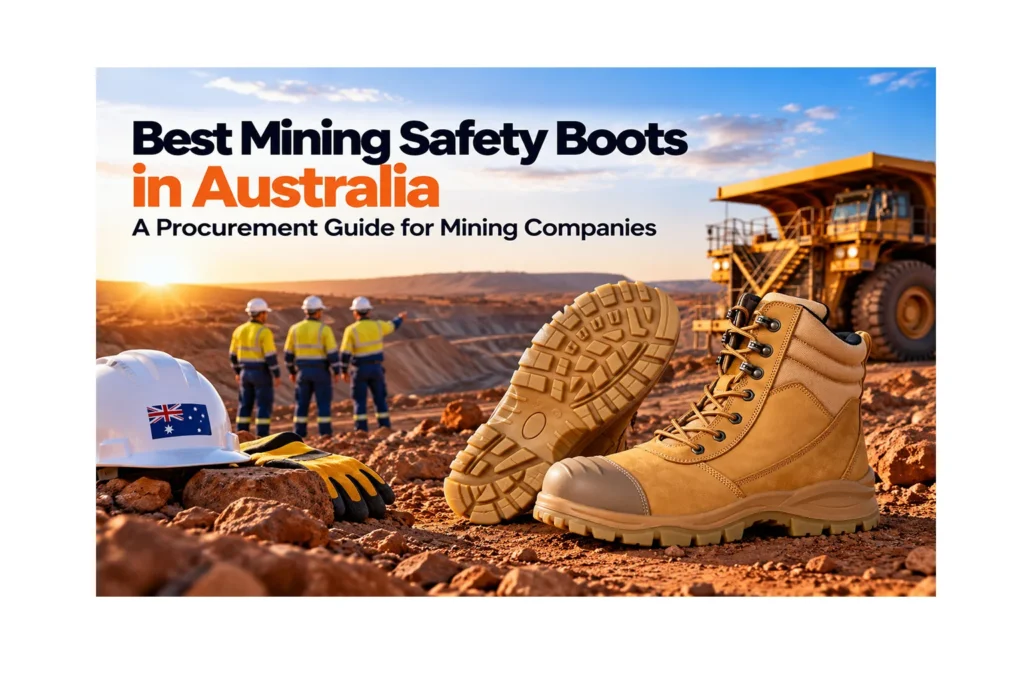
Choosing the right mining safety boots Australia operations require involves more than comparing footwear specifications or selecting a popular work boot brand.
For Australian mining companies, PPE distributors, procurement managers, and industrial footwear importers, safety boots are part of a larger operational supply programme. Workers need approved footwear in the correct sizes, at the right locations, and before their scheduled shifts begin.
This becomes particularly challenging for remote mining operations in Western Australia, Queensland, and other mining regions, where long transport distances, fly-in fly-out (FIFO) workforce arrangements, and changing production schedules can affect footwear availability.
A suitable mining boot may meet all technical requirements but still create procurement problems if replacement sizes are unavailable or deliveries consistently arrive late.
This guide focuses on the commercial and logistical side of mining footwear procurement, helping Australian B2B buyers plan purchasing volumes, manage remote-site inventory, evaluate suppliers, and control long-term footwear costs.
1. Why Mining Safety Boots Procurement Requires a Different Approach
Mining operations often purchase safety footwear for hundreds or thousands of workers across multiple locations.
Unlike a conventional workplace with predictable local deliveries, a remote mine may depend on scheduled freight services, regional distribution centres, and carefully managed stock.
The procurement challenge involves three connected requirements:
- Product approval: Every supplied model must satisfy the mine’s applicable protective requirements.
- Workforce availability: Approved footwear must be available in the sizes required by current and incoming workers.
- Supply continuity: Replacement stock must remain accessible throughout the operation.
A purchasing programme that addresses only the first requirement may still experience costly inventory shortages.
Mining Footwear as an Operational Supply Category
For large mining companies, safety boots should be managed as a recurring procurement category rather than an occasional equipment purchase.
This involves forecasting demand, maintaining approved product records, tracking footwear issuance, and reviewing supplier performance.
The objective is to provide suitable footwear consistently while reducing unnecessary stock and emergency purchasing.
2. Develop a Multi-Site Mining Footwear Procurement Strategy
Australian mining businesses may operate several sites with different workforce sizes, delivery arrangements, and footwear requirements.
A company with operations in the Pilbara, Bowen Basin, and regional New South Wales should not automatically assume that identical purchasing arrangements will work at every location.
Centralise Supplier Approval
A central procurement team can maintain a list of approved footwear models and suppliers.
This helps establish consistent commercial arrangements, documentation requirements, and purchasing procedures.
However, individual sites should retain responsibility for identifying their workplace hazards and confirming that the approved footwear is suitable.
Allow Site-Specific Inventory Planning
Although supplier approval may be centralised, inventory requirements should reflect each site’s conditions.
| Procurement Area | Central Procurement Team | Individual Mine Site |
|---|---|---|
| Supplier qualification | Primary responsibility | Provides operational feedback |
| Commercial agreements | Negotiates terms | Confirms service requirements |
| Product approval | Coordinates documentation | Confirms hazard suitability |
| Size distribution | Consolidates information | Collects workforce data |
| Replacement inventory | Sets planning framework | Monitors actual consumption |
| Supplier performance | Reviews overall results | Reports local delivery issues |
This approach combines purchasing consistency with operational flexibility.
3. Plan Mining Boots for FIFO Workforce Arrangements
Fly-in fly-out workforce arrangements create a distinctive challenge for Australian mining footwear procurement.
Workers may arrive at remote sites according to roster cycles, while new employees, contractors, and temporary personnel may join at different times.
Footwear shortages discovered during mobilisation can disrupt work readiness.
Forecast Demand Using Workforce Rosters
Procurement teams should coordinate with workforce planning and site administration.
Useful information includes:
- Expected worker numbers
- New employee commencement dates
- Contractor mobilisation schedules
- Required footwear sizes
- Approved footwear categories
- Existing suitable footwear
- Replacement demand
Example FIFO Footwear Planning Schedule
Consider a hypothetical mining operation preparing for workforce expansion.
| Period | New Workers | Initial Footwear Requirement |
|---|---|---|
| January | 40 | 40 pairs |
| February | 65 | 65 pairs |
| March | 35 | 35 pairs |
| April | 60 | 60 pairs |
| Total | 200 | 200 pairs |
These quantities assume one initial pair per new worker and exclude replacements or additional site-specific requirements.
The procurement team can use the mobilisation forecast to schedule deliveries before workers arrive.
Coordinate Footwear Issuance With Onboarding
Where possible, footwear sizing and approval should occur before mobilisation.
This may include fitting appointments, pre-arrival size confirmation, or coordination with a designated supplier.
The goal is to reduce situations where workers arrive at site without suitable protective footwear.
4. Build a Size Distribution Based on Actual Mining Workforce Data
For bulk purchasing, footwear size distribution can significantly affect inventory efficiency.
Ordering equal quantities of every available size is rarely an effective approach.
Use Historical Issuance Records
Mining companies can analyse previous footwear purchases and employee issuance records to identify commonly requested sizes.
However, historical information should be reviewed when workforce composition changes.
A new contractor group or expansion project may have a different size distribution from the existing workforce.
Example Mining Footwear Size Allocation
The following figures illustrate a hypothetical 500-pair order. They are not a recommended Australian workforce size distribution.
| AU/UK Footwear Size | Example Quantity |
|---|---|
| 5 | 15 |
| 6 | 30 |
| 7 | 60 |
| 8 | 100 |
| 9 | 120 |
| 10 | 95 |
| 11 | 55 |
| 12 | 25 |
| Total | 500 |
Actual orders should follow employee fitting data and the selected manufacturer’s size chart.
Account for Different Fits
Two boots labelled with the same size may fit differently.
Procurement teams should consider width options, manufacturer sizing variations, and worker feedback.
Where an approved model does not provide a suitable fit, an alternative approved product may be necessary.
5. Manage Replacement Stock at Remote Mining Sites
Remote mining operations cannot always rely on rapid replacement deliveries.
A missing footwear size may require shipment from a regional warehouse or distribution centre.
For this reason, mining boots Australia procurement programmes should include site-specific replacement inventory.
Calculate Average Replacement Demand
Start with actual footwear issuance and replacement records.
For example, suppose a mining operation records 180 replacement pairs over six months.
Average monthly replacement demand:
180 ÷ 6 = 30 pairs per month
If replenishment typically takes two months, expected demand during lead time is:
30 × 2 = 60 pairs
This provides a starting point for inventory planning, before accounting for uncertainty.
Add Safety Stock Based on Supply Risk
Additional inventory may be justified when:
- Delivery lead times vary significantly
- Transport routes are disrupted seasonally
- Certain sizes are frequently unavailable
- Supplier production schedules are unpredictable
- Emergency replenishment is expensive
The safety-stock quantity should be based on demand variability and delivery performance.
Use a Reorder Point
A basic inventory formula is:
Reorder Point = Expected Demand During Lead Time + Safety Stock
For example:
| Planning Variable | Illustrative Value |
|---|---|
| Average monthly replacement demand | 30 pairs |
| Replenishment lead time | 2 months |
| Expected lead-time demand | 60 pairs |
| Illustrative safety stock | 20 pairs |
| Reorder point | 80 pairs |
In this simplified example, a replenishment order is triggered when the inventory position reaches 80 pairs.
The model should also be applied to individual sizes or footwear categories where appropriate. A total of 80 pairs does not guarantee that the required sizes are available.
6. Reduce Inventory Problems With Approved Model Standardisation
Maintaining too many similar footwear models can make inventory planning difficult.
Each additional model may require separate size stock, supplier records, replacement arrangements, and purchasing controls.
Standardise Where Appropriate
Mining companies can consider a limited range of approved models for different operational requirements.
For example:
- A primary approved boot for general mine-site duties
- An alternative approved model for different fitting needs
- Specialist footwear for work requiring additional protection
Standardisation should never eliminate footwear options that are necessary for worker fit or hazard control.
Manage Model Changes Carefully
When a manufacturer updates or discontinues a boot, the purchasing team should assess the replacement model before approving it.
A new product code does not necessarily mean the footwear is equivalent.
Maintain records of the approved model, relevant documentation, effective dates, and any transition arrangements.
7. Compare Mining Safety Boots Using Annual Procurement Cost
The best mining boots Australia buyers select should offer appropriate protection and dependable supply, not simply the lowest purchase price.
For large mining operations, annual footwear expenditure can be substantial.
Example Annual Mining Boot Budget
Consider a hypothetical operation with 800 workers.
Assume an annual purchasing plan of 1,000 pairs, including initial issues and forecast replacements.
| Cost Component | Illustrative Amount |
|---|---|
| 1,000 pairs × A$120 | A$120,000 |
| Freight and regional distribution | A$8,000 |
| Inventory handling | A$4,000 |
| Size exchanges and returns | A$2,000 |
| Estimated annual programme cost | A$134,000 |
These figures are hypothetical and do not represent current Australian supplier quotations.
Actual expenditure depends on workforce requirements, footwear performance, transport arrangements, and replacement demand.
Monitor Cost per Pair Issued
Procurement teams can measure total footwear programme expenditure against the number of pairs issued.
However, a low cost per pair is not automatically evidence of a successful programme.
Purchasing performance should also be evaluated using stock availability, worker acceptance, and continued suitability.
8. Establish Supplier Delivery Agreements for Remote Mines
A dependable mining safety boots supplier should be able to support the delivery requirements of the operation.
For remote sites, delivery reliability may be as important commercially as the quoted footwear price.
Define Service Expectations
A purchasing agreement can specify:
- Standard order lead times
- Forecast-sharing procedures
- Delivery destinations
- Minimum stock commitments, if agreed
- Emergency replenishment arrangements
- Product substitution restrictions
- Order confirmation procedures
- Returns and warranty handling
- Escalation contacts
Prevent Unapproved Product Substitutions
A supplier should not replace an approved mining boot with a different model solely because the original product is unavailable.
Any proposed substitute should undergo the necessary technical and site approval before use.
Consider Regional Distribution Arrangements
Depending on purchasing volume, suppliers may offer consolidated shipments, scheduled deliveries, or inventory arrangements through Australian distribution partners.
These options should be assessed against total cost and service reliability.
9. Measure Mining Safety Footwear Supplier Performance
Mining companies can use a small number of procurement KPIs to identify supplier problems early.
| KPI | Measurement | Business Purpose |
|---|---|---|
| On-time delivery rate | Orders delivered by the agreed date | Measures delivery reliability |
| Order fill rate | Requested pairs supplied in full | Measures availability |
| Size availability | Required sizes available when needed | Identifies sizing shortages |
| Emergency order frequency | Unplanned urgent orders | Reveals forecasting problems |
| Product return rate | Returned pairs relative to issued pairs | Highlights potential issues |
| Documentation accuracy | Orders with correct required records | Supports procurement control |
| Complaint resolution time | Time to close reported issues | Measures supplier responsiveness |
Review Performance Regularly
Monthly reviews may be useful for active supply programmes, with broader quarterly assessments for supplier performance.
The review should identify recurring problems and agree on corrective actions.
For example, repeated shortages of one size may indicate that the inventory forecast needs adjustment rather than that the entire supplier relationship is unsuitable.
10. Evaluate Direct Manufacturers for Planned Mining Footwear Supply
Australian PPE distributors and large industrial buyers may consider direct factory sourcing when order quantities are predictable.
A mining safety boots manufacturer can potentially support planned production programmes, consistent specifications, and private-label product ranges.
Confirm Production Planning Capabilities
Ask whether the manufacturer can:
- Accept rolling demand forecasts
- Maintain agreed product specifications
- Support repeat orders
- Communicate production delays
- Coordinate staged shipments
- Provide relevant product documentation
Compare Factory Supply With Local Distribution
| Purchasing Requirement | Local Australian Supplier | Direct Manufacturer |
|---|---|---|
| Urgent replacement orders | Often advantageous | Depends on inventory arrangements |
| Smaller quantities | Usually more convenient | May require minimum orders |
| Planned large-volume orders | Supplier dependent | Potentially suitable |
| Custom branding | Supplier dependent | Often available |
| Local stockholding | May be available | Requires planning or a partner |
| Import administration | Usually managed upstream | May be buyer’s responsibility |
A hybrid model may work well for mining companies requiring both predictable bulk supply and urgent local replenishment.
11. OEM Mining Safety Boots for Australian PPE Distributors
For Australian distributors developing their own product ranges, OEM mining safety boots can offer commercial opportunities.
Private-label manufacturing may allow buyers to develop consistent branding, packaging, and product specifications for their target customers.
However, the business case should be based on genuine customer demand and a realistic repeat-order forecast.
Define the Target Customer
A distributor serving remote mining contractors may have different inventory and service requirements from a supplier serving regional industrial workshops.
Before starting OEM development, establish:
- Target mining customer segment
- Intended footwear applications
- Required protective performance
- Expected annual purchasing volume
- Distribution channels
- Branding and packaging needs
- Target commercial positioning
Plan Repeat Orders From the Beginning
A successful private-label programme requires more than a first production run.
Distributors should consider how they will manage ongoing size availability, product continuity, replenishment, and future design changes.
Any product modifications affecting protective performance must be appropriately assessed and supported by relevant documentation.
12. Create a Mining Footwear Procurement Scorecard
A procurement scorecard can help Australian buyers compare qualified suppliers consistently.
Mandatory safety and technical requirements should be verified before commercial scoring begins.
| Evaluation Area | Suggested Weight |
|---|---|
| Delivery reliability | 20% |
| Size availability | 20% |
| Product consistency | 15% |
| Replacement-stock support | 15% |
| Total programme cost | 15% |
| Documentation and order accuracy | 10% |
| Communication and issue resolution | 5% |
| Total | 100% |
These weights are illustrative rather than an official Australian procurement standard.
Buyers should adjust them according to operational risk, site location, and purchasing requirements.
13. Common Mining Footwear Procurement Mistakes
Ordering Without Workforce Forecasts
Purchasing quantities based only on previous orders can create shortages when new workers or contractors join the operation.
Holding Too Much Stock in Uncommon Sizes
Excess inventory ties up working capital and increases the risk of obsolete products.
Ignoring Regional Delivery Lead Times
A supplier’s production lead time does not necessarily include transport to a remote mine.
Allowing Unapproved Substitutions
Changing footwear models without the necessary approval can create safety and documentation problems.
Measuring Suppliers Only by Price
Low purchase prices do not compensate for repeated shortages, unreliable deliveries, or inconsistent products.
Failing to Review Replacement Data
Historical replacement records can reveal purchasing trends, recurring fit problems, and opportunities to improve inventory planning.
Frequently Asked Questions About Mining Safety Boots Australia
What Are the Best Mining Safety Boots Australia Mining Companies Should Buy?
The best mining safety boots are approved models that meet the hazards and working requirements of the mine, fit workers properly, and can be supplied reliably. Procurement teams should also evaluate replacement availability, delivery performance, and total programme cost.
How Should Remote Australian Mines Manage Safety Boot Inventory?
Remote mines should forecast replacement demand, monitor individual size availability, calculate replenishment lead times, and maintain appropriate safety stock. Reorder points should reflect both demand and delivery uncertainty.
How Can FIFO Mining Companies Plan Footwear Orders?
FIFO operations can use workforce rosters, onboarding schedules, contractor mobilisation forecasts, and historical size records to schedule footwear purchases before workers arrive on site.
Should Mining Companies Buy Boots Directly From Manufacturers?
Direct sourcing may be suitable for predictable, large-volume purchasing programmes. Local suppliers may be preferable for smaller or urgent orders. A combination of both can provide additional flexibility.
Can Australian Distributors Develop OEM Mining Safety Boots?
Yes. Manufacturers offering OEM services may support private-label development, custom branding, and planned bulk production. Buyers should verify the finished product’s protective suitability and supporting documentation.
How Often Should Mining Safety Boots Be Replaced?
There is no universal replacement interval. Footwear should be inspected and replaced when damage, excessive wear, poor fit, or loss of protective suitability makes continued use inappropriate.
What Is the Most Important KPI for Mining Footwear Suppliers?
There is no single KPI suitable for every operation. On-time delivery, size availability, order fill rate, and product consistency are useful measures when evaluating supplier reliability.
Conclusion
Selecting the best mining safety boots Australia operations require involves both workplace protection and dependable procurement management.
For Australian mining companies, successful footwear programmes depend on accurate workforce forecasts, practical size distribution, remote-site replacement inventory, and reliable supplier arrangements.
For PPE distributors and importers, long-term success also requires consistent manufacturing specifications, planned replenishment, and a clear understanding of customer demand.
By treating mining safety footwear as a managed supply category, businesses can improve availability, reduce avoidable purchasing costs, and support more reliable operations across multiple mining sites.
Source Wholesale and OEM Mining Safety Boots With Ocean Safety Shoes
Ocean Safety Shoes is a professional safety footwear manufacturer serving international PPE distributors, industrial footwear importers, wholesalers, and private-label brands.
We offer safety footwear manufacturing services, including OEM/ODM development, custom branding, and bulk production for industrial applications.
For Australian mining footwear buyers, our team can discuss product specifications, estimated purchasing volumes, size requirements, branding options, and planned production schedules.
Looking for a long-term mining safety boots manufacturing partner?
Contact Ocean Safety Shoes to discuss your wholesale or OEM mining footwear requirements for the Australian market.