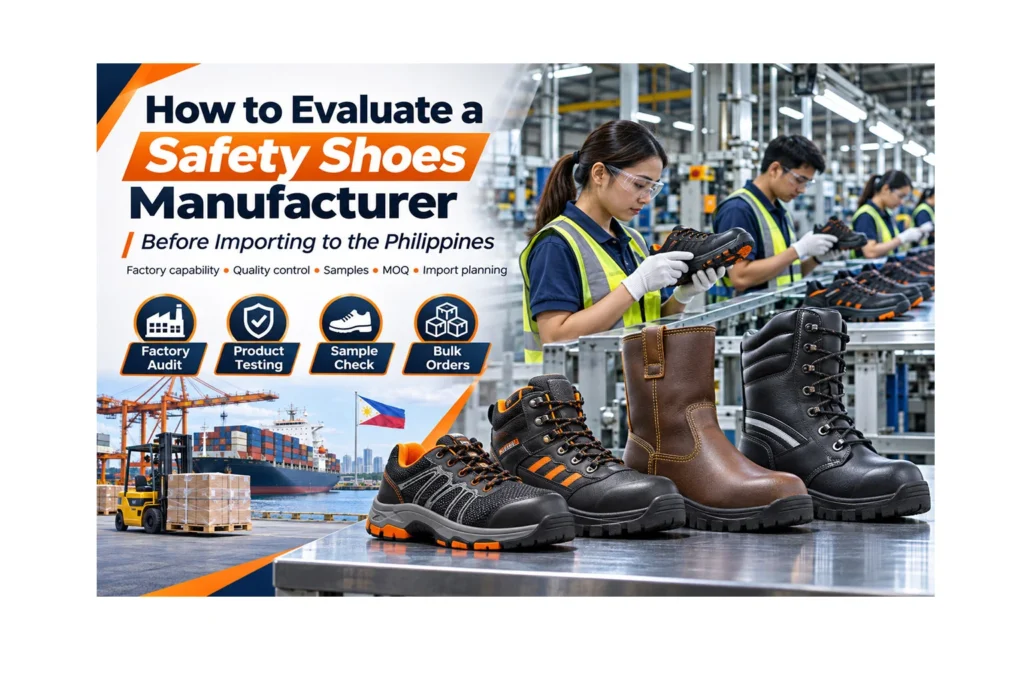
Choosing the right safety shoes manufacturer Philippines importers can rely on is an important step in building a profitable PPE distribution business. For wholesalers, industrial equipment suppliers, workwear distributors, and private-label brands, sourcing safety footwear from China can provide access to a wide range of product designs, manufacturing capabilities, and competitive bulk purchasing opportunities.
However, finding a manufacturer offering an attractive quotation does not necessarily mean you have found the right manufacturing partner.
Before importing, Philippine buyers need to evaluate factory capabilities, product quality, safety documentation, production consistency, minimum order quantities, and export experience. A supplier that performs well during initial negotiations may still create problems if it cannot maintain quality or meet delivery schedules.
This guide explains how to evaluate a safety shoes manufacturer China businesses can source from, what to inspect before placing bulk orders, and how to reduce sourcing risks when importing safety footwear into the Philippines.
It is particularly useful for:
- Philippine safety footwear distributors and wholesalers
- PPE importers and industrial equipment suppliers
- Construction and manufacturing supply businesses
- Workwear retailers developing their own product ranges
- Companies looking for OEM and private-label safety shoes
- Buyers planning to import safety shoes from China
The objective is to help B2B buyers make informed manufacturing decisions and establish reliable long-term supply relationships.
Why Manufacturer Evaluation Matters Before Importing Safety Shoes
Safety footwear is a specialised product. Its quality depends on more than the appearance of the upper material or the overall design.
Protective components, outsole construction, stitching, adhesives, material consistency, and manufacturing processes all influence the finished product.
For Philippine importers, choosing an unsuitable manufacturer can create several commercial problems.
| Potential problem | Possible business impact |
|---|---|
| Inconsistent product quality | Customer complaints and product returns |
| Unsupported safety claims | Product rejection or compliance concerns |
| Unreliable production capacity | Delayed customer orders |
| Poor size consistency | Inventory and fitting problems |
| Unclear MOQ requirements | Excessive inventory investment |
| Incomplete export documents | Customs clearance delays |
| Weak after-sales support | Difficulties resolving product issues |
These risks are particularly important when purchasing wholesale safety shoes Philippines distributors intend to resell to construction companies, warehouses, factories, and other industrial customers.
A proper manufacturer evaluation should therefore examine both manufacturing capability and commercial reliability.
Step 1: Verify Whether the Supplier Is a Real Manufacturer
The first step is determining whether you are communicating directly with a factory or with a trading company.
Both types of suppliers can be useful, but their responsibilities, production control, and pricing structures may differ.
Manufacturer vs Trading Company
A direct manufacturer generally manages production through its own facility or controlled manufacturing operations.
A trading company typically purchases products from one or more factories and coordinates sales, sourcing, and export activities.
| Evaluation factor | Direct manufacturer | Trading company |
|---|---|---|
| Production control | Usually has direct production involvement | Depends on partner factories |
| Product development | May provide direct technical support | Depends on factory relationships |
| Product range | Often reflects factory specialisation | May offer a wider selection |
| Customisation | Depends on production capability | Depends on manufacturing partners |
| Quality management | Can demonstrate factory procedures | Must explain supplier inspection arrangements |
| Communication | Direct access to production information may be available | May coordinate between buyer and factory |
Neither option automatically guarantees better quality or lower prices.
For buyers seeking long-term OEM production, understanding who actually manufactures the footwear is particularly important.
Documents to Request During Initial Verification
Ask the potential supplier to provide:
- Business registration information
- Factory address and contact details
- Manufacturing product catalogue
- Factory photographs or production videos
- Main product categories
- Production equipment information
- Quality management documentation
- Export experience and relevant references
Where possible, arrange a video factory tour or an independent factory inspection.
Confirm that the business name on the commercial quotation matches the entity responsible for the order and that the manufacturing arrangement is clearly explained.
How to Identify a Genuine Safety Shoes Factory China Buyers Can Trust
A professional factory should be able to explain its production processes rather than relying exclusively on sales presentations.
Ask specific questions about:
- Upper cutting and stitching
- Sole production and attachment
- Toe cap installation
- Midsole integration
- Lasting and shaping
- Finished-product inspection
- Packaging and shipment preparation
The answers should demonstrate a clear understanding of the footwear manufacturing process.
If a supplier cannot explain how its products are manufactured or refuses to identify the actual production facility, investigate further before paying a deposit.
Step 2: Evaluate the Manufacturer’s Product Range and Technical Capabilities
A good manufacturing partner should offer products that match your target customers and intended applications.
Philippine distributors may serve different industries, each with its own footwear requirements.
Check Available Safety Footwear Categories
Review whether the manufacturer can supply:
- Steel toe safety shoes
- Composite toe safety shoes
- Lightweight safety sneakers
- Mid-cut and high-cut safety boots
- Waterproof safety footwear
- Industrial safety gumboots
- Puncture-resistant footwear
- Specialised industrial safety shoes
A broad catalogue is useful, but product suitability matters more than the number of styles available.
Ask the manufacturer to identify which products are standard designs and which require additional development.
Evaluate Material and Construction Options
The materials used in safety footwear influence durability, comfort, appearance, and manufacturing costs.
Important components include:
| Component | What buyers should evaluate |
|---|---|
| Upper | Leather, synthetic materials, mesh, and construction quality |
| Toe cap | Steel, composite, or other specified protective materials |
| Outsole | Rubber, PU, dual-density PU, or other materials |
| Midsole | Protective properties and construction |
| Lining | Breathability, moisture management, and durability |
| Insole | Cushioning and wearing comfort |
| Stitching | Consistency, reinforcement, and workmanship |
Do not assume that two visually similar shoes have identical protective performance.
Request technical specifications for the exact model you intend to purchase.
Assess OEM and Private-Label Capabilities
If you plan to establish your own safety footwear brand in the Philippines, ask whether the manufacturer supports OEM or private-label production.
Potential options include:
- Custom logos
- Branded shoe boxes
- Custom product labels
- Colour adjustments
- Material selection
- Outsole design options
- Special packaging
- Product development
Clarify whether the requested customisation requires new tooling, sample development, or additional production costs.
Any modification involving protective components or construction should be assessed to determine whether additional testing is necessary.
Step 3: Check Safety Certifications and Product Testing
Product documentation is one of the most important areas when evaluating a safety footwear manufacturer.
A supplier’s general statement that its products are certified is not enough.
Philippine importers should establish which standards and protective requirements are relevant to their target customers before requesting supporting documents.
Request Product-Specific Test Reports
Depending on the product and intended application, request relevant evidence covering:
- Toe impact protection
- Toe compression resistance
- Puncture resistance
- Slip resistance
- Water resistance
- Antistatic properties
- Heat-resistant outsole performance
- Other specialised protective features
The manufacturer should identify the exact product model, applicable standard, edition, test laboratory, and report number.
Verify Certification Documents
When a supplier provides certification documents, check:
- The name of the issuing organisation.
- The exact product model covered.
- The standard and edition referenced.
- The issue date and validity, where applicable.
- The scope of certification.
- Whether the document can be independently verified.
An ISO 9001 certificate, for example, relates to an organisation’s quality management system. It does not independently certify that every safety shoe produced by that organisation meets a particular footwear performance standard.
The International Organization for Standardization also confirms that ISO itself does not issue certificates; certification is performed by independent certification bodies. https://www.iso.org/certification.html
For Philippine importers, the required product evidence should be determined by the intended market, workplace specifications, and applicable regulations.
Establish Product Documentation Requirements Before Ordering
Before approving a bulk order, request:
- Product specification sheets
- Relevant safety test reports
- Applicable certificates or declarations
- Material information
- Product labels and markings
- Quality inspection records
Keep these documents with your purchase order and approved sample records.
This makes it easier to verify that the delivered products match the agreed specifications.
Step 4: Request Samples and Conduct a Product Evaluation
Never rely exclusively on catalogue photographs when choosing a safety footwear manufacturer.
Samples allow buyers to assess the actual product before committing to large quantities.
What to Inspect During Sample Evaluation
A practical sample inspection should cover the following areas.
1. Upper material quality
Check the material surface, thickness, flexibility, stitching, and finishing.
Look for uneven seams, visible damage, weak stitching, or inconsistent materials.
2. Toe cap construction
Check the specified toe protection component and review the supporting test documentation.
Do not attempt to establish protective performance through appearance or informal impact testing.
3. Outsole construction
Inspect the outsole attachment, tread pattern, material consistency, and visible manufacturing defects.
Review relevant test evidence for any slip-resistance or specialised outsole claims.
4. Overall comfort and fit
Evaluate the internal space, heel fit, toe room, cushioning, and overall wearing experience.
If your customers include workers who wear footwear throughout long shifts, representative wearer trials can provide useful feedback.
5. Packaging and labelling
Check the shoe box, product markings, size labels, barcodes, and other agreed packaging requirements.
Compare Samples From Multiple Manufacturers
When possible, obtain samples from at least two or three shortlisted manufacturers.
Use the same evaluation criteria for each product.
| Evaluation area | Manufacturer A | Manufacturer B | Manufacturer C |
|---|---|---|---|
| Material quality | Evaluate | Evaluate | Evaluate |
| Construction | Evaluate | Evaluate | Evaluate |
| Comfort | Evaluate | Evaluate | Evaluate |
| Protective documentation | Evaluate | Evaluate | Evaluate |
| Packaging | Evaluate | Evaluate | Evaluate |
| Quoted price | Compare | Compare | Compare |
This approach makes supplier selection more objective and reduces the risk of choosing a product based on appearance or price alone.
Step 5: Evaluate Factory Production Capacity
A manufacturer may produce attractive samples but still lack the capacity to fulfil larger orders consistently.
For Philippine importers planning repeat purchases, production capacity is an important part of supplier evaluation.
Questions to Ask About Production
Ask the manufacturer:
- What is your normal monthly production capacity?
- How many production lines are available?
- What is the typical lead time for standard models?
- How long does OEM development take?
- Can you manufacture several models simultaneously?
- How do you manage peak-season demand?
- Can you support repeat orders?
- What happens if production is delayed?
The answers should be realistic and supported by production information where possible.
Understand the Manufacturing Process
A reliable factory should have an organised production workflow.
<CodeBlock language=”mermaid” editable> flowchart TD A[“Raw Material Inspection”] –> B[“Material Cutting”] B –> C[“Upper Stitching”] C –> D[“Toe Cap and Midsole Assembly”] D –> E[“Lasting and Sole Attachment”] E –> F[“Finishing and Cleaning”] F –> G[“Finished Product Inspection”] G –> H[“Packaging”] H –> I[“Shipment Preparation”] </CodeBlock>
Not every safety shoe factory uses exactly the same process. The workflow will depend on the footwear design and manufacturing technology.
However, the manufacturer should be able to explain how quality is controlled at important production stages.
Check Repeat-Order Consistency
For wholesale businesses, consistent repeat orders are often more important than receiving a low price on the first purchase.
Ask how the factory controls:
- Material specifications
- Product dimensions
- Colour consistency
- Size grading
- Protective components
- Outsole construction
- Finished-product quality
Establish written procedures for notifying buyers about product or material changes.
Step 6: Compare MOQ, Pricing, and Total Purchasing Costs
Price is an important consideration when selecting a China safety shoes supplier, but the lowest quotation does not necessarily offer the best commercial value.
Understand Minimum Order Quantities
Manufacturers may set different MOQs depending on the product design, materials, colours, and customisation requirements.
For example, standard products may have different order requirements from newly developed private-label designs.
Ask for separate MOQ information for:
- Standard models
- Custom colours
- Custom logos
- Special packaging
- New product development
- Mixed-size orders
For businesses entering the Philippine market, a manageable initial order may be preferable to purchasing excessive inventory simply to obtain a lower unit price.
Request Tiered Wholesale Pricing
Ask manufacturers to provide quotations for several order quantities.
For example:
| Order quantity | Quotation purpose |
|---|---|
| 300 pairs | Initial market testing |
| 500 pairs | Moderate wholesale purchasing |
| 1,000 pairs | Larger commercial order |
| 2,000 pairs | Higher-volume purchasing |
These are suggested quotation scenarios, not universal manufacturer MOQs.
Compare the price differences against the additional inventory investment.
Calculate the Landed Cost in the Philippines
The factory price is only one component of your final purchasing cost.
A more useful calculation is:
Landed cost per pair = Total applicable import and purchasing expenses ÷ Number of usable pairs received
Depending on the shipment, costs may include:
- Product purchase price
- International freight
- Cargo insurance
- Customs duties
- Applicable import taxes
- Customs clearance and handling
- Inspection expenses
- Local delivery
The Philippine Bureau of Customs provides importation guidance and identifies common commercial documents, including invoices, packing lists, transport documents, and certificates of origin where applicable. https://customs.gov.ph/guidelines-on-importation/
Buyers should also confirm the correct tariff classification and applicable import requirements before shipment.
The Philippine National Trade Repository lists footwear under Chapter 64, with classifications depending on footwear construction and materials. https://pntr.gov.ph/browse-commodity/chapter-64/
For accurate duty calculations, use the Philippine Tariff Finder and consult a qualified customs broker.
Do not assume that all safety shoes use the same HS or AHTN code.
Step 7: Verify the Manufacturer’s Export Experience
A manufacturer may be capable of producing good footwear but have limited experience handling international shipments.
For Philippine importers, export experience can make a significant difference in communication, documentation, and delivery coordination.
Ask About Previous Export Markets
Find out whether the manufacturer has supplied customers in:
- Southeast Asia
- Australia
- New Zealand
- Europe
- The Middle East
- Other international markets
Previous export experience is useful, although it does not automatically guarantee product suitability or regulatory compliance in the Philippines.
Ask for relevant references or examples of previous export orders where available.
Check Export Documentation Capability
Confirm whether the supplier can prepare or coordinate the documents required for your shipment.
Common documents include:
- Commercial invoice
- Packing list
- Bill of lading or air waybill
- Sales contract, where applicable
- Certificate of origin, where applicable
- Supporting product documentation
The final document requirements depend on the shipment and applicable Philippine import procedures.
Understand the Shipping Terms
Before approving the purchase order, clarify the agreed Incoterms and named delivery location.
For example, FOB and CIF quotations allocate certain transport responsibilities and costs differently.
Confirm:
- Who arranges international freight
- Who handles export clearance
- Who purchases cargo insurance
- Who is responsible for Philippine import clearance
- Which destination charges are included
- When risk transfers between the parties
Clear commercial terms help avoid unexpected expenses and disagreements.
Step 8: Assess Communication and After-Sales Support
A manufacturing relationship involves more than product delivery.
For wholesale buyers, good communication helps prevent misunderstandings during sampling, production, inspection, and repeat orders.
Evaluate Communication Quality
Pay attention to how the supplier responds during the quotation and sample stages.
A reliable manufacturer should be able to:
- Answer technical questions clearly
- Explain product specifications
- Provide realistic lead times
- Communicate production changes
- Respond to quality concerns
- Provide clear commercial quotations
If a supplier cannot explain its products before receiving an order, this may indicate potential difficulties during production.
Confirm Quality Issue Procedures
Before ordering, ask how the manufacturer handles:
- Manufacturing defects
- Incorrect sizes
- Damaged products
- Missing quantities
- Packaging discrepancies
- Product specification deviations
Agree on the inspection process and how complaints should be documented.
For repeat orders, establish a written procedure for investigating problems and agreeing on corrective actions.
Step 9: Consider OEM and Private-Label Manufacturing
For Philippine distributors looking to build their own brands, working directly with a manufacturer may provide greater control over product selection and branding.
A suitable factory may support:
- Custom safety shoe designs
- Private-label branding
- Custom packaging
- Material selection
- Logo development
- Product colour options
- Specialised protective configurations
What to Confirm Before Starting an OEM Project
Discuss the following details:
| OEM requirement | What to confirm |
|---|---|
| Product design | Existing model or new development |
| Logo | Placement, method, and artwork |
| Packaging | Custom shoe boxes and labels |
| MOQ | Minimum order per model or design |
| Samples | Development costs and approval process |
| Testing | Requirements for the final configuration |
| Lead time | Development and mass production |
| Design ownership | Rights and restrictions concerning custom designs |
For private-label products, buyers should be especially careful about safety documentation.
A change in the toe cap, outsole, midsole, materials, or construction may affect the relevance of existing test evidence.
Always assess the final product configuration before making protective performance claims.
Safety Shoes Manufacturer Evaluation Scorecard
A structured scorecard helps Philippine importers compare shortlisted factories using consistent criteria.
The following example can be adapted to your purchasing requirements.
| Evaluation category | Suggested weight |
|---|---|
| Manufacturing capability | 20% |
| Product quality and samples | 20% |
| Safety documentation | 20% |
| Pricing and MOQ | 15% |
| Production capacity | 10% |
| Export experience | 10% |
| Communication and support | 5% |
| Total | 100% |
You can rate each manufacturer from 1 to 5 for every category.
For example:
- 1 = Poor
- 2 = Below expectations
- 3 = Acceptable
- 4 = Good
- 5 = Excellent
Multiply each category score by its assigned weight to calculate an overall evaluation score.
The weights are illustrative. Buyers should increase the importance of product testing or quality assurance when supplying customers with particularly demanding protective requirements.
Importantly, a high commercial score should never compensate for missing evidence of a critical safety requirement.
Warning Signs When Choosing a Safety Shoes Factory China Supplier
Before making a deposit, watch for these common warning signs.
Extremely Low Prices Without Clear Specifications
An unusually low quotation may reflect different materials, missing protective components, or a different product configuration.
Always compare equivalent specifications.
Refusal to Provide Samples
A manufacturer that refuses reasonable sample requests makes it difficult to verify product quality before bulk production.
Unverifiable Certificates
Certificates without identifiable issuing organisations, product details, or verification information should be investigated.
Unclear Factory Information
If the supplier cannot explain where products are manufactured or who controls production, request additional verification.
Unrealistic Production Promises
Extremely short lead times or unusually high capacity claims should be checked against actual factory resources.
No Written Quality Agreement
A professional commercial order should clearly define product specifications, inspection criteria, packaging, delivery, and procedures for handling defects.
Avoid relying entirely on verbal promises.
Pre-Importing Checklist for Philippine Buyers
Before placing a commercial order with a safety shoes manufacturer Philippines importers are considering, complete the following checks.
- Verify the supplier’s legal business identity.
- Confirm the actual manufacturing location.
- Review the factory’s production capabilities.
- Identify the intended product applications.
- Request detailed product specifications.
- Obtain relevant safety test reports and documents.
- Evaluate samples from shortlisted manufacturers.
- Confirm product quality control procedures.
- Check production capacity and lead times.
- Compare MOQ and tiered pricing.
- Calculate the estimated landed cost.
- Confirm export documentation arrangements.
- Establish payment and shipping terms.
- Agree on quality inspection procedures.
- Confirm repeat-order and after-sales arrangements.
Completing these checks before production can help reduce purchasing uncertainty and improve supplier selection.
Frequently Asked Questions
How Do I Find a Reliable Safety Shoes Manufacturer in the Philippines?
Philippine importers can evaluate overseas factories by checking business credentials, manufacturing capability, product samples, safety documentation, production capacity, and export experience. Comparing several manufacturers using the same evaluation criteria can help identify suitable partners.
Should Philippine Importers Buy Directly From a China Safety Shoes Manufacturer?
Direct sourcing can be attractive for businesses purchasing larger quantities, developing private-label brands, or requiring customised products. However, buyers must evaluate production quality, supplier reliability, shipping costs, and import requirements before deciding.
What Documents Should I Request From a Safety Shoes Factory China Supplier?
Request business registration information, product specifications, relevant test reports, applicable certificates or declarations, quality control records, and export documentation. Verify that product-specific documents relate to the exact model being purchased.
How Can I Check Whether a Safety Shoes Manufacturer Is Genuine?
Review business registration details, confirm the factory address, request production photographs or videos, arrange a video factory tour, and consider an independent factory inspection. Verify that the entity accepting payment and signing the purchase agreement is clearly identified.
What Is a Reasonable MOQ for Wholesale Safety Shoes Philippines Distributors?
MOQ varies according to product design, materials, customisation, and factory production arrangements. Ask manufacturers for separate quotations for standard products and private-label orders rather than assuming that all models have the same MOQ.
Is ISO 9001 Certification Enough to Prove Safety Shoe Quality?
No. ISO 9001 relates to an organisation’s quality management system. It does not independently demonstrate that a specific safety shoe model meets a particular footwear performance standard. Request relevant product-specific test evidence as well.
Can Chinese Manufacturers Produce Private-Label Safety Shoes for Philippine Brands?
Yes. Many manufacturers offer OEM and private-label development options. Confirm MOQ, sample development, branding costs, product specifications, testing requirements, and production lead times before starting the project.
What Should I Check Before Paying a Deposit?
Confirm the supplier’s identity, final product specifications, approved sample, agreed price, MOQ, payment terms, production schedule, inspection requirements, and delivery arrangements. Ensure these details are documented in the purchase order or sales contract.
Conclusion
Choosing the right safety shoes manufacturer Philippines importers can depend on requires more than comparing factory quotations.
A reliable manufacturing partner should demonstrate genuine production capability, consistent product quality, relevant safety documentation, realistic production schedules, and the ability to support repeat orders.
For Philippine distributors, wholesalers, and PPE importers, the most effective sourcing strategy is to:
- Verify the manufacturer before ordering.
- Evaluate actual products through samples.
- Review product-specific safety documentation.
- Assess factory capacity and quality control.
- Compare MOQ, pricing, and landed costs.
- Confirm export and shipping arrangements.
- Establish clear procedures for repeat orders and quality issues.
A structured evaluation process helps businesses reduce sourcing risks, protect inventory investment, and develop a more dependable safety footwear supply chain.
Find a Manufacturing Partner for Your Safety Footwear Business
Ocean Safety Shoes provides safety footwear manufacturing solutions for international B2B buyers, including importers, wholesalers, distributors, and private-label brands.
Our product range includes different safety footwear styles designed for industrial and workplace applications.
Explore the Ocean Safety Shoes product range to review available styles and discuss your sourcing requirements.
For Philippine buyers interested in wholesale purchasing or OEM development, prepare the following information when requesting a quotation:
- Target footwear category
- Intended workplace applications
- Required protective features
- Estimated order quantity
- Size assortment
- Branding and packaging requirements
- Required product documentation
Providing clear specifications helps establish a more accurate basis for product selection, sample evaluation, and manufacturing quotations.
Looking for a China safety shoes manufacturer for your Philippine distribution business?
Contact Ocean Safety Shoes to discuss product options, wholesale sourcing, and private-label manufacturing opportunities.