
Every day, thousands of Australian workers step onto construction sites, enter warehouses, climb scaffolding, or operate heavy machinery without giving much thought to their footwear. Yet a single dropped tool, sharp nail, slippery floor, or electrical hazard can turn an ordinary workday into a serious accident.
That’s why safety shoes are far more than just another piece of workwear. They are an essential part of Personal Protective Equipment (PPE) that helps protect workers, reduce workplace injuries, and improve productivity across industries.
If you’ve ever wondered “What is AS 2210.3:2019?”, you’re not alone. Many procurement managers, distributors, safety officers, and business owners encounter this Australian standard when sourcing industrial safety shoes or protective work shoes, but few fully understand what it means.
This comprehensive guide explains everything you need to know about AS 2210.3:2019 safety boots, including their requirements, classifications, protection features, industry applications, buying tips, maintenance advice, and how to choose the right workplace safety footwear for your business.
What Are Safety Shoes and Why Are They Important?
Safety shoes are specially engineered footwear designed to protect workers from hazards that ordinary shoes simply cannot withstand. Unlike casual work shoes, industrial safety shoes are manufactured to meet recognized safety standards and undergo rigorous testing before reaching the market.
They play a critical role in modern PPE programs by protecting workers against:
- Falling objects
- Heavy compression
- Sharp objects penetrating the sole
- Slips and falls
- Electrical hazards
- Heat exposure
- Cold environments
- Water penetration
- Oil and fuel contamination
In industries such as construction, manufacturing, mining, warehousing, logistics, transportation, and oil & gas, wearing certified safety footwear is often a workplace requirement rather than a personal choice.
Even a relatively small foot injury can result in lost working hours, compensation claims, delayed projects, and reduced productivity. Investing in quality protective work shoes helps businesses minimize these risks while improving employee confidence and comfort.
What Is AS 2210.3:2019?
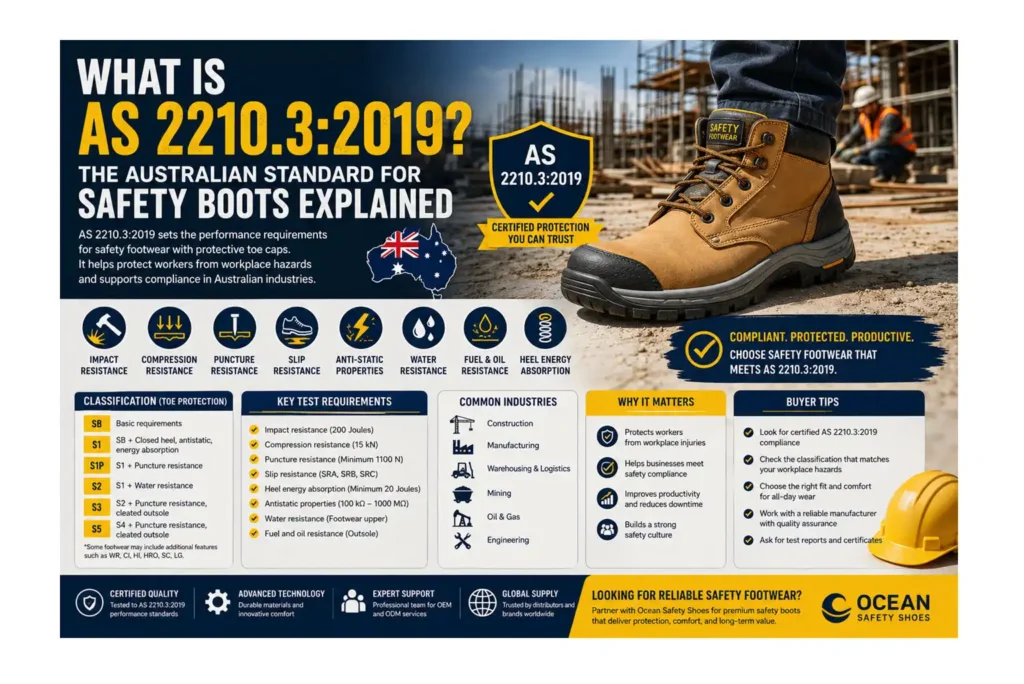
AS 2210.3:2019 is the Australian Standard that specifies performance requirements for general-purpose safety footwear with protective toe caps.
It replaced the earlier AS/NZS 2210.3:2009 standard and aligns closely with internationally recognized footwear safety requirements while addressing Australian workplace expectations.
Rather than describing how a boot should look, the standard defines how it must perform during testing.
Manufacturers must demonstrate that the footwear meets specific requirements relating to protection, durability, and safety before claiming compliance.
Common protection areas include:
- Protective toe impact resistance
- Compression resistance
- Slip resistance
- Heel energy absorption
- Penetration resistance
- Water resistance
- Fuel and oil resistance
- Antistatic properties
For Australian buyers, AS 2210.3:2019 provides confidence that certified safety boots have been assessed according to recognized testing procedures suitable for industrial workplaces.
Why AS 2210.3:2019 Matters
The standard benefits everyone involved in workplace safety.
For workers, it provides dependable protection.
For employers, it supports workplace compliance while reducing injury risks.
For importers and distributors, it provides confidence that supplied products meet Australian market expectations.
For procurement teams, it offers a common technical language when comparing different products.
Choosing certified workplace safety footwear isn’t simply about checking a box on a purchasing list—it’s about protecting people.
Different Types of Safety Shoes Explained
Not every workplace requires the same type of footwear. Different environments create different hazards, which is why manufacturers produce various types of industrial safety shoes.
Steel Toe Safety Shoes
Steel toe shoes remain one of the most popular choices worldwide.
Features
- Steel protective toe cap
- Excellent impact protection
- High compression resistance
- Durable construction
Benefits
- Maximum toe protection
- Proven reliability
- Suitable for heavy industrial work
Best Applications
- Construction
- Manufacturing
- Mining
- Warehouses
- Heavy engineering
Composite Toe Safety Shoes
Composite toe footwear uses materials such as fiberglass, carbon fiber, or reinforced plastics instead of steel.
Features
- Metal-free construction
- Lightweight
- Non-conductive
- Comfortable for long shifts
Benefits
- Reduced fatigue
- Airport-friendly
- Better thermal insulation
- Comfortable in cold weather
Best Applications
- Electrical work
- Airports
- Warehouses
- Logistics
- Security-sensitive environments
Slip Resistant Safety Shoes
Slips remain one of the leading causes of workplace injuries.
Slip resistant safety footwear uses specially designed rubber or PU outsoles that improve grip on wet, oily, or smooth surfaces.
Features
- High-traction outsole
- Multi-directional tread
- Oil-resistant compounds
Benefits
- Better stability
- Fewer slip accidents
- Improved confidence
Best Applications
- Food processing
- Warehouses
- Hospitals
- Kitchens
- Logistics centers
Waterproof Safety Shoes
Outdoor workers often encounter rain, mud, and standing water.
Waterproof safety shoes combine treated leather or synthetic uppers with waterproof membranes to keep feet dry.
Features
- Waterproof lining
- Water-resistant upper
- Sealed construction
Benefits
- Dry feet
- Improved comfort
- Better protection during outdoor work
Best Applications
- Construction
- Agriculture
- Utilities
- Landscaping
- Road maintenance
Electrical Hazard Safety Shoes
Electrical hazard footwear is designed to reduce the risk of electrical shock under specified conditions.
Features
- Electrical insulation
- Specialized outsole materials
- Non-conductive components
Benefits
- Increased electrical protection
- Reduced workplace risk
Best Applications
- Electricians
- Utility workers
- Maintenance technicians
- Industrial facilities
How to Choose the Right Safety Shoes
Selecting the right safety shoes involves much more than choosing a popular style.
1. Consider the Workplace Environment
Different workplaces present different hazards.
Construction sites often require puncture resistance and waterproof protection.
Factories may prioritize impact protection.
Warehouses usually emphasize lightweight comfort and slip resistance.
Outdoor workers need weather protection.
Always start by identifying the actual hazards.
2. Match the Protection Requirements
Think carefully about the risks workers face.
Questions to ask include:
- Is toe protection required?
- Is puncture resistance necessary?
- Will workers encounter slippery surfaces?
- Are electrical hazards present?
- Will workers be exposed to water?
The answers determine which protective work shoes are appropriate.
3. Prioritize Comfort
Workers spend eight, ten, or even twelve hours wearing safety footwear.
Comfort directly affects productivity.
Look for:
- Proper sizing
- Wide-fit options
- Cushioned PU footbeds
- Breathable lining
- Lightweight construction
- Shock absorption
Comfortable workers are more likely to wear PPE correctly throughout the day.
4. Evaluate Durability
Quality materials reduce replacement costs.
Pay attention to:
- Full-grain leather
- Premium microfiber
- Strong stitching
- Durable rubber outsoles
- High-quality PU midsoles
Long-lasting industrial safety shoes provide better value over time.
5. Check Safety Standards
Depending on your market, products may need to comply with:
- AS 2210.3:2019
- EN ISO 20345
- ASTM F2413
Always request supporting certification and test reports from suppliers.
Common Mistakes When Buying Safety Shoes
Choosing Price Over Quality
Cheap footwear often wears out quickly and may provide poor protection.
Solution: Evaluate total ownership cost rather than purchase price.
Ignoring Comfort
Uncomfortable footwear reduces worker compliance.
Solution: Select ergonomic designs with proper cushioning.
Buying the Wrong Protection Level
Heavy-duty boots aren’t always necessary.
Solution: Match footwear to workplace hazards.
Overlooking the Working Environment
Indoor and outdoor workplaces require different footwear.
Solution: Consider weather, flooring, and job tasks.
Forgetting Maintenance
Even premium footwear deteriorates without care.
Solution: Establish regular inspection and maintenance routines.
Safety Shoes Materials and Technologies
Modern safety footwear combines advanced materials with practical design.
Upper Materials
Full-Grain Leather
- Excellent durability
- Water resistance
- Long service life
Microfiber
- Lightweight
- Easy to clean
- Consistent quality
Mesh Fabrics
- Superior breathability
- Ideal for warm environments
Outsole Technologies
PU Outsole
- Lightweight
- Comfortable
- Excellent shock absorption
Rubber Outsole
- Outstanding slip resistance
- Heat resistance
- Abrasion resistance
PU/Rubber Combination
Combines cushioning with exceptional grip.
Comfort Technologies
- Breathable mesh lining
- PU footbeds
- EVA midsoles
- Ergonomic lasts
- Energy-return cushioning
Toe Protection Options
Steel Toe
Maximum impact protection.
Composite Toe
Lightweight, metal-free protection with excellent comfort.
Benefits of Investing in Quality Safety Shoes
High-quality safety footwear benefits both employees and employers.
Reduce Workplace Injuries
Proper footwear significantly lowers the risk of foot injuries.
Improve Employee Comfort
Comfortable employees experience less fatigue.
Increase Productivity
Workers who feel comfortable maintain better focus.
Lower Replacement Costs
Premium footwear generally lasts longer.
Strengthen Safety Culture
Providing quality PPE demonstrates commitment to employee wellbeing.
Safety Shoes Buying Guide for Businesses
For distributors, importers, wholesalers, and PPE buyers, selecting the right supplier is just as important as selecting the right product.
Consider the following:
Bulk Purchasing
Choose suppliers with stable production capacity and reliable delivery schedules.
Supplier Evaluation
Evaluate:
- Manufacturing experience
- Certifications
- Quality control
- Customer references
Customization
Professional factories should offer:
- OEM services
- ODM development
- Private labeling
- Custom packaging
- Logo printing
Quality Inspection
Request:
- Material inspections
- Production inspections
- Final random inspections
Packaging
Good export packaging reduces shipping damage while enhancing brand image.
Frequently Asked Questions About Safety Shoes
1. How long do safety shoes usually last?
Most quality safety shoes last between 6 and 18 months, depending on working conditions, usage frequency, and maintenance.
2. Are steel toe safety shoes better than composite toe shoes?
Neither is universally better. Steel toe shoes offer excellent impact protection, while composite toe shoes are lighter and metal-free. The right choice depends on your workplace requirements.
3. What industries require safety shoes?
Construction, manufacturing, logistics, warehousing, mining, transportation, oil & gas, utilities, and many industrial workplaces commonly require certified safety footwear.
4. Are safety shoes comfortable for all-day wear?
Modern safety shoes are designed with cushioned footbeds, breathable linings, lightweight materials, and ergonomic construction to improve comfort during long shifts.
5. How do I choose the correct size?
Measure your feet while wearing work socks, allow adequate toe room, and choose footwear that fits securely without excessive tightness.
6. How often should safety shoes be replaced?
Replace safety shoes when the outsole becomes worn, the toe cap is damaged, the upper loses structural integrity, or the footwear no longer provides adequate protection.
7. What safety standards should safety shoes meet?
This depends on your target market. Common standards include AS 2210.3:2019 for Australia, EN ISO 20345 for Europe, and ASTM F2413 for the United States.
8. Can safety shoes prevent workplace injuries?
Yes. Certified safety footwear helps reduce injuries caused by impact, compression, punctures, slips, and other common workplace hazards when properly selected and maintained.
Conclusion
Whether you’re purchasing PPE for a construction company, managing warehouse operations, or sourcing products for distribution, understanding AS 2210.3:2019 is essential.
High-quality safety shoes are much more than protective footwear—they are a long-term investment in worker safety, operational efficiency, and business success. By selecting certified industrial safety shoes that match your workplace hazards, prioritizing comfort and durability, and partnering with reliable manufacturers, businesses can reduce workplace injuries while improving employee confidence and productivity.
The right safety footwear not only meets regulatory requirements but also supports a stronger workplace safety culture and delivers better value throughout its service life.
Looking for a Reliable Safety Shoes Manufacturer?
With over 15 years of experience manufacturing Australian-style safety footwear, Ocean Safety Shoes is a trusted OEM and ODM partner for global PPE brands, distributors, and importers. We have produced safety boots for well-known brands including Bata Industrials, Master, and K-Mart, and our factory is Australian safety footwear factory audited, with products certified by BSI to Australian standards.
Whether you’re developing a new product line or expanding your existing range, our experienced team can provide certified safety footwear, private-label manufacturing, and reliable production support. Contact Ocean Safety Shoes today to request samples, discuss your OEM/ODM project, and receive a competitive wholesale quotation for premium safety footwear built for the Australian and international markets.