
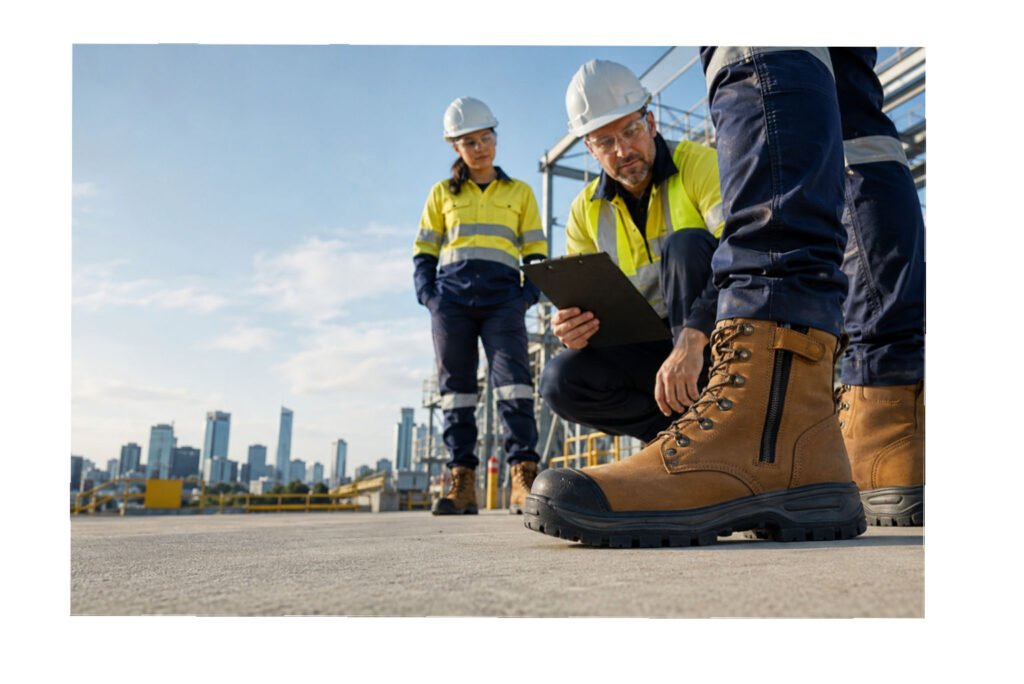
A construction worker arrives on site for what looks like a routine shift. Before lunch, a steel component falls near his feet, rain makes the access area slippery, and sharp offcuts appear around the work zone. His safety footwear may be the only barrier between these hazards and a serious injury.
Foot protection is sometimes treated as a simple purchasing decision: choose a work boot with a toe cap, check the price, and place the order. In reality, selecting safety shoes for an Australian workplace requires a clear understanding of the hazards, the worker, the task, and the relevant standard.
The main Australian product standard for safety footwear is AS 2210.3:2019, Personal protective equipment, Part 3: Safety footwear. It specifies basic and optional requirements for safety footwear used for general purposes. The standard is a modified adoption of ISO 20345:2011 and is currently listed by Standards Australia as current.
However, compliance with a product standard is only one part of the decision. Employers must also select footwear that fits properly, suits the working environment, remains comfortable throughout the shift, and addresses the hazards identified in the workplace risk assessment.
This guide explains the Australian safety footwear standard, common protection markings, different types of safety shoes, selection criteria, maintenance, and practical buying advice for workers, safety managers, distributors, and PPE procurement specialists.
What Is the Australian Standard for Safety Footwear?
The principal Australian standard is:
AS 2210.3:2019 — Personal protective equipment, Part 3: Safety footwear (ISO 20345:2011, MOD)
According to Standards Australia, AS 2210.3:2019 specifies basic and additional optional requirements for general-purpose safety footwear.
The standard covers important performance areas such as:
- Toe protection against impact and compression
- Footwear construction and ergonomic performance
- Upper and outsole strength
- Sole durability and flex resistance
- Slip resistance
- Electrical properties
- Water resistance
- Penetration resistance
- Heat and cold insulation
- Energy absorption in the heel area
- Resistance to fuel oil
- Outsole resistance to hot contact
Safety footwear claiming compliance should be tested according to the applicable methods and supplied with markings and documentation that identify the protection it provides.
Other Relevant Standards in the AS 2210 Series
Two related standards help complete the Australian safety footwear framework.
AS 2210.2:2019 — Personal protective equipment, Method 2: Test methods for footwear
This standard specifies laboratory testing methods for PPE footwear. Its tests cover areas such as toe-cap impact resistance, compression resistance, penetration resistance, electrical resistance, slip resistance, upper performance, sole abrasion, flexing, water resistance and outsole bond strength. Standards Australia lists AS 2210.2:2019 as current.
AS/NZS 2210.1:2025 — Safety and occupational footwear, Part 1: Guide to selection, care and use
Published in 2025, this standard provides guidance on selecting, using and maintaining safety and occupational footwear. It replaced the 2010 edition. Procurement teams should therefore avoid relying on an old care-and-selection reference when preparing new policies or tender documents. See the current listing for AS/NZS 2210.1:2025.
In simple terms:
- AS 2210.3:2019 tells manufacturers and buyers what safety footwear must achieve.
- AS 2210.2:2019 describes how its performance is tested.
- AS/NZS 2210.1:2025 helps workplaces select, use and care for the footwear.
What Are Safety Shoes and Why Are They Important?
Safety shoes are protective work shoes designed to reduce the risk of foot injuries. Unlike ordinary shoes or fashion boots, compliant safety footwear is manufactured and tested for specific workplace hazards.
The toe area is a major difference. Under AS 2210.3:2019, safety footwear incorporates a protective toe cap designed for a 200-joule impact level. This category should not be confused with lighter protective or occupational footwear that may be designed for different levels of risk.
Safety shoes form part of a worker’s personal protective equipment. Safe Work Australia identifies safety boots as PPE, but it also makes an important point: PPE should not be the only control used when hazards can be eliminated or reduced through more effective measures.
For example, a factory should not rely on steel toe safety shoes while ignoring unstable material storage. A warehouse should not issue slip resistant safety shoes as a substitute for repairing leaking equipment or improving floor cleaning. Footwear supports the hierarchy of controls; it does not replace it.
Hazards Addressed by Workplace Safety Footwear
Depending on its design and certified properties, safety footwear can help protect against:
- Falling tools, components and building materials
- Rolling drums, pallets or mobile equipment
- Compression around the toe area
- Nails, screws, metal offcuts and other sharp objects
- Wet, oily or contaminated walking surfaces
- Water and weather exposure
- Heat or cold transmitted through the sole
- Fuel oil and selected workplace substances
- Static electricity in controlled environments
- Abrasion caused by kneeling or contact with rough surfaces
These hazards are common in construction, manufacturing, logistics, mining, agriculture, transport, warehousing, utilities and oil and gas operations.
Understanding AS 2210.3 Safety Footwear Classifications
A boot should not be selected simply because the box says “safety approved.” Buyers need to understand its classification and any additional markings.
SB: Basic Safety Footwear
SB is the basic safety category. It includes fundamental requirements such as a 200-joule protective toe cap.
An SB boot may be appropriate where the primary identified hazard is impact or compression. However, many Australian workplaces need additional properties such as antistatic performance, energy absorption, water-resistant uppers or penetration resistance.
S1 Safety Footwear
S1 footwear normally adds important workplace properties to the basic requirements, including:
- Closed seat region
- Antistatic performance
- Energy absorption in the heel
- Resistance of the outsole to fuel oil
S1 safety shoes are commonly considered for dry indoor areas such as warehouses, assembly facilities and some logistics environments.
S2 Safety Footwear
S2 includes the S1 properties and adds resistance to water penetration and water absorption in the upper.
It can be useful in workplaces where workers may encounter damp surfaces, occasional rain or light water exposure. It does not automatically mean the footwear is completely waterproof. A water-resistant leather upper and a fully waterproof bootie construction are not the same thing.
S3 Safety Footwear
S3 footwear generally combines S2 properties with penetration resistance and a cleated outsole.
This category is widely used for construction, outdoor maintenance, civil work and industrial environments where workers may encounter nails, sharp debris, loose ground or uneven surfaces.
The classification alone is not enough to approve a product for every job. An S3 boot may still need additional properties such as heat-resistant outsoles or metatarsal protection, depending on the risk assessment.
Common Additional Markings
Depending on the applicable test results, buyers may encounter markings such as:
- P: Penetration resistance
- A: Antistatic footwear
- E: Energy absorption in the heel region
- WR: Water resistance of the complete footwear
- WRU: Water penetration and absorption resistance of the upper
- FO: Fuel-oil-resistant outsole
- HRO: Outsole resistant to hot contact
- HI: Heat insulation
- CI: Cold insulation
- M: Metatarsal protection
- AN: Ankle protection
- CR: Cut resistance
Because AS 2210.3:2019 is based on the 2011 edition of ISO 20345, Australian certification documents may also show the older slip-resistance markings SRA, SRB or SRC. Buyers should read the actual test report rather than assuming that any tread described as “non-slip” has passed the required test.
Different Types of Safety Shoes Explained
Steel Toe Safety Shoes
Steel toe safety shoes use a metal toe cap to protect against impact and compression.
Their main benefits include:
- Strong and proven protection
- Good dimensional stability
- Competitive manufacturing cost
- Wide availability across work boot styles
- Suitability for demanding industrial applications
They are widely used in construction, manufacturing, warehousing, mining, transport and heavy maintenance.
Steel toe caps are often slightly heavier than composite alternatives and may activate metal detectors. The toe-cap material alone does not determine compliance. The complete footwear must pass the required tests.
Composite Toe Safety Shoes
Composite toe safety shoes use non-metallic materials such as fiberglass or engineered composite structures.
Potential advantages include:
- Lower weight in some designs
- Metal-free construction when all components are non-metallic
- Reduced heat and cold transfer through the toe cap
- Convenience in security-sensitive workplaces
- Sportier footwear designs
Composite toe footwear is popular in logistics, airports, electronics facilities, light manufacturing and workplaces where employees walk long distances.
A composite toe is not automatically weaker or stronger than steel. A compliant product must meet the applicable impact and compression requirements regardless of the toe-cap material.
Slip Resistant Safety Shoes
Slip resistant safety shoes use outsole compounds and tread patterns developed for particular floor conditions.
A deep tread can help move water and loose contamination away from the contact area, while a broader contact pattern may perform better on certain dry indoor floors. Safe Work Australia advises that slip-resistant footwear must be appropriate for the work and properly worn. Its guidance also notes the importance of tread depth in wet conditions and suitable floor contact in dry conditions. More information is available in its guidance on slips, trips and falls.
Applications include:
- Commercial kitchens
- Food processing
- Warehouses
- Automotive workshops
- Cleaning operations
- Manufacturing lines
- Transport yards
No outsole is slip-proof in every environment. Water, detergent, oil, metal dust and food waste create different friction conditions. Procurement teams should compare tested performance with actual workplace contaminants and flooring.
Waterproof Safety Shoes
Waterproof safety shoes normally use a waterproof membrane or bootie inside the upper. Sealed or specially constructed seams help prevent water from entering the footwear.
They are suitable for:
- Outdoor construction
- Road maintenance
- Agriculture
- Wet-weather logistics
- Utilities
- Landscaping
- Civil engineering
Buyers should distinguish between three different claims:
- Water-resistant upper material
- Water resistance of the complete footwear
- Fully waterproof construction
A leather treatment may resist brief exposure but cannot be assumed to provide the same protection as a tested waterproof bootie.
Electrical Hazard Safety Shoes
Electrical protection requires careful terminology. Antistatic footwear is designed to reduce static accumulation while allowing controlled electrical resistance. Electrically insulating or dielectric footwear serves a different purpose.
An antistatic marking does not mean a worker can safely contact live electricity. Electrical workers need footwear selected as part of a complete electrical risk assessment, together with the applicable Australian electrical safety procedures, equipment and PPE.
Never substitute an ASTM electrical hazard claim, an ESD claim or an antistatic claim for the specific protection required by an Australian workplace without technical review.
How to Choose the Right Safety Shoes
1. Start With the Workplace Environment
The correct footwear depends on where and how it will be used.
Construction sites may require toe protection, penetration resistance, cleated outsoles, ankle support and water resistance.
Factories may need slip resistance, fuel-oil resistance, metatarsal protection or heat-resistant outsoles.
Warehouses often need lightweight industrial safety shoes with cushioning, flexible soles and reliable grip for polished concrete floors.
Outdoor workplaces may require waterproof safety shoes, deeper tread and materials that tolerate mud, rain and changing temperatures.
Record the hazards instead of ordering the same boot for every department.
2. Match Protection to the Risk Assessment
Consider:
- Is impact or compression possible?
- Are nails or sharp offcuts present?
- Are floors wet, oily or chemically contaminated?
- Does the worker handle hot materials?
- Is water exposure occasional or continuous?
- Is static control required?
- Is metatarsal or ankle protection necessary?
- Does the work involve electrical hazards?
Select only the features that are relevant, but do not remove essential protection simply to reduce the purchase price.
3. Check Comfort and Fit
Safe Work Australia states that a business must select PPE that is suitable for the work, fits properly and is reasonably comfortable. It also recommends consulting workers when choosing PPE. See its guidance on PPE duties and selection.
Comfortable work shoes should provide:
- Enough toe room without excessive movement
- Secure heel retention
- Suitable width
- Breathable lining
- Underfoot cushioning
- Heel energy absorption
- Reasonable weight
- Flexibility in the correct forefoot area
- Compatibility with work socks and orthotics where required
Test several sizes and widths with the socks normally worn at work. Fit testing near the end of the day can be helpful because feet may swell during a long shift.
4. Evaluate Durability
Look beyond the appearance of a new boot. Check:
- Upper material thickness and consistency
- Stitching around flex and stress points
- Zipper quality
- Toe-scuff reinforcement
- Upper-to-outsole bond strength
- Outsole abrasion and flex resistance
- Resistance to hydrolysis in PU soles
- Replaceable footbeds
- Reinforcement around eyelets and pull tabs
A more expensive boot is not automatically more durable, but extremely low pricing can indicate compromises in materials, components or quality control.
5. Verify the Standard and Documentation
For Australian safety footwear, request evidence relating to AS 2210.3:2019.
A serious supplier should be able to provide:
- Product classification
- Applicable additional markings
- Test reports from a competent laboratory
- Certificate details where certification is claimed
- Model or article-number identification
- Size range covered
- Manufacturing location
- User instructions and care guidance
- Product and packaging markings
Check that the model number on the certificate matches the product being purchased. A certificate for a visually similar boot is not proof that another construction, outsole or toe cap is compliant.
Safety Shoes Materials and Technologies
Upper Materials
Full-grain leather offers durability, support and good performance in demanding work boots.
Nubuck and split suede leather provide a familiar Australian workwear appearance and can deliver good value when properly selected and reinforced.
Mesh and knitted fabrics reduce weight and improve airflow, making them popular in sport-style industrial safety shoes.
Synthetic materials, including microfiber and high-strength technical fabrics, can offer low weight, consistent colour and specialised abrasion performance.
Outsole Materials
Dual-density PU outsoles combine a softer cushioning layer with a denser wearing surface. They are lightweight and comfortable but must be formulated and stored correctly to manage hydrolysis.
PU/TPU outsoles combine a cushioning PU midsole with a durable thermoplastic polyurethane contact layer.
Rubber outsoles can provide strong abrasion, heat and oil resistance, depending on the compound. HRO performance must be tested and should not be assumed from the word “rubber.”
EVA/rubber constructions are common in lightweight safety shoes, combining cushioning with a durable contact outsole.
Comfort Technologies
Useful comfort features include:
- Anatomically shaped footbeds
- Shock-absorbing midsoles
- Moisture-managing linings
- Padded collars and tongues
- Wide-fit lasts
- Flexible forefoot zones
- Stable heel structures
- Lightweight composite components
Comfort should support protection rather than compromise it. An oversized boot may feel roomy but can create instability, friction and trip risks.
Common Mistakes When Buying Safety Shoes
Choosing Price Over Verified Quality
The problem: Selecting the lowest quote without checking materials, test evidence or production controls.
The solution: Compare total value, including compliance, expected service life, worker acceptance, warranty and replacement rate.
Ignoring Comfort
The problem: Buying a technically protective boot that workers find painful or excessively heavy.
The solution: Conduct wearer trials across different roles, sizes and foot shapes before placing a large order.
Buying the Wrong Protection Level
The problem: Ordering a basic toe-protection boot for a site with penetration or heat hazards.
The solution: Link every specification to the workplace risk assessment and required performance marking.
Treating “Non-Slip” as a Guarantee
The problem: Accepting a marketing claim without considering the actual floor and contaminant.
The solution: Review slip test evidence and conduct a controlled workplace trial where appropriate.
Confusing Water Resistance With Waterproofing
The problem: Assuming treated leather will keep feet dry during continuous rain or standing water.
The solution: Specify whole-footwear water resistance or waterproof construction when the exposure requires it.
Ignoring Maintenance and Replacement
The problem: Issuing boots without inspection, cleaning or replacement procedures.
The solution: Include footwear in the workplace PPE inspection program and train workers to report damage.
Benefits of Investing in Quality Safety Shoes
For a business, appropriate safety footwear can deliver value beyond basic compliance.
Reduced Injury Risk
Correctly selected protective work shoes help reduce the consequences of impact, compression, penetration and slip hazards.
Better Worker Acceptance
Workers are more likely to wear PPE consistently when it fits properly and remains comfortable throughout the shift.
Improved Productivity
Painful, unstable or waterlogged footwear can distract workers and increase fatigue. Suitable footwear supports walking, standing and material-handling tasks.
Lower Replacement Costs
A durable, correctly specified boot may cost more initially but produce a lower cost per wear than cheap footwear that fails early.
Stronger Safety Culture
Consulting workers, documenting selection decisions and replacing damaged PPE show that safety requirements are taken seriously.
How to Maintain Safety Shoes for a Longer Lifespan
Clean Them Regularly
Remove mud and loose dirt with a soft brush. Use cleaning products suitable for the upper material. Wipe oils and chemicals off promptly, following workplace procedures and the manufacturer’s instructions.
Dry Them Correctly
Remove the footbed and loosen the laces. Allow footwear to dry naturally in a ventilated area.
Do not place leather or PU footwear directly against heaters, flames or very hot surfaces. Excessive heat can damage leather, adhesives, membranes and sole materials.
Store Them Properly
Keep safety shoes in a dry, ventilated location away from direct sunlight, chemicals and extreme temperatures. Avoid long storage periods in hot and humid conditions, particularly for polyurethane footwear.
Conduct Routine Inspections
Check for:
- Exposed or damaged toe caps
- Cracked or separated outsoles
- Worn tread
- Cuts or holes in the upper
- Broken stitching
- Damaged zippers or eyelets
- Penetration damage
- Persistent water leakage
- Deformed heel support
- Damaged internal lining
- Loss of secure fit
Know When to Replace Them
Safety footwear should be replaced when damage may reduce protection, grip, support or fit. Replace boots after a serious impact or penetration event, even if external damage looks limited.
There is no universal replacement interval. Lifespan depends on the work, frequency of use, worker, materials, maintenance and exposure conditions.
Safety Shoes Buying Guide for Businesses
Prepare a Hazard-Based Specification
Do not begin a tender with only a photograph and target price. Define:
- Required standard and classification
- Additional protection markings
- Workplace surfaces and contaminants
- Indoor or outdoor use
- Expected working hours
- Preferred upper and outsole materials
- Toe-cap type
- Width and size range
- Climate and waterproofing needs
- Industry-specific hazards
Evaluate the Supplier
Ask potential suppliers about:
- Safety footwear production experience
- Familiarity with the Australian market
- Quality-management procedures
- Material traceability
- Laboratory testing
- Certificate control
- Incoming material inspection
- In-process inspection
- Final inspection and sampling
- Corrective-action procedures
- Production capacity and lead times
Test Samples Before Bulk Ordering
Wearer trials can reveal issues that are not obvious from a specification sheet, such as heel movement, pressure around the toe cap, zipper discomfort, excessive weight or poor grip on the workplace floor.
Include workers from different roles and test more than one size and width.
Discuss OEM and Private-Label Options
Distributors and importers may require:
- Custom colours and materials
- Steel or composite toe caps
- Wide-fit Australian lasts
- Waterproof constructions
- Different outsole combinations
- Custom logos and labels
- Branded shoeboxes
- Barcode and carton requirements
- Market-specific instruction manuals
Every material or construction change should be reviewed for its effect on compliance. A new outsole, toe cap or penetration-resistant insert may require additional testing.
Establish Quality Inspection Criteria
A bulk inspection plan may include:
- Workmanship and appearance
- Material and colour confirmation
- Size and fitting checks
- Toe-cap position
- Outsole bonding
- Zipper operation
- Metal detection where applicable
- Packing and labelling
- Quantity verification
- Review of batch documentation
Clear acceptance criteria reduce disputes and help maintain consistent product quality.
Frequently Asked Questions About Safety Shoes
1. How long do safety shoes usually last?
Many safety shoes remain serviceable for approximately six to eighteen months, but there is no fixed lifespan. Heavy construction, abrasive floors, water, heat, chemicals and daily wear can shorten service life. Inspection condition matters more than age alone.
2. Are steel toe safety shoes better than composite toe shoes?
Neither material is automatically better. Steel toe caps are strong, proven and economical. Composite toe caps can reduce metal content and may lower weight or thermal transfer. The best choice depends on the job, and the complete footwear must meet the required standard.
3. What industries require safety shoes?
Safety footwear is commonly used in construction, manufacturing, mining, logistics, warehousing, agriculture, transport, utilities, engineering, oil and gas, and maintenance. The requirement should be based on the hazards and applicable workplace rules.
4. Are safety shoes comfortable for all-day wear?
Well-designed safety shoes can be comfortable for long shifts when the size, width, last, cushioning and weight suit the worker. A wearer trial is the best way to assess all-day comfort.
5. How do I choose the correct size?
Measure both feet, wear normal work socks and try the footwear while standing and walking. Confirm that the toes have enough room, the heel does not lift excessively, and the toe cap does not press against the foot.
6. How often should safety shoes be replaced?
Replace them when wear or damage could affect protection, grip, support or fit. They should also be replaced after a significant impact or penetration incident.
7. What safety standards should safety shoes meet in Australia?
The main product standard is AS 2210.3:2019. Test methods are covered by AS 2210.2:2019, while selection, care and use guidance is provided by AS/NZS 2210.1:2025. The required classification and optional properties depend on the workplace risk assessment.
8. Can safety shoes prevent workplace injuries?
Safety shoes can reduce the likelihood or severity of certain foot injuries, but they cannot eliminate every risk. They must be combined with hazard controls, training, housekeeping, safe systems of work and proper PPE use.
Conclusion: Choosing Australian-Standard Safety Footwear
Safety shoes are essential workplace protection equipment in many Australian industries. The central product standard is AS 2210.3:2019, supported by AS 2210.2:2019 for testing and AS/NZS 2210.1:2025 for selection, care and use.
Compliance should be the starting point, not the final purchasing decision. Effective safety footwear must match the workplace hazard, fit the worker, provide appropriate slip and environmental performance, and remain wearable throughout the shift.
Whether a business needs steel toe safety shoes, composite toe safety shoes, waterproof safety shoes or lightweight industrial safety shoes, quality documentation and hazard-based selection are more reliable than marketing claims alone.
For procurement teams, the best results come from combining verified test evidence, worker trials, supplier evaluation and ongoing PPE inspection. That approach improves protection, comfort, product life and confidence across the workforce.
Professional Safety Footwear Solutions from Ocean Safety Shoes
Looking for reliable safety shoes for your workplace, wholesale business or PPE distribution range? Ocean Safety Shoes provides professional safety footwear solutions developed for protection, comfort and durability.
With 15 years of experience manufacturing safety footwear for the Australian market, our factory understands Australian work boot fitting, wide-fit last development, industrial applications and private-label requirements. We support wholesalers, importers, workwear brands and PPE distributors with OEM and ODM development, material selection, product testing support, quality control and bulk production.
Contact Ocean Safety Shoes to discuss safety footwear designed around your market, workplace hazards and customer requirements.