
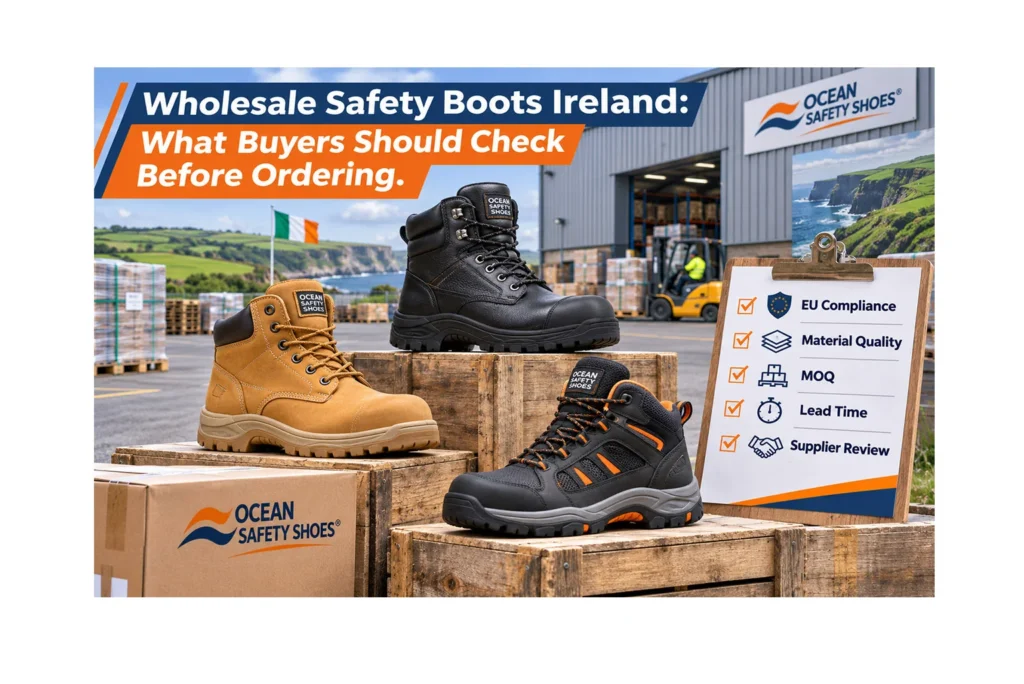
Buying wholesale safety boots Ireland distributors and importers can confidently sell requires more than comparing product prices. Buyers must evaluate product specifications, EU compliance, manufacturing quality, minimum order quantities, delivery arrangements, and the supplier’s ability to maintain consistent product quality across repeat orders.
Ireland has demand for protective footwear across construction, agriculture, manufacturing, engineering, warehousing, logistics, and other industrial sectors. These industries have different footwear requirements, making product selection an important part of wholesale purchasing.
For PPE distributors, workwear retailers, industrial suppliers, and importers, choosing the right wholesale safety footwear supplier can influence profit margins, inventory efficiency, customer satisfaction, and long-term business growth.
Sourcing directly from a manufacturer may also create opportunities for competitive factory pricing, OEM development, and private-label products. However, buyers need to understand the additional responsibilities involved in importing safety footwear into the European Union.
This guide explains what Irish buyers should check before ordering wholesale safety boots, how to evaluate manufacturers, and how to make more informed purchasing decisions.
Who should read this guide?
- Safety footwear wholesalers and distributors
- PPE importers and industrial suppliers
- Workwear retailers and trade merchants
- Construction and engineering procurement teams
- Agricultural equipment suppliers
- Private-label footwear brands
- Businesses purchasing safety boots in bulk
Table of Contents
- Understand the Irish Wholesale Safety Boots Market
- Choose the Right Safety Boot Categories
- Check EU Safety Standards and CE Compliance
- Evaluate Materials and Product Construction
- Request Samples Before Placing Bulk Orders
- Compare Wholesale Prices and MOQ
- Evaluate Supplier Manufacturing Capabilities
- Check Size Distribution and Inventory Planning
- Understand Shipping and Import Costs
- Consider OEM and Private-Label Safety Boots
- Common Mistakes When Ordering Wholesale Safety Boots
- Wholesale Safety Boots Purchasing Checklist
- Frequently Asked Questions
1. Understand the Irish Wholesale Safety Boots Market
Before contacting a supplier, buyers should understand the industries and customer groups they intend to serve.
Demand for safety boots comes from different workplace environments, and each application may require different protective features.
Key Industries Purchasing Safety Boots in Ireland
| Industry | Common footwear requirements |
|---|---|
| Construction | Protective toe caps, penetration resistance, durable outsoles |
| Agriculture | Waterproof construction, suitable traction, durable materials |
| Manufacturing | Impact protection, comfort, and workplace-specific protection |
| Warehousing | Lightweight designs, cushioning, and slip resistance |
| Engineering | Durable uppers, protective toes, and suitable outsole performance |
| Transport and logistics | Comfortable footwear for extended standing and walking |
| Food processing | Easy-to-clean materials and appropriate slip resistance |
For example, construction distributors may prioritise heavy-duty safety boots with protective toe caps and penetration-resistant midsoles.
Agricultural suppliers may focus more on waterproof safety boots, rubber footwear, and products suitable for muddy outdoor environments.
Warehouse customers may prefer lighter work boots that offer protection without unnecessary weight.
Identify Your Target Customers
Wholesale purchasing strategies should reflect the needs of your customers.
Potential buyers include:
- Independent workwear shops
- PPE distributors
- Agricultural supply retailers
- Builders’ merchants
- Industrial equipment wholesalers
- Construction contractors
- Manufacturing companies
- Corporate procurement departments
Understanding your customer base helps determine which products, sizes, and quantities should be included in your first order.
2. Choose the Right Safety Boot Categories
One of the first purchasing decisions is selecting the appropriate product categories.
A wholesale range should offer enough variety to serve different customers without creating unnecessary inventory complexity.
Steel Toe Safety Boots
Steel toe safety boots are widely used in construction, manufacturing, and industrial environments.
Common purchasing considerations include:
- Protective toe cap performance
- Durable leather or synthetic uppers
- Outsole grip
- Midsole construction
- Abrasion resistance
- Comfortable internal lining
Buyers should verify the product’s tested protective specifications rather than assuming that all steel toe boots offer identical protection.
Composite Toe Safety Boots
Composite toe boots provide an alternative to traditional steel toe footwear.
Depending on the design, they may offer:
- Lower weight
- Non-metallic toe protection
- Reduced thermal conductivity
- Compatibility with certain metal-detection environments
They can be attractive to distributors serving customers who prioritise lightweight protective footwear.
Waterproof Safety Boots
Waterproof safety boots are relevant to Irish outdoor working environments, particularly agriculture, construction, utilities, and maintenance.
When evaluating waterproof products, distinguish between water-resistant uppers and footwear designed to provide waterproof protection.
Request supporting test information for the specific waterproof claims.
Heavy-Duty Industrial Safety Boots
Heavy-duty boots may be suitable for demanding industrial applications.
Depending on workplace hazards, buyers may require:
- Reinforced toe protection
- Penetration-resistant midsoles
- Durable upper materials
- Suitable outsole traction
- Heat-resistant outsole properties
- Additional ankle or metatarsal protection
Additional features should be selected according to the intended application rather than simply choosing the highest specification available.
Lightweight Work Safety Boots
Lightweight safety boots can be useful for employees who walk or stand for extended periods.
Popular features include cushioned footbeds, breathable linings, flexible construction, and lightweight protective components.
For wholesalers, carrying both traditional heavy-duty boots and lightweight models can help address different customer preferences.
3. Check EU Safety Standards and CE Compliance
Product compliance is one of the most important considerations when purchasing wholesale safety boots for the Irish market.
The Republic of Ireland follows EU product legislation, including Regulation (EU) 2016/425 on personal protective equipment.
Understand EN ISO 20345
EN ISO 20345 is the European standard covering general-purpose safety footwear.
It establishes basic and additional requirements for safety footwear, including mechanical protection, slip resistance, thermal risks, and ergonomic performance.
When purchasing safety boots, check:
- Applicable standard edition
- Product classification
- Protective toe cap specifications
- Penetration resistance, where applicable
- Water resistance
- Slip resistance
- Additional protective features
The current Irish national standards listing includes I.S. EN ISO 20345:2022/A1:2024. Buyers should confirm the applicable harmonised standard and conformity documentation for the product being purchased.
Verify CE Marking and Product Documentation
Safety footwear covered by the EU PPE Regulation must meet the applicable conformity requirements and carry the appropriate CE marking.
Before placing an order, request the following documents:
| Document | Purpose |
|---|---|
| EU Declaration of Conformity | Identifies the manufacturer’s conformity declaration |
| EU type-examination certificate, where applicable | Provides evidence of the relevant conformity assessment |
| Product test reports | Supports specific performance claims |
| Technical documentation | Provides information supporting product conformity |
| User instructions | Explains intended use, limitations, and maintenance |
| Product identification | Identifies the manufacturer and product model |
Always check that documentation corresponds to the exact safety boot model.
A certificate for one product should not automatically be treated as evidence that every model from the same manufacturer is compliant.
Understand Importer Responsibilities
When importing safety boots from outside the EU, Irish businesses must understand their obligations under Regulation (EU) 2016/425.
Importers must verify that the manufacturer has completed the required conformity assessment and that the products carry the necessary markings and documentation.
If an importer or distributor markets PPE under its own name or trademark, it may assume manufacturer obligations under the regulation.
For official guidance, consult:
- European Commission – Personal Protective Equipment
- Irish Health and Safety Authority – Selling Goods on the EU Single Market
4. Evaluate Materials and Product Construction
Product construction directly affects durability, comfort, and suitability for different working environments.
Before selecting a wholesale safety footwear supplier, request detailed information about the materials and manufacturing methods used.
Upper Materials
Common upper materials include:
| Material | Typical characteristics |
|---|---|
| Full-grain leather | Durable construction and traditional appearance |
| Nubuck leather | Textured finish and comfortable feel |
| Split leather | Commonly used in industrial footwear |
| Microfiber | Lightweight synthetic material |
| Mesh with protective overlays | Breathability and sport-inspired styling |
| Rubber or PVC | Common in specialist waterproof footwear |
The appropriate material depends on the intended working conditions and product design.
Outsole Construction
The outsole influences grip, durability, and workplace suitability.
Common materials include:
- PU
- PU/PU
- PU/Rubber
- Rubber
- EVA combined with rubber
Buyers should compare abrasion resistance, slip performance, flexibility, and resistance to workplace contaminants where relevant.
Protective Components
Confirm the specifications of:
- Steel or composite toe caps
- Steel or non-metallic penetration-resistant inserts
- Protective midsoles
- Heel energy absorption
- Antistatic or ESD properties, where required
- Waterproof components
A detailed product specification sheet helps prevent misunderstandings between buyers and manufacturers.
5. Request Samples Before Placing Bulk Orders
One of the most effective ways to reduce purchasing risks is to inspect samples before approving mass production.
Product photographs and catalogue descriptions cannot demonstrate every aspect of footwear quality.
What Should You Inspect?
Upper construction
Check material consistency, stitching, surface finishing, and flexibility.
Toe protection
Confirm that the toe cap specification matches the approved product documentation.
Outsole attachment
Inspect bonding, stitching where applicable, tread quality, and finishing.
Internal comfort
Evaluate the lining, footbed, heel fit, and available width options.
Waterproof performance
Where waterproof protection is claimed, review the supporting test documentation and agreed product specifications.
Packaging
Check shoe boxes, labels, size markings, barcodes, and branding requirements.
Conduct a Pre-Production Sample Approval
Before approving bulk production, document the approved sample and product specifications.
A useful approval record should include:
- Product model
- Upper material
- Lining
- Footbed
- Outsole material
- Toe cap type
- Midsole type
- Size range
- Colour
- Logo placement
- Packaging requirements
This provides a reference for quality inspection during production and before shipment.
Arrange Pre-Shipment Inspection
For larger wholesale orders, consider an independent inspection before shipment.
The inspection can cover:
- Quantity verification
- Size assortment
- Visual workmanship
- Product specifications
- Packaging
- Labelling
- Carton condition
For safety-critical properties, visual inspection alone is not a substitute for appropriate laboratory testing and conformity assessment.
6. Compare Wholesale Prices and MOQ
Wholesale pricing is important for Irish importers, but the cheapest quotation does not necessarily represent the best purchasing decision.
Buyers should compare equivalent product specifications and calculate the total cost of receiving usable stock.
Understand Minimum Order Quantities
MOQ varies depending on the manufacturer and product configuration.
Factors influencing MOQ include:
- Existing catalogue models
- New product development
- Material availability
- Custom colours
- Logo application
- Custom packaging
- Production capacity
Ask suppliers to quote different purchasing quantities.
| Example order quantity | Purchasing purpose |
|---|---|
| 300 pairs | Initial market testing |
| 500 pairs | Medium-volume purchasing |
| 1,000 pairs | Regular wholesale supply |
| 2,000 pairs | Larger distribution orders |
These are illustrative quotation scenarios, not universal industry MOQ requirements.
Request Tiered Wholesale Pricing
A useful supplier quotation should include:
- Unit price at different quantities
- MOQ per model
- MOQ per colour
- Size assortment conditions
- Sample costs
- Packaging costs
- Logo application costs
- Production lead time
- Payment terms
Comparing these details makes it easier to identify the most commercially suitable supplier.
Calculate the Landed Cost Per Pair
When importing safety boots into Ireland, include all relevant purchasing and import costs.
Landed cost per pair = Total applicable purchasing and import costs ÷ Number of usable pairs received
Consider the following example:
| Cost component | Illustrative cost |
|---|---|
| 1,000 pairs at €20 | €20,000 |
| International freight | €1,600 |
| Insurance and handling | €250 |
| Customs clearance and local transport | €650 |
| Total before applicable customs duty and VAT | €22,500 |
| Cost per pair before those additional charges | €22.50 |
Actual costs depend on customs classification, country of origin, shipping terms, VAT treatment, and shipment arrangements.
For imports from outside the EU, check the applicable tariff and customs requirements through Irish Revenue.
7. Evaluate Supplier Manufacturing Capabilities
Choosing a supplier with suitable production capabilities is essential for maintaining consistent quality across wholesale orders.
This is particularly important for distributors planning to purchase the same safety boot models repeatedly.
Check Factory Production Facilities
If you are purchasing directly from a manufacturer, request information about its production facilities.
Review whether the factory has relevant capabilities for:
- Material cutting
- Upper stitching
- Lasting
- Sole injection or attachment
- Product finishing
- Quality inspection
- Packaging
A factory visit or video inspection can help verify the manufacturing arrangement.
Evaluate Production Capacity
Ask the supplier:
- What is your normal monthly production capacity?
- How many production lines are available?
- Can you support repeat orders?
- What is the normal production lead time?
- How do you manage peak-season orders?
- What quality control procedures are used?
- How are product changes documented?
A supplier should provide realistic answers supported by its actual production arrangements.
Check Quality Control Procedures
A professional manufacturing partner should have defined quality control procedures.
These may include:
- Incoming material inspection
- In-process production checks
- Finished-product inspection
- Size and quantity verification
- Packaging inspection
- Pre-shipment quality checks
For long-term wholesale cooperation, consistent production specifications are as important as the initial sample quality.
8. Check Size Distribution and Inventory Planning
Safety boots are sold across different sizes, so inventory planning is an important consideration for wholesalers.
An unsuitable size assortment can lead to slow-moving stock, while insufficient quantities in popular sizes may result in missed sales.
Confirm the Available Size Range
Before placing an order, confirm:
- Available European sizes
- Size conversion information
- Whether half sizes are available
- Width options
- Size labelling
- Size consistency between models
Request a size chart and, where appropriate, physical samples.
Plan Your Size Assortment
Your initial size distribution should be based on actual customer demand rather than an arbitrary equal split.
Track:
- Historical sales
- Customer industry
- Gender and user requirements
- Repeat purchase patterns
- Returns caused by fit issues
Establish Reorder Points
A simple inventory formula can help wholesalers plan replenishment.
Reorder point = Expected demand during lead time + Safety stock
For example, if a distributor sells 100 pairs per month, the replenishment lead time is two months, and the business maintains 50 pairs of safety stock:
100 × 2 + 50 = 250 pairs
This is an illustrative example. Actual planning should consider individual models, sizes, seasonal demand, and delivery uncertainty.
9. Understand Shipping and Import Costs
For Irish businesses importing wholesale safety boots from outside the EU, shipping arrangements can significantly affect purchasing costs and delivery schedules.
Compare Shipping Methods
| Shipping method | Main advantages | Considerations |
|---|---|---|
| Sea freight | Suitable for larger bulk shipments | Longer transit time |
| Air freight | Faster delivery | Higher transportation cost |
| Express courier | Useful for samples and small orders | Expensive for bulk footwear |
Sea freight is often worth evaluating for larger wholesale orders, while air freight may be appropriate for urgent replenishment or samples.
Understand Incoterms
Before confirming an order, establish the agreed Incoterm and named delivery location.
Common options include:
- EXW
- FOB
- CIF
- DAP
- DDP
These terms determine how costs, responsibilities, and risks are allocated between the seller and buyer.
For example, a CIF quotation includes specified freight and insurance to the named destination port. It does not automatically mean Irish import VAT, customs clearance, and local delivery are included.
Prepare Import Documents
Depending on the shipment and transaction, documents may include:
- Commercial invoice
- Packing list
- Bill of lading or air waybill
- Customs declaration information
- Certificate of origin, where applicable
- Product conformity documentation
Irish importers should also establish the relevant EORI and customs requirements with Revenue.
10. Consider OEM and Private-Label Safety Boots
For Irish wholesalers and distributors looking to differentiate their businesses, private-label safety boots can provide an alternative to selling only established brands.
Working directly with a manufacturer may allow buyers to develop products under their own business identity.
Available Customisation Options
Depending on the factory’s capabilities, options may include:
- Custom logos
- Branded shoe boxes
- Product labels
- Upper material selection
- Colour combinations
- Outsole options
- Custom product development
What Should You Confirm?
| Project requirement | Details to establish |
|---|---|
| Product selection | Existing model or new development |
| Logo | Placement and application method |
| Materials | Upper, lining, footbed, and outsole |
| MOQ | Minimum quantity per model and colour |
| Samples | Development costs and approval process |
| Packaging | Custom box and labelling requirements |
| Production | Lead time and quality control |
| Compliance | Conformity assessment for the final configuration |
If changes to the product could affect its protective performance, the final configuration must be appropriately assessed.
Businesses placing PPE on the market under their own name or trademark may assume manufacturer responsibilities under EU PPE legislation.
11. Common Mistakes When Ordering Wholesale Safety Boots
Choosing a Supplier Based Only on Unit Price
A low quotation may not include equivalent materials, protective features, packaging, or delivery arrangements.
Always compare the complete product specifications.
Ignoring Product-Specific Certification
A supplier’s general statement of compliance is not enough.
Request documentation that corresponds to the exact model and configuration.
Ordering Large Quantities Without Samples
Never approve a substantial production order based solely on catalogue photographs.
Inspect samples and document the approved specifications first.
Overlooking Size Distribution
An unsuitable size assortment can create unnecessary inventory costs.
Use customer requirements and sales data to guide purchasing quantities.
Failing to Confirm Delivery Responsibilities
Misunderstanding Incoterms can result in unexpected freight, customs, and handling expenses.
Confirm all responsibilities before placing an order.
Not Planning Repeat Orders
For wholesale distributors, a reliable supplier must be capable of maintaining product specifications and supporting future replenishment.
Discuss repeat-order arrangements before establishing a long-term relationship.
12. Wholesale Safety Boots Purchasing Checklist
Use this checklist before confirming a wholesale order for the Irish market.
- Define target industries and customer requirements.
- Select suitable safety boot categories.
- Confirm product specifications and materials.
- Verify applicable EU PPE compliance.
- Request the EU Declaration of Conformity.
- Review relevant certificates and test reports.
- Inspect physical samples.
- Approve the final product specifications.
- Compare wholesale prices at different quantities.
- Confirm MOQ and size assortment.
- Calculate total landed costs.
- Verify supplier manufacturing capabilities.
- Establish quality inspection procedures.
- Confirm shipping terms and delivery schedules.
- Review repeat-order arrangements.
- Document quality complaint procedures.
Following a structured purchasing process can help reduce risks and improve the consistency of wholesale supply.
13. Frequently Asked Questions
Where Can I Buy Wholesale Safety Boots in Ireland?
Irish businesses can source safety boots through local PPE wholesalers, workwear distributors, European manufacturers, and overseas factories. The most suitable option depends on order quantity, delivery requirements, product selection, and customisation needs.
What Should I Check Before Ordering Wholesale Safety Boots?
Check product specifications, CE marking, EU conformity documentation, materials, samples, MOQ, wholesale prices, size distribution, production lead times, and shipping arrangements.
What Safety Standards Should Wholesale Safety Boots Meet in Ireland?
Safety footwear placed on the Irish market must comply with applicable EU PPE requirements. EN ISO 20345 is an important standard for general-purpose safety footwear. Buyers should verify the applicable edition and product-specific conformity documentation.
What Is the Difference Between Steel Toe and Composite Toe Safety Boots?
Steel toe boots use a metal protective toe cap, while composite toe boots use non-metallic protective materials. Both must meet the applicable protective performance requirements when certified to EN ISO 20345. Their weight, thermal characteristics, and suitability for specific workplaces may differ.
What Is the MOQ for Wholesale Safety Boots?
MOQ depends on the supplier, product design, materials, and customisation requirements. Existing catalogue models may have different purchasing conditions from newly developed private-label products. Request quotations at several quantities before deciding.
Can Irish Businesses Import Safety Boots Directly From China?
Yes. Irish businesses can import safety boots from Chinese manufacturers, provided the products meet applicable EU PPE requirements and the importer fulfils its legal, customs, and documentation responsibilities.
How Can I Calculate the Wholesale Cost of Imported Safety Boots?
Include the factory price, international freight, insurance, customs duty, applicable VAT, customs clearance, local delivery, inspection, and storage. Calculate the total landed cost per usable pair before setting your wholesale selling price.
Are Waterproof Safety Boots Suitable for Irish Outdoor Workers?
Waterproof safety boots may be suitable for agriculture, construction, utilities, and outdoor maintenance. However, buyers should verify the actual waterproof performance and ensure the footwear provides the protection required by the workplace risk assessment.
Can I Develop My Own Private-Label Safety Boots in Ireland?
Yes. Irish distributors can work with manufacturers offering OEM and private-label services. However, the final product must satisfy applicable EU PPE requirements, and businesses marketing PPE under their own name or trademark may assume manufacturer responsibilities.
Conclusion
Buying wholesale safety boots Ireland distributors can rely on requires careful evaluation of products, suppliers, and purchasing conditions.
For importers, PPE wholesalers, and workwear retailers, the most important considerations include:
- Selecting the right safety boot categories for target industries
- Verifying EU PPE compliance and product documentation
- Evaluating materials, construction, and sample quality
- Comparing MOQ and total landed costs
- Checking factory production and quality control capabilities
- Planning size distribution and inventory
- Confirming shipping and repeat-order arrangements
A competitive wholesale purchase is not simply the order with the lowest unit price. It is the purchase that provides suitable product quality, verified protection, reliable supply, and sustainable commercial value.
Source Wholesale Safety Boots From Ocean Safety Shoes
Ocean Safety Shoes is a professional safety footwear manufacturer serving international B2B buyers, including importers, wholesalers, PPE distributors, industrial suppliers, and private-label brands.
We provide manufacturing and product development solutions covering:
- OEM safety boots manufacturing
- ODM safety footwear development
- Private-label safety boots
- Custom logos and packaging
- Product specification development
- Wholesale manufacturing support
Our product range includes different safety footwear styles for industrial and workplace applications.
Explore the Ocean Safety Shoes product range to review available models and manufacturing options.
For Irish distributors and importers interested in direct manufacturing, provide the following information when requesting a quotation:
- Target safety boot categories
- Intended workplace applications
- Required EU safety standards
- Estimated order quantities
- Size assortment
- Branding and packaging requirements
- Required product documentation
This information helps us understand your purchasing requirements and discuss suitable product options, samples, and manufacturing arrangements.
Looking for a reliable wholesale safety boots manufacturer for the Irish market?
Contact Ocean Safety Shoes to discuss bulk orders, product samples, and OEM or private-label manufacturing opportunities.