
Brief outline
- What EN ISO 20345:2022 means in 2026
- Key changes from EN ISO 20345:2011
- New protection classes and markings
- What buyers, distributors, and PPE managers should check
- Compliance risks that quietly hurt margins
- 5 FAQs
EN ISO 20345:2022 – 2026 Compliance Guide
Safety footwear compliance used to feel simple. Check the toe cap. Check the certificate. Confirm S1, S2, or S3. Done.
Well… not anymore.
EN ISO 20345:2022 changed how safety footwear is classified, tested, and marked. By 2026, safety shoes purchasing managers, PPE importers, distributors, and category merchandisers can’t treat the 2022 standard as “new news.” It’s now the working language of serious safety footwear sourcing.
And yes, the old EN ISO 20345:2011 certificates may still appear in the market, because certificates generally remain valid until their stated expiry date. But new product development, new tenders, and new compliance checks are moving toward EN ISO 20345:2022 and, in some markets, EN ISO 20345:2022+A1:2024.
Here’s the thing: this standard isn’t just paperwork. It affects outsole design, puncture plates, waterproof claims, labeling, test reports, and even how sales teams explain products to buyers.
That’s where many companies get caught.
A shoe may look the same. The marking may look similar. But the meaning behind it has changed.
Why EN ISO 20345:2022 Matters More in 2026
EN ISO 20345 covers safety footwear used for general workplace protection. It includes basic and optional requirements for mechanical risks, slip resistance, thermal risks, ergonomic behavior, and other performance areas.
For a safety shoes purchasing director, that means one thing: the marking on the shoe is no longer a small technical detail. It’s a commercial risk point.
If your sales catalog says S3, but the certificate now says S3L or S3S, your customer may ask hard questions. If your outsole claim says “oil resistant” but FO is missing, that’s a problem too. If your puncture resistance is non-metallic but marked only as P, someone in the chain may have misunderstood the 2022 update.
Nobody wants that email.
Especially not after goods have landed.
The Big Shift: Safety Footwear Got More Specific
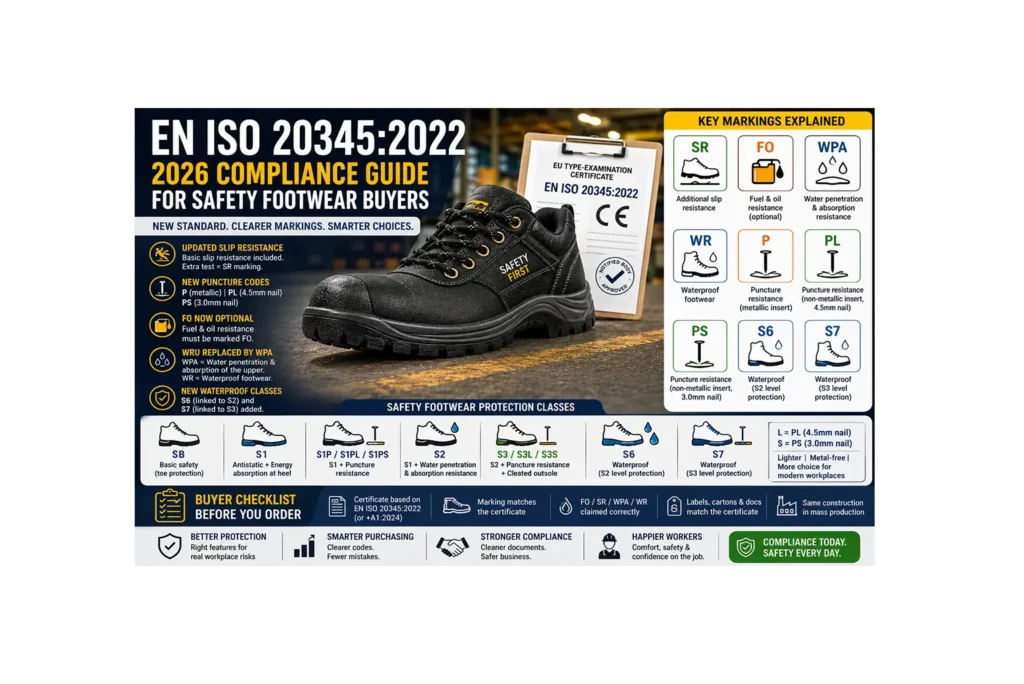
The 2022 version didn’t throw the old system away. It made it sharper.
In EN ISO 20345:2011, many buyers relied heavily on broad classes like S1P and S3. That worked, but it also hid useful details. For example, puncture-resistant footwear could use different insert materials, yet the marking often looked too simple.
EN ISO 20345:2022 gives buyers more detail.
That’s good.
Also, slightly annoying.
Good, because PPE managers can match footwear more closely to jobsite hazards. Annoying, because sales teams, import departments, and factories need to update product sheets, labels, ERP systems, hangtags, and training documents.
Let me explain the main changes.
1. Slip Resistance: SRA, SRB, and SRC Are Gone
This is one of the biggest updates.
Under EN ISO 20345:2011, slip resistance used SRA, SRB, and SRC. SRA meant testing on ceramic tile with a soap solution. SRB meant testing on steel with glycerol. SRC meant both tests were passed.
Under EN ISO 20345:2022, basic slip resistance on ceramic tile with detergent is now a core requirement, so it does not need a special SRA-style mark. An extra slip test on ceramic tile with glycerol can be tested as an additional requirement and marked SR.
So, if a customer asks, “Where is SRC?”
Don’t panic.
The answer is: SRC belongs to the older marking system. In the 2022 system, look for SR when extra slip resistance has been tested.
A simple way to explain it:
Old world: SRA / SRB / SRC
New world: basic slip test included; extra slip test = SR
That’s cleaner, in a way. But only if your team knows how to explain it.
2. Puncture Resistance: P, PL, and PS Now Matter
This change catches many buyers off guard.
In EN ISO 20345:2011, puncture resistance was usually marked P. Simple.
In EN ISO 20345:2022, puncture resistance is split more clearly by insert type and nail size. P is used for metallic inserts. For non-metallic inserts, markings include PL and PS, depending on the test nail size. PL relates to a 4.5 mm nail test, while PS relates to a 3.0 mm nail test.
That little difference matters a lot.
Why? Because non-metallic anti-puncture midsoles are common in modern safety footwear. They’re lighter, flexible, and metal-free. Great for comfort. Great for logistics and airport-style environments. But they need the correct marking.
For product managers, this is not just a lab detail. It affects:
- Product names
- Hangtags
- Tender documents
- Sales training
- Import inspection files
- Customer comparison sheets
Honestly, this is where a lot of quiet mistakes happen.
A buyer sees “S3” and assumes the old meaning. But under the new system, S3 may become S3L or S3S, depending on the puncture resistance result.
Small letters. Big consequences.
3. FO Is No Longer Automatically Included
Here’s another one that can sting.
Fuel and oil resistance of the outsole, marked FO, was previously mandatory from certain classes in the 2011 system. Under EN ISO 20345:2022, FO became optional. If the outsole is fuel and oil resistant, it must be marked FO.
For distributors, this is a catalog-cleanup moment.
If your older product page says “oil-resistant outsole” because the shoe was S3 under the 2011 logic, check the new certificate. Don’t assume.
In 2026, buyers should ask:
“Is FO actually listed on the certificate?”
Not “does the outsole look oil resistant?”
Not “did the old version have it?”
Actually listed. In black and white.
That’s the safe path.
4. Water Resistance: WRU Becomes WPA
Another marking change: WRU has been replaced by WPA for water penetration and absorption of the upper material. Waterproof footwear still uses WR, and the newer system includes classes such as S6 and S7 for waterproof safety footwear.
This matters because buyers often confuse water-repellent upper material with full waterproof footwear.
They are not the same.
WPA means the upper resists water penetration and absorption.
WR means the footwear is waterproof, often involving a membrane or full footwear water resistance test.
That difference can decide whether a boot suits rainy outdoor work, food processing washdown areas, utilities, or muddy construction sites.
You know what? Workers know this difference fast.
A product manager may debate wording for weeks. A worker steps into wet grass at 6:40 a.m. and knows within minutes.
New Protection Classes: S6 and S7 Enter the Chat
EN ISO 20345:2022 introduced newer class structures to make waterproof footwear easier to identify.
Common buyer-facing categories now include:
- SB – basic safety footwear with toe protection
- S1 – closed heel, antistatic, energy absorption at heel
- S2 – S1 plus water penetration and absorption resistance
- S3 – S2 plus puncture resistance and cleated outsole
- S6 – waterproof version linked to S2-style protection
- S7 – waterproof version linked to S3-style protection
You may also see versions such as S3L, S3S, S7L, and S7S, depending on puncture resistance type.
This is where the standard becomes more useful for professional buyers.
Instead of one vague “water-resistant safety boot,” you get a clearer map. It’s like changing from a hand-drawn warehouse sketch to a proper pick-and-pack barcode system. Less guesswork. Fewer wrong shipments.
Chemical Safety and Leather Testing Became More Visible
EN ISO 20345:2022 also pays attention to innocuousness requirements. For leather parts, the standard includes testing for pH and chromium VI presence.
That may sound like lab talk, but it matters for importers.
Why?
Because restricted substances can create customs, compliance, and reputational trouble. A safety shoe is not only judged by toe protection anymore. Materials must also be safe for the wearer.
For PPE general managers and import department heads, this means test reports should not be treated as decoration. Read them. File them. Match them to production batches.
Boring? Maybe.
Necessary? Absolutely.
What Buyers Should Check Before Placing 2026 Orders
Now let’s get practical.
If you’re buying safety footwear for resale, tender supply, private label development, or distribution, build a simple compliance review before confirming bulk production.
Not a huge legal ritual. Just a smart buying habit.
Check these points:
- Is the certificate based on EN ISO 20345:2022 or EN ISO 20345:2022+A1:2024?
- Does the certificate match the exact model, outsole, upper, toe cap, and midsole?
- Are markings correct: S1, S1P, S1PL, S1PS, S3L, S3S, S6, S7, and so on?
- Is FO listed if you claim oil resistance?
- Is SR listed if you claim extra slip resistance?
- Is WPA or WR used correctly?
- Are the test report and certificate from a credible notified body or recognized lab?
- Do labels, cartons, user instructions, and website descriptions match the certificate?
That last one sounds dull, but it’s a classic trap.
The lab certificate says one thing. The catalog says another. The carton sticker says a third. Then a customer notices.
Awkward.
What Distributors Should Tell Their Sales Teams
Sales teams don’t need to memorize every clause. Please don’t make them.
But they do need a clean explanation.
Here’s a simple sales-friendly version:
EN ISO 20345:2022 gives clearer markings for slip resistance, puncture resistance, water resistance, and outsole fuel/oil resistance. Some old marks like SRC and WRU have changed, and new marks like SR, WPA, PL, and PS are now important.
That’s enough to start.
Then give them a cheat sheet.
Because when a trade buyer asks, “Why did S3 become S3S?” your sales rep should not blink like a deer in headlights.
A trained rep builds trust. A confused rep makes the whole company look shaky.
Private Label Buyers, Be Careful Here
If you develop private label safety shoes, EN ISO 20345:2022 touches the whole workflow.
Design teams need to know the target class before sampling starts. Factories need to select the correct midsole and outsole compound. Packaging teams need updated symbols. Marketing teams need correct wording.
And the sample must match mass production.
That sounds obvious. Still, mistakes happen.
A factory may submit one outsole compound for testing, then switch material later due to cost or supply. A buyer may approve a steel midsole sample, then request metal-free production. A designer may add a waterproof membrane but forget the WR claim needs testing.
Compliance is like stitching on a boot. One broken thread may not ruin the shoe immediately, but enough weak points and the whole thing pulls apart.
2026 Compliance Risk: Old Stock, New Questions
Many warehouses still hold footwear certified under EN ISO 20345:2011. That doesn’t automatically mean the products are invalid. Certificates issued under the older standard may remain valid until expiry.
But here’s the commercial wrinkle.
Customers in 2026 may ask for EN ISO 20345:2022 as a tender requirement. Retailers may prefer new markings. Distributors may want cleaner product comparison.
So old stock can still be sellable, yet less attractive.
That’s the mild contradiction: valid does not always mean competitive.
For purchasing directors, this means stock planning matters. Don’t overbuy older-marked styles if your customer base is shifting toward the 2022 system.
Common Marking Confusion, Explained Plainly
“Where did SRC go?”
SRC belongs to the 2011 marking system. Under EN ISO 20345:2022, basic slip resistance is included, and extra slip resistance is marked SR.
“Is WPA waterproof?”
No. WPA means water penetration and absorption resistance of the upper. WR means waterproof footwear.
“Is P still used?”
Yes, but mainly for metallic puncture-resistant inserts. Non-metallic insert markings include PL and PS.
“Does S3 always mean the same thing now?”
Not quite. You may now see S3L or S3S, which gives more detail about puncture resistance.
“Is FO included automatically?”
No. FO is optional under EN ISO 20345:2022 and should be clearly marked when claimed.
How This Affects Product Development
Product development managers should treat EN ISO 20345:2022 as a design brief, not a final inspection item.
Start with the market need.
For logistics workers, maybe lightweight S1PS with SR makes sense.
For wet outdoor jobs, S7S with WR and SR may be stronger.
For fuel exposure, check FO.
For metal-free tenders, confirm composite toe cap plus non-metallic puncture insert, then make sure the marking reflects PL or PS correctly.
See the pattern?
The standard helps define the product story. It’s not just a pass/fail gate at the end.
That’s useful for sales too. Instead of saying “high quality safety shoes,” your team can say, “This model is S3S SR FO, designed for puncture risk, oily floors, and outdoor industrial wear.”
Much stronger.
Much clearer.
Less fluff.
What Importers Should Keep in the Compliance File
A clean compliance file saves pain later.
For each model, keep:
- EU type-examination certificate
- Full test report
- Declaration of conformity
- User instruction sheet
- Product photos
- Label artwork
- Carton markings
- Material specification
- Production batch records
Yes, it’s paperwork. But it’s also insurance.
When a customer asks for proof, you answer in minutes instead of digging through old emails from three factories and one lab manager who left last year.
We’ve all seen that movie.
The Buyer’s Shortlist for 2026
Before confirming a safety footwear order, ask these questions:
Does the marking match the hazard?
Don’t buy S1 footwear for wet outdoor work and expect miracles.
Does the claim match the certificate?
No certificate, no claim.
Does the factory understand 2022 markings?
If they still talk only in SRA/SRB/SRC terms, slow down.
Does your sales sheet explain the new codes?
Buyers appreciate clarity. They really do.
Can the supplier repeat the same tested construction in mass production?
Sampling is nice. Stable production is better.
Final Thoughts: Compliance Is Commercial Now
EN ISO 20345:2022 is not just a technical update. It’s a buying language.
For safety shoes CEOs, PPE sales representatives, import managers, and footwear product specialists, the 2026 challenge is simple: make compliance easy to understand and hard to dispute.
That means cleaner markings. Better documents. Smarter product matching. Clearer sales training.
Honestly, the brands and suppliers that explain this well will win trust faster.
Because in safety footwear, trust is not built with glossy words. It’s built with correct certificates, consistent production, and workers who come back after a long shift without sore feet, wet socks, or a story nobody wants to hear.
Compliance sounds dry.
But when it protects your customer, your shipment, and your reputation, it starts to feel pretty alive.
FAQs About EN ISO 20345:2022 Compliance
1. What is EN ISO 20345:2022 for safety footwear?
EN ISO 20345:2022 is the European safety footwear standard covering basic and optional requirements such as toe protection, slip resistance, puncture resistance, water resistance, thermal risks, and ergonomic performance.
2. What changed from EN ISO 20345:2011 to EN ISO 20345:2022?
The main changes include new slip resistance marking, updated puncture resistance codes, FO becoming optional, WRU changing to WPA, and new waterproof classes such as S6 and S7.
3. Is SRC still used in EN ISO 20345:2022 safety shoes?
No. SRC belongs to the older EN ISO 20345:2011 system. Under EN ISO 20345:2022, basic slip resistance is included, while extra slip resistance is marked SR.
4. What is the difference between P, PL, and PS in safety footwear?
P usually refers to metallic puncture-resistant inserts. PL and PS refer to non-metallic puncture-resistant inserts tested with different nail sizes under EN ISO 20345:2022.
5. What should PPE buyers check before importing EN ISO 20345:2022 safety shoes?
PPE buyers should check the certificate, test report, product marking, FO/SR/WPA/WR claims, label artwork, user instructions, and whether the certified sample matches mass production.