A quick outline before we get into the boots
- Why the Australian safety footwear market feels different
- What purchasing managers care about now
- The top 10 safety shoe and work boot brands in Australia
- Which brands suit mining, logistics, construction, warehousing, and heavy industry
- A few overlooked buying details that quietly affect margins
- FAQs for distributors, importers, and PPE decision-makers
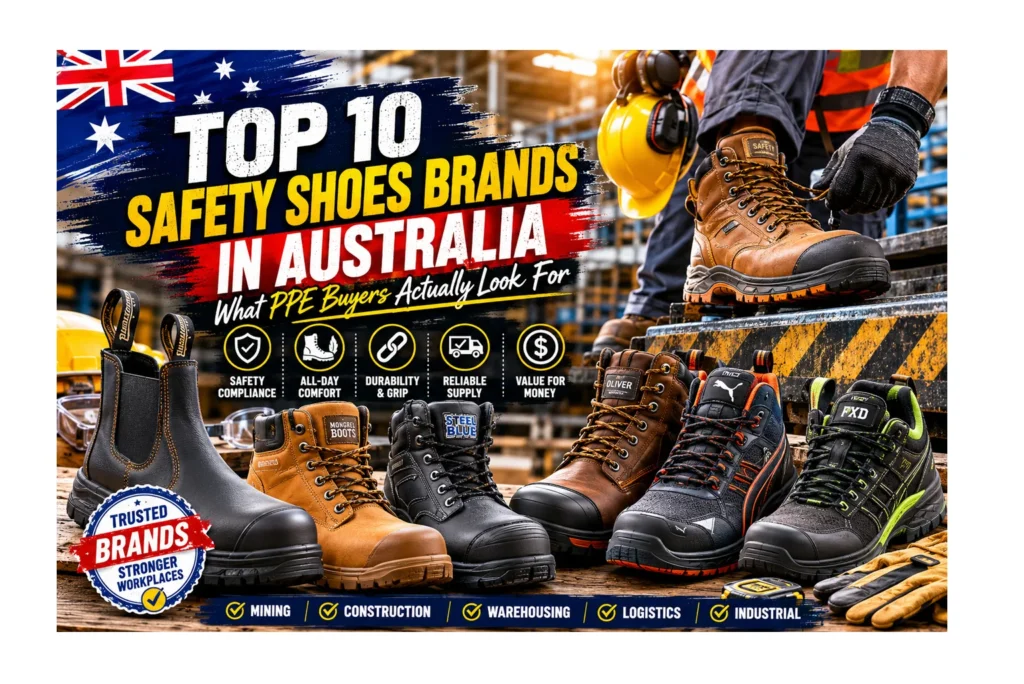
Top 10 Safety Shoes Brands in Australia
Australia takes work boots seriously. And honestly, it has to.
Between mining sites in Western Australia, logistics hubs around Melbourne, construction crews in Sydney, and agricultural operations stretching across Queensland, footwear failure isn’t a small inconvenience. It’s downtime. Claims. Complaints. Sometimes worse.
That’s why Australian buyers—especially PPE purchasing managers and distributors—tend to be unusually practical. Flashy marketing rarely works for long here. A boot either survives heat, mud, concrete slurry, warehouse abrasion, and twelve-hour shifts… or it disappears from the next procurement list.
And there’s another thing. Australian workers are vocal. If a boot rubs the heel raw by week two, everyone hears about it.
So when buyers search for dependable safety footwear brands, they’re usually balancing five things at once:
- Compliance with Australian standards
- Comfort during long shifts
- Supply consistency
- Price stability
- Brand reputation among workers themselves
Simple on paper. Messy in real life.
Let me explain.
A boot can pass every certification and still fail in the field because workers hate wearing it. On the flip side, a comfortable boot with poor outsole durability creates warranty headaches for distributors. The sweet spot sits somewhere in the middle—and the brands below have managed to stay there for years.
Why the Australian market has its own rhythm
Before naming brands, it helps to understand the local environment.
Australian safety footwear demand leans heavily toward:
- Heat-resistant outsoles
- Slip resistance
- Lightweight composite toe options
- Pull-on work boots
- Electrical hazard protection
- Water-resistant leather
- Wide-fit comfort
Mining and infrastructure projects continue to shape buying habits. Warehousing and transport are growing fast too, especially with e-commerce pushing distribution centers harder each year.
And interestingly, many Australian workers prefer boots that look less “industrial” than they used to. Athletic-inspired safety shoes are gaining traction. Not everywhere—but enough to matter.
That trend has changed product development conversations across the PPE sector.
1. Blundstone — The Name That Never Really Leaves the Conversation
4
If you ask ten Australian PPE buyers about trusted work boot brands, chances are several will mention Blundstone before you finish the sentence.
That kind of recall matters.
Founded in Tasmania, the brand built its reputation on pull-on boots that survive brutal conditions without feeling like concrete blocks strapped to your feet. Their elastic-sided safety boots became almost iconic across construction, logistics, utilities, and agriculture.
What buyers like:
- Strong brand recognition
- Reliable comfort for long shifts
- Wide dealer network
- Consistent stock availability
What distributors often mention quietly? Return rates tend to stay manageable. That’s a bigger deal than many outsiders realize.
2. Mongrel Boots — Built for Harsh Conditions, Not Showrooms
There’s something refreshingly straightforward about Mongrel Boots.
The brand focuses heavily on practical worksite performance. Not excessive branding. Not gimmicks.
Their lace-up and slip-on safety boots are widely used across mining, infrastructure, and industrial maintenance environments. Buyers often point to outsole grip and overall durability as key strengths.
And yes, comfort comes up repeatedly too.
Australian workers spend enormous time on concrete surfaces. That repetitive impact destroys poorly designed midsoles fast. Mongrel understood this earlier than many brands did.
3. Oliver Footwear — Heavy Industry Still Trusts Them
Oliver has long been associated with mining and heavy industrial sectors.
Their footwear often appears on procurement lists where protection standards carry more weight than fashion trends. Thick leather construction, metatarsal protection options, heat resistance—these are serious-site boots.
Honestly, some younger workers may prefer lighter athletic-style footwear now. But in high-risk sectors, many safety managers still stick with proven industrial-grade products.
And that trust wasn’t built overnight.
A good analogy? Oliver boots are a bit like old diesel engines. Maybe not glamorous. Still running years later.
4. Steel Blue — Comfort Became Their Calling Card
Steel Blue changed part of the conversation around safety footwear in Australia.
Instead of treating comfort as secondary, they pushed it closer to the center of the buying decision. Their cushioning systems and ergonomic design gained strong traction among workers doing long shifts.
That worker approval matters more than some procurement teams initially expect.
Because here’s the thing—when workers like a boot, compliance improves naturally. Fewer complaints. Less resistance. Fewer “forgot my boots” situations.
Steel Blue performs especially well in:
- Logistics
- Warehousing
- Civil construction
- Transport operations
The brand also benefits from strong after-sales reputation among Australian distributors.
5. Redback Boots — Rugged Simplicity Works
Redback built a loyal following through straightforward, durable designs.
Their boots often appeal to industries where workers move between indoor and outdoor environments repeatedly—transport yards, farms, workshops, utility operations.
One subtle strength: flexibility.
Some heavy-duty boots feel protective but stiff. Redback found a middle ground that many workers appreciate during extended movement-heavy shifts.
And yes, Australian-made branding still carries emotional value for certain buyers. Especially government contracts and local procurement initiatives.
6. KingGee — Workwear Recognition Helps
KingGee is already deeply embedded in Australia’s workwear landscape.
That crossover visibility helps their footwear category too.
For PPE retailers, recognizable branding reduces friction during upselling. Workers already familiar with KingGee apparel may feel more comfortable trying their safety footwear.
Their product range tends to suit:
- Construction
- Light industrial work
- Warehousing
- Trade sectors
Not every buyer wants ultra-heavy mining boots. Sometimes they want versatile footwear that handles mixed-site environments without exhausting the wearer.
That’s where KingGee often enters the conversation.
7. Bata Industrials — Quietly Strong in Volume Procurement
Bata has a long industrial footwear history globally, and its Australian presence remains relevant—especially for larger procurement projects.
Large organizations often appreciate:
- Broad product range
- International manufacturing capability
- Competitive pricing structures
- Standardized specifications across regions
For distributors serving budget-conscious sectors, Bata can become a practical option without sacrificing baseline compliance requirements.
Not every customer needs premium boots with every advanced feature. Sometimes procurement teams simply need reliable footwear that fits operational budgets.
That balance matters.
8. Hard Yakka — Tough Branding Still Resonates
Hard Yakka has one of those names that already sounds durable before you even see the product.
And in Australia, branding tied to toughness still carries weight in blue-collar industries.
Their safety footwear line generally targets:
- Construction crews
- Tradespeople
- General industrial users
The designs often lean practical rather than technical. That’s not criticism. In fact, many buyers prefer uncomplicated products workers can trust immediately.
A boot doesn’t always need twenty marketing features. It needs to stay comfortable during a wet Tuesday shift. That’s the real test.
9. FXD — Modern Styling Meets Worksite Reality
FXD represents a newer direction in Australian workwear culture.
Younger workers increasingly want safety footwear that feels lighter, more flexible, and visually closer to athletic shoes. FXD tapped into that shift effectively.
Now, some traditional safety managers were skeptical at first. Fair enough.
But lightweight safety footwear technology has improved dramatically. Composite toe caps, energy-return midsoles, and flexible construction no longer automatically mean reduced protection.
FXD footwear performs particularly well among:
- Urban construction teams
- Warehouse staff
- Service technicians
- Trade professionals
There’s a lifestyle element here too. Workers don’t necessarily want to change footwear immediately after shifts anymore.
That trend keeps growing.
10. Puma Safety — Athletic Influence Keeps Expanding
Athletic-inspired safety footwear used to feel niche.
Not anymore.
Puma Safety helped push sports-shoe aesthetics deeper into industrial environments. Their designs attract workers wanting lighter footwear with modern styling while still meeting safety requirements.
This category continues growing in:
- Logistics
- Last-mile delivery
- Warehousing
- Light manufacturing
Now, are these ideal for every mining site? Probably not.
But for many operational environments, lighter footwear reduces fatigue and improves wear compliance. That’s becoming harder for procurement teams to ignore.
What Australian PPE Buyers Are Really Asking in 2026
The buying conversation has shifted a little recently.
Price still matters, obviously. But procurement teams are also watching:
Worker retention
Comfortable footwear sounds like a small issue until staff turnover rises. Replacing trained labor costs far more than upgrading boots.
Sustainability claims
Some brands now discuss recycled materials and lower-impact manufacturing. Buyers are listening—but cautiously. Australian procurement managers tend to prefer verified performance over marketing language.
Lightweight protection
Composite toe footwear continues gaining share, especially in warehousing and logistics.
Faster replenishment cycles
Stock reliability matters more than ever. A brilliant boot that arrives eight weeks late becomes a problem quickly.
Especially for distributors.
A Few Buying Mistakes That Keep Happening
Oddly enough, many purchasing teams still focus almost entirely on unit price.
That can backfire.
A cheaper boot with:
- higher return rates,
- faster sole breakdown,
- worker discomfort,
- or inconsistent sizing
…often costs more over a full contract cycle.
Experienced PPE managers usually calculate total operational cost instead of purchase price alone.
That’s the smarter play.
Another overlooked detail? Climate suitability.
Australia’s heat changes everything. Boots performing well in colder European environments may struggle badly in remote Australian operations.
Sweat management suddenly becomes a serious issue—not just a comfort issue.
So, Which Brand Is “Best”?
Honestly, there isn’t one universal answer.
For mining operations, durability and protection may dominate.
For logistics warehouses, lightweight comfort could matter more.
For distributors, stock consistency and margin stability may decide everything.
That’s why the strongest PPE buyers rarely ask:
“What’s the best boot?”
They ask:
“What’s the best boot for this workforce, this site, and this budget?”
Completely different question.
And usually, much more profitable.
Final Thoughts
Australia’s safety footwear market keeps evolving, but a few truths remain steady.
Workers still value comfort. Site managers still demand compliance. Distributors still need dependable supply chains. And brands that ignore any one of those pillars tend to fade surprisingly fast.
The ten brands above continue appearing across procurement discussions because they’ve earned practical trust over time—not just attention.
That distinction matters.
Especially in safety footwear, where reputation is built one shift at a time.
FAQs About Safety Shoes Brands in Australia
What are the most trusted safety shoe brands in Australia?
Brands like Blundstone, Steel Blue, Oliver Footwear, and Mongrel Boots are widely recognized across construction, mining, logistics, and industrial sectors for durability and worker comfort.
Which safety shoe brands are popular for mining in Australia?
Mining operations often prefer heavy-duty brands such as Oliver Footwear and Mongrel Boots because of their heat resistance, ankle support, outsole grip, and long-term durability in demanding environments.
Are lightweight safety shoes becoming more popular in Australia?
Yes. Lightweight composite-toe safety footwear is growing rapidly in warehousing, transport, and urban construction sectors. Brands like FXD and Puma Safety are helping drive this shift.
What should PPE distributors look for when choosing a safety footwear supplier?
Distributors should evaluate:
- Product consistency
- Australian safety standard compliance
- Delivery reliability
- Warranty support
- Worker feedback
- Size range availability
Long-term operational performance often matters more than low initial pricing.
Which Australian safety footwear brands work well for warehouse staff?
Warehouse teams often prefer brands known for cushioning and lightweight comfort, including Steel Blue, KingGee, and Puma Safety. These boots help reduce fatigue during long hours on concrete floors.