A quick roadmap before we get into the hi-vis and hard hats
- Why Australia’s PPE market behaves differently
- What safety wear buyers actually care about now
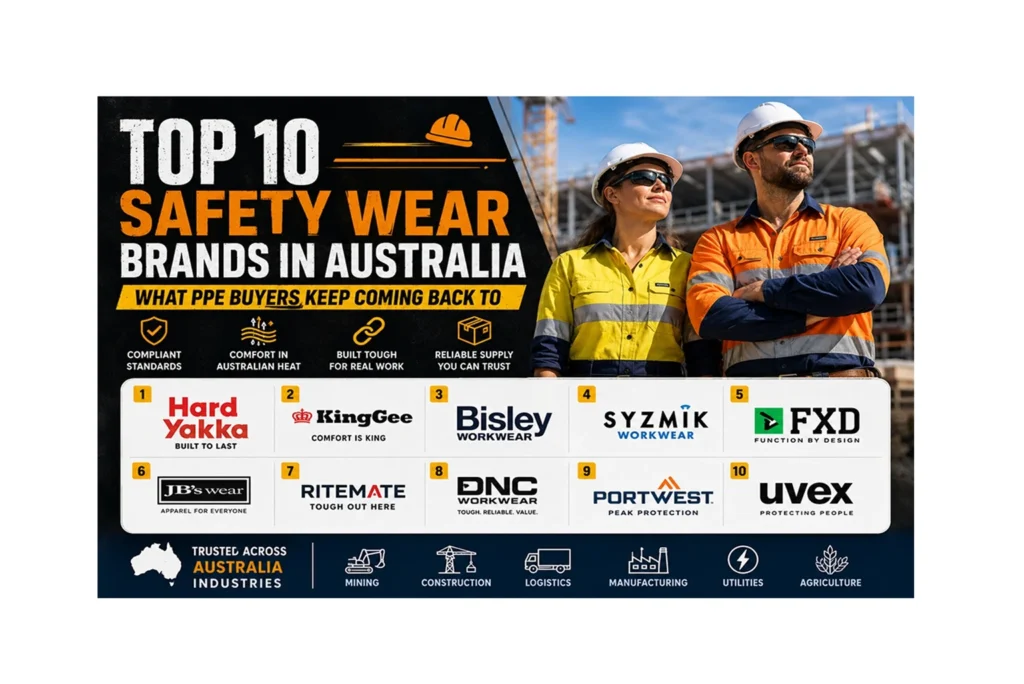
- The top 10 safety wear brands trusted across Australia
- Which brands perform well in mining, construction, logistics, and industrial sectors
- Small buying details that quietly affect profitability
- FAQs for PPE distributors, wholesalers, and procurement teams
Top 10 Safety Wear Brands in Australia
Australian worksites are demanding. That’s probably the simplest way to put it.
Heat. Dust. Heavy machinery. Sudden weather shifts. Long shifts on remote sites where replacing damaged PPE isn’t exactly convenient. Safety wear in Australia has to survive more than a product catalog photo shoot. It has to survive real punishment.
And honestly, workers notice everything.
If hi-vis shirts trap heat, crews complain. If reflective tape peels after a few washes, supervisors remember. If workwear tears around the knees during week three, purchasing managers hear about it sooner or later.
That’s why safety wear buying in Australia tends to become deeply practical. Fancy slogans only go so far.
For PPE distributors, safety wear wholesalers, and procurement directors, the conversation usually circles around a few key things:
- Compliance with Australian standards
- Worker comfort in hot conditions
- Fabric durability
- Consistent supply
- Brand reputation on actual jobsites
Simple? Not really.
A product can look excellent during sourcing meetings yet struggle once workers wear it through an Australian summer. Let me explain — Australia’s climate changes PPE expectations dramatically. Breathability becomes more important. Moisture control matters more. Lightweight fabrics suddenly stop being “nice extras” and become operational necessities.
That shift has reshaped the market over the past few years.
Why Australian Safety Wear Has Its Own Personality
Australia’s PPE sector doesn’t mirror Europe or North America exactly.
Mining still influences buying behavior heavily. Construction remains enormous. Logistics and warehousing continue expanding as distribution networks grow around major cities like Sydney, Melbourne, Brisbane, and Perth.
At the same time, younger workers increasingly care about fit and appearance. That sounds superficial at first. It isn’t.
When workers feel comfortable and confident in PPE, compliance improves naturally. Crews are less likely to remove gear during shifts or substitute non-compliant clothing.
You know what? Many experienced safety managers already understand this instinctively.
Modern Australian safety wear now balances:
- Function
- Comfort
- Heat management
- Mobility
- Branding consistency
And yes, style too — though nobody always says that part out loud.
1. Hard Yakka — Built Into Australian Worksite Culture
Hard Yakka feels almost woven into Australia’s industrial identity.
The brand has been around long enough that many workers grew up seeing it on construction sites, rail crews, workshops, and infrastructure projects. That familiarity matters more than people sometimes realize.
Procurement managers often appreciate:
- Strong local recognition
- Durable cotton drill products
- Reliable hi-vis ranges
- Broad distribution availability
Their workwear tends to lean practical rather than fashion-driven. And honestly, many buyers prefer that. Especially for heavy-duty environments where garments are expected to take constant abuse.
One subtle advantage? Workers already trust the name. That reduces friction during uniform rollouts.
2. KingGee — Consistency Keeps Them Relevant
KingGee has remained a major player because it understands something simple: workers want comfort without sacrificing durability.
Sounds obvious. Yet plenty of brands still struggle with that balance.
Their safety wear ranges perform strongly across:
- Construction
- Warehousing
- Transport
- Utilities
- General industrial sectors
The company also adapted reasonably well to changing worker expectations. More stretch fabrics. Better ventilation panels. Improved fit profiles.
And here’s the thing — comfort isn’t just a worker issue anymore. It’s a productivity issue too.
Workers distracted by overheating or restrictive clothing simply don’t perform as well during long shifts.
3. Bisley Workwear — The Quiet Giant of PPE Supply
Bisley appears everywhere in Australia’s PPE market.
Warehouses. Civil engineering projects. Mining contractors. Municipal operations. The brand developed broad appeal because its catalog covers almost every major workwear category.
Buyers often mention:
- Wide product selection
- Competitive pricing across volume orders
- Seasonal adaptability
- Strong hi-vis compliance options
Bisley also benefits from excellent visibility within distributor networks.
That matters. PPE distributors prefer brands with stable replenishment pipelines because stock gaps create headaches fast — especially during large contract fulfillment cycles.
4. Syzmik Workwear — Performance Fabrics Changed the Conversation
Syzmik gained traction by leaning harder into technical workwear features.
Ventilation systems. Moisture control fabrics. Stretch panels. Lightweight constructions.
Now, some old-school buyers initially viewed these features as marketing fluff. Fair enough. But after workers spend twelve hours in high heat conditions, breathable fabrics stop sounding gimmicky very quickly.
Syzmik performs particularly well in:
- Infrastructure projects
- Roadwork crews
- Outdoor industrial sectors
- Logistics operations
Australian summers can be brutal. Safety wear that traps heat becomes a liability, not merely an annoyance.
That’s one reason lightweight industrial apparel continues gaining ground.
5. FXD — Younger Workers Notice This Brand
FXD approached workwear differently.
Instead of making industrial clothing look purely functional, the brand blended streetwear influence with jobsite practicality. Surprisingly—or maybe not surprisingly—it worked.
Especially among younger tradespeople.
Their products are commonly seen across:
- Urban construction
- Electrical trades
- Service technicians
- Warehouse operations
And yes, there’s a cultural shift happening here.
Workers increasingly wear jobsite clothing beyond work hours. So fit, appearance, and flexibility matter more than they used to.
Some traditional PPE managers resisted this change initially. Yet worker adoption rates often tell a clearer story than internal debates do.
6. JB’s Wear — Practical, Accessible, and Everywhere
JB’s Wear became popular partly because it delivers dependable basics at accessible price points.
Not every procurement contract requires highly technical garments. Sometimes organizations simply need:
- Reliable hi-vis polos
- Durable work shirts
- Consistent sizing
- Fast stock replenishment
That’s where JB’s Wear performs strongly.
Their broad distributor reach also helps wholesalers and retailers maintain stock flow more smoothly. And honestly, supply consistency has become a bigger issue lately across the PPE industry.
Shipping disruptions over recent years taught many buyers an uncomfortable lesson: dependable supply chains can matter almost as much as product quality.
7. Ritemate — Toughness Still Sells
Ritemate holds strong recognition across agriculture and regional industrial sectors.
Their workwear often prioritizes:
- Heavy-duty fabrics
- Outdoor durability
- Sun protection
- Long-wear reliability
There’s a distinctly Australian feel to the brand too. Rural operations often require gear that handles dust, heat, fencing work, machinery maintenance, and unpredictable weather all in one shift.
That versatility matters.
A bit like a good utility vehicle — not glamorous, maybe, but deeply dependable.
8. DNC Workwear — Value Matters More Than People Admit
Some procurement conversations become heavily focused on innovation. Others become refreshingly straightforward.
DNC sits closer to the second category.
The brand performs well among buyers seeking:
- Cost-effective PPE solutions
- Large-volume purchasing
- Basic compliance-focused products
- Reliable industrial uniforms
And honestly, there’s nothing wrong with that positioning.
Not every project requires premium technical fabrics. Some operations simply need durable, compliant garments delivered consistently and affordably.
Experienced PPE managers understand this balancing act very well.
9. Portwest — International Reach Helps Large Procurement Teams
Portwest has expanded strongly across Australia’s PPE sector over recent years.
Its global manufacturing footprint appeals to:
- Multinational procurement teams
- Large distributors
- Industrial wholesalers
- Mining contractors
The product catalog is enormous too — from flame-resistant garments to rainwear and high-visibility apparel.
That breadth simplifies sourcing for organizations managing multiple worksite categories simultaneously.
And here’s something buyers rarely say directly: dealing with fewer suppliers can reduce operational stress considerably.
10. Uvex Safety — Technical PPE Keeps Growing
Uvex tends to attract buyers looking for more technical PPE solutions.
The brand is especially respected for:
- Advanced protective materials
- Ergonomic designs
- Lightweight industrial PPE
- Integrated safety systems
Industries with higher technical requirements—manufacturing, chemical processing, advanced logistics—often gravitate toward this category of safety wear.
There’s also a broader trend happening here.
PPE is slowly becoming more engineered and less generic. Fabrics are getting smarter. Garments are becoming lighter while maintaining protection levels.
That evolution isn’t slowing down anytime soon.
What Australian PPE Buyers Care About Right Now
The conversation around safety wear has shifted noticeably over the last few years.
Heat management
Australia’s climate pushes breathable fabrics higher up procurement checklists.
Worker retention
Comfortable PPE helps morale more than many companies expect. Workers notice when employers invest in better gear.
Branding consistency
Companies increasingly want uniforms that support professional appearance while remaining compliant.
Supply reliability
Late deliveries create chaos during major projects. Stable inventory pipelines matter enormously now.
Sustainability conversations
Some buyers ask about recycled materials and manufacturing standards. Cautiously, though. Most still prioritize performance first.
A Few Mistakes PPE Buyers Still Make
One common mistake? Focusing almost entirely on garment pricing.
That approach can backfire quickly.
Cheaper safety wear sometimes leads to:
- Higher replacement frequency
- Faster fading of reflective tape
- Fabric shrinkage
- Worker dissatisfaction
- Increased warranty claims
Suddenly the “cheaper” product becomes expensive.
Another overlooked issue is sizing consistency.
Australian workforces are diverse, and inconsistent sizing creates frustration during uniform distribution. Experienced distributors usually pay close attention to fit reliability across product batches.
That detail sounds small until you’re replacing hundreds of garments across multiple sites.
The Future of Safety Wear in Australia Looks More Human
Interestingly, modern PPE development feels more worker-centered than before.
Years ago, industrial clothing often prioritized durability above everything else. Comfort came second. Sometimes third.
That mindset is changing.
Now brands compete on:
- Mobility
- Breathability
- Fit
- Lightweight construction
- Worker acceptance
And honestly, that’s probably a good thing.
Workers who feel physically comfortable tend to wear PPE correctly and consistently. Safety culture improves from there.
Not magically, of course. But noticeably.
Final Thoughts
Australia’s safety wear market continues evolving, yet some truths stay remarkably steady.
Workers still want durable gear. Procurement managers still need dependable supply chains. Distributors still value brands with stable reputations and manageable return rates.
The brands listed above continue appearing across Australian worksites because they’ve earned practical trust over time—not merely attention.
And in PPE, trust matters.
Maybe more than anything else.
FAQs About Safety Wear Brands in Australia
What are the most popular safety wear brands in Australia?
Popular safety wear brands in Australia include Hard Yakka, KingGee, Bisley Workwear, and Syzmik Workwear due to their durability, compliance standards, and worker comfort.
Which safety wear brands are best for Australian construction sites?
Construction projects commonly use Hard Yakka, KingGee, and FXD because they provide durable fabrics, hi-vis compliance, and flexible worksite apparel suitable for long shifts.
Why is breathable safety wear important in Australia?
Australia’s climate can become extremely hot, especially across mining and infrastructure sectors. Breathable safety wear helps reduce worker fatigue, improves comfort, and encourages better PPE compliance during long outdoor shifts.
What should PPE distributors consider when sourcing Australian workwear brands?
PPE distributors should evaluate product durability, stock reliability, compliance certifications, reflective tape quality, fabric performance, and sizing consistency before committing to large safety wear purchasing contracts.
Are lightweight industrial workwear products becoming more common?
Yes. Lightweight and stretch-based industrial workwear is becoming increasingly popular across logistics, warehousing, construction, and trade sectors as workers seek better comfort and mobility without sacrificing protection.