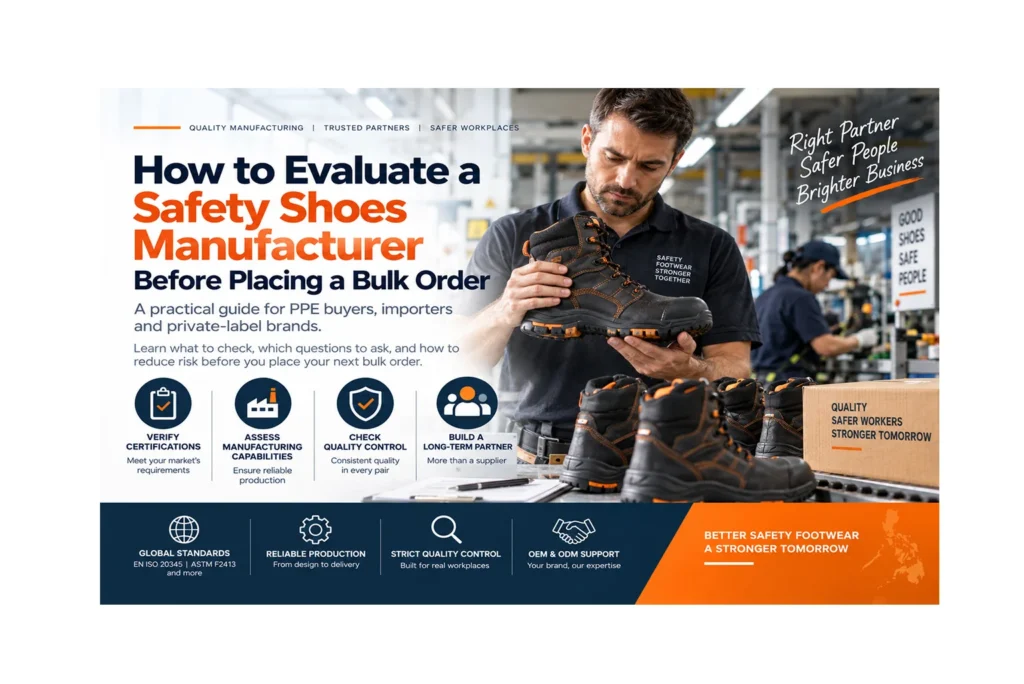
Choosing a safety shoes manufacturer is one of the most important decisions for PPE distributors, importers, wholesalers and private-label footwear brands. A supplier may offer an attractive quotation and professional product photos, but those details alone cannot tell you whether it can consistently manufacture footwear that meets your specifications.
A bulk order introduces risks that are easy to overlook when evaluating a single sample: inconsistent sizing, material substitutions, incomplete certification, production delays, packaging errors and quality problems discovered only after the shipment arrives.
The best way to evaluate a safety shoes manufacturer is to verify its identity, confirm product compliance, assess production and quality-control capabilities, test representative samples and agree on measurable order requirements before paying a deposit.
This guide explains how to do that, from the first supplier enquiry to the final pre-shipment inspection.
Quick Checklist: How to Evaluate a Safety Shoes Manufacturer
Use this checklist to structure your supplier assessment.
| Evaluation area | What to verify | Evidence to request |
|---|---|---|
| Company identity | Who manufactures the footwear and where? | Registration details, factory address, video tour |
| Product compliance | Does the exact model meet your market’s requirements? | Model-specific certificates and test reports |
| Manufacturing capability | Can the factory make your design and quantity? | Production-line information, capacity and schedule |
| Quality control | How are defects prevented and detected? | Inspection procedures, records and corrective actions |
| Materials | Will bulk production match the approved sample? | Material specifications and approved component list |
| Samples | Does the footwear perform as expected? | Production-representative samples and test results |
| Commercial terms | What exactly is included in the price? | Itemised quotation and written purchase agreement |
| Delivery | Can the supplier meet your required shipment date? | Production plan and agreed milestones |
| After-sales support | What happens if a batch has defects? | Written claims and corrective-action procedure |
A supplier should not be approved simply because it performs well in one area. Strong pricing does not compensate for missing compliance documentation, and a good sample does not prove that the factory can reproduce it consistently.
1. Verify That You Are Dealing With a Genuine Manufacturer
The first step is to establish who will actually produce your safety shoes.
A supplier may be a factory, a trading company, a sourcing agent or a business combining several of these roles. None of these arrangements is automatically unsuitable, but buyers need to understand the relationship.
Ask Who Owns and Operates the Factory
Request the supplier’s registered company name, factory address and the name of the entity that will appear on your commercial documents.
Then ask:
- Which facility will manufacture my order?
- Are the cutting, stitching and sole-attachment processes performed there?
- Which operations are subcontracted?
- Can I inspect the production site?
- Will the same facility manufacture the approved sample and bulk order?
A manufacturer that uses subcontractors may still deliver a reliable product. The important issue is whether it discloses those arrangements and controls the work.
Conduct a Factory Visit or Live Video Audit
If an in-person visit is impractical, arrange a live video call.
Ask the supplier to show the production areas, material storage, inspection stations, finished-goods warehouse and equipment relevant to your proposed footwear.
A live tour is more informative than a promotional video because you can ask the supplier to show specific processes and answer questions in real time.
For a large first order, consider commissioning an independent factory audit.
2. Verify Product Certification for Your Target Market
A factory’s quality-management certificate is not the same as certification of a safety shoe.
This distinction is essential for importers.
A supplier might have an ISO 9001-certified management system while a particular footwear model has not been assessed against the safety requirements relevant to your market.
Identify the Correct Footwear Requirements
Start with the country of sale, the intended workplace and the protection the footwear must provide.
For example, buyers may encounter:
- EN ISO 20345 for safety footwear intended for relevant European markets.
- ASTM F2413 in US safety-footwear specifications.
- Australian footwear standards and customer-specific requirements for Australian projects.
ISO 20345:2021 specifies basic and additional requirements for general-purpose safety footwear, including mechanical risks, slip resistance, thermal risks and ergonomic behaviour. Specialised hazards can require additional, job-specific standards.
Do not assume that a certificate issued for one market automatically satisfies another market’s legal or contractual requirements.
Check the Exact Model, Not Just the Brand
Ask the supplier for documents that identify the footwear you intend to purchase.
Compare the documentation with the sample and specification sheet:
- Manufacturer’s name
- Model or type number
- Applicable standard and edition
- Protection category or markings
- Test or certification body
- Issue and expiry dates, where applicable
- Materials and construction covered by the assessment
For EU-market PPE, Regulation (EU) 2016/425 establishes conformity-assessment and documentation requirements. Its EU type-examination provisions require identification of the PPE type and the manufacturer on the certificate.
Ask the supplier for documents that identify the footwear you intend to purchase.
Compare the documentation with the sample and specification sheet:
- Manufacturer’s name
- Model or type number
- Applicable standard and edition
- Protection category or markings
- Test or certification body
- Issue and expiry dates, where applicable
- Materials and construction covered by the assessment
For EU-market PPE, Regulation (EU) 2016/425 establishes conformity-assessment and documentation requirements. Its EU type-examination provisions require identification of the PPE type and the manufacturer on the certificate.
A certificate for a leather steel-toe boot should not be treated as proof that a newly developed textile composite-toe model has also been assessed.
Verify Documents Independently
Where possible, contact the issuing body or use its official verification service.
For EU PPE, verify the notified body’s identity and relevant scope rather than relying solely on a logo printed on a PDF.
Also ask whether changing the upper, outsole, toe cap, penetration-resistant insert or other construction details would require further assessment.
A certified sample and a modified bulk-production shoe are not necessarily the same product.
3. Check the Manufacturer’s Quality-Management System
A factory should be able to explain how it maintains consistent quality across thousands of pairs.
ISO 9001 certification can provide evidence that a management system has been independently assessed, but it does not guarantee that every pair of footwear is defect-free.
Verify ISO 9001 Claims
Request the certificate and check the company name, covered locations, scope and status.
IAF CertSearch provides a way to verify accredited management-system certificates by company name or certificate number. Its records can show the certification status, scope, certification body and accreditation body.
IAF CertSearch is for management-system certification; it is not a substitute for checking product-specific safety-footwear certification.
If a certificate cannot be found, ask the issuing certification body to confirm its status rather than immediately assuming it is fraudulent.
Ask How Quality Control Works in Practice
A capable manufacturer should be able to explain its inspection process at several stages.
Incoming materials: Are leather, textiles, toe caps, midsoles and outsole materials checked before production?
In-process inspection: Are cutting, stitching, lasting and sole attachment monitored?
Finished-product inspection: Are sizing, appearance, bonding, markings and packaging checked?
Corrective action: What happens when a recurring defect is discovered?
Ask for anonymised inspection records or an example of a corrective-action report. A supplier that can show how it identified and resolved a problem may provide more useful evidence than one that simply claims it never has defects.
4. Evaluate Production Capacity and Lead-Time Reliability
A factory may produce good samples but struggle to deliver a large order on schedule.
Before ordering, establish whether its capacity matches your quantity, construction method and delivery requirements.
Ask for Relevant Capacity, Not Just a Headline Number
A claim such as “5,000 pairs per day” is difficult to interpret without context.
Ask:
- Is that maximum capacity or typical output?
- Does it cover all footwear types or only certain models?
- How much capacity is already committed?
- Can the factory handle your required size range and colour combinations?
- Which components have the longest procurement lead times?
- What happens if a key machine is unavailable?
A factory producing simple PU-injected footwear may have a different schedule for a complex waterproof boot with specialised materials.
Request a Production Timeline
Ask the supplier to break the schedule into milestones:
| Stage | What the buyer should confirm |
|---|---|
| Design and specification approval | All construction details are final |
| Material procurement | Critical components are available |
| Pre-production sample | The final production specification is approved |
| Bulk manufacturing | Start date and planned output |
| Testing and inspection | Time is reserved for checks and corrections |
| Packing and shipment | Cartons, labels and shipping documents are ready |
Do not treat an estimated production lead time as a guaranteed delivery date until the factory has confirmed material availability and production scheduling.
5. Assess the Materials and Footwear Construction
Two safety boots can look nearly identical in a photograph while using very different materials.
The upper, lining, toe cap, penetration-resistant component, outsole and construction method all influence performance and cost.
Request a Detailed Specification Sheet
For each proposed model, ask for:
- Upper material and relevant specifications
- Lining material
- Toe-cap type
- Penetration-resistant component, if required
- Outsole and midsole materials
- Sole-attachment method
- Insole or footbed construction
- Closure system
- Waterproof construction, if claimed
- Sizes, colours and packaging
Where a characteristic matters commercially or technically, define it precisely rather than relying on broad terms such as “premium leather” or “high-quality rubber.”
Prevent Unapproved Material Substitution
Agree that the manufacturer cannot change critical components without written approval.
A different outsole compound, toe cap or penetration-resistant insert may affect performance, fit, certification or durability.
Maintain an approved specification and component list that both parties can reference during production and inspection.
6. Test Samples Before Approving a Bulk Order
Samples are essential, but buyers should understand what they prove.
A well-made sample demonstrates what a supplier can produce. It does not, by itself, demonstrate what every pair in a bulk shipment will be like.
Evaluate the Sample Against a Written Specification
Inspect the footwear for:
- Correct size and fit
- Toe clearance
- Stitching quality
- Sole bonding
- Upper finish
- Weight
- Flexibility
- Outsole pattern
- Closure function
- Markings and labels
Have intended users try the footwear under representative working conditions where practical.
A safety shoe that meets a technical specification but causes widespread fit complaints may still be a poor commercial choice for your customer base.
Distinguish Development Samples From Production Samples
A development sample may use temporary materials or a construction that has not yet been finalised.
Before bulk production, approve a pre-production sample representing the intended materials, construction, markings and packaging.
Keep an agreed reference sample available for comparison with the production batch.
Use Independent Testing When Appropriate
For a new design, a large order or a market with demanding compliance requirements, independent laboratory testing may be warranted.
Testing should address the applicable standard and relevant claimed properties—not simply produce a generic “quality passed” report.
7. Audit the Factory’s Bulk-Order Inspection Process
Bulk-order quality depends on repeatability.
A supplier should have a documented process for identifying defects before the goods leave the factory.
Define What Counts as a Defect
Agree on examples of critical, major and minor defects appropriate to the product and contract.
A potentially compromised protective component is not equivalent to a small cosmetic mark.
Your inspection plan should distinguish safety-related nonconformities from appearance issues and specify how each category will be handled.
Agree on a Sampling Plan
Buyers often use acceptance-sampling methods for lot inspections. ISO 2859-1:2026 describes sampling schemes indexed by acceptance quality limit (AQL) for lot-by-lot inspection.
An AQL plan is a statistical acceptance method, not a promise that every accepted shipment contains no defects.
Safety-critical failures may require stricter treatment, including additional testing or rejection, regardless of an otherwise acceptable cosmetic-defect count.
Arrange Pre-Shipment Inspection
For a first large order, consider an independent inspection when production is complete and the goods are ready for packing or shipment.
The inspection should compare the goods with the purchase agreement, approved sample and product specifications.
Typical checks include quantity, size distribution, workmanship, markings, packaging and agreed functional tests.
8. Compare Quotations on the Same Basis
The lowest quoted unit price is not necessarily the lowest total cost.
Before comparing suppliers, make sure their quotations cover equivalent products and commercial terms.
Ask for an Itemised Quotation
Confirm:
- Exact model and specification
- Quantity and size breakdown
- Unit price
- Sample or tooling charges
- Testing and certification costs
- Custom logo and packaging charges
- Incoterm and named place
- Payment schedule
- Production lead time
- Inspection arrangements
A quotation for a basic steel-toe boot should not be compared directly with one for a waterproof composite-toe boot unless the differences are intentional.
Calculate Landed Cost
For importers, consider the full cost of getting the footwear into the destination market.
This may include freight, insurance, duties, taxes, customs charges, testing, inspection and local delivery, depending on the agreed trade terms.
Also consider potential costs associated with defects, replacements and delayed deliveries.
9. Confirm OEM and ODM Capabilities
If you are developing a private-label safety shoe brand, evaluate the supplier’s product-development capability—not just its existing catalogue.
OEM: Manufacturing to an Agreed Specification
For an OEM project, establish whether the manufacturer can reliably produce your approved design and technical requirements.
Clarify who owns the design, patterns, tooling and branding assets.
ODM: Developing a Product With the Manufacturer
For an ODM project, ask how the factory handles:
- Design development
- Material selection
- Prototype revisions
- Fit trials
- Testing
- Certification planning
- Packaging development
- Production handover
A useful test is to ask the supplier to explain a design trade-off.
For example: How would you reduce the weight of this boot without compromising its required protection or making it too expensive?
A technically capable team should be able to discuss realistic options and the testing implications of changes.
10. Evaluate Communication and Problem-Solving
Communication becomes particularly important when an order includes custom development, certification or a fixed delivery deadline.
Look for a supplier that answers specific questions clearly and identifies uncertainties early.
Watch for These Warning Signs
- The supplier avoids identifying the actual factory.
- Certificate model numbers do not match the proposed product.
- Material specifications change without explanation.
- Lead times are promised before key materials are confirmed.
- The supplier refuses reasonable inspection arrangements.
- Quotations omit important charges.
- Every question receives a generic sales response.
- The supplier cannot explain how it handles defective production.
One warning sign may have an innocent explanation. Several unresolved issues together justify further investigation before payment.
11. Agree on Clear Purchase-Order Terms
Verbal promises and chat messages are difficult to manage when a shipment contains thousands of pairs.
Put the essential requirements in the purchase agreement or purchase order.
Include the Approved Product Specification
Identify the model, construction, materials, sizes, colours, markings and packaging.
Reference the approved sample and any required testing documentation.
Define Inspection and Acceptance
Specify when inspections can take place, who pays for them and what happens if the goods fail the agreed criteria.
Set Out Delivery and Payment Terms
Confirm the shipment schedule, trade terms, payment milestones and documents required before the final payment.
Establish a Defect-Claims Process
Agree on how defects will be reported, investigated and resolved.
Possible remedies may include repair where appropriate, replacement, credit or another contractually agreed solution. Safety-critical issues may require the affected goods to be withheld from use or sale.
For substantial cross-border orders, have a qualified trade or legal adviser review the agreement.
12. Start With a Controlled Trial Order
A trial order can reveal problems that samples and factory presentations do not.
Where commercially practical, begin with a manageable quantity before committing to a much larger programme.
Use the trial to evaluate:
- Consistency across sizes
- Fit feedback from actual users
- Packaging accuracy
- Communication during production
- Delivery performance
- Defect handling
- Reorder responsiveness
Record the results and use them to refine the specification before scaling up.
A trial order does not replace certification or inspection, but it can provide valuable evidence of how the supplier performs under real commercial conditions.
Questions to Ask a Safety Shoes Manufacturer Before Ordering
You can send the following questions to shortlisted suppliers as part of your initial enquiry:
Supplier Evaluation Checklist
- What is your registered company name and manufacturing address?
- Which production processes are performed in-house or subcontracted?
- Can you provide model-specific certification and test reports?
- Can the issuing bodies independently verify those documents?
- What materials and components will be used in bulk production?
- Can you provide a production-representative sample?
- What is your available capacity for this model and quantity?
- What inspections and safety-related tests do you perform?
- Can we arrange an independent factory audit and pre-shipment inspection?
- What are your MOQ, lead time, payment terms and Incoterm?
- How do you control changes to approved materials or construction?
- What is your procedure for defective goods and corrective actions?
Frequently Asked Questions
How can I tell whether a safety shoes supplier is a real factory?
Verify the registered business and production address, ask which processes are performed in-house, arrange a live factory tour and consider an independent audit. A trading company can also be a legitimate supplier, but it should disclose who manufactures your footwear.
Is ISO 9001 enough to approve a safety shoes manufacturer?
No. ISO 9001 concerns the quality-management system. Buyers must separately verify that the exact footwear model meets applicable product requirements and that bulk production matches the approved design.
What documents should I request before placing a bulk order?
At minimum, request company details, a detailed product specification, relevant model-specific compliance documents, an itemised quotation, an approved sample and written order terms. Additional documents depend on your market and product.
Should I pay for independent inspection?
It is worth considering for a first large order, a new supplier, a custom product or a shipment with significant financial or safety implications. The inspection scope should be agreed before production.
Can I use one certificate for several safety shoe models?
Only if the certificate and its scope actually cover those models and constructions. Do not assume that a certificate for one model applies to an altered design or every product from the same manufacturer.
What is more important: price or production capacity?
Neither can be considered in isolation. The manufacturer must first be able to meet the required protection, specification and delivery needs. Price can then be compared among suppliers capable of meeting those requirements.
How do I reduce the risk of defects in a bulk order?
Use a detailed specification, approve a production-representative sample, control component changes, agree on inspection criteria and arrange appropriate production or pre-shipment checks.
Conclusion
Evaluating a safety shoes manufacturer requires more than comparing catalogues and FOB prices.
A reliable sourcing process checks who makes the footwear, whether the exact model meets the required standards, how the factory controls production and what happens when something goes wrong.
Before placing a bulk order, verify the supplier’s identity, review model-specific documentation, inspect representative samples, confirm capacity, agree on materials and inspection criteria, and put the commercial requirements in writing.
The objective is not simply to find a manufacturer that can produce a good-looking sample. It is to find a partner that can reproduce the approved safety footwear consistently, at the agreed quality, quantity, cost and delivery schedule.
Discuss Your Bulk Safety Footwear Requirements
Ocean Safety Shoes supports OEM and ODM safety footwear development for importers, wholesalers, PPE distributors and private-label brands.
If you are preparing a bulk order, share your target market, required footwear specifications, estimated quantity and branding requirements. These details provide a practical starting point for discussing product development, samples, documentation and production planning.