
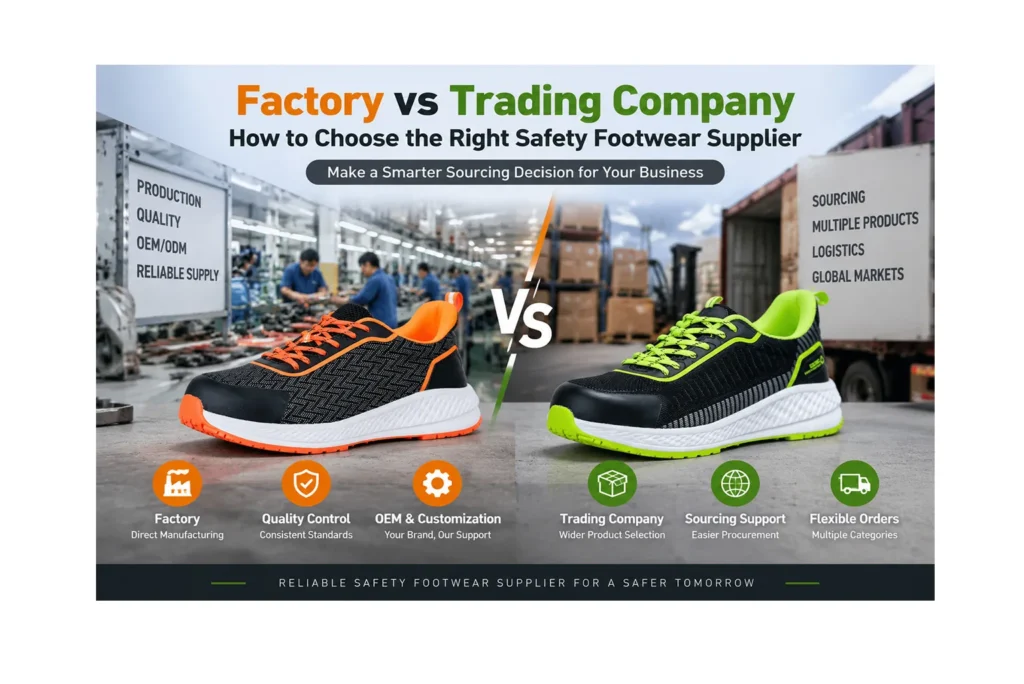
When businesses purchase safety footwear for employees, customers, or distribution networks, selecting the right Safety Footwear Supplier is a critical sourcing decision. The supplier you choose can directly influence product quality, delivery reliability, customization options, and long-term business growth.
For importers, PPE distributors, wholesalers, and industrial buyers, one of the most common sourcing questions is:
Should you work directly with a safety footwear factory or choose a trading company?
Both supplier models have different advantages. A safety footwear factory provides direct manufacturing capability, quality control, and OEM solutions, while a trading company may offer broader product sourcing and supplier management support.
However, selecting a supplier based only on price can create risks. Safety footwear is professional personal protective equipment (PPE), and buyers must consider product quality, safety standards, production capability, and long-term cooperation potential.
This guide explains the differences between a factory and a trading company, helping global buyers choose the right safety footwear supplier for their business requirements.
Why Choosing the Right Safety Footwear Supplier Matters
Safety footwear protects workers from common workplace hazards, including:
- Falling objects
- Heavy equipment impact
- Compression risks
- Slippery surfaces
- Electrical hazards
- Extreme working environments
Industries that commonly require protective footwear include:
- Construction
- Manufacturing
- Warehousing
- Logistics
- Mining
- Oil and gas
For companies purchasing safety shoes in bulk, a supplier is more than a product source. A reliable partner should provide:
| Evaluation Factor | Why It Matters |
|---|---|
| Manufacturing capability | Ensures stable production and supply |
| Quality control system | Maintains consistent product performance |
| OEM capability | Supports branding and customization |
| Export experience | Reduces international sourcing risks |
Choosing the right supplier helps businesses avoid:
- Quality issues
- Delivery delays
- Customer complaints
- Unexpected costs
What Is a Safety Footwear Factory?
A safety footwear factory is a manufacturer that directly produces protective footwear through its own production facilities.
Unlike companies that only source products, factories manage the complete manufacturing process, including:
- Material selection
- Product development
- Cutting and stitching
- Sole production
- Assembly
- Quality inspection
- Packaging
Working directly with a factory allows buyers to communicate with the actual production team and better understand manufacturing capability.
Direct Manufacturing Control
One of the biggest advantages of working with a factory is direct control over production.
A professional factory can manage:
- Raw material quality
- Production processes
- Manufacturing schedules
- Product consistency
- Quality inspections
For example, a PPE distributor supplying construction companies may require thousands of pairs of safety shoes annually. Direct cooperation with a manufacturer helps maintain stable quality across repeated orders.
A professional factory also provides technical knowledge about:
- Steel toe safety shoes
- Composite toe protection
- Slip-resistant outsole technology
- Waterproof safety footwear
- Industrial footwear applications
OEM and Customization Capability
Many businesses require customized products instead of standard safety shoes.
A professional safety shoes manufacturer can provide:
- Custom logos
- Private label solutions
- Customized packaging
- Material selection
- Product modifications
| Factory Capability | Business Benefit |
|---|---|
| Direct production | Better quality control |
| OEM services | Build private brands |
| Technical support | Better product solutions |
| Flexible customization | Meet market requirements |
For distributors and importers, working with a manufacturer that understands OEM requirements can create stronger market advantages.
What Is a Trading Company?
A trading company acts as an intermediary between buyers and manufacturers.
Instead of producing products directly, trading companies usually cooperate with multiple factories and provide sourcing services.
Their services may include:
- Product sourcing
- Supplier coordination
- Export documentation
- Logistics management
- Order communication
Benefits of Working With Trading Companies
Trading companies can be useful for certain purchasing situations.
They may provide:
Wider Product Selection
Because trading companies often work with different manufacturers, they can provide access to more product categories.
This can be useful for buyers needing:
- Multiple PPE products
- Different footwear styles
- Various price ranges
Easier Supplier Management
For companies without international sourcing experience, trading companies can simplify purchasing by handling communication and coordination.
| Trading Company Advantage | Suitable Buyers |
|---|---|
| Multiple supplier networks | Companies needing different products |
| Sourcing support | New importers |
| Export assistance | Businesses without sourcing teams |
However, buyers should still confirm:
- Where products are manufactured
- How quality is controlled
- Whether customization is available
Factory vs Trading Company: Key Differences Explained
Understanding the difference between these supplier models helps buyers make better sourcing decisions.
| Comparison Factor | Safety Footwear Factory | Trading Company |
|---|---|---|
| Production control | Direct manufacturing management | Depends on partner factories |
| Product knowledge | Strong technical expertise | Depends on supplier information |
| Pricing | Direct factory pricing | May include service costs |
| OEM capability | Usually stronger | Depends on factory relationships |
| Quality control | Managed internally | Requires coordination |
| Communication | Direct with manufacturer | Through intermediary |
| Product variety | Usually focused categories | Usually broader selection |
A factory is often more suitable for:
- Large-volume purchasing
- Custom product development
- Long-term partnerships
- Stable supply requirements
A trading company may be suitable for:
- Smaller orders
- Multiple product requirements
- Buyers needing sourcing support
How to Choose a Reliable Safety Footwear Supplier
Selecting the right Safety Footwear Supplier requires careful evaluation.
Evaluate Manufacturing Experience
Experience is one of the most important factors when choosing a supplier.
Buyers should check:
- Years of manufacturing experience
- Export markets
- Production capacity
- Industry experience
Experienced suppliers usually understand:
- International customer requirements
- Workplace applications
- Product development needs
Check Quality Control Systems
Quality control is essential because safety shoes directly protect workers.
A professional supplier should inspect:
Raw Materials
Including:
- Leather
- Fabric
- Toe caps
- Outsole materials
Production Process
Including:
- Stitching quality
- Assembly accuracy
- Manufacturing consistency
Finished Products
Including:
- Appearance checks
- Performance testing
- Packaging inspection
Confirm Certifications and OEM Capability
Before placing bulk orders, buyers should confirm whether suppliers understand their target market requirements.
Important factors include:
- Safety standards
- Testing procedures
- Certification documents
- Customization options
Depending on the market, suppliers may need to understand:
- EN ISO standards
- ASTM requirements
- Regional PPE regulations
Common Mistakes When Selecting a Safety Shoes Supplier
Choosing Only the Lowest Price
Price is important, but the cheapest supplier may not provide the best overall value.
Low prices can sometimes result from:
- Lower-quality materials
- Limited inspection procedures
- Reduced durability
A better approach is evaluating:
- Product quality
- Supplier reliability
- Long-term cost
Ignoring Supplier Verification
Some buyers select suppliers without checking actual capability.
Before cooperation, review:
- Factory information
- Production facilities
- Quality systems
- Export experience
Focusing Only on Product Samples
A good sample does not always guarantee stable bulk production.
Buyers should also evaluate:
- Production capacity
- Quality management
- Manufacturing consistency
Questions to Ask Before Choosing a Safety Footwear Supplier
Before placing a large order, professional buyers should ask detailed questions.
| Question | Purpose |
|---|---|
| Are you a factory or trading company? | Understand supply chain structure |
| How long have you produced safety footwear? | Evaluate experience |
| What is your production capacity? | Check supply reliability |
| Can you provide OEM services? | Confirm customization ability |
| What standards do your products meet? | Verify compliance |
| How do you control product quality? | Understand inspection process |
These questions help buyers identify reliable long-term partners.
Why Work With a Professional Safety Shoes Manufacturer?
A professional safety shoes manufacturer provides more than production. A reliable manufacturing partner can support:
- Product development
- Quality improvement
- Custom solutions
- Stable supply
- Long-term cooperation
For importers and distributors, working directly with an experienced manufacturer can improve:
- Supply chain efficiency
- Product consistency
- Market competitiveness
Ocean Safety Shoes is a professional safety footwear factory and safety footwear supplier providing protective footwear solutions for global customers.
With factory-direct production, OEM capability, and quality-focused manufacturing, Ocean Safety Shoes supports:
- PPE distributors
- Importers
- Wholesale buyers
- Industrial companies
- Private-label brands
Frequently Asked Questions About Safety Footwear Suppliers
What Is the Difference Between a Safety Footwear Factory and a Trading Company?
A safety footwear factory directly manufactures products, while a trading company sources products from different manufacturers. Factories usually provide stronger production control and customization capability.
Is Buying Directly From a Factory Cheaper?
Direct factory purchasing can reduce intermediary costs, especially for large orders. However, buyers should consider quality, reliability, and service instead of price alone.
How Can I Verify a Safety Footwear Supplier?
Buyers can review:
- Factory capability
- Production facilities
- Certifications
- Quality systems
- Export experience
These checks help reduce sourcing risks.
Should Importers Work Directly With Manufacturers?
Importers requiring large quantities, customization, or long-term supply often benefit from working directly with manufacturers.
Can Safety Footwear Factories Provide OEM Services?
Yes. Professional manufacturers can provide:
- Custom branding
- Packaging solutions
- Product modifications
- Private label development
Conclusion
Choosing the right Safety Footwear Supplier is essential for businesses purchasing protective footwear.
Both factories and trading companies can provide value, but their advantages are different. Trading companies may offer convenience and broader sourcing options, while professional safety footwear factories can provide direct manufacturing control, OEM capability, and long-term cooperation opportunities.
For importers, distributors, and businesses purchasing safety shoes in bulk, supplier selection should focus on quality, reliability, production capability, and future business needs.
Ocean Safety Shoes is a professional safety shoes manufacturer and safety footwear supplier providing reliable protective footwear solutions for global customers. With manufacturing expertise, OEM services, and quality-focused production, we help businesses source durable safety footwear designed for workplace protection and long-term value.