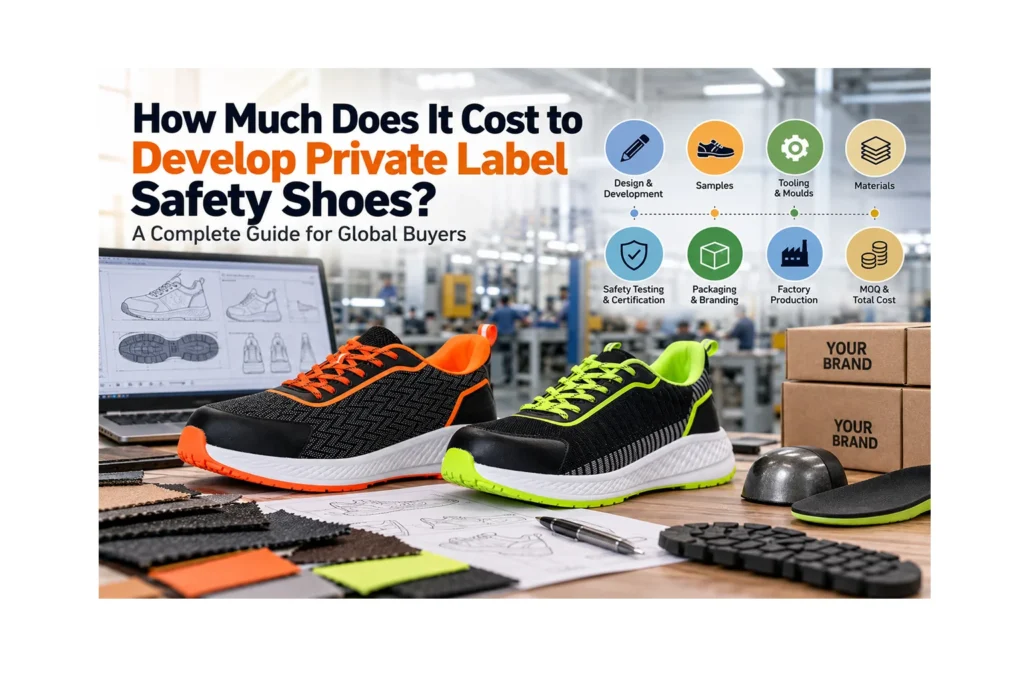
Developing your own safety footwear line can be an attractive opportunity for PPE distributors, importers, workwear brands, and industrial suppliers. But before approaching a safety shoes factory, one question usually comes first: how much does it cost to develop private label safety shoes?
There is no single price that applies to every project. A relatively simple private-label program based on an existing factory model may require little product-development investment beyond samples, branding, packaging, testing, and the first production order. A completely new safety shoe, however, can require new lasts, outsole moulds, prototypes, material development, testing, and significantly higher minimum order quantities.
For B2B buyers, the useful question is therefore not simply, “What does one pair cost?” It is: What is the total cost required to take the product from concept to a commercially viable bulk order?
This guide explains the major cost components, the difference between private label and custom development, and how buyers can control their investment without compromising product quality.
What Does It Mean to Develop Private Label Safety Shoes?
Private-label safety footwear is manufactured by a third-party factory and sold under the buyer’s own brand. Depending on the project, customization can range from applying a logo to an existing model to developing an almost entirely new shoe.
This distinction matters because the level of customization has a major effect on development cost.
Existing Model With Private Branding
This is usually the simplest route. A buyer selects an existing model from a safety shoes manufacturer and changes elements such as:
- Logo
- Insole branding
- Tongue label
- Color combinations
- Shoe box
- Packaging
- Hangtags
Because the existing construction, last, outsole, and production process are already established, development is usually faster and requires less upfront investment.
Modified Existing Model
The next level involves changing an existing shoe more substantially. Buyers might request:
- Different upper materials
- New color combinations
- Alternative toe caps
- Different insoles
- Waterproof construction
- Modified outsole specifications
- New accessories or trims
This approach can provide greater product differentiation while still using part of the factory’s existing platform.
Fully Custom Safety Footwear
A fully customized project can involve:
- New shoe design
- Custom last
- New outsole
- New moulds
- Specialized materials
- Custom components
- Multiple prototype rounds
- Product testing
This is normally the most expensive approach, but it gives brand owners greater control over product differentiation.
How Much Does It Cost to Develop Private Label Safety Shoes?
The total investment depends on the product, order quantity, customization level, certification requirements, and commercial terms agreed with the factory.
Instead of relying on a universal price, buyers should separate the project into individual cost categories.
| Cost Category | Existing Private-Label Model | Modified Model | Fully Custom Model |
|---|---|---|---|
| Design work | Low | Moderate | Higher |
| Samples | Usually required | Multiple rounds possible | Multiple rounds likely |
| Last development | Usually unnecessary | Sometimes required | Often required |
| Outsole mould | Existing mould | Existing or modified | New mould may be required |
| Branding | Required | Required | Required |
| Packaging | Optional/custom | Usually custom | Usually custom |
| Testing | Depends on market | Often required | Typically important |
| MOQ commitment | Usually lower | Medium | Usually higher |
| Development time | Shorter | Medium | Longer |
Actual quotations can vary substantially between factories and projects. Buyers should therefore ask for a cost breakdown rather than comparing only the quoted price per pair.
What Determines Private Label Safety Shoe Development Cost?
Several factors have a much greater impact on the budget than others.
Product Design and Customization Level
The closer your product is to an existing factory model, the lower the development burden is likely to be.
For example, changing a logo and packaging is fundamentally different from asking a factory to create a new athletic-style safety shoe with a proprietary outsole.
Before contacting a safety shoes supplier, decide which elements genuinely need to be unique. Customizing every component may increase cost without providing equivalent commercial value.
Last and Outsole Development
The last determines important aspects of footwear shape and fit. A new outsole normally requires tooling or mould development.
These components can create significant upfront costs because they require engineering work and must be suitable for production.
A practical option for a new brand is often to begin with a manufacturer’s proven last and outsole platform, then differentiate the product through:
- Upper design
- Materials
- Color
- Branding
- Comfort features
- Packaging
Once sales volume justifies further investment, a proprietary outsole can be considered.
Materials
Material selection affects both development and unit cost.
Common choices include:
- Full-grain leather
- Nubuck leather
- Split suede
- Microfiber
- Mesh
- Technical woven fabrics
- PU and rubber outsoles
Additional protective or comfort features can also change costs, such as:
- Waterproof membranes
- Steel toe caps
- Composite toe caps
- Puncture-resistant midsoles
- Premium insoles
- Specialized linings
The correct material specification should reflect the intended workplace rather than simply selecting the most expensive option.
Safety Testing and Certification
Safety footwear is PPE, so compliance should be considered early in development.
Depending on the intended market and product claims, footwear may need to be evaluated against relevant standards and conformity requirements. Testing can affect both development time and cost.
A common mistake is developing a product first and discussing certification only after samples are finalized. Instead, buyers should tell the factory where the product will be sold and which performance requirements are needed at the beginning of the project.
Private Label Development Cost vs Unit Price
Development cost and manufacturing price are not the same thing.
A shoe might have an attractive factory price but require substantial tooling, testing, or packaging investment before production begins. Conversely, a slightly higher unit price based on an established platform may reduce upfront development costs.
For procurement teams, total project cost is a more useful measurement.
| Cost | One-Time or Recurring? | Questions to Ask |
|---|---|---|
| Design/development | Mostly one-time | Is development included in the quotation? |
| Samples | Development stage | How many revisions are included? |
| Tooling/moulds | Usually one-time | Who owns the mould after payment? |
| Testing | Initial and possibly recurring | Which tests are required? |
| Packaging setup | Initial + recurring | Are printing plates or setup fees required? |
| Production | Recurring | What is the price at different quantities? |
| Freight | Recurring | Which Incoterm is being quoted? |
This distinction makes quotations from different suppliers much easier to compare.
How MOQ Affects the Cost to Develop Private Label Safety Shoes
Minimum order quantity, or MOQ, is one of the most important commercial factors in private-label development.
A safety shoes factory must purchase materials, schedule production, prepare machinery, and manage different sizes. Very small orders can therefore be inefficient.
Existing Models Usually Reduce the Entry Barrier
Using an existing factory design may allow a buyer to start with a more manageable order because:
- Existing moulds can be used
- Materials may already be available
- Production processes are established
- Development work is reduced
Custom Products Usually Require Greater Commitment
A highly customized product may require dedicated:
- Materials
- Components
- Packaging
- Moulds
- Production preparation
As a result, the required order commitment may be higher.
Buyers should clarify whether MOQ applies:
- Per model
- Per color
- Across all sizes
- Per outsole
- Per production order
This detail can substantially change the real inventory investment.
What Does the Private Label Development Process Look Like?
Understanding the process makes it easier to budget correctly and avoid unnecessary revisions.
Define the Product Brief
Start with a clear commercial and technical brief covering:
- Target market
- Target industry
- Expected selling price
- Required safety features
- Preferred materials
- Branding
- Order quantity
Avoid beginning with vague instructions such as “make a premium safety shoe.” The more specific the brief, the easier it is for the manufacturer to recommend an appropriate construction.
Select an Existing Platform or Develop a New One
The safety shoes manufacturer should determine whether an existing model can meet your requirements.
If it can, modifying that platform can save both development time and investment.
If it cannot, the project may move into custom design and tooling.
Develop and Evaluate Samples
Samples should be evaluated for more than appearance.
Check:
- Fit
- Comfort
- Construction
- Materials
- Branding
- Outsole
- Protective components
- Workmanship
Document requested changes clearly so that each revision solves specific issues.
Complete Testing and Approval
Once the design is stable, confirm required product testing and documentation.
The exact process depends on the intended market, product specification, and applicable requirements.
Approve Bulk Production
Before production, confirm:
- Final sample
- Size range
- Color
- Materials
- Packaging
- Quantity
- Inspection requirements
- Delivery schedule
A written specification sheet can reduce misunderstandings.
How to Reduce Private Label Development Costs Without Sacrificing Quality
Cost reduction should focus on removing unnecessary development rather than reducing essential protection or quality.
Start With a Proven Factory Platform
For a new brand, using an existing last and outsole can be one of the most effective ways to reduce investment.
You can still differentiate the product through:
- Upper design
- Material combinations
- Colors
- Logo
- Insole
- Packaging
Limit Early-Stage SKUs
Launching too many styles and colors can increase:
- Sample costs
- Material requirements
- Packaging complexity
- Inventory
Starting with a smaller, focused collection makes it easier to test market demand.
Define Requirements Before Sampling
Repeatedly changing the specification during development increases cost and delays.
Prepare a clear product brief before the first sample.
Discuss Testing Early
Tell your supplier which market you are targeting before product development begins. This helps the factory select appropriate components and construction from the start.
Common Cost Mistakes When Developing Private Label Safety Shoes
Comparing Only Price Per Pair
A low unit price can look attractive while hiding tooling, testing, packaging, or other costs.
Better approach: compare the complete landed and development cost.
Requesting Full Customization Too Early
A new brand may not need proprietary tooling for its first product.
Better approach: determine which custom features actually create customer value.
Ignoring MOQ Across Sizes and Colors
A quotation may look affordable until the buyer calculates inventory across multiple colors and size runs.
Better approach: ask for the MOQ structure in writing.
Skipping Pre-Production Approval
Small differences in materials, branding, or construction can become expensive when multiplied across thousands of pairs.
Better approach: approve a final reference sample and detailed specification before bulk manufacturing.
How to Choose a Factory for Private Label Safety Shoes
Price matters, but private-label projects require a supplier capable of supporting product development.
Evaluate potential partners using criteria such as:
| Supplier Factor | What Buyers Should Verify |
|---|---|
| Manufacturing capability | Production facilities and capacity |
| Safety footwear experience | Knowledge of protective footwear construction |
| OEM/ODM capability | Design, branding, packaging, and customization |
| Quality control | Incoming, in-process, and final inspections |
| Testing knowledge | Understanding of target-market requirements |
| Communication | Clear technical and commercial responses |
| Scalability | Ability to support future order growth |
A capable safety shoes supplier should also be willing to explain which customization requests are practical and which may unnecessarily increase costs.
Frequently Asked Questions About Developing Private Label Safety Shoes
How Much Does It Cost to Develop Private Label Safety Shoes?
There is no universal cost. The budget depends on customization, tooling, samples, materials, testing, packaging, MOQ, and the first production order. Request an itemized quotation from the manufacturer.
Is Private Label Cheaper Than Developing a Completely New Safety Shoe?
Usually, yes. Using an existing factory platform can eliminate or reduce costs associated with new lasts, outsole moulds, and extensive product engineering.
What Is the MOQ for Private Label Safety Shoes?
MOQ varies by manufacturer, model, material, color, and customization level. Buyers should ask whether MOQ applies per style, color, or total order.
Do I Need a New Outsole Mould?
Not necessarily. Existing factory outsoles can often be used for private-label products. A new mould is generally needed when a proprietary outsole design is required.
Can I Put My Own Logo on Safety Shoes?
Private-label manufacturers commonly offer branding options such as upper logos, tongue labels, insoles, boxes, and other packaging elements. Available methods depend on the shoe construction and materials.
How Long Does Private Label Development Take?
Timing depends on the complexity of the product, number of sample revisions, tooling requirements, testing, and material availability. A modified existing model is generally faster than a completely new design.
Should I Work With a Factory or Trading Company?
For buyers requiring direct customization, technical communication, and ongoing product development, a factory relationship can be useful. Trading companies can also be appropriate when broader sourcing and supplier coordination are priorities.
What Should I Send a Safety Shoes Manufacturer for a Quotation?
Provide the target market, product type, safety requirements, materials, expected order quantity, size range, branding needs, packaging requirements, and reference images or specifications where available.
Conclusion
The cost to develop private label safety shoes depends far more on the scope of the project than on a single development fee. Branding an existing model can keep upfront investment relatively low, while creating a proprietary shoe with new tooling, materials, testing, and packaging requires a larger commitment.
For importers, distributors, and PPE brands, the most effective approach is to define the target market first, decide which features genuinely require customization, and compare suppliers based on total project cost rather than unit price alone.
Ocean Safety Shoes is a professional safety shoes manufacturer and safety shoes factory supporting global B2B customers with OEM/ODM development, private-label footwear, customization, and bulk manufacturing. For buyers planning a new safety footwear range, working directly with an experienced manufacturer can help clarify development requirements, control unnecessary costs, and build a product that is practical for both production and the target market.