
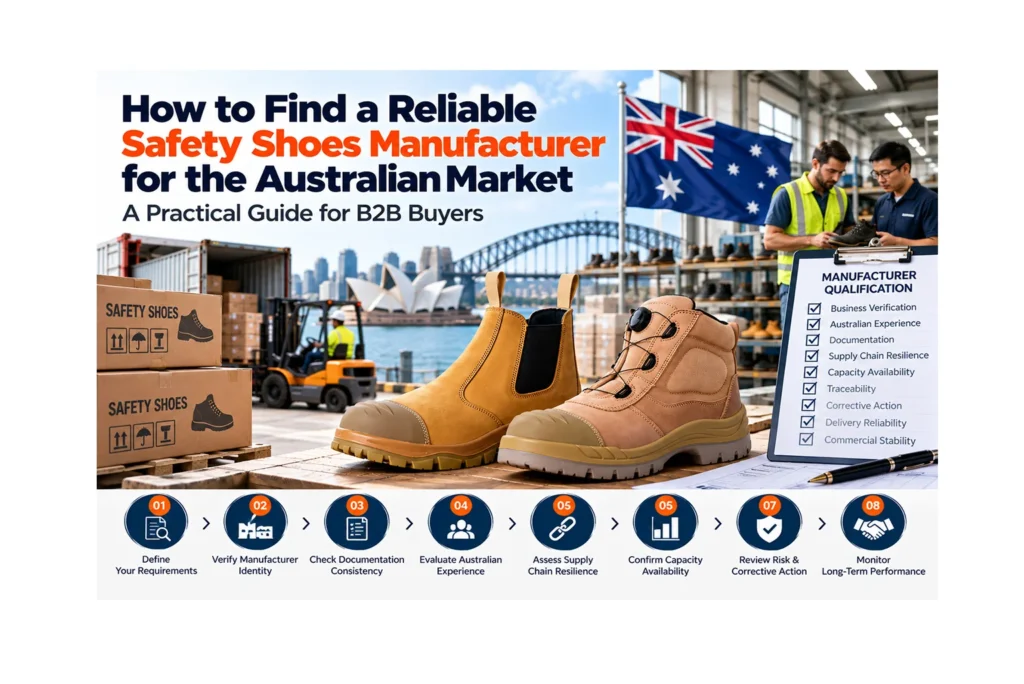
inding a reliable safety shoes manufacturer Australia buyers can work with is not simply a matter of comparing product catalogues and factory quotations.
For Australian PPE distributors, workwear wholesalers, importers and private-label businesses, the bigger challenge is determining whether a manufacturer can become a dependable long-term supply partner.
A factory may produce an impressive sample, offer a competitive price and promise a short lead time. But professional procurement also needs to consider business verification, documentation consistency, supply-chain resilience, capacity availability, corrective-action capability and repeat-order performance.
This guide provides Australian B2B buyers with a structured approach to qualifying an overseas safety shoes manufacturer before building a long-term sourcing relationship.
What Makes a Reliable Safety Shoes Manufacturer for Australia?
A reliable manufacturer should be able to demonstrate more than the ability to make footwear.
Australian buyers should determine whether the supplier can consistently support their purchasing programme as order volumes, product ranges and customer expectations develop.
A useful qualification framework includes:
| Qualification Area | What Buyers Should Determine |
|---|---|
| Business identity | Who actually manufactures the footwear? |
| Australian experience | Has the company supported Australian B2B customers? |
| Documentation | Can documents be connected to the actual product? |
| Supply resilience | How does the factory manage component shortages? |
| Capacity availability | Will production capacity be available when required? |
| Traceability | Can production batches and components be traced? |
| Corrective action | How are recurring problems investigated and prevented? |
| Delivery reliability | Can production schedules be maintained? |
| Commercial stability | Is the manufacturer suitable for a long-term relationship? |
| Communication | Are problems communicated clearly and early? |
Rather than making a decision from one quotation, buyers can use these areas to create an internal supplier-approval system.
Stage 1: Define Your Manufacturer Qualification Criteria
Before contacting factories, establish what a manufacturer must demonstrate to become an approved supplier.
Without predefined criteria, supplier selection can easily become dominated by price.
Separate Must-Have Requirements From Preferred Requirements
For example, your must-have requirements might include:
- Verifiable manufacturing identity
- Relevant safety footwear experience
- Appropriate technical documentation
- Export capability
- Production traceability
- Defined problem-resolution process
- Ability to support expected order volumes
Preferred requirements could include:
- Previous Australian customers
- Flexible production scheduling
- Dedicated account management
- Experience with private-label programmes
- Capacity for future growth
This distinction is useful because not every desirable capability should carry the same purchasing weight.
Build the Criteria Around Your Business Model
A national PPE distributor may prioritise supply continuity and repeat-order capacity.
A new private-label brand may place more importance on commercial flexibility.
A workwear wholesaler with hundreds of existing accounts may be particularly sensitive to delivery reliability.
The manufacturer should therefore be evaluated against your actual business requirements rather than a generic sourcing checklist.
Stage 2: Verify the Company’s Legal and Manufacturing Identity
International sourcing can involve several business entities.
The company operating the website may not necessarily be the same entity shown on the quotation, receiving payment, exporting the goods or manufacturing the footwear.
Australian buyers should understand the relationship between:
Quoted Company → Contracting Company → Bank Beneficiary → Exporter → Actual Manufacturing Facility
Information to Request
Ask for:
- Registered company name
- Factory name and address
- Business registration information
- Year established
- Exporting entity
- Main manufacturing location
- Main contact information
- Bank beneficiary details
The objective is not merely to collect documents.
The objective is to establish a clear commercial chain.
Questions Worth Asking
- Who will manufacture our order?
- Will production take place at the factory we evaluated?
- Are any important processes subcontracted?
- Which company will issue the commercial invoice?
- Which entity will receive payment?
- Can the production location be independently verified?
If several companies are involved, ask the supplier to explain why.
A legitimate commercial structure can involve multiple entities. What matters is transparency.
Stage 3: Conduct a Document Consistency Audit
Many buyers ask a potential safety shoes manufacturer Australia supplier to provide certificates, reports and company documents.
A better approach is to determine whether those documents are consistent with one another.
Build a Verification Chain
Review:
Business Registration
↓
Factory Information
↓
Product Specification
↓
Technical Documentation
↓
Quotation
↓
Product Model
↓
Commercial Order
These elements should form a logical chain.
Check Company Information
Compare company and factory names across relevant documents.
If several entities appear, understand their relationship.
Check Model Identification
The product referenced in supporting technical documentation should be appropriately connected to the model being purchased.
Do not assume that documentation for one visually similar shoe automatically applies to another.
Check Product Descriptions
Compare the quotation, specification, sample and supporting documentation.
Look for unexplained differences involving:
- Model number
- Product construction
- Protective claims
- Component references
- Product classification
Check Revision Dates
Ask whether the product has changed since supporting documentation was issued.
The purpose of a document consistency audit is not simply to collect paperwork. It is to verify that the paperwork describes the supply chain and product you are actually purchasing.
Stage 4: Evaluate Real Australian Market Experience
A manufacturer may say:
“We have exported safety shoes to Australia for many years.”
Instead of accepting the statement at face value, ask questions that reveal the depth of that experience.
Ask About Repeat Australian Business
Useful questions include:
- How long have you supplied Australian B2B customers?
- Are Australian orders primarily new projects or repeat orders?
- What order volumes are typical?
- How frequently do customers reorder?
- What types of commercial issues have Australian buyers raised?
- How are repeat-order specifications maintained?
The manufacturer may not be able to disclose customer names because of confidentiality agreements.
That is reasonable.
You are looking for evidence of operational experience rather than a customer list.
Ask What Australian Customers Commonly Reject
This can be particularly revealing.
An experienced manufacturer may be able to discuss issues such as:
- Product consistency
- Documentation
- Packaging
- Delivery schedules
- Product specifications
- Order planning
A supplier with genuine market experience should understand what professional Australian buyers expect from the manufacturing relationship.
Stage 5: Check Current Australian Market Requirements
Australian buyers should establish the requirements applicable to the specific safety footwear they intend to source.
Standards Australia currently lists AS/NZS 2210.1:2025 — Safety and occupational footwear, Part 1: Guide to selection, care and use, published on 27 June 2025.
However, buyers should not use one general standard reference as a substitute for determining the requirements applicable to the actual product.
When evaluating a manufacturer, ask:
- Which requirements apply to this proposed model?
- Which standard and edition are being referenced?
- Which product classification is relevant?
- What supporting documentation is available?
- Can the documentation be linked to the model being quoted?
- What happens if a relevant component or construction changes?
A technically capable manufacturer should provide specific answers rather than simply stating that a product is “Australian standard.”
Stage 6: Evaluate Supply-Chain Resilience
Manufacturing reliability depends on more than the factory itself.
Safety footwear production can depend on external suppliers providing materials, components, packaging and other inputs.
A manufacturer should therefore be evaluated partly on how it manages its upstream supply chain.
Identify Critical Components
Ask which product elements create the greatest supply risk.
Examples could include:
- Specific upper materials
- Special textiles
- Protective components
- Outsole materials
- Zippers or closure systems
- Custom packaging
Then ask:
- Is the component single-sourced?
- What is the normal procurement lead time?
- Is safety stock maintained?
- Is there an alternative supplier?
- How would a shortage affect production?
Create a Supply Risk Matrix
Australian procurement teams can use a simple matrix:
| Supply Risk | Probability | Business Impact | Mitigation |
|---|---|---|---|
| Key material shortage | Medium | High | Forward purchasing |
| Special component delay | Medium | High | Safety stock |
| Packaging delay | Medium | Low | Backup supplier |
| Production congestion | Medium | High | Capacity reservation |
| Freight disruption | Medium | Medium | Alternative routing |
This makes supplier risk more visible before the purchase order is placed.
Stage 7: Evaluate Capacity Availability, Not Just Factory Capacity
Factories frequently advertise annual or monthly production capacity.
But a more important question is:
How much capacity will actually be available for your orders?
A factory capable of producing 150,000 pairs per month may already have most of that capacity committed to existing customers.
Provide a Forecast
Instead of asking only about total capacity, give the manufacturer a realistic purchasing forecast.
For example:
| Period | Forecast Quantity |
|---|---|
| Initial order | 1,000 pairs |
| Q2 | 2,500 pairs |
| Q3 | 3,500 pairs |
| Q4 | 5,000 pairs |
| Following year | 20,000–30,000 pairs |
Then ask how the factory would allocate production.
Ask About Peak Season
Questions can include:
- Which months are normally busiest?
- How far ahead should production be booked?
- Can capacity be reserved for forecast orders?
- What happens when production is overbooked?
- How are priority orders allocated?
- How quickly will customers be informed of a potential delay?
The answers reveal more about delivery reliability than a headline capacity figure.
Stage 8: Use Scenario-Based Supplier Evaluation
Traditional factory questionnaires often produce predictable answers.
Ask:
“Do you have good quality control?”
and almost every supplier will answer:
“Yes.”
Scenario-based questions can provide more useful information.
Scenario 1: A Critical Material Becomes Unavailable
Ask:
“Our production starts in two weeks, but the approved material is unavailable. What happens next?”
A strong answer should involve communication and controlled decision-making rather than automatic substitution.
Scenario 2: A Significant Problem Is Found Before Shipment
Ask:
“A major issue is discovered in a substantial portion of the order. How would you manage it?”
Look for a structured response involving:
Containment → Investigation → Correction → Reinspection → Shipment Decision
Scenario 3: A Customer Reports a Problem Months Later
Ask:
“An Australian customer reports a problem with a specific batch three months after delivery. What information can you retrieve?”
This tests traceability.
Scenario 4: Your Demand Suddenly Increases
Ask:
“Our next order increases from 3,000 to 8,000 pairs. How would you determine whether the delivery date is achievable?”
This tests production planning rather than sales enthusiasm.
Scenario-based questions reveal how a manufacturer thinks when normal production conditions change.
Stage 9: Evaluate Traceability as a Business Risk Tool
Traceability becomes particularly important when a product remains in the market for several years.
Suppose an Australian distributor identifies an issue with one shipment.
Can the manufacturer identify:
- Production period
- Purchase order
- Relevant product revision
- Material or component information
- Inspection records
- Shipment details
Why Traceability Matters
Consider two situations.
Supplier A:
Cannot identify which batches used a particular component.
Supplier B:
Can identify the affected production period and relevant orders.
Supplier B may allow the buyer to focus investigation on a limited quantity of stock.
Supplier A creates much greater uncertainty.
For procurement teams, traceability is therefore not merely a factory procedure—it is a commercial risk-control mechanism.
Stage 10: Examine Corrective-Action Capability
No manufacturer should be evaluated on the assumption that production problems will never occur.
The better question is:
What does the manufacturer do when something goes wrong?
Ask for an Anonymised Example
Request an example of a previous manufacturing problem without asking the supplier to disclose confidential customer information.
Look for a process such as:
Problem Identified
↓
Affected Goods Contained
↓
Root Cause Investigated
↓
Corrective Action Implemented
↓
Effectiveness Checked
↓
Case Closed
Be Careful With Superficial Corrective Actions
Statements such as:
“We told the workers to be more careful.”
may not address the root cause.
A recurring issue might actually be related to:
- Equipment settings
- Production instructions
- Material variation
- Operator training
- Process design
- Inspection frequency
A manufacturer capable of investigating causes rather than simply treating symptoms is generally better positioned for long-term B2B supply.
Stage 11: Evaluate Commercial Stability
Technical capability is only one part of supplier reliability.
A long-term Australian sourcing programme also depends on commercial stability.
Watch for unexplained patterns such as:
- Frequent changes in payment details
- Repeated changes of contracting company
- Unexpected production relocation
- Large unexplained price movements
- Unusual payment requests
- Constant changes in agreed commercial terms
None of these automatically means the supplier is unreliable.
They are signals that require further investigation.
Look for Predictability
Long-term buyers benefit from suppliers that provide reasonable predictability around:
- Quotations
- Payment arrangements
- Production scheduling
- Order confirmation
- Export documentation
- Problem escalation
Predictability reduces internal procurement workload.
Stage 12: Calculate Supplier Risk, Not Just Product Price
Price comparisons can hide significant differences in supplier performance.
Imagine two factories quoting an equivalent product.
| Factor | Manufacturer A | Manufacturer B |
|---|---|---|
| Unit price | Lower | Slightly higher |
| Delivery reliability | Variable | Strong |
| Traceability | Limited | Structured |
| Supply backup | Weak | Documented |
| Corrective action | Reactive | Systematic |
| Australian experience | Limited | Established |
The cheaper quotation may still be the better option—but the answer cannot be determined from unit price alone.
Consider the Cost of Supplier Failure
Potential indirect costs include:
- Delayed inventory
- Emergency freight
- Additional inspection
- Rework
- Replacement stock
- Customer claims
- Stockouts
- Lost sales
- Staff time
- Damaged customer relationships
A useful conceptual model is:
Total Procurement Cost = Purchase Cost + Quality Risk + Delivery Risk + Inventory Risk + Supply Disruption Risk
Not every risk can be converted precisely into dollars, but considering them creates a more realistic supplier comparison.
Stage 13: Use a Vendor Probation Period
Supplier approval does not have to be a one-step decision.
Australian B2B buyers can use a staged qualification process.
Potential Supplier
The manufacturer has been identified but not yet fully evaluated.
Qualified Supplier
Business, technical and commercial due diligence has been completed.
Conditional Vendor
The manufacturer receives an initial commercial order but remains under enhanced review.
Approved Vendor
The supplier has demonstrated acceptable performance through actual orders.
Strategic Supplier
A proven manufacturer receives longer-term forecasts, repeat programmes or deeper commercial cooperation.
This creates a logical progression:
Potential → Qualified → Conditional → Approved → Strategic
It also prevents one successful sample from being treated as proof of long-term manufacturing performance.
Stage 14: Build a Safety Shoes Manufacturer Australia Scorecard
A weighted scorecard can make manufacturer selection more objective.
Here is an example:
| Evaluation Area | Suggested Weight |
|---|---|
| Legal/manufacturing verification | 10% |
| Australian-market experience | 10% |
| Documentation consistency | 15% |
| Supply-chain resilience | 15% |
| Capacity availability | 10% |
| Traceability | 10% |
| Corrective-action capability | 10% |
| Delivery planning | 10% |
| Commercial stability | 5% |
| Communication | 5% |
| Total | 100% |
Suggested Supplier Rating
85–100: Preferred Supplier
Suitable for long-term development, subject to normal commercial review.
75–84: Approved Supplier
Acceptable for regular sourcing, with identified areas to monitor.
65–74: Conditional Approval
Additional controls or improvements should be completed before significant volume is allocated.
Below 65: Further Review Required
Key risks should be resolved before commercial commitment.
The scoring thresholds are an internal procurement example rather than an industry standard. Companies should adapt them to their own risk tolerance.
Stage 15: Measure Manufacturer Performance After Approval
Supplier qualification should continue after the first shipment.
A manufacturer that performed well three years ago should not automatically remain a preferred supplier if current performance deteriorates.
On-Time Delivery
Track the percentage of orders completed according to the agreed schedule.
First-Pass Inspection Performance
Monitor how frequently orders meet agreed inspection criteria without significant rework.
Complaint Rate
Track complaints relative to the volume supplied.
Documentation Accuracy
Record recurring errors in commercial or product documentation.
Corrective-Action Closure Time
Measure how quickly significant issues are investigated and resolved.
Repeat-Order Consistency
Monitor whether subsequent production continues to match the agreed product requirements.
Supplier KPI Example
| KPI | What It Helps Measure |
|---|---|
| On-time delivery | Production reliability |
| Inspection performance | Manufacturing consistency |
| Complaint rate | Field performance |
| Corrective-action closure | Problem-solving capability |
| Documentation accuracy | Administrative control |
| Repeat-order consistency | Long-term manufacturing control |
| Response time | Communication efficiency |
These KPIs can be reviewed quarterly, every six months or annually depending on purchasing volume and supplier risk.
Questions Australian Buyers Should Ask Before Approving a Manufacturer
Before adding a manufacturer to your approved vendor list, ask:
- Which legal entity will contract with us?
- Which facility will manufacture our products?
- Which parts of production are subcontracted?
- How long have you supplied Australian B2B customers?
- Can supporting documents be linked to the actual product?
- Which components have the greatest supply risk?
- Which components rely on a single supplier?
- How much production capacity can be allocated to our forecast?
- What happens if the factory becomes overbooked?
- How do you manage unexpected component shortages?
- What information can you retrieve if a batch problem occurs?
- How do you investigate recurring production problems?
- How are major delays communicated?
- Can supplier performance be reviewed against agreed KPIs?
- How would you support our business if annual demand doubled?
The objective is not to receive perfect answers.
It is to understand how the manufacturer manages uncertainty.
Frequently Asked Questions About Safety Shoes Manufacturers in Australia
How Do I Find a Reliable Safety Shoes Manufacturer Australia Buyers Can Work With?
Use a structured qualification process rather than choosing from price alone. Verify the manufacturing entity, Australian-market experience, documentation consistency, supply resilience, available capacity, traceability, corrective-action capability and actual order performance.
What Is the Difference Between a Safety Shoes Manufacturer and a Safety Shoes Supplier?
A manufacturer produces footwear or directly controls manufacturing operations. A supplier can be a manufacturer, distributor, exporter or trading company. Australian B2B buyers should establish who actually controls production and product specifications.
Should Australian Buyers Visit or Audit a Safety Shoe Factory?
For significant sourcing programmes, independent verification or a factory visit can provide additional information about manufacturing identity, capacity and operational controls. The level of due diligence should reflect order value and commercial risk.
How Can I Compare Several Safety Footwear Manufacturers?
Give each manufacturer the same qualification criteria and use a weighted supplier scorecard. This reduces the influence of subjective impressions and makes internal purchasing decisions easier to document.
Is the Cheapest Safety Shoes Supplier Australia Buyers Find Usually the Best Choice?
Not necessarily. Compare equivalent product and commercial requirements while also considering delivery reliability, documentation, supply continuity, traceability and the potential cost of supplier failure.
What Should I Ask About Factory Capacity?
Do not ask only for maximum monthly output. Provide your expected order forecast and ask how much capacity can realistically be allocated to your programme, particularly during peak production periods.
How Should Australian Buyers Handle a New Manufacturer?
A staged vendor-approval process can reduce risk. Complete due diligence first, then use initial commercial orders to measure real performance before allocating larger or longer-term purchasing volumes.
How Often Should a Safety Shoes Manufacturer Be Reviewed?
Review frequency depends on order volume and supplier risk. High-volume or strategically important manufacturers may justify quarterly or six-month reviews, while lower-risk suppliers may be reviewed annually.
Conclusion
Finding a reliable safety shoes manufacturer Australia buyers can depend on requires more than locating a factory capable of producing the right footwear.
The stronger approach is to build a manufacturer qualification system:
Define → Verify → Cross-Check → Stress-Test → Score → Trial → Measure
Verify who actually manufactures the product.
Cross-check business and product documentation.
Understand supply-chain vulnerabilities.
Determine whether production capacity will actually be available for your orders.
Test how the manufacturer responds to realistic supply and production problems.
Then measure performance after the commercial relationship begins.
For Australian importers, PPE distributors and workwear wholesalers, this approach can turn manufacturer selection from a price-driven decision into a structured procurement process.
Looking for a Safety Shoes Manufacturer for the Australian Market?
Ocean Safety Shoes is a professional safety footwear manufacturer supporting importers, PPE distributors, wholesalers and private-label businesses with bulk production and OEM/ODM manufacturing.
For an Australian sourcing project, send your target market, product category, expected annual volume, initial order quantity, required specifications and purchasing forecast.
This allows the manufacturing programme to be evaluated not only around the first order, but also around production planning, repeat-order consistency and long-term supply requirements.