
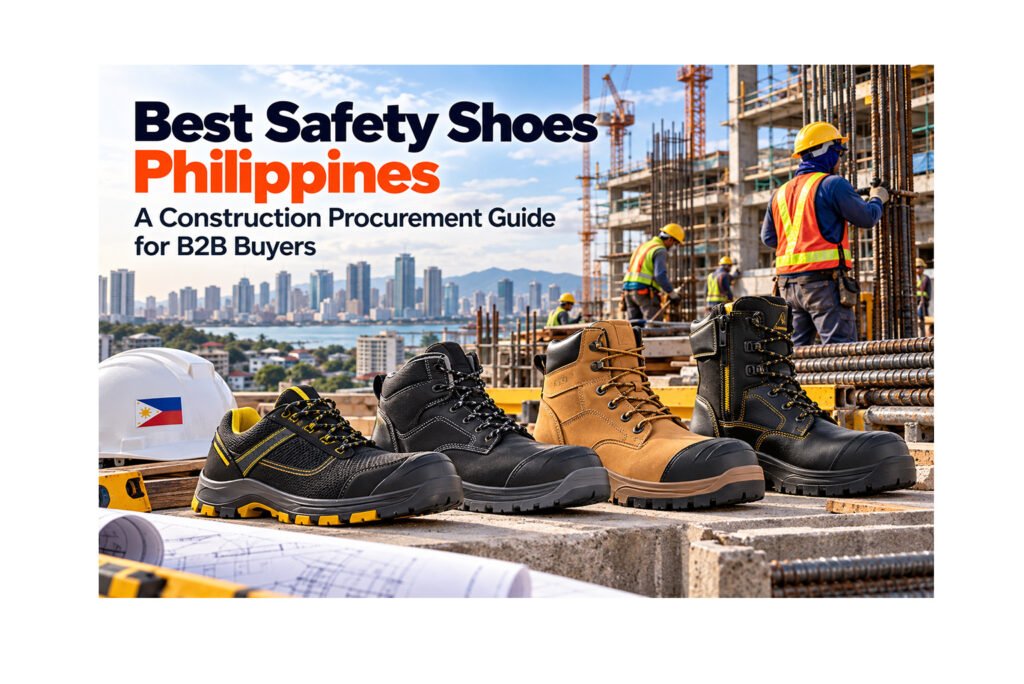
Buying the best safety shoes Philippines construction projects require is not simply about choosing a popular footwear brand or placing an order for several hundred pairs of boots.
For construction contractors, engineering companies, PPE distributors, and industrial procurement teams, footwear purchasing is an operational decision. The right products must reach the right workers, in the correct sizes, at the appropriate stage of the project.
Consider a contractor managing three projects: a high-rise development in Metro Manila, a road construction project in Central Luzon, and a warehouse development in Cebu. Each project may have different workforce sizes, ground conditions, delivery schedules, and footwear replacement needs.
Buying the same quantity of one boot model for all three projects can create unnecessary inventory, delayed deployment, and additional procurement costs.
This guide explains how Philippine construction businesses can establish a practical safety footwear purchasing programme, from project planning and supplier selection to inventory allocation and repeat orders.
Why Construction Safety Footwear Procurement Is Different in the Philippines
The Philippines presents several practical challenges for construction footwear purchasing.
Projects may be located in major urban centres, developing industrial zones, coastal areas, or provinces where deliveries require additional transport arrangements.
Construction schedules also change as projects progress from excavation and structural work to mechanical installation and interior finishing.
At the same time, tropical weather can influence both footwear requirements and inventory planning.
For B2B buyers, these conditions create three important purchasing priorities:
- Product suitability: Footwear must meet the requirements established for each construction activity.
- Availability: Workers need approved footwear before entering areas where it is required.
- Continuity: Replacement sizes and repeat-order stock must remain available throughout the project.
A procurement programme should address all three rather than focusing exclusively on purchase price.
1. Build a Footwear Plan Around Construction Project Phases
One practical way to organise construction safety shoes Philippines procurement is to divide the project into phases.
Different phases may require different approved footwear categories.
Phase 1: Site Preparation and Earthworks
During site preparation, workers may operate on exposed ground, temporary access routes, and areas affected by rain.
Procurement teams should confirm the required protection and consider footwear suited to the site’s actual terrain and moisture exposure.
Phase 2: Structural Construction
Structural work often involves extensive material handling, reinforcement work, concrete operations, and movement between active construction zones.
The purchasing specification should reflect the protective requirements established by the project safety team.
Phase 3: Mechanical, Electrical, and Building Services
Specialist contractors may need footwear selected for their specific tasks.
Electrical work, in particular, requires an assessment of the actual electrical hazards. Footwear with a particular electrical marking should not be assumed suitable for every electrical task.
Phase 4: Interior Finishing and Handover
As construction progresses, work may move onto completed floors and finished interior surfaces.
The project may permit different approved footwear models for certain roles, provided they continue to satisfy the relevant protection requirements.
Construction Phase Purchasing Matrix
| Project Phase | Procurement Consideration | Suggested Planning Action |
|---|---|---|
| Site preparation | Exposed terrain and wet conditions | Confirm outdoor footwear requirements |
| Structural works | Material handling and changing hazards | Maintain core protective footwear stock |
| Building services | Specialist trade requirements | Approve task-specific footwear where needed |
| Interior finishing | Movement on completed surfaces | Review approved models for each role |
| Handover | Smaller teams and replacements | Reduce surplus stock and maintain essential sizes |
This approach helps avoid ordering an unnecessarily broad range of footwear at the beginning of the project.
2. Establish a Construction Footwear Approval List
Instead of allowing every department or subcontractor to purchase independently, larger construction companies can maintain an approved footwear list.
The list should identify products that meet the requirements determined by the project’s safety team.
What Should an Approval List Include?
For each approved model, record:
- Product name and model number
- Supplier
- Intended work areas or roles
- Required protective properties
- Applicable documentation
- Approved size range
- Internal product code
- Purchasing status
- Replacement or discontinuation status
This provides a consistent reference for purchasing teams, site supervisors, and warehouse staff.
Avoid Too Many Similar Models
An approval list containing twenty nearly identical boots can become difficult to manage.
Where practical, standardise around a smaller number of suitable models.
Standardisation may simplify stock control, but it must never override genuine differences in workplace hazards or worker fit.
3. Plan Safety Shoe Quantities Using Workforce Data
A common bulk-purchasing mistake is calculating the order quantity from total project headcount alone.
For example, a project employing 500 workers does not necessarily need exactly 500 pairs delivered at the same time.
Some workers may already have suitable approved footwear. Others may join later, and subcontractors may be responsible for their own equipment under the applicable arrangements.
Use a Workforce Deployment Schedule
Consider this hypothetical project:
| Deployment Period | New Workers Requiring Footwear |
|---|---|
| Month 1 | 120 |
| Month 2 | 180 |
| Month 3 | 100 |
| Month 4 | 60 |
| Total | 460 |
Rather than receiving all 460 pairs immediately, the buyer can evaluate phased deliveries aligned with mobilisation.
This can reduce storage requirements and improve inventory visibility.
Include Replacement Demand
Initial distribution is only part of the requirement.
Workers may need replacement footwear because of damage, wear, fit problems, or changes in assigned duties.
The project should establish a replacement process and estimate reserve stock using actual consumption records.
4. Develop a Practical Size Distribution
Size planning is particularly important when ordering bulk safety shoes Philippines projects will distribute across a large workforce.
A supplier may offer an attractive unit price, but the savings can disappear if the order contains too many slow-moving sizes and too few commonly requested ones.
Collect Size Information Before Ordering
Where possible, obtain worker sizing information through:
- Existing PPE issuance records
- Employee onboarding
- Representative fitting sessions
- Historical order data
- Previous footwear exchange records
Avoid assuming that a size distribution from another country or workforce will accurately represent your project.
Example Size Allocation
The following table is a hypothetical planning example, not a recommended Philippine population size distribution.
| Footwear Size (EU) | Example Quantity |
|---|---|
| 38 | 20 |
| 39 | 35 |
| 40 | 70 |
| 41 | 100 |
| 42 | 95 |
| 43 | 55 |
| 44 | 20 |
| 45 | 5 |
| Total | 400 |
Actual quantities should be determined from the workforce and the manufacturer’s sizing system.
Plan for Exchanges
A footwear programme should also define how unused, incorrectly sized pairs can be exchanged.
An exchange policy can reduce waste and prevent workers from wearing poorly fitting footwear simply because their preferred size is unavailable.
5. Prepare for Rainy-Season Procurement and Delivery
Weather can affect both footwear demand and the movement of goods between warehouses and construction sites.
For Philippine contractors operating during the rainy season, footwear purchasing should be coordinated with project schedules and delivery planning.
Separate Product Requirements From Delivery Planning
Two decisions should be managed independently:
Product suitability: Which approved footwear is appropriate for wet working conditions?
Supply availability: Will enough pairs be available before the expected period of heavy rainfall?
A supplier may offer suitable footwear but still be unable to deliver the required sizes when the project needs them.
Build a Delivery Buffer
Where lead times are uncertain, consider ordering critical sizes earlier and maintaining reserve stock.
This is especially relevant for projects outside major distribution centres or those dependent on multiple transport connections.
The appropriate buffer should be based on historical supplier performance and the project’s delivery risk, not an arbitrary fixed number of weeks.
6. Understand Philippine PPE Purchasing Responsibilities
Safety footwear procurement should be coordinated with the employer’s occupational safety and health programme.
Under Section 8 of Republic Act No. 11058, employers, contractors, or subcontractors must provide appropriate PPE free of charge where necessary because of workplace hazards. The law also addresses DOLE-approved PPE and the role of safety officers in determining its use.
The Department of Labor and Employment issued revised implementing rules through Department Order No. 252-25 in 2025.
Department of Labor and Employment
Include PPE in Project Cost Planning
Procurement teams should coordinate footwear budgets with the construction project’s safety and health programme rather than treating required protective footwear as an optional employee purchase.
This includes planning for:
- Initial issuance
- New worker mobilisation
- Replacement footwear
- Suitable sizes
- Project-specific requirements
- Documentation and stock records
Verify Product Testing and Approval Requirements
The Philippine Occupational Safety and Health Center provides PPE testing services, including testing of safety shoes. Manufacturers, distributors, suppliers, and users can access its published testing service procedures.

Occupational Safety and Health Center
Buyers should confirm the applicable Philippine requirements and the suitability of supporting product documentation before approving footwear for use.
7. Choose Between Centralised and Project-Based Purchasing
Construction companies operating multiple sites often need to decide whether footwear should be purchased centrally or by individual project teams.
Centralised Purchasing
A head office or central procurement team selects approved suppliers, negotiates commercial terms, and coordinates inventory.
Potential advantages include consistent specifications, consolidated purchasing volumes, and stronger control over approved models.
However, central purchasing also requires accurate information from individual projects.
Project-Based Purchasing
Individual construction projects purchase footwear based on immediate workforce requirements.
This can improve responsiveness to local demand, but may create inconsistent specifications and fragmented supplier relationships.
A Hybrid Purchasing Model
For companies operating in Metro Manila, Cebu, Davao, and other regions, a hybrid system may be practical.
Head office can manage supplier approval and major purchasing contracts, while project teams submit workforce requirements and coordinate local distribution.
The goal is to maintain purchasing control without delaying footwear availability at the jobsite.
8. Establish a Safety Footwear Issuance and Replacement System
After delivery, the next challenge is ensuring footwear reaches the intended workers.
A structured issuance process can reduce missing inventory, incorrect sizing, and uncertainty over replacement demand.
Record Each Issuance
A basic footwear issuance record can include:
| Record Field | Example |
|---|---|
| Employee reference | Worker ID |
| Project | Cebu Warehouse Project |
| Footwear model | Approved Model A |
| Size | EU 42 |
| Issue date | 15 October 2026 |
| Reason | Initial issuance |
| Issued by | Site PPE Coordinator |
The example is illustrative. Actual records should follow the employer’s privacy and document-retention policies.
Define Replacement Procedures
Workers should know how to request replacement footwear when their current pair becomes damaged, worn, or unsuitable.
A replacement request may involve the worker, site supervisor, and safety officer, depending on the company’s procedures.
Required protective footwear should not remain in service merely because a scheduled replacement date has not arrived.
9. Compare Local Suppliers and Overseas Manufacturers for Bulk Orders
Philippine B2B buyers may purchase from domestic distributors or source directly from overseas manufacturers.
The most suitable arrangement depends on purchasing volume, delivery urgency, and the company’s ability to manage international procurement.
Local Distribution
A local safety shoes supplier Philippines construction companies work with may offer practical advantages for smaller orders, urgent replacement stock, and local delivery coordination.
Direct Manufacturing
Direct factory sourcing may be suitable for planned purchasing programmes, especially when a contractor or distributor has predictable demand and requires consistent product specifications.
It may also support custom branding or private-label development where commercially appropriate.
Compare the Purchasing Model
| Requirement | Local Distributor | Direct Manufacturer |
|---|---|---|
| Urgent replenishment | Often more practical | Depends on available stock |
| Small orders | Often easier | May face minimum quantities |
| Large planned orders | Depends on distributor capacity | Can be suitable |
| Private-label branding | Supplier dependent | Often available |
| Local delivery | Usually simpler | Requires coordination |
| Import management | Usually handled upstream | May be buyer’s responsibility |
A mixed approach may also be appropriate: planned bulk purchasing from a manufacturer, supported by local replenishment arrangements.
10. Use a Total Project Cost Model
For construction companies, the relevant financial question is not simply:
How much does one pair cost?
It is:
How much will the footwear programme cost throughout the project?
A useful purchasing budget includes initial footwear, replacements, delivery, storage, and inventory losses.
Example: A 12-Month Construction Project
The following figures are hypothetical and intended only to demonstrate a budgeting method.
| Cost Component | Example |
|---|---|
| Initial footwear: 400 pairs × ₱1,200 | ₱480,000 |
| Replacement allowance: 40 pairs × ₱1,200 | ₱48,000 |
| Delivery and handling | ₱12,000 |
| Estimated programme budget | ₱540,000 |
This represents a planning budget, not a current Philippine market price quotation.
Actual replacement requirements should be adjusted using observed wear, workforce turnover, and safety requirements.
Track Cost per Worker
For internal budgeting, companies can compare the total programme cost against the number of workers supplied.
However, cost-control targets should never delay replacement when footwear is no longer suitable.
11. Create a Safety Shoes Procurement Scorecard
For construction companies evaluating industrial safety shoes Philippines supply programmes, a procurement scorecard can help compare offers consistently.
| Evaluation Area | Suggested Weight |
|---|---|
| Product suitability and documentation | 25% |
| Size availability | 15% |
| Delivery reliability | 15% |
| Repeat-order consistency | 15% |
| Total procurement cost | 15% |
| Replacement-stock support | 10% |
| Communication | 5% |
| Total | 100% |
These weights are an illustrative internal purchasing tool, not an official Philippine standard.
Safety and regulatory requirements should be treated as mandatory approval conditions, not weaknesses that can be offset by a lower price.
Frequently Asked Questions About Safety Shoes in the Philippines
What Are the Best Safety Shoes Philippines Construction Companies Should Buy?
The best safety shoes are approved models that meet the protection requirements of the relevant work activities, fit workers properly, and can be supplied consistently. Construction companies should also evaluate size availability, delivery reliability, and replacement support.
How Many Safety Shoes Should a Construction Company Order?
Start with the number of workers who need footwear, their mobilisation dates, existing suitable PPE, and the anticipated replacement requirement. Use workforce size records rather than ordering equal quantities of every size.
Are Employers Required to Provide Safety Shoes in the Philippines?
Under Republic Act No. 11058, employers, contractors, and subcontractors must provide necessary protective equipment free of charge when workplace hazards require it. The specific PPE must be appropriate for the work and applicable requirements.
Should Philippine Construction Companies Buy Safety Shoes Locally or Import Them?
Local purchasing may be more convenient for urgent and smaller orders. Direct manufacturing may be suitable for larger, planned purchasing programmes. Some businesses use both channels to balance availability and cost.
How Should Contractors Plan Safety Shoes for the Rainy Season?
Confirm the footwear requirements for wet conditions, forecast worker mobilisation, check supplier lead times, and maintain appropriate reserve stock. Ordering decisions should reflect project conditions rather than relying on a single national weather assumption.
Can Philippine PPE Distributors Order Private-Label Construction Safety Shoes?
Yes. Overseas manufacturers offering OEM or private-label services may support custom branding, packaging, and product development. Buyers should verify product specifications, applicable documentation, and commercial requirements before ordering.
Conclusion
Selecting the best safety shoes Philippines construction projects need requires more than comparing footwear brands and individual product features.
For contractors and B2B buyers, the strongest approach is to manage safety footwear as a project procurement programme.
That means aligning approved models with construction phases, forecasting workforce demand, planning size distribution, preparing for rainy-season deliveries, and maintaining a reliable issuance and replacement system.
It also means choosing suppliers that can support repeat orders, consistent specifications, and predictable deliveries.
By combining workplace safety requirements with structured procurement planning, Philippine construction companies can improve footwear availability, reduce unnecessary inventory, and build a more dependable PPE supply programme.
Wholesale Construction Safety Shoes for the Philippines — Ocean Safety Shoes
Ocean Safety Shoes is a professional safety footwear manufacturer supporting importers, PPE distributors, construction suppliers, wholesalers, and private-label brands.
For Philippine buyers planning larger construction footwear programmes, we offer manufacturing services for safety shoes and work boots, including OEM/ODM and custom branding options.
Whether you are supplying construction projects in Metro Manila, developing a distribution network in Cebu, or planning bulk footwear orders for industrial customers across the Philippines, our team can discuss your requirements.
Contact Ocean Safety Shoes with your target product category, required specifications, estimated quantity, size range, branding requirements, and delivery schedule to discuss a suitable manufacturing solution.