
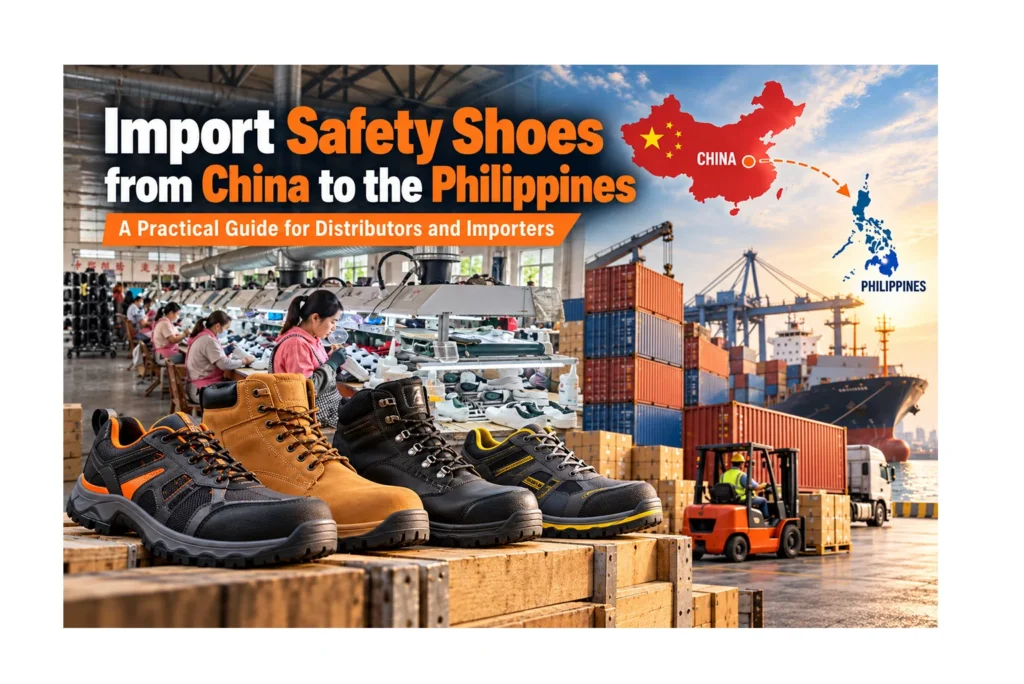
Importing safety footwear from China can help Philippine distributors, PPE wholesalers, workwear retailers, and industrial suppliers expand their product ranges and develop competitive B2B businesses. China offers a broad manufacturing base, with suppliers producing safety shoes for construction, warehousing, manufacturing, logistics, and other industrial applications.
However, successful importing involves more than finding a manufacturer and negotiating a price. Buyers must coordinate product specifications, supplier verification, import documentation, shipping, customs clearance, and delivery to their warehouse or customers.
For businesses planning to import safety shoes from China, a well-organised purchasing process can help control costs, reduce delays, and avoid problems with unsuitable products or incomplete paperwork.
This guide explains how Philippine importers can source safety footwear from China, evaluate manufacturers, estimate landed costs, prepare for customs clearance, and establish a reliable supply chain.
It is designed for B2B buyers, including:
- Safety footwear distributors and wholesalers
- PPE and industrial equipment suppliers
- Construction and workwear supply companies
- Importers developing their own safety footwear brands
- Procurement teams purchasing footwear in bulk
The goal is to help businesses make informed sourcing decisions before committing to a commercial order.
Step 1: Verify Your Import Business and Product Requirements
Before placing an order, confirm that your Philippine business is prepared to import commercial goods.
Check Importer Registration and Accreditation
The Philippine Bureau of Customs (BOC) requires importers to obtain the appropriate accreditation before conducting import transactions. Requirements depend on the importer and the nature of the shipment. Review the current requirements through the official BOC Importation Guidelines and Accounts Management Office.
If your business is importing safety shoes for the first time, consider working with an experienced Philippine customs broker who can help confirm the registration requirements and prepare the customs declaration.
Before contacting suppliers, also define:
- The types of safety shoes you intend to import
- Your estimated order quantity
- Your target wholesale selling price
- The industries you plan to serve
- Your required protective features
- Whether you need OEM or private-label products
Clear purchasing requirements make it easier to request comparable quotations from different manufacturers.
Confirm the Product Classification
Footwear falls under Chapter 64 of the Philippine tariff classification system, but the precise classification depends on factors such as the upper material, outsole material, construction, and protective features.
Do not assume that all safety shoes use the same tariff code.
Use the Philippine National Trade Repository to review relevant product classifications and import requirements. You can also consult the Philippine Tariff Finder to check applicable duty rates.
If the classification is unclear, ask your customs broker or the relevant authority to confirm it before shipment.
Step 2: Find a Reliable Safety Shoes Supplier in China
Choosing a supplier is one of the most important parts of importing safety footwear. A competitive quotation is useful, but buyers also need confidence in manufacturing capability, product consistency, and export documentation.
Evaluate Manufacturing Capability
When evaluating a potential safety shoes supplier Philippines businesses can work with, ask for information about the supplier’s production capabilities and export experience.
Consider the following:
- Main safety footwear categories
- Manufacturing facilities and production processes
- Quality control procedures
- Available product specifications
- Export experience
- OEM and private-label capabilities
- Production lead times and repeat-order capacity
Where possible, distinguish between a manufacturer that controls production and a trading company that sources products from other factories. Either may suit your business, but you should understand who is responsible for manufacturing, quality control, and resolving product issues.
Request Samples Before Bulk Production
Samples help you evaluate whether a product matches your commercial requirements.
Inspect:
- Upper materials and stitching
- Outsole construction
- Toe protection and other specified safety features
- Fit, comfort, and available sizes
- Packaging and labelling
- Supporting test reports and documentation
For safety footwear, visual inspection alone cannot establish protective performance. Verify relevant product testing and compliance documentation against your intended application and customer requirements.
Once the sample is approved, document the agreed specifications. This gives both parties a reference for mass production and future orders.
Confirm Branding and OEM Requirements
If you plan to sell safety footwear under your own brand, confirm customisation requirements before approving the order.
These may include:
- Logo placement
- Product colours
- Custom labels
- Branded shoe boxes
- Packaging artwork
- Product-specific design changes
Ask the supplier to separate one-time development costs from recurring production costs. This makes it easier to estimate the total cost of launching a private-label range.
Step 3: Understand the Costs of Importing Safety Shoes
When businesses import safety shoes from China to the Philippines, the manufacturer’s unit price is only one component of the final cost.
Calculate the Landed Cost
The landed cost represents the overall cost of bringing the goods to the agreed destination, based on the charges applicable to the shipment.
A useful budgeting formula is:
Landed cost = Product cost + Freight + Insurance + Import duty + Taxes + Clearance and handling + Other applicable expenses
For example, consider a hypothetical order of 1,000 pairs.
| Cost component | Illustrative amount |
|---|---|
| Product cost: 1,000 pairs × US$12 | US$12,000 |
| International freight | US$1,500 |
| Insurance | US$100 |
| Customs duty | To be confirmed |
| Import taxes | To be confirmed |
| Customs clearance and local handling | To be confirmed |
| Total landed cost | Calculated after applicable charges are confirmed |
These figures are illustrative only. They are not current market quotations or a calculation of Philippine import duty and taxes.
Once all applicable charges are established, divide the total landed cost by the number of usable pairs received to estimate your cost per pair.
This calculation helps importers set wholesale prices and estimate gross margins more accurately.
Check Import Duties and Taxes
Import duties depend on the correct tariff classification and applicable tariff schedule. The Philippine Tariff Finder provides access to MFN rates and preferential schedules, including the ASEAN-China Free Trade Area (ACFTA).
Preferential rates may be available when the goods qualify under the relevant rules of origin and the required proof of origin is provided. Do not assume that every product shipped from China automatically qualifies.
Before finalising your budget:
- Confirm the tariff classification.
- Select China as the country of origin in the tariff tool.
- Review the applicable tariff rate.
- Ask your broker to confirm the applicable import taxes and charges.
- Include clearance, handling, and delivery expenses in your cost estimate.
For authoritative information, use the Philippine Tariff Finder.
Compare Shipping Terms Carefully
Your quotation should specify the agreed Incoterms and named delivery location.
For example, an FOB quotation and a CIF quotation allocate certain transport costs and responsibilities differently. They should not be compared as though they cover the same services.
Before paying a deposit, clarify:
- Who arranges international freight
- Who purchases cargo insurance
- Who handles export clearance
- Who is responsible for Philippine import clearance
- Which party pays destination charges
- Where responsibility for risk transfers
Clear shipping terms reduce misunderstandings and make quotations easier to compare.
Step 4: Choose the Right Shipping Method
The appropriate shipping method depends on your order size, budget, urgency, and product availability.
Sea Freight for Commercial Bulk Orders
Sea freight is often worth evaluating for large commercial orders because it can be suitable for transporting palletised or containerised shipments.
When comparing sea freight quotations, consider:
- Shipment volume and weight
- Container or consolidated cargo options
- Origin and destination charges
- Port handling
- Customs clearance
- Final delivery to your warehouse
A low ocean freight rate does not necessarily mean the lowest total logistics cost. Compare the complete service and confirm which charges are included.
Air Freight for Urgent or Smaller Shipments
Air freight may be suitable for samples, urgent replenishment, or relatively small shipments where delivery speed is a priority.
However, air freight can materially increase the landed cost per pair.
For importers testing a new product, shipping samples by air and arranging bulk production and shipping separately can be a practical approach.
Plan Lead Times Before Ordering
Do not plan your inventory based only on the manufacturer’s production estimate.
The complete schedule may include:
- Sample development and approval
- Material preparation
- Manufacturing
- Quality inspection
- Export documentation
- International transit
- Customs clearance
- Local delivery
Ask your supplier and logistics provider for separate production and transport estimates. Allow additional time for unexpected delays, especially before a large customer delivery or seasonal sales period.
Step 5: Prepare the Documents Needed for Philippine Customs
Incomplete or inconsistent paperwork can delay a shipment and create additional handling expenses.
The Philippine BOC identifies common import documents including commercial invoices, sales contracts, packing lists, bills of lading or air waybills, certificates of origin where applicable, and permits or clearances where required. 【turn299114search1】
Commercial Invoice
The commercial invoice should accurately identify the goods, quantities, prices, seller, and buyer.
Check that the product description and declared values are consistent with the purchase agreement.
Packing List
The packing list should describe how the shipment is packed.
For safety footwear, useful details may include:
- Number of cartons
- Pairs per carton
- Size assortment
- Gross and net weight
- Carton dimensions
The details should match the actual shipment.
Bill of Lading or Air Waybill
The transport document records key shipment information. Check the consignee details and cargo description carefully before finalising the document.
Certificate of Origin, Where Applicable
A certificate of origin or other accepted proof of origin may be needed to support a preferential tariff claim, depending on the applicable trade agreement and procedures.
Confirm the required documentation with your customs broker before shipment.
Product Test Reports and Supporting Documents
Maintain relevant product specifications and testing documents for your customers and any applicable regulatory checks.
The BOC advises importers to verify whether goods require permits or clearances using the Philippine National Trade Repository and the relevant regulatory agencies.
Requirements depend on the precise product classification and applicable rules. Confirm whether any product-specific certification or import clearance applies before the goods leave China.
Step 6: Arrange Customs Clearance and Final Delivery
Once the shipment arrives, the importer or authorised customs broker must complete the applicable declaration and clearance process.
The BOC’s current guidance states that the Goods Declaration must be lodged and filed within 15 days from the discharge of the last package from the vessel or aircraft. Confirm the applicable procedure and timing with your broker for your shipment. 【turn299114search1】
A typical clearance process includes:
- Submit the Goods Declaration and supporting documents.
- Respond to documentary checks or inspection requests.
- Review the customs assessment.
- Pay applicable duties, taxes, and charges.
- Complete the requirements for release.
- Arrange delivery to the warehouse or distribution centre.
Customs may inspect shipments to verify the goods, declared value, origin, quantity, and tariff classification. Accurate documentation and preparation can help reduce avoidable problems.
After release, check the delivered quantity and packaging against the purchase order. If damage or discrepancies are identified, document them promptly and notify the relevant supplier or logistics provider.
Common Mistakes When Importing Safety Shoes from China
Choosing a Supplier Based Only on Price
A low quotation may not reflect product quality, testing, shipping, or after-sales support.
Compare equivalent product specifications and total landed costs rather than focusing exclusively on the unit price.
Ordering Before Approving Samples
Bulk production should follow a clear sample approval process. Document the agreed specifications to reduce the risk of receiving products that differ from the approved sample.
Miscalculating Import Costs
Freight, handling, customs duty, taxes, and local delivery can affect profitability. Confirm the relevant charges before setting your wholesale selling price.
Using Incorrect Product Classification
Different footwear constructions may fall under different tariff classifications. Confirm the correct code rather than relying on a generic footwear description.
Preparing Documents Too Late
Prepare invoices, packing lists, shipping details, and applicable supporting documents before dispatch. Ask your broker to review the documentation early enough to correct inconsistencies.
Ignoring Future Replenishment
Your first order is only one part of the supply relationship. Confirm repeat-order pricing, production capacity, size availability, and lead times before relying on a supplier for ongoing business.
Importing Safety Shoes from China: Buyer Checklist
Use this checklist before confirming a commercial order.
- Confirm importer registration and accreditation requirements.
- Define the product specifications and intended workplace applications.
- Verify supplier capability and request samples.
- Confirm product testing and documentation requirements.
- Approve the final sample and production specifications.
- Compare quotations using the same order quantities and Incoterms.
- Confirm tariff classification, duty, taxes, and applicable permits.
- Agree on payment terms, production schedules, and shipping arrangements.
- Check commercial invoices, packing lists, and transport documents.
- Arrange customs clearance and final delivery.
- Inspect the delivered order and document any discrepancies.
Completing these checks before ordering helps make the import process more predictable.
Frequently Asked Questions
Is it profitable to import safety shoes from China to the Philippines?
It can be profitable when product costs, freight, duties, taxes, and other expenses leave sufficient margin for the intended selling price. Profitability also depends on product quality, customer demand, inventory turnover, and supplier reliability.
What documents are needed to import safety shoes into the Philippines?
Common documents include a commercial invoice, packing list, bill of lading or air waybill, and sales contract or proof of payment where applicable. A certificate of origin and regulatory permits or clearances may also be required, depending on the transaction and product.
How can I check import duty for safety shoes from China?
Identify the correct tariff classification and use the Philippine Tariff Finder to check the applicable schedule for China. Ask a customs broker to confirm the classification, any preferential tariff eligibility, and the full import charges.
Should I use a customs broker?
A customs broker can help with declarations, documentation, tariff classification, and clearance coordination. This can be particularly useful for businesses making their first commercial import or handling shipments with complex documentation requirements.
How can I reduce the risk of importing unsuitable safety footwear?
Verify the supplier, approve samples, confirm product-specific testing and documentation, establish clear specifications, and arrange appropriate quality inspections before shipment.
Can I import private-label safety shoes from China?
Yes, you can discuss OEM or private-label arrangements with manufacturers. Confirm branding, packaging, design ownership, sample approval, minimum order quantities, and production costs before committing to the project.
Conclusion
To import safety shoes from China to the Philippines successfully, businesses need a structured approach to supplier selection, product verification, cost planning, documentation, shipping, and customs clearance.
The most important steps are to:
- Define clear product requirements.
- Verify supplier capability and approve samples.
- Calculate the full landed cost.
- Confirm tariff classification and applicable import requirements.
- Prepare accurate shipping and customs documents.
- Plan inventory and repeat orders carefully.
For Philippine distributors, importers, and PPE wholesalers, these steps help control purchasing risks and build a more reliable safety footwear supply chain.
Source Safety Footwear for Your Philippine Business
Ocean Safety Shoes provides safety footwear manufacturing solutions for B2B buyers, including distributors, wholesalers, importers, and businesses exploring OEM or private-label products.
Explore the Ocean Safety Shoes product range to review available footwear options and discuss your sourcing requirements.
When requesting a quotation, provide your intended applications, required protective features, estimated order quantity, size assortment, and branding requirements. Clear specifications help establish a more accurate basis for pricing, sampling, and production planning.