
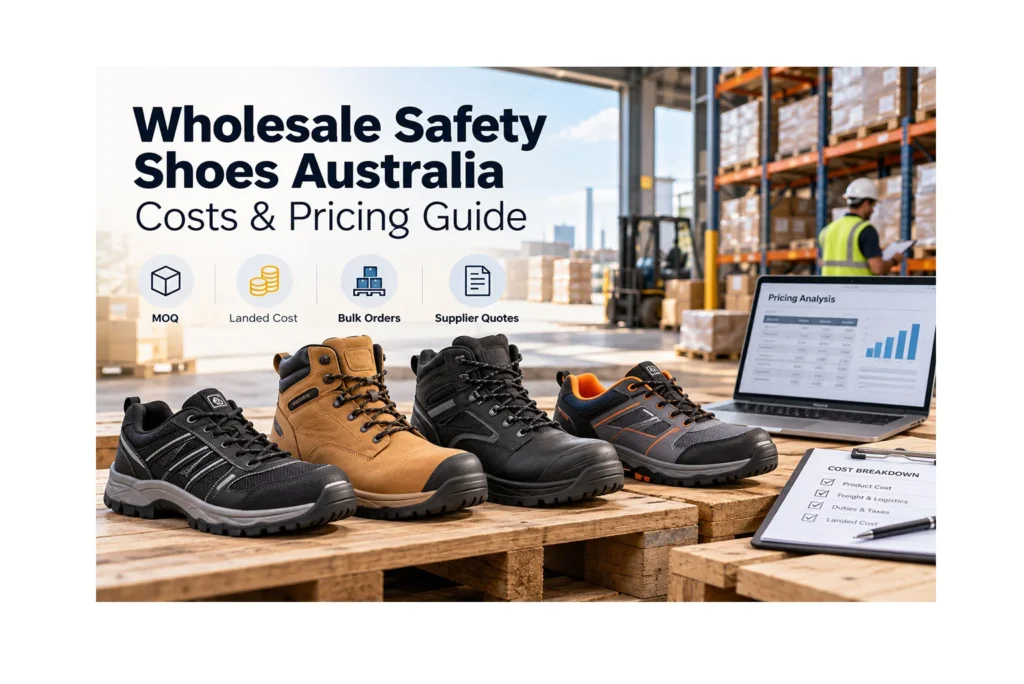
For Australian PPE distributors, workwear wholesalers, safety equipment suppliers, and industrial procurement teams, understanding the cost of wholesale safety shoes Australia suppliers offer is essential for planning inventory, setting competitive prices, and protecting profit margins.
Wholesale safety footwear prices can vary significantly depending on product design, materials, protective features, order quantities, manufacturing location, and shipping arrangements. A basic safety shoe and a specialised mining boot may have very different production costs, even when both are purchased in bulk.
For B2B buyers, the real question is not simply how much one pair costs. It is how much the complete purchasing process costs after freight, import expenses, quality inspection, and other applicable charges are included.
This guide explains wholesale safety footwear pricing in Australia, the factors that affect supplier quotations, how to calculate landed costs, and how distributors can compare manufacturers before placing bulk orders.
How Much Do Wholesale Safety Shoes Cost in Australia?
There is no single wholesale price that applies to every safety footwear product. Prices depend on the specification, order quantity, supplier type, and whether the quotation includes delivery and other expenses.
Public listings provide useful reference points, but they should not be treated as guaranteed wholesale market averages.
For example, a wholesale marketplace has displayed a safety footwear offer at approximately A$21.40 per pair for a 100-unit quantity. This is an individual marketplace listing, not a verified landed price for compliant footwear delivered to Australia.
Australian retail listings provide another useful comparison. General safety boots are commonly advertised at around A$150–A$250, while some specialised or premium models exceed A$300 per pair. These are retail examples rather than wholesale quotations.
The following table illustrates how B2B buyers should approach price comparisons.
| Product category | Main pricing considerations | What buyers should compare |
|---|---|---|
| Basic safety shoes | Standard materials and construction | Unit price, protective features, and durability |
| Lightweight safety sneakers | Upper materials, weight, and outsole design | Comfort, protection, and manufacturing cost |
| General-purpose safety boots | Construction, materials, and boot height | Durability, fit, and repeat-order pricing |
| Waterproof safety boots | Water-resistant materials and construction | Waterproof performance and testing |
| Heavy-duty industrial boots | Reinforced construction and specialised components | Required protection, service life, and quality documentation |
| OEM or private-label footwear | Custom materials, branding, and packaging | Development costs, MOQ, and total order value |
For accurate budgeting, request quotations based on the same specifications and quantities from each supplier. Otherwise, a lower quotation may simply reflect a different product configuration.
What Factors Affect Wholesale Safety Shoes Prices in Australia?
Understanding the components of a supplier quotation helps buyers identify where costs come from and which specifications are worth paying for.
Materials and Construction
The upper material, lining, footbed, outsole, and manufacturing method all influence production costs.
For example, leather uppers, breathable mesh, synthetic materials, and specialised waterproof constructions have different material and processing requirements.
Buyers should consider:
- Material quality and consistency
- Stitching and construction methods
- Outsole material and durability
- Comfort and moisture management
- Expected performance under workplace conditions
A cheaper material may reduce the initial purchase price but could be unsuitable for demanding work environments.
For distributors, the objective is to select materials that meet customer expectations without unnecessarily increasing product costs.
Safety Features and Product Specifications
Protective components can influence the final price of safety footwear.
Depending on the intended application, buyers may require:
- Steel or composite toe protection
- Puncture-resistant midsoles
- Slip-resistant outsoles
- Water-resistant or waterproof construction
- Electrical hazard protection
- Additional reinforcement for demanding environments
Not every product needs every feature. Adding unnecessary specifications can increase costs without providing meaningful value to the intended customer.
Before requesting quotations, identify the workplace hazards and the protection required. Then compare products against the same specification.
Order Quantity and Minimum Order Quantity
Order quantity is one of the most important factors affecting wholesale purchasing costs.
Manufacturers may be able to offer more competitive unit pricing when orders use standard designs, established materials, and efficient production runs.
However, the relationship between quantity and price is not always linear. A larger order may require additional packaging, more complex size allocation, or greater inventory investment.
Ask suppliers to quote several quantities so you can compare the pricing structure.
| Quotation detail | Why it matters |
|---|---|
| Minimum order quantity (MOQ) | Determines the smallest practical purchase |
| Price at different quantities | Shows potential volume savings |
| Size assortment requirements | Affects how inventory must be allocated |
| Mixed-model ordering | Determines whether multiple designs can be combined |
| Repeat-order MOQ | Helps plan future replenishment |
For new distributors, a manageable initial order may be preferable to purchasing excessive inventory solely to obtain a lower unit price.
OEM and Private-Label Requirements
OEM and private-label projects can involve additional development and customisation expenses.
Depending on the project, costs may include:
- Logo application
- Custom colours or materials
- Branded packaging
- Special labels
- New product development
- Sample production and approval
The cost structure depends on how much customisation is required.
Using an existing design with customised packaging may involve a different cost structure from developing a new upper, outsole, or product construction.
Australian distributors should ask for a breakdown of one-time development expenses and recurring per-pair production costs. This makes it easier to assess the commercial viability of a private-label range.
Quality Control and Product Documentation
Quality assurance is another consideration when comparing wholesale safety shoes Australia suppliers offer.
Depending on the product and procurement requirements, buyers may need product testing, inspection, traceability, and supporting documentation.
These activities may influence the overall purchasing cost, but they also help buyers assess whether a product is suitable for its intended use.
Australian workplace guidance emphasises selecting PPE that is appropriate for the task, fits properly, and is reasonably comfortable. Buyers should therefore consider suitability and quality alongside price.
Safe Work Australia
Local Supplier vs Overseas Manufacturer: Which Offers Better Value?
Australian buyers can source safety footwear through local wholesalers, importers, or overseas manufacturers. Each option has a different cost structure.
Buying Through an Australian Wholesaler
A local wholesaler may provide several advantages:
- Domestic stock availability
- Shorter replenishment times for stocked products
- Local customer service
- Easier access to samples
- Simpler communication about returns and product issues
The quoted unit price may be higher than a direct manufacturing quotation, but buyers should evaluate the full service package.
Local sourcing can be attractive for businesses that need small quantities, frequent replenishment, or rapid delivery.
Sourcing Directly From an Overseas Manufacturer
Direct manufacturing relationships may provide opportunities for competitive production pricing, product customisation, and private-label development.
However, buyers also need to account for:
- International freight
- Insurance, where applicable
- Import-related charges
- Customs clearance and handling
- Quality inspection
- Longer lead times
- Inventory financing
Direct sourcing can be especially relevant for distributors purchasing repeat bulk orders or developing their own brands.
The best option depends on order volume, inventory requirements, product specifications, and the total landed cost.
How to Calculate the Landed Cost of Wholesale Safety Shoes
The supplier’s unit price is only one component of the final purchasing cost.
To compare quotations properly, calculate the landed cost per pair.
Landed cost per pair = Total applicable purchasing and delivery costs ÷ Total usable pairs received
Depending on the transaction, total costs may include:
- Product purchase value
- International freight
- Cargo insurance
- Customs duty, if applicable
- Customs clearance and handling
- Inspection expenses
- Packaging or labelling costs
- Domestic delivery
GST treatment and recoverability depend on the transaction and the buyer’s circumstances, so these should be assessed separately when calculating the effective business cost.
Example of a Wholesale Cost Comparison
Consider a hypothetical order of 1,000 pairs from two suppliers.
| Cost component | Supplier A | Supplier B |
|---|---|---|
| Product cost per pair | A$24.00 | A$27.00 |
| Freight and handling per pair | A$6.00 | A$3.50 |
| Inspection and additional costs per pair | A$1.50 | A$1.00 |
| Illustrative landed cost per pair | A$31.50 | A$31.50 |
| Total illustrative cost for 1,000 pairs | A$31,500 | A$31,500 |
These figures are hypothetical and exclude any additional applicable taxes, duties, or costs not listed.
Although Supplier A has a lower quoted unit price, the final calculated cost is identical in this example.
This demonstrates why buyers should compare complete quotations rather than choosing a supplier based solely on the initial price.
How to Compare Safety Boots Wholesale Australia Quotations
A well-structured request for quotation (RFQ) helps buyers compare suppliers more accurately.
Prepare a Consistent Product Specification
Before contacting suppliers, prepare a specification that includes:
- Product type and intended application
- Required protective features
- Upper and outsole materials
- Size range
- Colour options
- Branding and packaging requirements
- Estimated order quantity
- Required documentation
Providing the same requirements to each supplier reduces the risk of comparing products with different specifications.
Request Tiered Pricing
Ask each supplier to quote different order quantities, such as 300, 500, and 1,000 pairs, where these quantities are commercially practical.
Compare the price differences against the additional inventory investment.
A lower price at a higher quantity may not be worthwhile if stock moves slowly or the size distribution is uncertain.
Confirm What the Quotation Includes
Before placing an order, clarify whether the price is:
- Ex-factory
- Based on another agreed international trade term
- Inclusive of freight
- Inclusive of packaging or branding
- Inclusive of inspection expenses
Confirm the named delivery location and applicable Incoterms in the quotation or purchase contract. This helps establish which party is responsible for transport, risk, and specified costs.
Evaluate Quality Before Ordering in Bulk
Request samples and review the relevant documentation before approving production.
Check that the product matches the agreed specification and that any claimed protective performance is supported by appropriate product-specific evidence.
A low price is not good value if the footwear fails to meet the intended workplace requirements or creates avoidable customer complaints.
How to Choose the Right Safety Footwear Supplier Australia Businesses Need
For distributors and wholesalers, a supplier should be evaluated on both product economics and operational reliability.
Check Manufacturing and Supply Capability
Ask about production capacity, standard lead times, material availability, and the ability to fulfil repeat orders.
For established distributors, consistent replenishment can be more valuable than a small initial price reduction.
Review Quality Management
Understand how the supplier controls materials, production, finished products, and non-conforming items.
Ask how the supplier handles quality complaints and what procedures are available for investigating problems.
Evaluate Communication and Commercial Terms
A professional supplier should provide clear quotations and communicate changes that may affect pricing or delivery.
Before placing an order, confirm payment terms, production schedules, order approval procedures, and the process for resolving disputes.
Consider Long-Term Purchasing Value
The right supplier should fit your business model.
For a local reseller with frequent small orders, domestic stock availability may be the priority. For an importer developing a private-label range, manufacturing flexibility and repeat-order consistency may matter more.
Compare suppliers against the needs of your business rather than applying one pricing strategy to every purchase.
Common Mistakes When Buying Wholesale Safety Shoes in Australia
Choosing the Lowest Quotation
The lowest unit price does not necessarily produce the lowest landed cost or the best product performance.
Compare specifications, freight, inspection, quality, and delivery reliability before making a decision.
Ignoring MOQ and Inventory Costs
Large orders may reduce unit prices but tie up working capital and increase the risk of unsold inventory.
Forecast demand before agreeing to minimum order quantities.
Overlooking Product Documentation
Buyers should confirm the applicable requirements for their intended workplace and verify that documentation relates to the actual product being purchased.
Do not assume that a generic certificate or supplier statement automatically establishes compliance.
Failing to Plan Repeat Orders
A supplier that performs well on one order may still struggle with future capacity or size availability.
Clarify replenishment arrangements before relying on a supplier for ongoing business.
Frequently Asked Questions
What is a reasonable wholesale price for safety shoes in Australia?
There is no universal wholesale price. Basic imported products may be advertised at relatively low unit prices, while branded or specialised safety footwear can cost considerably more. The actual quotation depends on specifications, quantity, supplier location, freight, and other costs.
Are safety boots more expensive than safety shoes?
Not necessarily. Price depends on materials, construction, protective features, and intended application. A specialised low-cut safety shoe can cost more than a basic safety boot, so compare products by specification rather than category alone.
Does buying safety shoes in bulk always reduce the price?
Larger orders may reduce the unit price, but savings depend on production efficiency, material costs, and order requirements. Buyers should compare the additional discount against inventory investment and total landed cost.
What affects safety boots price Australia buyers receive from suppliers?
Important factors include materials, protective components, outsole design, product complexity, order quantity, customisation, shipping, and quality documentation.
How can Australian distributors reduce wholesale purchasing costs?
Prepare accurate product specifications, request tiered quotations, compare landed costs, approve samples before bulk production, and plan repeat orders. Avoid unnecessary customisation and select products that match actual customer requirements.
Should distributors source directly from a safety footwear manufacturer?
Direct sourcing can be attractive for bulk purchases, repeat orders, and private-label projects. Local wholesalers may be more suitable for smaller quantities or urgent replenishment. The decision should be based on total cost and operational requirements.
Conclusion
The cost of wholesale safety shoes Australia buyers purchase depends on much more than the quoted price per pair.
Materials, protective features, order quantity, customisation, freight, inspection, and supplier reliability all influence the final purchasing decision.
For PPE distributors, importers, and workwear wholesalers, the most effective approach is to establish clear specifications, compare equivalent quotations, calculate landed costs, and evaluate product quality before committing to bulk orders.
A well-planned sourcing strategy helps businesses control costs while maintaining the product quality and supply consistency their customers expect.
Request a Wholesale Safety Footwear Quote From Ocean Safety Shoes
Ocean Safety Shoes works with B2B buyers seeking safety footwear manufacturing, wholesale supply, and OEM or private-label development opportunities.
Explore our safety footwear product range to review available styles and discuss your purchasing requirements.
When requesting a quotation, provide your target product type, protective specifications, estimated order quantity, size assortment, and branding requirements. This information helps establish a clearer basis for pricing and product evaluation.