
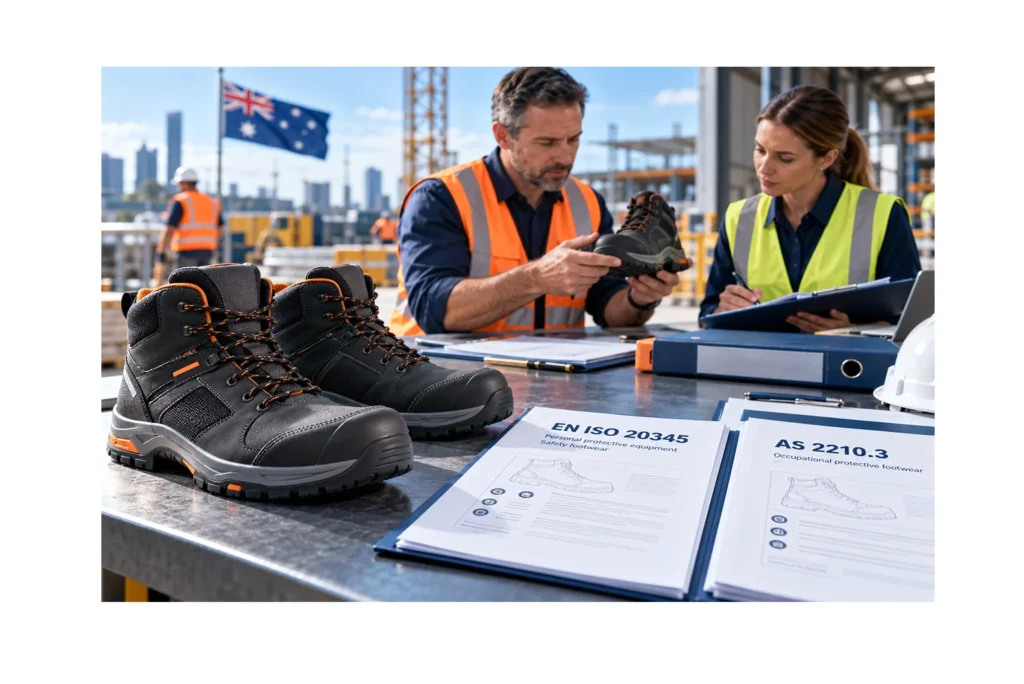
Can safety shoes certified to EN ISO 20345 be sold in Australia? This is an important question for PPE distributors, workwear wholesalers, safety footwear importers, and businesses sourcing protective footwear from overseas manufacturers.
The short answer is yes, EN ISO 20345 safety shoes may be sold in Australia, but European certification does not automatically establish compliance with every Australian workplace or purchasing requirement.
Australian businesses must distinguish between three different questions:
- Can the product legally be supplied in Australia?
- Does the footwear meet the protective requirements of the intended workplace?
- Will customers accept the manufacturer’s certification and supporting documentation?
These questions are particularly relevant to businesses researching EN ISO 20345 Australia requirements before importing or distributing safety footwear.
For example, a Chinese manufacturer may offer safety shoes tested to EN ISO 20345:2022. The product may have credible European testing documentation, but an Australian construction company may specifically request evidence of compliance with AS 2210.3:2019.
In that situation, the importer needs to determine whether additional documentation, assessment, or testing is necessary.
This guide explains the relationship between European and Australian safety footwear standards, the legal considerations surrounding product supply, and the steps B2B buyers should take before placing bulk orders.
Can EN ISO 20345 Safety Shoes Be Legally Sold in Australia?
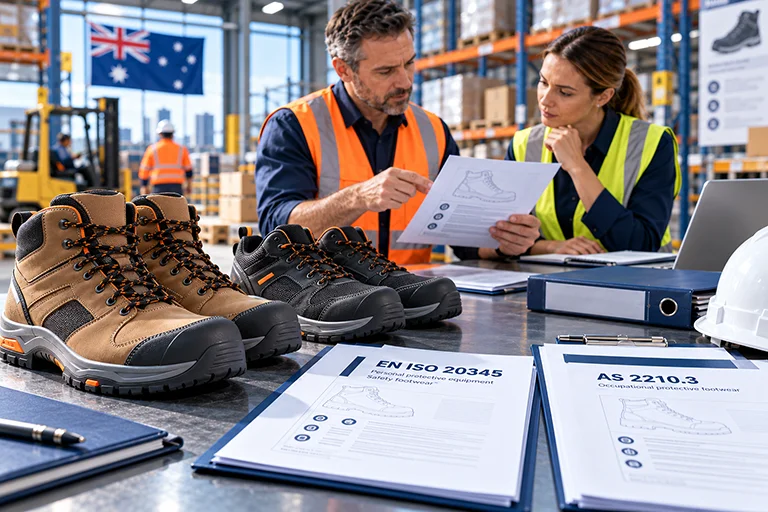
Safety shoes manufactured to EN ISO 20345 are not automatically prohibited from sale in Australia simply because they carry European certification.
However, the legal position depends on the product, relevant regulatory requirements, and how the footwear is marketed and supplied.
Australia distinguishes between mandatory product safety requirements and voluntary standards.
According to the Australian Competition and Consumer Commission (ACCC), products subject to a mandatory safety standard must comply with the applicable requirements before being supplied.
The existence of an Australian Standard does not, by itself, make that standard legally mandatory for every product.
Similarly, Safe Work Australia explains that standards become mandatory under workplace health and safety legislation when the relevant law requires conformity with them.
For importers, this creates an important distinction.
Selling a product and having that product accepted as suitable workplace PPE are not necessarily the same thing.
Even where a particular standard is not directly mandated by law, businesses still have obligations concerning product safety, truthful representations, and workplace risk management.
Three Questions Australian Buyers Should Answer
| Question | What buyers need to establish |
|---|---|
| Can the shoes be supplied in Australia? | Whether applicable product safety laws, mandatory requirements, or restrictions are satisfied |
| Are the shoes suitable for workplace use? | Whether their protective performance addresses the identified workplace hazards |
| Will the customer accept the footwear? | Whether the product meets the customer’s specified standards, documentation, and purchasing conditions |
A pair of European-certified safety shoes may be commercially suitable for some Australian customers but unsuitable for a particular tender requiring verified conformity with AS 2210.3:2019.
Importers should resolve these questions before shipping inventory.
Understanding EN ISO 20345 and Australian Safety Footwear Standards
European and Australian safety footwear standards share important technical foundations, but buyers should not assume that every edition or requirement is interchangeable.
What Is EN ISO 20345?
EN ISO 20345 is the European adoption of the international safety footwear standard ISO 20345.
It specifies basic and additional requirements for general-purpose safety footwear, including requirements relating to mechanical protection, slip resistance, thermal properties, and ergonomic performance.
The international standard ISO 20345:2021 is the technical basis for EN ISO 20345:2022.
Footwear manufacturers may provide products assessed under earlier or newer editions, depending on the model and its certification history.
For procurement purposes, the exact edition matters.
A document stating only “EN ISO 20345 certified” may not provide enough information to determine which requirements were tested.
What Is AS 2210.3:2019?
The relevant Australian standard for general-purpose safety footwear is AS 2210.3:2019 — Personal protective equipment, Part 3: Safety footwear.
It specifies basic and additional requirements for protective footwear used in general workplace applications.
AS 2210.3:2019 is a modified adoption of ISO 20345:2011, incorporating Australian modifications.
It superseded the earlier joint Australian/New Zealand standard AS/NZS 2210.3:2009.
This distinction is important because some Australian websites and product descriptions still use the older designation AS/NZS 2210.3 when referring to safety footwear standards.
Buyers should always confirm the complete designation and edition rather than relying on an abbreviated reference.
The current status and scope of the Australian edition can be checked through the AS 2210.3:2019 standards listing.
EN ISO 20345 vs AS/NZS 2210.3: What Is the Difference?
When researching EN ISO 20345 vs AS/NZS 2210.3, Australian buyers should first clarify which editions are being compared.
The historical designation AS/NZS 2210.3:2009 should not be confused with AS 2210.3:2019.
Furthermore, EN ISO 20345:2022 incorporates revisions based on ISO 20345:2021, whereas AS 2210.3:2019 is based on ISO 20345:2011 with modifications.
Therefore, the documents are related but not automatically identical.
| Comparison | EN ISO 20345:2022 | AS 2210.3:2019 |
|---|---|---|
| Primary market | European market | Australian market |
| Technical basis | ISO 20345:2021 | Modified ISO 20345:2011 |
| Focus | General-purpose safety footwear | General-purpose safety footwear |
| Protective performance | Basic and additional requirements | Basic and additional requirements |
| Test methods and markings | Revised under the newer edition | Based on the adopted edition and Australian modifications |
| Australian procurement acceptance | Must be assessed against applicable requirements | Directly relevant where the Australian standard is specified |
| Automatic equivalence | No | No automatic equivalence with newer European editions |
The practical implication is straightforward: a product tested to EN ISO 20345:2022 should not automatically be advertised as compliant with AS 2210.3:2019 unless the manufacturer has appropriate evidence supporting that claim.
Why the Different Editions Matter
The updated EN ISO 20345:2022 introduced revised performance classifications and markings.
For example, the newer European edition changed slip-resistance classifications and introduced revised markings for certain types of puncture-resistant footwear.
Older European markings such as SRA, SRB, and SRC were replaced by a different approach to slip-resistance testing and marking.
The updated standard also introduced categories such as S6 and S7.
These changes do not necessarily mean that a product certified under an earlier edition is unsafe.
However, they do mean that purchasing teams should not interpret classification symbols without confirming the applicable edition.
A supplier should identify the complete standard reference and explain which tests support each claimed protective feature.
Does EN ISO 20345 Certification Automatically Meet Australian Requirements?
No.
European certification may provide valuable evidence of footwear performance, but it does not automatically establish conformity with a different Australian standard.
The correct assessment depends on:
- The exact European standard and edition
- The Australian standard or requirement being considered
- Differences between applicable test methods
- Australian modifications or additional requirements
- The product’s protective specifications
- The intended workplace hazards
- Any applicable legal, contractual, or customer requirements
Safe Work Australia explains that international standards may be useful alongside corresponding Australian standards, particularly where they achieve an equivalent or higher overall level of safety.
However, where legislation specifically requires conformity with an Australian Standard, the relevant Australian requirement must be addressed.
This means Australian distributors should avoid making unsupported claims of automatic equivalence.
What If the Manufacturer Provides European CE Marking?
CE marking can be relevant evidence of conformity with applicable European requirements.
However, CE marking is not an Australian government approval or a substitute for assessing Australian regulatory and workplace requirements.
Buyers should request the relevant product-specific supporting documents rather than treating the CE mark alone as sufficient evidence.
For importers serving construction companies, industrial employers, and government procurement customers, independently reviewing the supplier’s documentation can reduce the risk of rejected products.
What Documents Should Australian Importers Request?
Documentation is one of the most important parts of evaluating safety shoes certification Australia buyers may need.
Before committing to a bulk purchase, request documents that clearly identify the footwear model and substantiate its protective claims.
Product Specification Sheet
The specification should identify:
- Manufacturer and product model
- Upper and outsole materials
- Protective toe type
- Puncture-resistant components, where applicable
- Protective performance claims
- Available sizes and configurations
- Intended applications
- Referenced standard and edition
The model details should match the quotation and approved sample.
Test Reports and Certification Documents
Ask the supplier for:
- Relevant EN ISO 20345 test reports
- Applicable European conformity documents
- Australian standard test evidence, if claimed
- Product-specific certificates, where available
- Details of the testing laboratory or certification body
Check the issue dates, model numbers, standards, test results, and scope of the documentation.
Where a test report is issued by an accredited laboratory, verify that the laboratory’s accreditation covers the relevant tests.
A general factory certificate should not be treated as proof that every individual footwear model meets a particular safety standard.
Quality Control and Production Records
For wholesale purchasing, importers should also request information about manufacturing quality controls.
Useful records may cover:
- Material inspection
- Production monitoring
- Finished-product checks
- Batch identification
- Product changes
- Procedures for handling quality issues
These records help buyers assess whether repeat orders can maintain the specifications of an approved sample.
When Should Australian Buyers Request AS 2210.3 Testing?
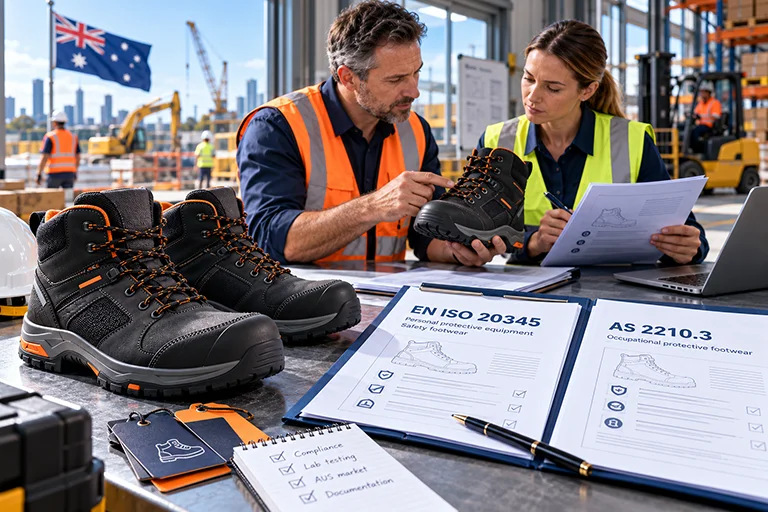
Additional assessment may be necessary when an Australian customer, workplace policy, purchasing contract, or relevant legal requirement explicitly calls for evidence relating to AS 2210.3:2019.
Common situations include procurement contracts that specify an Australian standard and purchasing programmes with detailed technical approval requirements.
Example: Supplying Construction Companies
An Australian construction company issues a purchase specification requiring safety boots that conform to AS 2210.3:2019.
A distributor identifies an overseas product certified to EN ISO 20345:2022.
The distributor should not assume the European certificate alone fulfils the contractual requirement.
Instead, the buyer should ask the manufacturer to provide evidence supporting conformity with the requested Australian edition.
If sufficient evidence is unavailable, further testing or another suitable model may be required.
Example: Supplying Industrial Wholesalers
A workwear distributor plans to offer European-certified safety footwear through its wholesale catalogue.
Before advertising the product, it should confirm that descriptions of protective features are accurate and supported by evidence.
It should also identify customers whose purchasing specifications require Australian-standard documentation.
This process helps the distributor avoid promising product suitability that has not been established.
Example: Developing Private-Label Safety Shoes
An Australian PPE brand requests customised safety shoes from an overseas manufacturer.
If branding is the only change, the buyer should still confirm that the approved product and its documentation remain consistent.
If the manufacturer changes protective components, materials, or construction, the existing reports may no longer fully represent the finished footwear.
Any changes affecting safety performance should be assessed before the new product is marketed or supplied.
Can European-Certified Safety Shoes Be Imported from China?
Australian buyers can consider importing European-certified safety footwear from Chinese manufacturers, subject to applicable import, product safety, and commercial requirements.
However, importer responsibility extends beyond accepting the manufacturer’s initial claims.
Before importing, businesses should establish whether the products meet the requirements of their intended Australian customers.
Supplier Evaluation Checklist
| Evaluation area | Questions Australian buyers should ask |
|---|---|
| European certification | Which EN ISO 20345 edition applies? |
| Australian requirements | Is evidence available for AS 2210.3:2019 where needed? |
| Test reports | Do reports cover the exact product model? |
| Manufacturer | Who controls production and protective components? |
| Product changes | Will changes be disclosed before production? |
| Quality control | How is batch consistency maintained? |
| Labelling | Are performance claims and markings accurate? |
| Customer acceptance | Will target customers accept the supplied evidence? |
| Repeat orders | Can the same approved specifications be maintained? |
For B2B importers, resolving these questions early can prevent unnecessary inventory risks.
How to Verify Safety Footwear Compliance Before Bulk Ordering
A structured process helps Australian distributors compare manufacturers and reduce sourcing uncertainty.
Step 1: Define the Required Protection
Identify the industries and workplaces the footwear will serve.
Different applications may require different protective features.
A general warehouse shoe should not automatically be assumed suitable for specialised electrical, chemical, mining, or high-temperature hazards.
Step 2: Identify the Applicable Requirements
Confirm whether the purchasing specification requires AS 2210.3:2019, EN ISO 20345, another standard, or additional product-specific testing.
Review any relevant workplace requirements and customer contracts.
Step 3: Obtain Supporting Documentation
Request relevant test reports, certification documents, product specifications, and quality control information.
Check that all documents refer to the correct model and edition.
Step 4: Resolve Differences Between Standards
If the supplied product is tested to one standard but the customer specifies another, establish whether the available evidence satisfies the requirement.
Where necessary, consult a qualified testing laboratory, certification body, or relevant compliance specialist.
Step 5: Approve Samples and Production Specifications
Confirm the final product configuration before mass production.
Record the approved materials, protective components, markings, and packaging.
Step 6: Control Repeat-Order Changes
Require written notification of changes that could affect product identity, tested performance, or compliance claims.
This is particularly important for OEM products supplied under an Australian distributor’s private label.
Common Mistakes Australian Safety Footwear Importers Should Avoid
Assuming CE Certification Means Australian Certification
European conformity documentation should not be presented as Australian certification without evidence supporting the Australian claim.
Using Outdated Standard References
Some product catalogues refer to AS/NZS 2210.3 without specifying the edition.
Check whether the supplier means the superseded 2009 joint standard or AS 2210.3:2019.
Comparing Classification Codes Without Checking Editions
A code from EN ISO 20345:2022 may not be interpreted in the same way as an older Australian or European classification.
Always review the relevant edition and the underlying performance evidence.
Accepting Generic Factory Certificates
A manufacturer’s management-system certificate does not necessarily demonstrate that a particular shoe model passed safety footwear testing.
Request product-specific evidence.
Ignoring Workplace Purchasing Requirements
A product may be available for sale but rejected by a customer whose purchasing contract requires a different standard or particular documentation.
Making Unsupported Compliance Claims
Importers should avoid advertising footwear as Australian-standard compliant unless their evidence supports the claim.
Accurate descriptions protect customer trust and reduce commercial risk.
Frequently Asked Questions About EN ISO 20345 Australia
Can EN ISO 20345 Safety Shoes Be Sold in Australia?
Yes, they may be sold, provided applicable Australian legal requirements are satisfied. European certification alone does not establish compliance with every Australian workplace specification or purchasing contract.
Is EN ISO 20345 the Same as AS/NZS 2210.3?
No. AS/NZS 2210.3:2009 is a superseded joint standard. The current Australian edition identified for general-purpose safety footwear is AS 2210.3:2019, a modified adoption of ISO 20345:2011. EN ISO 20345:2022 is based on a newer international edition.
Is EN ISO 20345 Accepted in Australian Workplaces?
Acceptance depends on the applicable legal obligations, workplace risk assessment, customer requirements, and evidence of protective performance. International standards may provide useful supporting evidence but should not be assumed automatically interchangeable with Australian requirements.
Does CE Marking Mean Safety Shoes Meet Australian Standards?
No. CE marking relates to applicable European requirements and does not automatically demonstrate conformity with AS 2210.3:2019.
Do Safety Shoes Need Australian Certification Before Being Imported?
There is no universal rule that every imported safety shoe must obtain a single form of Australian certification simply because it is safety footwear. However, importers must check applicable product safety requirements and the standards or evidence required for their intended markets.
Can Chinese Manufacturers Supply Safety Shoes for Australia?
Yes. Chinese manufacturers may supply safety footwear for Australian distributors and industrial buyers. Importers should verify product specifications, supporting test evidence, manufacturing quality, and applicable purchasing requirements before ordering.
What Should Australian Buyers Do If a Supplier Only Has EN ISO 20345 Reports?
Review the exact edition and product coverage, then compare the available evidence with the applicable Australian or customer requirements. If the evidence is insufficient, request additional assessment or testing before making compliance claims.
Conclusion
The answer to whether EN ISO 20345 safety shoes can be sold in Australia is more nuanced than a simple yes or no.
European-certified footwear is not automatically excluded from the Australian market. However, it must satisfy applicable legal requirements, and its suitability for a particular workplace or purchasing contract needs to be established separately.
For PPE distributors, importers, and workwear wholesalers, the most important considerations are:
- Understanding the difference between EN ISO 20345 and AS 2210.3
- Checking the exact standard edition
- Reviewing product-specific test reports
- Confirming the applicable Australian and customer requirements
- Avoiding unsupported certification claims
- Maintaining manufacturing and product consistency
A careful approach to EN ISO 20345 Australia requirements helps buyers reduce purchasing risks and make more informed decisions when sourcing safety footwear internationally.
Source Safety Footwear for the Australian Market With Ocean Safety Shoes
Australian PPE distributors and importers need manufacturing partners capable of supporting clear product specifications, consistent production, and appropriate documentation for their target markets.
Ocean Safety Shoes provides safety footwear manufacturing and OEM/private-label development services for international B2B buyers.
Explore our safety footwear product range to identify potential products for Australian distribution.
When requesting a quotation, provide the intended workplace applications, protective requirements, relevant standard references, estimated quantities, and documentation requirements.
Our team can discuss available product specifications, sampling, and manufacturing options. Any claim of conformity with a particular Australian or international standard should be verified against the supporting evidence for the exact product model.
Looking for a safety footwear manufacturing partner for Australia?
Contact Ocean Safety Shoes to discuss your bulk sourcing, OEM development, and product documentation requirements.