
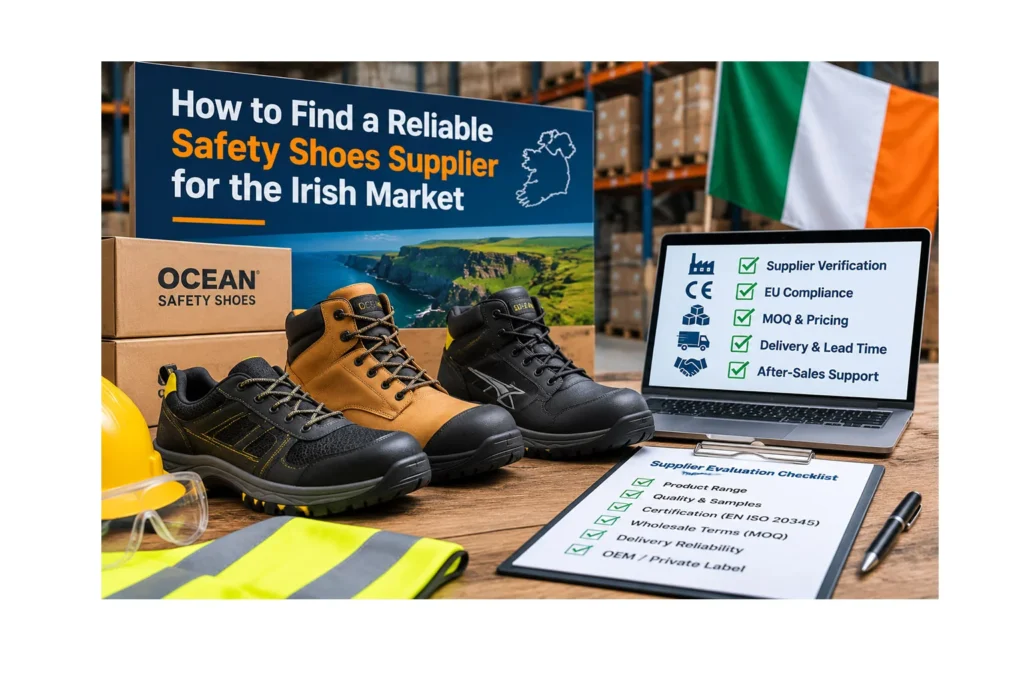
Finding a reliable safety footwear supplier Ireland businesses can depend on is an important decision for PPE distributors, workwear wholesalers, industrial suppliers, and procurement managers. The Irish market offers several sourcing options, including local safety footwear distributors, European manufacturers, international wholesalers, and overseas factories.
However, choosing the right supplier involves more than finding a company with an attractive product catalogue or competitive prices. Buyers must evaluate product compliance, manufacturing quality, delivery reliability, pricing, stock availability, and long-term supply capabilities.
For Irish businesses purchasing safety shoes in bulk, an unreliable supplier can create problems such as inconsistent product quality, delayed deliveries, missing certification documents, and difficulties maintaining inventory.
Sourcing directly from a manufacturer may offer additional opportunities for competitive pricing and private-label development. At the same time, working with an established Irish distributor may provide faster delivery, local support, and access to ready-stock products.
This guide explains how to identify and evaluate a reliable safety footwear supplier for the Irish market, compare different sourcing options, and reduce risks before placing wholesale orders.
It is particularly useful for:
- Irish safety footwear wholesalers and distributors
- PPE importers and industrial equipment suppliers
- Workwear retailers and trade merchants
- Construction and manufacturing companies
- Warehouse and logistics procurement teams
- Businesses sourcing bulk safety shoes Ireland
- Private-label brands developing their own footwear ranges
1. Understand the Irish Safety Footwear Supply Market
Before choosing a supplier, Irish buyers should understand the different types of businesses operating in the safety footwear market.
Not every supplier has the same business model, product range, or ability to support bulk purchasing.
Local Safety Footwear Distributors
Local distributors purchase products from manufacturers or established brands and supply them to businesses, retailers, and end users.
Their main advantages often include:
- Faster domestic delivery
- Access to stocked products
- Easier communication
- Local customer service
- Smaller purchasing quantities
- Established distribution arrangements
For example, Irish businesses can investigate suppliers such as:
- Charles Hughes / Portwest Ireland
- Scully Supplies
- Alpha Workwear
- O’Sullivan Safety
- M.A. Healy & Sons
These businesses illustrate different distribution and workwear supply models in Ireland.
Some specialise in trade distribution, while others supply a broader selection of workwear and PPE to business customers.
European Safety Footwear Manufacturers
European manufacturers can offer established product ranges, technical support, and access to products developed for European workplace requirements.
Potential advantages include:
- Established footwear designs
- Regional distribution networks
- Product-specific technical documentation
- Access to recognised safety footwear brands
- Established supply arrangements
However, buyers should compare wholesale pricing, MOQ, delivery arrangements, and product availability rather than assuming that European sourcing is always more economical.
Overseas Safety Footwear Manufacturers
International factories, particularly manufacturers in China, may provide another sourcing option for Irish importers and wholesalers.
Potential advantages include:
- Factory-direct purchasing
- Competitive manufacturing costs
- OEM and ODM development
- Custom logos and packaging
- Flexible product specifications
- Opportunities to develop private-label footwear
However, direct importing requires more supplier verification, product compliance checks, and logistics planning.
The most suitable sourcing model depends on your purchasing volume, customer requirements, inventory strategy, and available resources.
2. Define Your Safety Footwear Purchasing Requirements
Before contacting potential suppliers, establish what types of safety footwear your business needs.
A supplier may offer hundreds of models, but only a smaller selection may be relevant to your target customers.
Identify Your Target Industries
Different Irish industries require different types of protective footwear.
| Industry | Typical footwear requirements |
|---|---|
| Construction | Protective toe caps, durable uppers, and suitable grip |
| Manufacturing | Impact protection, comfort, and workplace-specific protection |
| Warehousing | Lightweight designs, cushioning, and slip resistance |
| Agriculture | Waterproof footwear and durable outsoles |
| Food processing | Easy-to-clean materials and suitable slip resistance |
| Engineering | Protective toes, penetration resistance, and durable construction |
| Transport and logistics | Comfort for extended standing and walking |
The correct footwear must be selected according to the workplace risk assessment.
For example, a lightweight safety sneaker may be appropriate for certain warehouse applications but unsuitable for a construction environment requiring additional protection.
Select the Right Product Categories
When evaluating a potential safety footwear supplier Ireland businesses may work with, check whether its product range includes the categories your customers need.
Common options include:
- Steel toe safety shoes
- Composite toe safety shoes
- Lightweight safety sneakers
- Waterproof safety boots
- Mid-cut and high-cut work boots
- Puncture-resistant safety footwear
- Industrial safety gumboots
- Specialist protective footwear
For wholesalers, having several complementary categories can help serve different customer segments.
Establish Your Purchasing Volume
Your estimated purchasing volume influences which supplier model is most appropriate.
| Purchasing situation | Potential sourcing option |
|---|---|
| Small quantities | Local distributors or stocked wholesalers |
| Regular wholesale orders | Established trade suppliers or manufacturers |
| Large-volume purchasing | Direct manufacturers |
| Custom branded footwear | OEM/ODM manufacturers |
| Multiple brands and product categories | Multi-brand distributors |
Ask suppliers to quote according to realistic quantities rather than providing only a single unit price.
3. Verify the Supplier’s Business Identity and Experience
One of the first steps in supplier evaluation is confirming that the company is a legitimate and established business.
This is particularly important when purchasing bulk safety shoes Ireland businesses intend to resell.
Check Business Information
Request or independently verify:
- Registered company name
- Business address
- Contact information
- Company registration details
- Trading history
- Product catalogue
- Main business activities
- References or customer experience, where available
For Irish suppliers, check relevant company information through the Companies Registration Office (CRO).
For overseas manufacturers, request their business registration information and verify the actual manufacturing location.
Evaluate Industry Experience
A supplier with experience in occupational safety footwear may be better equipped to answer technical questions than a general footwear trader.
Ask:
- How long have you supplied safety footwear?
- Which industries do your customers serve?
- Which safety footwear categories do you specialise in?
- Do you supply wholesalers and distributors?
- Can you support repeat bulk orders?
- Do you have experience exporting to Ireland or other EU markets?
Experience alone does not guarantee quality, but it helps buyers understand the supplier’s commercial capabilities.
Request a Factory or Warehouse Tour
If you are evaluating a manufacturer, request a video tour or arrange an independent factory inspection.
Look for evidence of:
- Production equipment
- Material storage
- Cutting and stitching operations
- Sole attachment processes
- Quality inspection areas
- Finished-product storage
- Packaging facilities
For distributors, a warehouse visit may help establish whether products are genuinely stocked and how orders are managed.
4. Check EU Safety Footwear Compliance and Certification
Product compliance is one of the most important criteria when selecting a safety footwear supplier for Ireland.
Ireland is an EU member state, so applicable European PPE legislation must be considered when safety footwear is placed on the Irish market.
Understand EU PPE Regulation 2016/425
Regulation (EU) 2016/425 establishes requirements for the design, manufacture, and marketing of personal protective equipment.
Safety footwear covered by this regulation must satisfy the applicable essential health and safety requirements.
The regulation establishes responsibilities for manufacturers, importers, and distributors.
Buyers should consult the official European Commission PPE guidance when reviewing product compliance.
Check EN ISO 20345 Documentation
EN ISO 20345 is an important European standard for general-purpose safety footwear.
When evaluating a supplier, request information about:
- Applicable standard edition
- Product classification
- Toe protection
- Puncture resistance, where applicable
- Slip resistance
- Water resistance
- Other claimed protective properties
The documentation should refer to the exact product model being purchased.
Do not assume that every shoe in a manufacturer’s catalogue has identical testing or certification.
Documents to Request From Your Supplier
| Document | What it demonstrates |
|---|---|
| EU Declaration of Conformity | Identifies the manufacturer’s conformity declaration |
| EU type-examination certificate, where applicable | Evidence of the relevant conformity assessment |
| Product test reports | Results for specified product tests |
| Technical documentation | Supporting information for conformity assessment |
| User instructions | Product limitations, intended use, and maintenance |
| Product identification | Manufacturer and model information |
A generic ISO 9001 certificate is not a substitute for product-specific safety footwear conformity documentation.
Understand Importer and Distributor Responsibilities
When importing safety footwear from outside the EU, businesses must understand their obligations under Regulation (EU) 2016/425.
Importers have responsibilities concerning product conformity, manufacturer documentation, CE marking, and identification information.
Distributors must also exercise due care and check that required markings and documentation accompany the products.
If you sell PPE under your own name or trademark, you may assume manufacturer responsibilities under the regulation.
This is particularly important for Irish businesses developing private-label safety shoes.
For additional information, consult the Irish Health and Safety Authority (HSA).
5. Evaluate Product Quality Before Placing Bulk Orders
A reliable supplier should be able to demonstrate that its products meet the agreed specifications.
Do not choose a supplier based entirely on catalogue photographs or product descriptions.
Request Physical Samples
Request samples from shortlisted suppliers before approving large orders.
Inspect the following areas:
Upper material
Check the material quality, stitching, thickness, flexibility, and finishing.
Protective toe cap
Confirm the specified toe cap type and review the relevant supporting test evidence.
Outsole construction
Inspect the tread pattern, sole attachment, and overall workmanship.
Internal comfort
Evaluate cushioning, lining, heel fit, and available sizes.
Product finishing
Look for uneven stitching, excess adhesive, damaged surfaces, and inconsistent construction.
Packaging
Check the product labels, size markings, shoe boxes, and packaging specifications.
Compare Several Suppliers Using the Same Criteria
A simple comparison table can help make supplier selection more objective.
| Evaluation factor | Supplier A | Supplier B | Supplier C |
|---|---|---|---|
| Product quality | Evaluate | Evaluate | Evaluate |
| Safety documentation | Evaluate | Evaluate | Evaluate |
| Product range | Evaluate | Evaluate | Evaluate |
| MOQ | Compare | Compare | Compare |
| Wholesale price | Compare | Compare | Compare |
| Delivery time | Compare | Compare | Compare |
| After-sales support | Evaluate | Evaluate | Evaluate |
Do not allow an attractive price to compensate for missing evidence of a critical safety requirement.
6. Compare Wholesale Pricing, MOQ, and Total Purchasing Costs
Price is important for wholesalers and importers, but the lowest quoted unit price does not necessarily provide the best commercial value.
Understand Minimum Order Quantities
MOQ varies depending on the supplier, product model, material selection, and customisation requirements.
Ask for separate MOQ information for:
- Standard safety shoes
- Custom colours
- Custom logos
- Private-label packaging
- New product development
- Mixed-size orders
For example, a manufacturer may offer different purchasing conditions for existing products and newly developed designs.
Always confirm the actual MOQ for the product configuration you intend to purchase.
Request Tiered Wholesale Quotations
Ask potential suppliers to quote different order quantities.
| Example quantity | Purchasing purpose |
|---|---|
| 300 pairs | Initial product testing |
| 500 pairs | Medium-volume wholesale order |
| 1,000 pairs | Larger distribution order |
| 2,000 pairs | High-volume purchasing |
These are illustrative quotation scenarios rather than standard industry MOQs.
Compare the unit price against the additional inventory investment.
Calculate the Total Landed Cost
When importing safety footwear into Ireland, include more than the factory price.
Relevant costs may include:
- Product purchase price
- International freight
- Cargo insurance
- Customs duty
- Import VAT
- Customs clearance
- Local delivery
- Inspection expenses
- Warehousing
A basic calculation is:
Landed cost per pair = Total applicable purchasing and import costs ÷ Number of usable pairs received
Before placing an order, check the applicable tariff classification and customs requirements through Irish Revenue.
For overseas purchases, also compare shipping terms such as FOB, CIF, DAP, and DDP.
Make sure you understand which costs and responsibilities are included in each quotation.
7. Check Stock Availability and Delivery Reliability
For businesses supplying regular customers, stock availability is an important part of supplier selection.
A supplier offering attractive prices but frequently missing delivery deadlines can damage your customer relationships.
Questions to Ask About Delivery
Before signing a wholesale agreement, establish:
- What products are currently in stock?
- What are the normal delivery lead times?
- Can the supplier handle urgent orders?
- How frequently are popular sizes replenished?
- Can repeat orders maintain the same specifications?
- What happens if a delivery is delayed?
- Are partial deliveries available?
Local Stock vs Overseas Production
| Factor | Irish stockist | Overseas manufacturer |
|---|---|---|
| Delivery | Generally faster | Requires international shipping |
| MOQ | May support smaller orders | Depends on production requirements |
| Customisation | Usually limited to stocked products | Often more flexible |
| Product availability | Depends on local inventory | Depends on production schedule |
| Unit price | Includes distribution costs | May offer factory-direct pricing |
| Replenishment | Potentially faster for stocked items | Requires production and shipping planning |
For Irish wholesalers, maintaining a combination of locally available stock and planned overseas purchasing may be worth considering.
8. Evaluate OEM and Private-Label Capabilities
For distributors seeking to establish their own safety footwear brands, supplier customisation capabilities can provide an important commercial advantage.
A manufacturer offering OEM and ODM services may support product development beyond standard catalogue models.
What Can Be Customised?
Depending on the factory’s capabilities, options may include:
- Custom logos
- Shoe box branding
- Product labels
- Upper material selection
- Colour combinations
- Outsole designs
- Custom product development
- Packaging specifications
What Should You Confirm?
Before beginning an OEM project, establish:
| Requirement | Questions to ask |
|---|---|
| Product design | Existing model or new development? |
| Logo | What application methods are available? |
| Packaging | Can custom shoe boxes be supplied? |
| MOQ | What is the minimum order per design? |
| Samples | What are the development costs and lead times? |
| Testing | Does the final product require additional assessment? |
| Production | What is the expected mass-production schedule? |
Any changes that could affect product safety performance should be appropriately assessed before the final product is placed on the EU market.
9. Assess Communication and After-Sales Support
A supplier relationship does not end when the order is shipped.
For wholesalers and importers, communication and after-sales support can significantly affect long-term purchasing efficiency.
Evaluate Communication Quality
A professional supplier should be able to:
- Answer technical questions clearly
- Provide accurate quotations
- Explain product specifications
- Communicate realistic lead times
- Provide production updates
- Respond to quality complaints
- Support repeat orders
If the supplier avoids technical questions or provides inconsistent information, investigate further before committing to a large purchase.
Confirm Quality Complaint Procedures
Discuss how the supplier handles:
- Manufacturing defects
- Incorrect sizes
- Damaged products
- Missing quantities
- Packaging errors
- Product specification deviations
Agree on inspection procedures, evidence requirements, and corrective actions before placing the order.
For large wholesale orders, documenting these arrangements in the purchase agreement is particularly important.
10. Examples of Safety Footwear Suppliers and Trade Distributors in Ireland
When researching the Irish market, buyers can use established suppliers as reference points for understanding local product ranges and distribution models.
The following companies provide examples of businesses operating in Ireland’s safety footwear and PPE supply market. This is not a ranking or endorsement.
| Company | Supply model / market focus | Website |
|---|---|---|
| Charles Hughes / Portwest Ireland | Irish workwear, PPE and safety footwear wholesaler | charleshughes.ie |
| Scully Supplies | Trade distribution of safety footwear and PPE | scully.ie |
| Alpha Workwear | Irish workwear and safety footwear trade supplier | alphaworkwear.ie |
| O’Sullivan Safety | Safety footwear and PPE supplier with Irish stores | osullivansafety.ie |
| M.A. Healy & Sons | Irish PPE and industrial safety supplier | mahealy.com |
| WTH Supplies | Independent safety footwear and workwear supplier | wthsupplies.ie |
| Keypoint | Irish PPE, workwear and industrial consumables supplier | keypointgroup.ie |
These companies illustrate several ways safety footwear reaches the Irish market.
Some operate as multi-brand trade distributors, while others combine footwear supply with wider PPE and workwear services.
For a new distributor, reviewing their product categories, brands, and commercial positioning can help identify potential market gaps.
11. Warning Signs When Choosing a Safety Footwear Supplier
Before making a purchasing commitment, look out for the following warning signs.
Unusually Low Prices Without Clear Specifications
A very low quotation may reflect different materials, missing protective components, or a different product configuration.
Always compare equivalent specifications.
Unverifiable Certification Documents
Do not accept generic certificate images without checking the issuing organisation, product model, standard, and supporting information.
Refusal to Provide Samples
If a supplier refuses reasonable sample requests, it becomes difficult to assess the product before bulk purchasing.
Unclear Manufacturing Arrangements
If the supplier cannot explain where products are manufactured or who controls production, request additional information.
Unrealistic Delivery Promises
Production and shipping schedules should be realistic and supported by the supplier’s actual capacity.
No Written Quality Agreement
Product specifications, inspection requirements, packaging, delivery conditions, and defect procedures should be documented.
12. Safety Footwear Supplier Evaluation Checklist
Use the following checklist when comparing potential suppliers for the Irish market.
- Verify the supplier’s business identity.
- Confirm its manufacturing or distribution model.
- Review product categories and technical capabilities.
- Request detailed product specifications.
- Check applicable EU PPE conformity documentation.
- Verify relevant test reports and certificates.
- Request and inspect product samples.
- Compare wholesale prices and MOQ.
- Calculate total landed costs.
- Confirm stock availability and delivery lead times.
- Evaluate quality control procedures.
- Check OEM and private-label capabilities.
- Establish after-sales support arrangements.
- Confirm repeat-order reliability.
- Document all purchasing conditions.
Completing these checks before placing an order can help reduce supplier selection risks and improve purchasing decisions.
13. Frequently Asked Questions
How Do I Find a Reliable Safety Footwear Supplier in Ireland?
Start by identifying suppliers that serve your target industries. Verify their business information, product range, safety documentation, pricing, stock availability, and customer support. Request samples and compare several suppliers before committing to a bulk order.
Who Supplies Wholesale Safety Shoes in Ireland?
Irish businesses can investigate companies such as Charles Hughes / Portwest Ireland, Scully Supplies, Alpha Workwear, O’Sullivan Safety, and M.A. Healy & Sons. Their product ranges and trade purchasing conditions differ, so request quotations directly.
Can Irish Businesses Buy Safety Shoes Directly From China?
Yes. Irish importers can source safety footwear from Chinese manufacturers, provided applicable EU PPE regulations, customs requirements, and importer obligations are satisfied.
What Documents Should a Safety Shoes Supplier Provide?
Depending on the product and conformity assessment, buyers should request an EU Declaration of Conformity, relevant EU type-examination documentation, product test reports, technical information, and user instructions.
What Is the Best MOQ for Wholesale Safety Shoes Ireland Buyers?
There is no universal MOQ. It depends on the supplier, product design, materials, and customisation. Ask for quotations at several quantities and compare unit prices against inventory requirements.
Is It Better to Buy From an Irish Supplier or a Chinese Manufacturer?
An Irish supplier may offer faster delivery, locally available inventory, and easier communication. A Chinese manufacturer may offer factory-direct purchasing, product customisation, and OEM development opportunities. The best choice depends on order volume, delivery needs, and product requirements.
Can I Create My Own Safety Shoes Brand in Ireland?
Yes. Businesses can work with manufacturers to develop private-label safety footwear. However, companies placing PPE on the market under their own name or trademark may assume manufacturer responsibilities under EU PPE Regulation 2016/425.
How Can I Check the Quality of Safety Shoes Before Bulk Ordering?
Request physical samples, inspect the materials and construction, review product-specific test reports, and verify that the final product matches the approved specifications. For large orders, consider independent pre-shipment inspections.
Conclusion
Finding a reliable safety footwear supplier Ireland businesses can depend on requires a structured evaluation process.
Irish buyers should look beyond product prices and consider supplier experience, product compliance, manufacturing quality, MOQ, delivery reliability, and long-term commercial support.
For wholesalers, importers, and industrial distributors, the most effective sourcing strategy is to:
- Define the requirements of your target customers.
- Compare local distributors and overseas manufacturers.
- Verify product-specific EU compliance documentation.
- Evaluate samples before bulk purchasing.
- Compare total landed costs rather than factory prices alone.
- Confirm production and delivery capabilities.
- Establish clear quality and after-sales procedures.
A reliable supply relationship can help protect product quality, improve inventory planning, and support long-term business growth in the Irish safety footwear market.
Source Safety Footwear From Ocean Safety Shoes
Ocean Safety Shoes is a professional safety footwear manufacturer serving international B2B buyers, including wholesalers, importers, distributors, PPE suppliers, and private-label brands.
We provide manufacturing and product development solutions covering:
- OEM safety footwear manufacturing
- ODM product development
- Private-label safety shoes
- Custom logos and packaging
- Product specification development
- Wholesale manufacturing support
Our product range includes different safety footwear styles designed for industrial and workplace applications.
Explore the Ocean Safety Shoes product range to review available products and manufacturing options.
For Irish distributors and importers considering direct manufacturing, provide the following information when requesting a quotation:
- Target footwear categories
- Intended workplace applications
- Required safety standards
- Estimated order quantities
- Size assortment
- Branding and packaging requirements
- Required product documentation
This information helps establish a clearer basis for product selection, sample evaluation, and manufacturing quotations.
Looking for a reliable safety footwear supplier for the Irish market?
Contact Ocean Safety Shoes to discuss wholesale sourcing, product samples, and OEM or private-label manufacturing opportunities.