
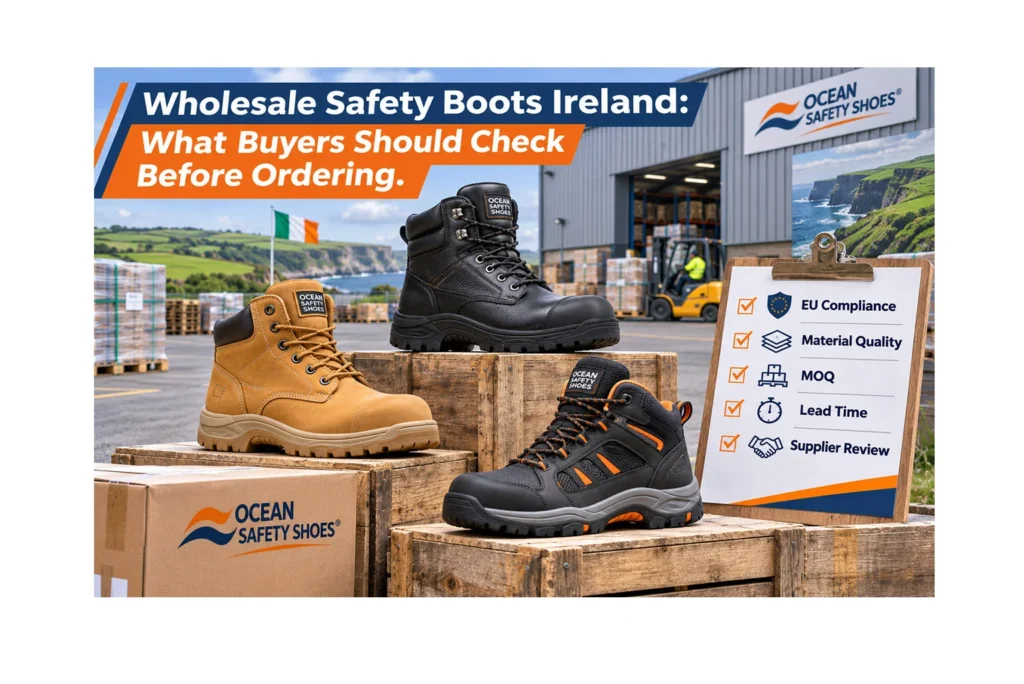
Developing a private label safety footwear Ireland business can create valuable opportunities for PPE distributors, workwear retailers, industrial suppliers, and entrepreneurs looking to establish their own protective footwear brands.
Rather than relying entirely on established footwear brands, businesses can work directly with manufacturers to develop products under their own brand identity. This approach offers greater flexibility in product selection, branding, packaging, and long-term product development.
However, launching a private-label safety footwear range involves more than adding a logo to an existing pair of work boots. Buyers must consider product design, European safety requirements, manufacturing capabilities, minimum order quantities (MOQ), product testing, packaging, and import responsibilities.
For Irish PPE brands, selecting the right manufacturing partner is particularly important because safety footwear placed on the Irish market must comply with applicable EU personal protective equipment legislation.
This guide explains how to source private-label safety footwear, evaluate OEM manufacturers, calculate development costs, and build a competitive footwear brand for the Irish market.
It is particularly relevant to:
- PPE distributors developing their own brands
- Safety footwear wholesalers
- Workwear retailers
- Industrial equipment suppliers
- Footwear importers
- Start-ups entering the safety footwear market
- Established businesses expanding their product portfolios
1. Why Private Label Safety Footwear Is an Opportunity in Ireland
Ireland has an established market for occupational safety products, supported by construction, manufacturing, agriculture, engineering, warehousing, and logistics industries.
Businesses operating in these sectors require footwear that provides suitable workplace protection, durability, and comfort.
For distributors and retailers, selling only established third-party brands can limit product differentiation and pricing flexibility.
Private-label manufacturing provides another business model.
Benefits of Developing Your Own Safety Footwear Brand
Brand differentiation
A private-label range allows your business to develop a recognisable identity rather than competing exclusively through existing brands.
Product selection flexibility
You can select suitable footwear designs, materials, colours, and protective features according to customer requirements.
Control over branding
Custom logos, shoe boxes, labels, and product presentation help create a consistent brand image.
Wholesale business opportunities
Owning a product brand can create opportunities to supply retailers, PPE distributors, construction companies, and industrial customers.
Long-term product development
Once an initial product range is established, businesses can introduce additional models based on customer feedback and sales performance.
Which Businesses Should Consider Private Label?
| Business type | Potential opportunity |
|---|---|
| PPE distributors | Develop an exclusive footwear range |
| Workwear retailers | Expand existing product categories |
| Safety equipment wholesalers | Build a recognisable product brand |
| Footwear importers | Increase control over product specifications |
| Industrial suppliers | Offer customised footwear solutions |
| Start-up brands | Enter the occupational footwear market |
Private-label footwear is particularly worth considering for businesses with established B2B customer relationships and a clear understanding of their target industries.
2. Decide Which Safety Footwear Products to Develop
Before contacting an OEM manufacturer, define the products your brand will offer.
Starting with too many designs can increase development costs and inventory risks.
A more practical approach is to identify a few product categories that match your customers’ needs.
Steel Toe Safety Shoes
Steel toe footwear is a traditional category for industrial and construction applications.
Potential product features include:
- Steel protective toe caps
- Durable leather uppers
- Abrasion-resistant materials
- Suitable outsole grip
- Comfortable internal lining
- Different outsole constructions
These products can serve construction contractors, manufacturing companies, and industrial distributors.
Composite Toe Safety Shoes
Composite toe footwear offers a non-metallic alternative to traditional steel toe designs.
Depending on the construction, potential benefits include:
- Lightweight designs
- Non-metallic toe protection
- Reduced thermal conductivity
- Suitability for certain metal-detection environments
Composite toe models can be attractive to distributors targeting warehouse, logistics, and industrial customers.
Lightweight Safety Sneakers
Sport-inspired safety footwear is another potential private-label category.
Common design options include:
- Breathable mesh uppers
- TPU overlays
- Composite toe caps
- Lightweight midsoles
- Cushioned footbeds
- Slip-resistant rubber outsoles
These designs may appeal to customers who prefer modern footwear styling for professional environments.
Waterproof Safety Boots
Waterproof work boots can be relevant to Irish agricultural, construction, outdoor maintenance, and utility customers.
Potential features include:
- Waterproof upper construction
- Durable leather or synthetic materials
- Protective toe caps
- Suitable outsole traction
- Water-resistant internal construction
Buyers should distinguish between water-resistant and waterproof products and ensure that claims are supported by appropriate testing.
Specialist Industrial Safety Footwear
Depending on the target market, your private-label range may also include:
- Heavy-duty safety boots
- Industrial safety gumboots
- Heat-resistant safety footwear
- Specialist chemical-resistant footwear
- ESD safety shoes
- Electrical hazard-related footwear
Specialist protection claims must be supported by the appropriate product assessment and documentation.
3. Understand EU Safety Footwear Requirements Before Developing Your Brand
Regulatory compliance is one of the most important considerations when developing private-label safety footwear for Ireland.
Ireland is an EU member state, so applicable European PPE legislation applies to safety footwear placed on the Irish market.
EU PPE Regulation 2016/425
Regulation (EU) 2016/425 establishes essential health and safety requirements for personal protective equipment.
Safety footwear covered by the regulation must undergo the applicable conformity assessment before being placed on the market.
The requirements include:
- Appropriate product design and protection
- Conformity assessment
- Technical documentation
- EU Declaration of Conformity
- CE marking
- Required manufacturer identification and instructions
Official guidance is available from the European Commission – Personal Protective Equipment.
EN ISO 20345 Safety Footwear Standard
EN ISO 20345 is an important European standard for general-purpose safety footwear.
When developing a private-label product, discuss the applicable standard and protective classification with your manufacturer.
Depending on the intended product, specifications may include:
- Protective toe cap performance
- Penetration resistance
- Slip resistance
- Water-related performance
- Antistatic properties
- Heat-resistant outsole performance
- Additional mechanical protection
The final specifications must match the intended workplace application.
Important: Private-Label Brands May Have Manufacturer Responsibilities
One of the most important legal considerations for private-label businesses is Article 12 of Regulation (EU) 2016/425.
An importer or distributor that places PPE on the market under its own name or trademark is treated as a manufacturer under the regulation.
This means your business may assume manufacturer obligations, including responsibility for conformity assessment, technical documentation, and the EU Declaration of Conformity.
You should not assume that a factory’s existing CE documentation automatically covers every private-label product or configuration.
Discuss regulatory responsibilities with a qualified conformity assessment specialist before starting production.
4. How to Find a Reliable OEM Safety Footwear Manufacturer
Choosing the right manufacturing partner is central to a successful private-label project.
A suitable manufacturer should offer more than competitive quotations. It should understand safety footwear construction, product specifications, quality control, and the requirements of the intended export market.
Evaluate Manufacturing Experience
Start by checking:
- Years of safety footwear manufacturing experience
- Main product categories
- Production facilities
- Manufacturing equipment
- Monthly production capacity
- Export experience
- Existing OEM and ODM projects
Ask the manufacturer to explain which production processes are handled in-house and which are outsourced.
Review Production Capabilities
A professional safety footwear factory may have capabilities covering:
- Material cutting
- Upper stitching
- Lasting
- Sole injection or attachment
- Product finishing
- Quality inspection
- Packaging
Request factory photographs, videos, and production information.
Where practical, arrange an independent factory audit or visit.
Evaluate OEM and ODM Services
There is an important distinction between OEM and ODM manufacturing.
| Service | Description | Suitable for |
|---|---|---|
| OEM | Manufacturing according to the buyer’s specifications or design | Businesses with defined product requirements |
| ODM | Selecting or adapting manufacturer-developed designs | Businesses seeking a faster development process |
| Private Label | Selling products under your own brand | Distributors and retailers building their own brand identity |
Some manufacturers offer all three services.
Ask which customisation options are available and whether they can support product development from initial samples to mass production.
Questions to Ask a Potential Manufacturer
- Do you specialise in safety footwear manufacturing?
- Which product categories can you produce?
- Do you support OEM and ODM projects?
- What are your minimum order quantities?
- Can you develop custom logos and packaging?
- Can you provide product-specific EU conformity documentation?
- What quality inspection procedures do you follow?
- What is your normal sample development lead time?
- What is your mass-production lead time?
- Can you support repeat orders with consistent specifications?
Compare several manufacturers before selecting a long-term partner.
5. Private Label Safety Footwear Development: From Idea to Production
Developing a private-label footwear collection normally involves several stages.
Understanding the process helps buyers control costs, communicate requirements, and reduce unnecessary revisions.
Step 1: Define Your Brand Positioning
Start by deciding what type of customers your brand will serve.
For example:
- Premium industrial safety footwear
- Affordable work boots for trade professionals
- Lightweight safety sneakers for warehouses
- Waterproof boots for agricultural workers
- Specialist footwear for manufacturing environments
Your positioning influences product design, materials, target pricing, and packaging.
Step 2: Select Existing Designs or Develop New Products
You can either select an existing manufacturer model or request a new product design.
Using an existing model may reduce development time and initial investment.
Developing a new product provides greater design flexibility but may involve additional sampling, tooling, and testing costs.
For new brands, adapting an existing model can be a practical starting point.
Step 3: Confirm Product Specifications
Prepare a detailed product specification sheet.
| Component | Example specification |
|---|---|
| Upper | Full-grain leather, microfiber, or mesh |
| Lining | Breathable mesh or moisture-managing textile |
| Footbed | Cushioned removable insole |
| Outsole | PU/PU, PU/rubber, or rubber |
| Toe cap | Steel or composite |
| Midsole | Steel or non-metallic penetration-resistant insert, where required |
| Standard | Applicable EN ISO 20345 requirements |
| Branding | Custom logo and labels |
| Packaging | Private-label shoe box |
The final materials and components should be selected according to the required product performance.
Step 4: Develop and Approve Samples
Once specifications are confirmed, the manufacturer can prepare samples.
Evaluate:
- Overall appearance
- Materials
- Construction quality
- Fit and comfort
- Weight
- Protective components
- Branding
- Packaging
Record all approved specifications and retain a reference sample.
Step 5: Complete Testing and Conformity Assessment
Before commercial production and market placement, establish the required conformity assessment route.
For PPE in the applicable higher-risk categories, EU type-examination and ongoing conformity assessment procedures may apply.
Confirm that the final private-label model and configuration are covered by the appropriate documentation.
Step 6: Start Mass Production
After sample approval and compliance arrangements, the manufacturer can proceed with production.
Agree on:
- Production quantity
- Size assortment
- Materials
- Colours
- Branding
- Packaging
- Inspection requirements
- Delivery schedule
Step 7: Conduct Final Quality Inspection
Before shipment, verify that the production matches the approved sample and product specifications.
A final inspection can include quantity, workmanship, sizes, labelling, packaging, and visible defects.
6. How Much Does It Cost to Develop Private Label Safety Footwear?
The total investment depends on product complexity, order quantity, material selection, customisation, and testing requirements.
There is no single standard development price.
Main Cost Components
| Cost category | What it covers |
|---|---|
| Sample development | Initial product samples |
| Design development | Custom product design and modifications |
| Tooling | New moulds or specialised production tools, where needed |
| Materials | Upper, lining, outsole, and protective components |
| Branding | Logos, labels, and custom packaging |
| Testing | Applicable product testing and conformity assessment |
| Manufacturing | Mass-production costs |
| Shipping | International transportation and insurance |
| Import costs | Customs duty, VAT, and clearance where applicable |
Existing Models vs Custom Development
| Factor | Existing manufacturer model | Fully customised model |
|---|---|---|
| Initial development | Usually simpler | More complex |
| Design flexibility | Limited by available options | Greater flexibility |
| Tooling investment | May be unnecessary | May be required |
| Sample process | Often shorter | May involve several revisions |
| MOQ | Depends on factory | Depends on design and production |
| Development risk | Generally lower | Requires more planning |
For businesses launching their first private-label safety footwear range, existing designs with customised branding may help reduce initial complexity.
Calculate Your Expected Landed Cost
Do not evaluate a manufacturer’s quotation using unit price alone.
Calculate:
Landed cost per pair = Total purchasing and import costs ÷ Number of usable pairs received
Include production, packaging, freight, insurance, applicable customs duty, import VAT, clearance, and local transportation.
For imports into Ireland, check the applicable tariff classification and customs requirements through Irish Revenue.
7. MOQ and Inventory Planning for a New Safety Footwear Brand
MOQ is an important consideration when launching a private-label footwear business.
Ordering too little may increase the unit cost, while ordering too much can create cash flow and inventory problems.
Understand Different MOQ Requirements
Ask manufacturers for separate MOQ information covering:
- Existing product models
- Custom colours
- Custom logos
- Special materials
- Custom shoe boxes
- New product development
A factory may have different MOQ requirements for standard production and customised projects.
Start With a Focused Product Range
Instead of launching ten or twenty different designs immediately, consider starting with a small collection.
For example:
| Initial product category | Target customers |
|---|---|
| Steel toe safety shoes | Construction and industrial buyers |
| Composite toe sneakers | Warehousing and logistics |
| Waterproof safety boots | Agriculture and outdoor work |
This approach helps simplify inventory management and identify which products generate the strongest demand.
Plan Your Size Assortment
Footwear inventory requires careful size management.
Before placing an order, request:
- European size availability
- Size conversion information
- Width options
- Size chart
- Sample fitting information
Use customer requirements and sales data to determine the size distribution.
8. Branding and Packaging for Private Label Work Boots
Brand presentation can help distinguish your products from competing safety footwear ranges.
However, branding should complement product quality rather than replace it.
Custom Logo Options
Depending on the product construction, manufacturers may offer:
- Printed logos
- Embossed logos
- Woven labels
- Tongue labels
- Heel branding
- Custom logo plates
Select an application method that suits the upper material and intended product appearance.
Custom Shoe Boxes
Packaging is another opportunity to develop a consistent brand identity.
Options may include:
- Custom shoe boxes
- Branded labels
- Product specification cards
- Barcode labels
- Size stickers
- Branded packaging materials
For EU sales, ensure that required product identification, manufacturer or responsible economic operator information, and user instructions are properly addressed.
Build a Consistent Brand Identity
Your logo, product design, packaging, website, and marketing materials should communicate a consistent market position.
For B2B brands, professional product specifications and technical documentation are especially important because distributors and industrial buyers need clear information before purchasing.
9. Shipping and Importing Private Label Safety Footwear Into Ireland
If your manufacturer is based outside the EU, shipping and import planning should be included in the initial project budget.
Choose the Appropriate Shipping Method
| Method | Suitable situation | Main consideration |
|---|---|---|
| Sea freight | Larger commercial orders | Longer transit time |
| Air freight | Urgent orders | Higher freight costs |
| Express courier | Samples and small shipments | Generally unsuitable for large bulk orders |
For regular wholesale purchasing, sea freight is often worth evaluating.
Confirm Incoterms
Common shipping terms include:
- EXW
- FOB
- CIF
- DAP
- DDP
Understand exactly which transportation, customs, and delivery costs are included in the quotation.
A CIF quotation, for example, does not automatically include all Irish import taxes and clearance expenses.
Prepare the Required Documents
Depending on the shipment, common documents may include:
- Commercial invoice
- Packing list
- Bill of lading or air waybill
- Customs declaration information
- Certificate of origin, where applicable
- Product conformity documentation
Irish businesses importing commercially should also establish their EORI and customs requirements with Revenue.
10. Common Mistakes When Starting a Private Label Safety Footwear Brand
Choosing a Manufacturer Based Only on Price
Low production prices do not guarantee consistent quality or appropriate product compliance.
Evaluate manufacturing capabilities, samples, documentation, and commercial conditions.
Developing Too Many Products Initially
A large collection can increase development expenses and inventory risks.
Start with products that serve clearly identified customer groups.
Ignoring Compliance Responsibilities
Using a factory’s existing certificate without checking whether it covers the final branded product can create serious compliance problems.
Understand your obligations as the brand owner before placing products on the market.
Skipping Sample Approval
Mass production should not begin until the final sample and specifications have been approved.
Underestimating Total Development Costs
Include sampling, tooling, testing, branding, packaging, freight, and import costs in your business plan.
Failing to Plan Repeat Orders
A successful product range needs a reliable manufacturing partner capable of maintaining specifications across future orders.
11. Private Label Safety Footwear Launch Checklist
Use this checklist before launching your own safety footwear brand in Ireland.
- Define your target customers and industries.
- Establish your brand positioning.
- Select initial footwear categories.
- Identify suitable OEM manufacturers.
- Verify factory capabilities.
- Review EU PPE compliance responsibilities.
- Prepare product specifications.
- Confirm MOQ and development costs.
- Approve product samples.
- Complete the appropriate conformity assessment.
- Finalise logo and packaging designs.
- Confirm size distribution.
- Calculate landed costs and wholesale pricing.
- Approve production arrangements.
- Conduct quality inspection.
- Prepare product information and sales materials.
- Plan repeat orders and inventory replenishment.
Following these steps can help reduce unnecessary development costs and improve the chances of establishing a sustainable private-label business.
12. Frequently Asked Questions
What Is Private Label Safety Footwear?
Private-label safety footwear refers to protective footwear manufactured by a factory and marketed under another company’s brand name. The brand owner may customise logos, packaging, materials, colours, and product specifications.
How Can I Start a Private Label Safety Footwear Brand in Ireland?
Start by identifying your target market, selecting product categories, finding a suitable OEM manufacturer, defining product specifications, approving samples, and completing the required EU conformity assessment. Then organise production, branding, packaging, and distribution.
What Is the Difference Between OEM and ODM Safety Footwear?
OEM manufacturing involves producing footwear according to the buyer’s specifications or design. ODM manufacturing involves selecting or adapting designs developed by the manufacturer. Both models can support private-label businesses.
Can I Develop Private Label Work Boots in Ireland Using a Chinese Manufacturer?
Yes. Irish businesses can work with Chinese factories to develop private-label work boots. However, the products must meet applicable EU PPE requirements, and businesses placing PPE on the market under their own brand may assume manufacturer responsibilities.
What Is the MOQ for Private Label Safety Footwear?
MOQ depends on the factory, product design, materials, branding requirements, and packaging. Existing manufacturer models may have different MOQ conditions from newly developed products. Request a quotation based on your intended order quantity.
How Much Does It Cost to Start a Private Label Safety Shoe Brand?
The investment depends on sampling, product development, tooling, testing, packaging, production quantity, shipping, and import costs. Existing factory models with customised logos may require less initial development than fully customised footwear.
Do Private Label Safety Shoes Need CE Marking in Ireland?
Yes. Safety footwear covered by Regulation (EU) 2016/425 must meet applicable conformity requirements and carry the appropriate CE marking. The brand owner must also understand its legal responsibilities under the regulation.
Can I Use an Existing Manufacturer’s CE Certificate for My Private Label Product?
Not automatically. You must establish whether the existing conformity assessment and documentation cover the exact product, final configuration, manufacturer arrangements, and branding responsibilities. Obtain professional regulatory guidance where necessary.
Can I Customise Safety Shoes With My Own Logo and Packaging?
Yes. Many OEM manufacturers offer logo printing, labels, branded shoe boxes, and packaging customisation. The final product must remain compliant with applicable PPE requirements.
How Long Does Private Label Safety Footwear Development Take?
The timeline depends on whether you select an existing design or develop a new model. Sampling, revisions, conformity assessment, materials, production scheduling, and shipping all influence the overall project timeline. Request a project schedule from your manufacturer before confirming the order.
Conclusion
Developing private label safety footwear Ireland businesses can sell offers opportunities for PPE distributors, wholesalers, workwear retailers, and footwear entrepreneurs looking to build their own brands.
However, a successful private-label project requires careful planning across product development, manufacturing, compliance, branding, pricing, and inventory management.
Before starting, focus on:
- Selecting products that match Irish workplace requirements
- Finding an experienced OEM safety footwear manufacturer
- Preparing detailed product specifications
- Verifying EU PPE conformity requirements
- Approving samples before mass production
- Calculating development and landed costs
- Planning MOQ and size distribution
- Establishing reliable repeat-order arrangements
Building a safety footwear brand is a long-term commercial project. Choosing the right manufacturing partner can help reduce development risks and establish a more consistent product supply.
Develop Your Private Label Safety Footwear Brand With Ocean Safety Shoes
Ocean Safety Shoes is a professional safety footwear manufacturer providing OEM, ODM, and private-label manufacturing solutions for international B2B customers.
We work with importers, wholesalers, PPE distributors, workwear retailers, and private-label brands seeking manufacturing partners for their safety footwear collections.
Our manufacturing services include:
- OEM safety footwear manufacturing
- ODM safety shoe development
- Private-label work boots
- Custom logos and packaging
- Material and component selection
- Product specification development
- Wholesale manufacturing support
Whether you are developing your first private-label safety shoe model or expanding an existing footwear collection, we can discuss suitable product options and manufacturing requirements.
Explore the Ocean Safety Shoes product range to review available safety footwear styles.
When contacting us, provide the following information:
- Target footwear categories
- Intended customer industries
- Required EU safety standards
- Preferred product materials
- Estimated order quantities
- Logo and packaging requirements
- Target delivery schedule
This information helps establish a clearer basis for sample development, product selection, and manufacturing quotations.
Looking for an OEM safety footwear manufacturer for your Irish private-label brand?
Contact Ocean Safety Shoes to discuss product development, samples, and private-label manufacturing opportunities.