
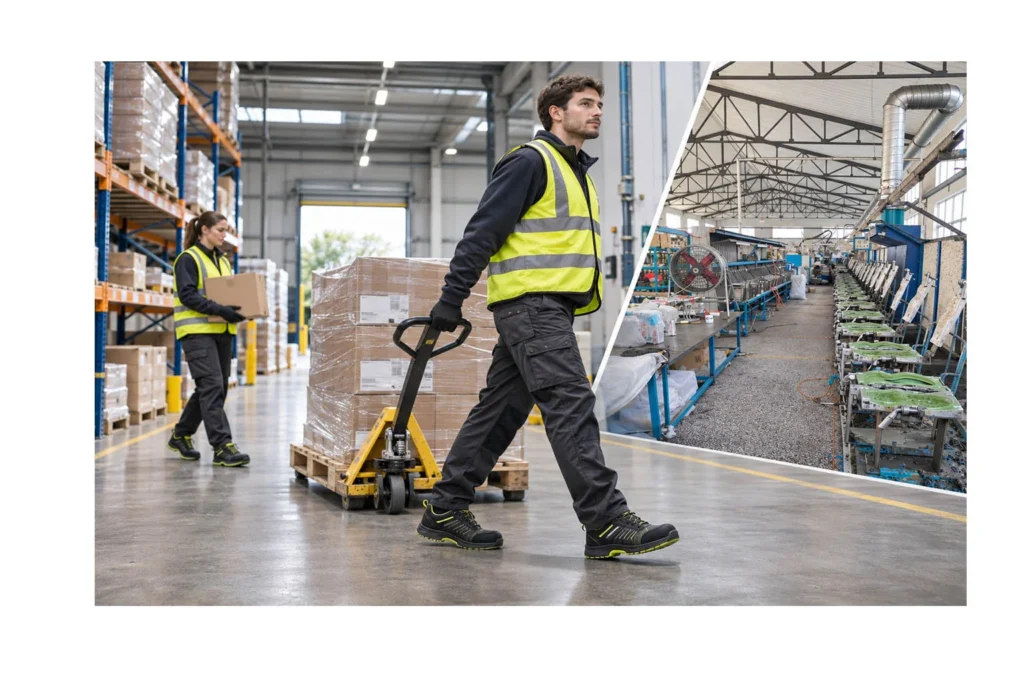
Choosing the right warehouse safety shoes Ireland businesses need involves more than selecting lightweight footwear with a protective toe cap. Warehouse and logistics operations have different workplace hazards, employee requirements, and purchasing priorities. For Irish PPE distributors, workwear wholesalers, and logistics companies, selecting suitable safety footwear requires a balance between protection, comfort, durability, compliance, and supply reliability.
Warehouse employees often spend long shifts walking on concrete floors, picking orders, moving pallets, loading vehicles, and working around forklifts and material-handling equipment. These activities create different risks from those found on construction sites or in heavy manufacturing facilities.
For businesses purchasing safety footwear in bulk, the challenge is finding products that meet workplace requirements while remaining commercially practical.
This guide examines the key considerations when sourcing safety shoes for Irish warehouse and logistics operations, including footwear specifications, EU compliance, supplier selection, wholesale purchasing, and inventory planning.
It is particularly useful for:
- Warehouse and distribution centre operators
- Logistics and transport companies
- PPE distributors and wholesalers
- Workwear retailers
- Industrial procurement managers
- Safety footwear importers
- Businesses developing private-label footwear ranges
Table of Contents
- Understand Warehouse and Logistics Footwear Requirements in Ireland
- Key Features of Safety Shoes for Warehouse Workers
- Compare Different Types of Warehouse Safety Footwear
- Check EU Safety Standards and Product Compliance
- Prioritise Comfort for Long Warehouse Shifts
- How Irish Businesses Should Evaluate Wholesale Suppliers
- Calculate Wholesale Purchasing and Import Costs
- Plan Bulk Orders and Size Distribution
- Common Mistakes When Buying Warehouse Safety Shoes
- Frequently Asked Questions
1. Understand Warehouse and Logistics Footwear Requirements in Ireland
Ireland’s warehousing and logistics sector includes distribution centres, e-commerce fulfilment facilities, transport depots, cold storage facilities, and manufacturing warehouses.
Although these workplaces share some hazards, their footwear requirements can differ considerably.
Common Warehouse Workplace Hazards
| Workplace environment | Potential hazards | Footwear considerations |
|---|---|---|
| Distribution centres | Moving pallets and falling goods | Protective toe caps |
| E-commerce warehouses | Long walking distances | Lightweight construction and cushioning |
| Loading docks | Wet floors and vehicle movement | Suitable outsole grip and toe protection |
| Cold storage | Low temperatures and condensation | Thermal comfort and appropriate traction |
| Food warehouses | Liquid contamination and frequent cleaning | Easy-clean materials and suitable slip resistance |
| Manufacturing warehouses | Sharp materials and heavy components | Penetration resistance where required |
The Irish Health and Safety Authority (HSA) identifies vehicle movement, pedestrian-vehicle interaction, loading and unloading, falls, and slips and trips as major warehousing safety issues.
This makes footwear selection an important part of a wider workplace safety programme.
However, there is no universal shoe specification that automatically suits every warehouse employee.
The correct protection should be established through the workplace risk assessment.
For more information, consult the HSA Warehousing Safety guidance.
Identify Different Employee Groups
A large warehouse may need different footwear specifications for different departments.
For example:
- Order pickers may prioritise lightweight shoes and cushioning.
- Forklift operators may require suitable toe protection and secure footwear.
- Loading dock employees may need footwear suitable for wet outdoor surfaces.
- Cold-store workers may require additional thermal protection.
- Maintenance personnel may need penetration-resistant soles.
For procurement teams, separating employees into footwear requirement groups can prevent unnecessary spending on unsuitable products.
2. Key Features of Safety Shoes for Warehouse Workers
When evaluating safety shoes for warehouse workers, Irish buyers should focus on features that address the actual working environment.
The following specifications are particularly relevant to indoor logistics and distribution operations.
Protective Toe Caps
Warehouse workers may encounter falling cartons, moving pallets, dropped equipment, and heavy materials.
Depending on the risk assessment, protective toe caps may be required.
Common options include:
Steel toe caps
- Established protective construction
- Suitable for many industrial applications
- Generally heavier than comparable composite designs
Composite toe caps
- Non-metallic construction
- Can reduce overall footwear weight
- Useful for businesses requiring metal-free footwear designs
Both types must meet the applicable protective performance requirements.
Slip-Resistant Outsoles
Warehouse floors can become slippery because of dust, packaging materials, water, oil, and other contaminants.
Outsole selection should consider:
- Floor surface
- Type of contamination
- Tread design
- Rubber compound
- Tested slip performance
- Ease of cleaning
A product advertised as slip-resistant is not automatically suitable for every warehouse floor.
The HSA recommends assessing footwear against the actual slip risks and, where practical, trialling it in the workplace.
Puncture-Resistant Midsoles
Some warehouses handle pallets, metal components, damaged packaging, and other materials that may expose workers to sharp objects.
If the risk assessment identifies underfoot penetration hazards, buyers should consider footwear with an appropriate penetration-resistant insert.
Options include metallic and non-metallic constructions.
For lighter warehouse footwear, non-metallic inserts may provide a useful balance between protection and flexibility.
Breathable Uppers
Warehouse employees may wear safety footwear for extended periods.
Breathable uppers can help manage heat and moisture during long indoor shifts.
Common materials include:
- Engineered mesh
- Knitted textile
- Microfiber
- Synthetic leather
- Leather with breathable lining systems
Material selection should also consider abrasion resistance and the likelihood of contact with workplace contaminants.
Shock Absorption and Cushioning
Concrete warehouse floors place repeated loading on workers’ feet.
Important comfort-related features include:
- Cushioned footbeds
- Heel energy absorption
- Supportive midsoles
- Flexible forefoot construction
- Appropriate shoe width
- Secure heel fit
Comfort should be evaluated through actual wear trials rather than product descriptions alone.
3. Compare Different Types of Warehouse Safety Footwear
Not every warehouse requires traditional heavy-duty work boots.
Many indoor logistics applications may be better served by lightweight industrial footwear.
| Footwear type | Main characteristics | Potential applications |
|---|---|---|
| Lightweight safety sneakers | Sport-inspired design, flexible construction | Order picking and distribution |
| Composite toe safety shoes | Non-metallic toe protection | General warehouse operations |
| Steel toe work shoes | Traditional protective construction | Heavy goods handling |
| Mid-cut safety boots | Additional upper coverage | Loading and mixed indoor-outdoor work |
| Waterproof safety boots | Protection against water ingress when properly tested | Outdoor loading and wet environments |
Lightweight Safety Sneakers
Lightweight safety sneakers are an increasingly relevant option for warehouse and logistics businesses.
They combine protective components with footwear designs inspired by athletic shoes.
Typical specifications may include:
- Mesh uppers
- Composite toe caps
- Non-metallic penetration-resistant inserts
- EVA cushioning
- Slip-resistant rubber outsoles
- Breathable linings
For workers who spend much of their shifts walking on indoor floors, this construction can be more practical than unnecessarily heavy traditional boots.
Composite Toe Safety Shoes
Composite toe models can be particularly useful for businesses looking to reduce footwear weight.
Depending on the construction, they may also support metal-free footwear requirements.
However, composite toe protection does not automatically mean that the entire shoe is metal-free. Buyers should verify all product components.
When Should Businesses Choose Safety Boots?
Higher-cut footwear may be appropriate when employees work in environments requiring additional ankle coverage, water protection, or more durable upper construction.
For example, employees moving between indoor warehouses and outdoor loading yards may need different footwear from workers performing indoor order picking.
The decision should be based on actual workplace conditions rather than boot height alone.
4. Check EU Safety Standards and Product Compliance
Safety footwear supplied to Irish businesses must meet the applicable EU personal protective equipment requirements.
This is particularly important for wholesalers, importers, and companies purchasing products directly from overseas manufacturers.
EN ISO 20345 Safety Footwear Standard
EN ISO 20345 is a key European standard for general-purpose safety footwear.
When evaluating products, buyers should check:
- Applicable standard edition
- Toe protection
- Product classification
- Penetration resistance where required
- Slip performance
- Antistatic properties where required
- Water-related protection where claimed
- Other additional protective features
Common product classifications include S1, S1P, S1PL, S1PS, S2, and S3.
The appropriate classification depends on the product construction and the hazards identified at the workplace.
For example, a dry indoor warehouse may require different protection from a warehouse handling sharp materials or operating in wet outdoor conditions.
Do not assume that every warehouse requires S3 footwear.
CE Marking and Documentation
Safety footwear covered by Regulation (EU) 2016/425 must satisfy the applicable conformity requirements.
Before purchasing bulk quantities, request:
| Document | Purpose |
|---|---|
| EU Declaration of Conformity | Identifies the manufacturer’s conformity declaration |
| EU type-examination certificate, where applicable | Evidence of the relevant conformity assessment |
| Product test reports | Supports specific performance claims |
| Technical documentation | Supports the conformity assessment |
| User instructions | Provides information about intended use and limitations |
| Product identification | Identifies the manufacturer and model |
Documentation should correspond to the exact footwear model being purchased.
For official information, consult:
Irish importers should also understand their legal responsibilities when sourcing safety footwear from manufacturers outside the European Union.
5. Prioritise Comfort for Long Warehouse Shifts
Comfort is an important purchasing consideration for warehouse and logistics businesses.
Employees may spend most of their working day standing, walking, pushing equipment, and moving between storage locations.
Footwear that feels uncomfortable can affect employee acceptance and consistent use.
Lightweight Construction
Reducing unnecessary footwear weight can be useful for employees who walk long distances.
Potential design options include:
- Composite toe caps
- Lightweight textile uppers
- Non-metallic protective midsoles
- Lightweight cushioning systems
- Flexible outsole constructions
However, weight reduction must not compromise the protection required by the workplace.
Correct Fit and Size Availability
Poorly fitting safety shoes can create pressure points, heel movement, and discomfort.
Buyers should evaluate:
- Toe box space
- Heel retention
- Foot width
- Arch and footbed support
- Size consistency
- Available size range
Where possible, arrange wear trials with employees representing different foot shapes.
Breathability and Moisture Management
Breathable linings and suitable upper materials can improve comfort in indoor environments.
For warehouses with temperature-controlled areas, consider the difference between ordinary indoor footwear and products intended for cold storage.
Trial Products Before Bulk Purchasing
A useful procurement process is to test several shortlisted models with a small group of employees.
Collect feedback on:
- Comfort after several hours
- Weight
- Flexibility
- Slip performance
- Fit
- Durability
- Ease of cleaning
This helps businesses avoid selecting products based entirely on catalogue specifications.
6. How Irish Businesses Should Evaluate Wholesale Suppliers
For PPE distributors, workwear retailers, and logistics companies, supplier reliability is as important as product quality.
A suitable supplier should be able to provide consistent specifications, relevant documentation, competitive pricing, and reliable delivery.
Local Distributors vs Direct Manufacturers
Irish buyers generally have several sourcing options.
| Purchasing factor | Irish distributor | Overseas manufacturer |
|---|---|---|
| Delivery | Often faster for stocked products | Requires international shipping |
| MOQ | May support smaller orders | Depends on production requirements |
| Customisation | Usually limited | Often offers OEM/ODM options |
| Product selection | Depends on available brands | May offer factory-developed models |
| Unit price | Includes distribution costs | May offer factory-direct pricing |
| Technical support | Local contact may be available | Depends on export support |
Neither sourcing method is automatically better.
Local distributors may be more practical for urgent replenishment, while direct manufacturing may be worth considering for regular bulk purchases and private-label development.
Questions to Ask a Potential Supplier
Before placing an order, establish:
- Do you specialise in industrial safety footwear?
- Which warehouse safety shoe models do you offer?
- Can you provide product-specific EU conformity documents?
- What are your MOQ requirements?
- Can you supply mixed sizes?
- Do you offer composite toe and lightweight models?
- What is your normal delivery lead time?
- Can you support repeat orders?
- Do you provide OEM and private-label services?
- How do you handle quality complaints?
Evaluate Manufacturing and Quality Control
For direct factory purchasing, request information about:
- Production facilities
- Material inspection
- Upper stitching
- Sole attachment
- Finished-product inspection
- Size consistency
- Packaging
- Pre-shipment inspection
For larger orders, consider independent quality inspections before shipment.
7. Calculate Wholesale Purchasing and Import Costs
When sourcing warehouse safety shoes Ireland businesses intend to purchase in bulk, the factory price is only one part of the overall purchasing cost.
Importers should calculate the complete landed cost before setting wholesale selling prices.
Main Cost Components
| Cost item | What to consider |
|---|---|
| Factory price | Product manufacturing cost |
| Sampling | Product evaluation and approval |
| Customisation | Logo and packaging expenses |
| Freight | International shipping |
| Insurance | Cargo insurance |
| Customs duty | Depends on tariff classification and origin |
| Import VAT | Applicable Irish VAT treatment |
| Clearance | Customs and handling expenses |
| Local transport | Delivery to warehouse |
| Inspection | Quality verification costs |
Example of Wholesale Cost Calculation
Consider an illustrative order of 1,000 pairs of warehouse safety shoes.
| Cost component | Example |
|---|---|
| Factory price: 1,000 × €18 | €18,000 |
| International freight | €1,400 |
| Insurance and handling | €200 |
| Customs clearance and local transport | €500 |
| Total before applicable customs duty and VAT | €20,100 |
| Cost per pair before those additional charges | €20.10 |
Actual costs depend on shipping terms, customs classification, origin, tax treatment, and shipment arrangements.
For more information, consult Irish Revenue – Importing Goods.
8. Plan Bulk Orders and Size Distribution
For wholesalers and large logistics companies, size distribution can influence inventory costs and product availability.
Ordering the correct total quantity is not enough. Buyers must also ensure that the size assortment reflects employee requirements.
Establish Your Size Requirements
Before confirming a bulk order, collect information about:
- Number of employees
- Required footwear models
- European size range
- Available widths
- Replacement frequency
- Expected new employee requirements
Consider a Phased Purchasing Strategy
For businesses introducing a new footwear model, a phased approach may reduce purchasing risk.
| Stage | Purchasing activity | Objective |
|---|---|---|
| Stage 1 | Sample evaluation | Check fit and specifications |
| Stage 2 | Small initial order | Test employee acceptance |
| Stage 3 | Larger wholesale order | Establish regular supply |
| Stage 4 | Repeat purchasing | Maintain stock availability |
This approach is particularly useful when introducing a new private-label model.
Maintain Consistent Product Specifications
For repeat orders, retain the approved sample and product specification sheet.
Confirm that future production uses the agreed materials, protective components, colours, and construction.
This helps reduce differences between the original sample and subsequent deliveries.
9. Common Mistakes When Buying Warehouse Safety Shoes
Choosing Products Based Only on Appearance
Sport-inspired safety sneakers may look comfortable, but appearance does not demonstrate protective performance.
Check the certification and product specifications.
Assuming All Warehouse Employees Need the Same Shoe
Order pickers, forklift operators, loading dock employees, and cold-store workers may face different hazards.
Develop footwear specifications according to the individual work areas.
Ignoring Slip Resistance
A product labelled slip-resistant may not perform equally well on every surface or contaminant.
Evaluate the outsole for the actual workplace environment.
Buying Without Employee Trials
A product may meet the required technical specifications but still have unsuitable fit or comfort.
Collect wearer feedback before committing to a large order.
Ignoring Repeat Supply Capability
For logistics companies and distributors, inconsistent product availability can create unnecessary purchasing problems.
Confirm the supplier’s ability to maintain specifications and support replenishment.
Overlooking Import Responsibilities
When purchasing from overseas manufacturers, ensure that the required conformity documentation, customs arrangements, and importer obligations are addressed.
10. Frequently Asked Questions
What Are the Best Safety Shoes for Warehouse Workers in Ireland?
The best model depends on the warehouse risk assessment. Lightweight safety sneakers with protective toe caps, suitable slip-resistant outsoles, cushioning, and breathable uppers may suit many indoor logistics environments. Additional protection may be required for specific hazards.
Are Lightweight Safety Shoes Suitable for Warehouse Work?
Yes. Lightweight safety shoes can be suitable for many warehouse applications, particularly where employees walk long distances on indoor floors. However, they must provide the protective features identified by the workplace risk assessment.
What Safety Standard Should Warehouse Safety Shoes Meet in Ireland?
Safety footwear placed on the Irish market must comply with applicable EU PPE requirements. EN ISO 20345 is an important standard for general-purpose safety footwear. Buyers should verify the applicable classification and product-specific documentation.
Do All Warehouse Workers Need Steel Toe Safety Shoes?
No. The appropriate toe protection depends on the workplace hazards. Steel and composite toe footwear can both provide certified protection. The choice should reflect the product specification, working environment, and employee requirements.
Are Composite Toe Safety Shoes Better for Logistics Workers?
Composite toe footwear can offer a lighter, non-metallic alternative to steel toe designs. It may be attractive for employees who walk for extended periods, but overall shoe weight, fit, cushioning, and outsole performance should also be evaluated.
What Is the Difference Between S1 and S3 Safety Shoes?
S1 footwear provides basic protective features for general-purpose safety footwear, while S3 footwear includes additional protection such as penetration resistance and water-related upper requirements under the applicable standard classification. The exact classification should be checked against the current standard and product documentation.
Can Irish Businesses Buy Warehouse Safety Shoes Directly From China?
Yes. Irish importers can purchase directly from Chinese manufacturers. They must ensure the products meet applicable EU PPE requirements and fulfil their importer responsibilities, including checking conformity documentation and customs arrangements.
What Should PPE Distributors Check Before Buying Bulk Safety Shoes?
Distributors should compare product specifications, certification documents, samples, MOQ, size assortment, wholesale pricing, production capacity, delivery schedules, and after-sales support.
Can Warehouse Safety Shoes Be Customised With a Private Label?
Yes. Manufacturers offering OEM and ODM services may support custom logos, packaging, materials, and product development. The final product must remain compliant with applicable EU PPE requirements.
Conclusion
Choosing the right warehouse safety shoes Ireland businesses need requires a balance between workplace protection, employee comfort, product quality, and purchasing efficiency.
For warehouse operators, logistics companies, and PPE distributors, the most important considerations include:
- Understanding different warehouse hazards
- Selecting suitable protective footwear categories
- Checking EU PPE compliance and documentation
- Prioritising fit, comfort, and slip resistance
- Evaluating suppliers and manufacturing capabilities
- Comparing wholesale prices and landed costs
- Planning size distribution and repeat orders
For businesses purchasing footwear in bulk, the best commercial decision is not necessarily the cheapest product. It is the product that provides suitable protection, consistent quality, employee acceptance, and reliable long-term supply.
Source Warehouse Safety Shoes From Ocean Safety Shoes
Ocean Safety Shoes is a professional safety footwear manufacturer serving international B2B customers, including PPE distributors, wholesalers, importers, workwear retailers, and industrial businesses.
We provide manufacturing and product development solutions covering:
- OEM safety footwear manufacturing
- ODM product development
- Lightweight safety shoes
- Composite toe safety sneakers
- Industrial safety boots
- Custom logos and packaging
- Private-label safety footwear
Our product range includes different styles designed for industrial, warehouse, logistics, and other workplace applications.
Explore the Ocean Safety Shoes product range to review available models and manufacturing options.
For Irish distributors and logistics businesses considering direct manufacturing, provide the following information when requesting a quotation:
- Required footwear categories
- Intended warehouse applications
- Required safety standards
- Preferred toe cap and midsole specifications
- Estimated order quantities
- Size assortment
- Branding and packaging requirements
- Expected delivery schedule
This information helps us understand your requirements and discuss suitable products, samples, and manufacturing arrangements.
Looking for a reliable warehouse safety shoes manufacturer for the Irish market?
Contact Ocean Safety Shoes to discuss wholesale orders, product samples, and OEM or private-label manufacturing opportunities.