
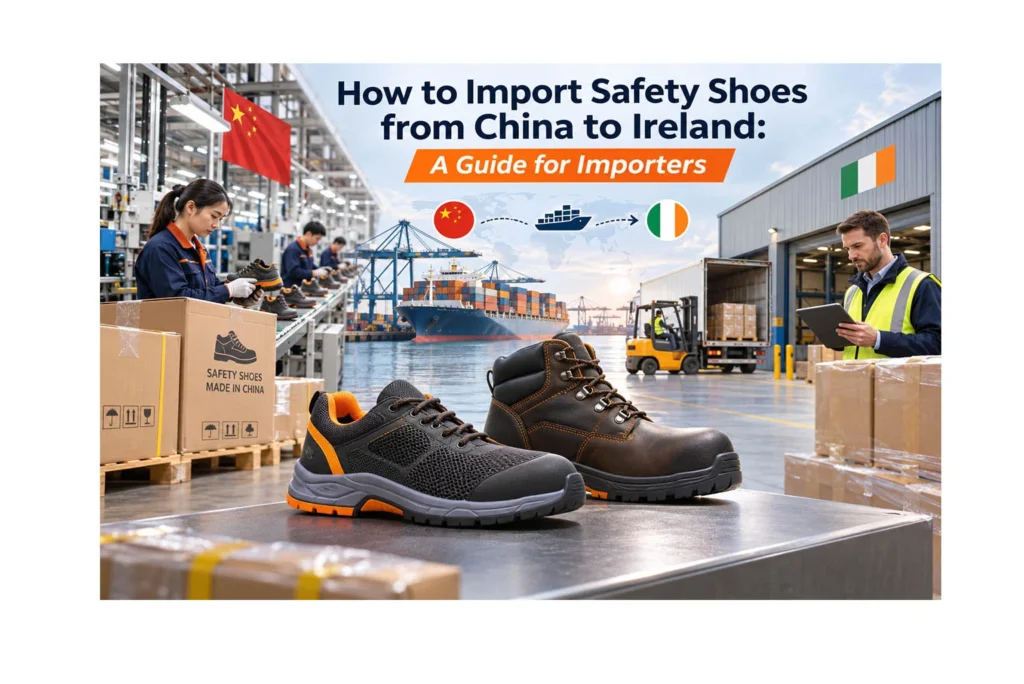
Importing safety shoes from China to Ireland can offer significant opportunities for PPE distributors, workwear wholesalers, industrial suppliers, and private-label brands looking for competitive manufacturing costs and a wider product selection.
China has an established safety footwear manufacturing industry, offering products ranging from steel toe work boots and composite toe safety sneakers to waterproof industrial footwear and specialist protective shoes.
However, importing safety footwear into Ireland involves more than finding a manufacturer and arranging international shipping. Buyers must understand EU product compliance, customs classification, import duties, VAT, shipping arrangements, quality inspections, and importer responsibilities.
For Irish businesses, overlooking any of these areas can result in unexpected costs, customs delays, or products that cannot legally be placed on the EU market.
This guide explains how to import safety shoes from China to Ireland, from selecting a suitable manufacturer to receiving goods at your Irish warehouse. It is designed for B2B buyers who want to establish reliable and commercially sustainable sourcing arrangements.
Who should read this guide?
- Irish safety footwear importers
- PPE distributors and wholesalers
- Workwear retailers
- Industrial equipment suppliers
- Construction and manufacturing procurement teams
- Private-label footwear brands
- Businesses planning bulk safety footwear purchases
Table of Contents
- Why Import Safety Shoes from China to Ireland?
- Find a Reliable Safety Shoes Manufacturer in China
- Choose the Right Safety Footwear Products
- Understand EU Safety Footwear Compliance Requirements
- Prepare the Documents Required for Importing
- Understand Irish Customs Clearance and EORI Requirements
- Check Customs Codes, Import Duty and VAT
- Choose the Right Shipping Method from China to Ireland
- Calculate the Total Landed Cost
- Control Quality Before Shipment
- Common Importing Mistakes to Avoid
- Step-by-Step Importing Checklist
- Frequently Asked Questions
1. Why Import Safety Shoes from China to Ireland?
For Irish businesses purchasing safety footwear in commercial quantities, China can be an attractive sourcing destination.
Chinese manufacturers offer different product categories, production capabilities, and customisation options to meet the requirements of international buyers.
Competitive Manufacturing Costs
Factory-direct purchasing may provide opportunities to reduce sourcing costs, particularly when ordering established product models in larger quantities.
However, buyers should compare the complete landed cost rather than evaluating manufacturers solely on their quoted unit prices.
Wide Product Selection
Chinese safety footwear factories can manufacture a broad range of products, including:
- Steel toe safety shoes
- Composite toe safety sneakers
- Lightweight industrial work shoes
- Waterproof safety boots
- Heavy-duty construction boots
- Puncture-resistant safety footwear
- Industrial gumboots
- Specialist protective footwear
This variety allows Irish distributors to develop product ranges for different industries.
OEM and Private-Label Manufacturing
Another advantage is the opportunity to develop products under your own brand.
Depending on the manufacturer’s capabilities, customisation may include:
- Custom logos
- Upper material selection
- Colour combinations
- Outsole designs
- Product specifications
- Branded shoe boxes
- Custom packaging
For Irish PPE distributors and workwear retailers, private-label manufacturing can create opportunities to differentiate their product offerings.
Flexible Product Development
Manufacturers offering OEM and ODM services may support buyers from initial product selection through sampling and mass production.
This can be useful for businesses looking to develop specialised safety footwear for construction, warehousing, agriculture, and industrial applications.
2. Find a Reliable Safety Shoes Manufacturer in China
Selecting the right manufacturing partner is one of the most important steps when importing safety footwear.
Not every supplier advertising safety shoes is an actual manufacturer. Some businesses operate as trading companies or sourcing agents.
Both business models can serve different purchasing needs, but buyers should understand exactly who will manufacture and control their products.
Verify the Manufacturer’s Business Information
Before discussing a large order, request:
- Registered company name
- Business registration information
- Factory address
- Product catalogue
- Main manufacturing categories
- Export experience
- Production capacity
- OEM and ODM capabilities
If the supplier claims to own a factory, ask for a factory video tour or arrange an independent inspection.
Evaluate Manufacturing Capabilities
A professional safety footwear factory should be able to explain its production processes.
Check whether it has relevant capabilities covering:
- Upper material cutting
- Stitching and assembly
- Lasting
- Sole injection or attachment
- Product finishing
- Finished-product inspection
- Packaging
Also ask which production processes are outsourced.
Check Export Experience
Experience supplying international markets can help a manufacturer understand product specifications, documentation, packaging, and shipping requirements.
Ask whether the supplier has previously worked with European importers and whether it can support the documentation required for products placed on the EU market.
Questions to Ask Before Choosing a Manufacturer
| Question | Why it matters |
|---|---|
| Are you a manufacturer or trading company? | Clarifies the supply chain |
| Which safety footwear models do you produce? | Confirms product suitability |
| Do you support OEM and ODM? | Establishes customisation options |
| What is your MOQ? | Helps with purchasing planning |
| Can you provide EU conformity documentation? | Supports compliance verification |
| What is your production capacity? | Helps assess order capability |
| What are your quality control procedures? | Evaluates production consistency |
| What is your normal lead time? | Supports inventory planning |
Compare at least several suitable suppliers before committing to a long-term purchasing relationship.
3. Choose the Right Safety Footwear Products
Before requesting quotations, define the products you want to import.
The Irish market includes different industries, and their safety footwear requirements can vary.
Safety Shoes for Construction
Construction customers may require:
- Protective toe caps
- Penetration-resistant midsoles
- Durable upper materials
- Suitable outsole grip
- Abrasion resistance
- Additional protection based on workplace hazards
Heavy-duty safety boots and protective mid-cut shoes are common categories to investigate.
Lightweight Safety Shoes for Warehousing
Warehouse and logistics businesses may prefer footwear with:
- Composite toe caps
- Lightweight construction
- Breathable mesh uppers
- Cushioned footbeds
- Slip-resistant outsoles
- Comfortable internal lining
These products can be suitable for employees who spend long periods walking and standing, provided they meet the workplace risk assessment requirements.
Waterproof Safety Boots for Agriculture
Agricultural and outdoor workers may need:
- Waterproof construction
- Durable uppers
- Suitable outsole traction
- Protective toe caps
- Resistance to relevant workplace conditions
Rubber safety boots and waterproof leather work boots can be considered for different applications.
Select Products According to Customer Demand
For new importers, starting with a focused product range can reduce inventory risks.
| Product category | Potential Irish customers |
|---|---|
| Steel toe safety shoes | Construction and industrial distributors |
| Composite toe sneakers | Warehouses and logistics companies |
| Waterproof safety boots | Agriculture and outdoor work suppliers |
| Heavy-duty work boots | Construction and engineering businesses |
| Industrial gumboots | Food processing and agricultural suppliers |
Before finalising the product range, confirm the protective specifications required by the intended end users.
4. Understand EU Safety Footwear Compliance Requirements
This is one of the most important parts of importing safety shoes from China to Ireland.
Ireland is an EU member state, so safety footwear placed on the Irish market must comply with applicable European personal protective equipment legislation.
Understand Regulation (EU) 2016/425
Regulation (EU) 2016/425 governs the design, manufacture, and marketing of personal protective equipment.
Safety footwear covered by this regulation must satisfy the applicable essential health and safety requirements and undergo the appropriate conformity assessment.
The regulation establishes responsibilities for manufacturers, importers, and distributors.
Official information is available from the European Commission – Personal Protective Equipment.
Check EN ISO 20345
EN ISO 20345 is an important European standard for general-purpose safety footwear.
When evaluating Chinese safety footwear, ask the manufacturer which standard edition and product classification apply.
Check the relevant specifications, including:
- Protective toe cap performance
- Penetration resistance, where required
- Slip resistance
- Water-related protection
- Antistatic properties, where required
- Additional protective features
Different safety shoe classifications provide different levels and combinations of protection.
Do not assume that every product in a manufacturer’s catalogue meets the same requirements.
Verify CE Marking
Safety footwear covered by the PPE Regulation must carry the appropriate CE marking after the required conformity assessment has been completed.
However, a CE logo on a product or shoe box is not sufficient evidence of compliance.
Buyers should verify the supporting documentation and ensure that it corresponds to the exact product being imported.
Documents to Request From the Manufacturer
| Document | Purpose |
|---|---|
| EU Declaration of Conformity | Identifies the manufacturer’s conformity declaration |
| EU type-examination certificate, where applicable | Evidence of the relevant conformity assessment |
| Product test reports | Supports specific performance claims |
| Technical documentation | Provides supporting conformity information |
| User instructions | Explains intended use, limitations, and maintenance |
| Product identification | Identifies the manufacturer and model |
Check the product model, applicable standard, certificate information, and issuing organisation.
Where necessary, verify the notified body’s details through the EU NANDO database.
Understand Your Responsibilities as an Irish Importer
Under Article 10 of Regulation (EU) 2016/425, importers must place only compliant PPE on the EU market.
Before placing safety footwear on the market, importers must verify that:
- The manufacturer has completed the appropriate conformity assessment.
- Technical documentation has been prepared.
- The product carries the CE marking.
- Required documents accompany the product.
- Manufacturer identification requirements have been fulfilled.
Importers must also provide their own name, registered trade name or trademark, and contact postal address on the product, packaging, or accompanying documentation, as permitted by the regulation.
If an importer sells PPE under its own name or trademark, it may assume manufacturer responsibilities.
This is particularly important for businesses developing private-label safety footwear.
Read the official Regulation (EU) 2016/425 before launching an imported product range.
5. Prepare the Documents Required for Importing
Importing safety footwear from China involves both commercial shipping documents and product compliance documentation.
These serve different purposes and should not be confused.
Commercial and Shipping Documents
Common documents include:
| Document | Purpose |
|---|---|
| Commercial Invoice | Records the seller, buyer, product description, quantity, and transaction value |
| Packing List | Identifies carton quantities, weights, and packaging details |
| Bill of Lading | Transport document for sea freight |
| Air Waybill | Transport document for air freight |
| Certificate of Origin | Provides origin information where required |
| Insurance Certificate | Evidence of cargo insurance, if applicable |
| Customs Declaration | Provides information for import clearance |
The exact documents required depend on the shipment, transport method, and customs arrangements.
Product Compliance Documents
For safety footwear, maintain a separate compliance file containing:
- EU Declaration of Conformity
- Relevant EU type-examination documentation
- Applicable test reports
- Technical product specifications
- User instructions
- Product identification and labelling information
A commercial invoice does not prove that a safety shoe complies with EU PPE requirements.
Check Document Consistency
Before shipment, compare the following information across your documents:
- Product model
- Product description
- Quantity
- Carton count
- Gross weight
- Net weight
- Country of origin
- Manufacturer information
- Invoice value
- Shipping terms
Differences between the commercial invoice, packing list, and transport documents can create unnecessary customs delays.
6. Understand Irish Customs Clearance and EORI Requirements
Irish businesses importing safety footwear from China must complete the relevant customs formalities.
Obtain an EORI Number
An Economic Operators Registration and Identification (EORI) number is required for businesses conducting customs activities involving goods moving into or out of the EU.
An EORI number issued by an EU Member State is generally valid throughout the EU.
Irish businesses can apply through Revenue’s online services.
Before applying, check the registration requirements, including the Eircode requirement for Irish business addresses.
Official guidance:
Irish Revenue – EORI Registration
Submit an Import Customs Declaration
Commercial imports from China require an import declaration.
In Ireland, customs import declarations are submitted electronically through Revenue’s Automated Import System (AIS), either by the importer or an authorised customs representative.
Many importers appoint a customs broker or freight forwarder to handle this process.
However, appointing an agent does not automatically remove the importer’s legal responsibilities.
Understand Customs Clearance Requirements
Before the shipment arrives, establish:
- Which party will submit the declaration
- Whether the importer has a valid EORI
- Which commodity code will be used
- What customs value will be declared
- Whether customs duty applies
- How import VAT will be handled
- Which documents the customs broker requires
Irish Revenue’s New to Customs guide provides a useful starting point.
Understand ICS2 and Advance Cargo Information
The EU’s Import Control System 2 (ICS2) is used to collect advance cargo information for security and risk analysis.
As of 2026, ICS2 is operational for all transport modes.
For imports from China, the relevant carrier or supply-chain operator must ensure that the required Entry Summary Declaration (ENS) information is submitted before arrival.
Irish importers should confirm with their freight forwarder who is responsible for providing and submitting the necessary cargo information.
Official guidance:
Irish Revenue – Import Control System 2
7. Check Customs Codes, Import Duty and VAT
Import duty is an important part of the cost of sourcing safety footwear from China.
However, there is no single customs code or duty rate that applies to every safety shoe.
Identify the Correct Commodity Code
Footwear is generally classified under Chapter 64 of the EU Combined Nomenclature.
The correct classification depends on several product characteristics, including:
- Upper material
- Outer sole material
- Whether the footwear covers the ankle
- Protective toe cap construction
- Product design
- Other relevant classification characteristics
For example, leather-upper safety shoes with protective metal toe caps may fall under a different classification from textile-upper safety sneakers or certain waterproof rubber boots.
Do not automatically use one commodity code for every model.
Use TARIC to Check Import Duty
The EU’s TARIC database provides information about customs duties, trade measures, and other import requirements.
Before confirming your order:
- Establish the likely commodity code.
- Select China as the country of origin.
- Select Ireland as the destination.
- Check the applicable third-country duty.
- Review any additional measures or requirements.
- Confirm the information with your customs broker.
Useful official resources:
If the correct classification is uncertain, consider applying for Binding Tariff Information (BTI). A BTI decision provides legal certainty about the classification of the goods covered by the decision, subject to its validity and conditions.
Understand Import VAT
Import VAT is generally payable when goods enter Ireland from outside the EU.
The applicable VAT treatment should be confirmed according to the product, transaction, and importer’s VAT status.
For VAT-registered businesses, import VAT accounting arrangements may affect how the tax is reported and recovered, subject to the applicable rules.
Do not treat import VAT as automatically recoverable without checking your business’s eligibility.
Calculate the Customs Value Correctly
The customs value is used to determine the customs duty payable.
It is generally based on the transaction value, adjusted as required under EU customs valuation rules.
Depending on the transaction and shipping arrangements, relevant costs may include:
- Product price
- Transport to the EU entry point
- Insurance
- Certain commissions and other additions required by customs valuation rules
Work with your customs broker to confirm the correct declared value.
8. Choose the Right Shipping Method from China to Ireland
Shipping arrangements can significantly affect the total landed cost and delivery schedule.
The most appropriate method depends on order quantity, shipment urgency, product value, and available budget.
Sea Freight
Sea freight is commonly worth considering for larger safety footwear shipments.
Advantages include:
- Suitable for larger commercial orders
- Generally lower transportation cost per unit for substantial shipments
- Options for full container load (FCL) and less than container load (LCL)
Potential disadvantages include:
- Longer transit times
- Port handling and destination charges
- More complicated coordination between transport and customs clearance
FCL may be suitable for larger orders, while LCL allows smaller shipments to share container space.
Air Freight
Air freight can be useful when:
- Samples are required urgently
- A small quantity needs replenishment
- Delivery speed is more important than freight cost
However, air freight is generally more expensive for large quantities of safety shoes.
Express Courier
Express courier services are suitable for product samples and small shipments.
They can simplify delivery arrangements but are generally not the most economical option for regular bulk purchasing.
Compare Shipping Methods
| Shipping method | Best suited for | Main consideration |
|---|---|---|
| Sea freight FCL | Large wholesale orders | Container utilisation |
| Sea freight LCL | Smaller bulk shipments | Consolidation and handling charges |
| Air freight | Urgent commercial shipments | Higher freight cost |
| Express courier | Samples and small parcels | Cost per unit |
Always request a quotation showing the origin charges, freight, destination charges, customs clearance, and final delivery costs separately.
Understand Incoterms
The shipping term determines how costs, responsibilities, and risks are divided between the seller and buyer.
Common options include:
| Incoterm | General meaning | Buyer consideration |
|---|---|---|
| EXW | Goods made available at the seller’s premises | Buyer arranges most transport and export logistics |
| FOB | Seller delivers goods on board at the named port | Buyer arranges main carriage and subsequent costs |
| CIF | Seller pays cost, insurance, and freight to the named destination port | Risk transfers under the Incoterm rules when goods are loaded on board |
| DAP | Seller arranges delivery to the named destination | Buyer generally handles import clearance and duties |
| DDP | Seller takes responsibility for delivery with import clearance and duties | Confirm that the seller can legally and practically fulfil the import obligations |
For new Irish importers, it is important to understand exactly what a quotation includes.
A low CIF quotation, for example, does not automatically include all destination port charges, Irish import VAT, customs clearance, and warehouse delivery.
9. Calculate the Total Landed Cost
One of the most common mistakes made by new importers is evaluating safety footwear based only on the factory quotation.
The actual purchasing cost includes several additional expenses.
Main Landed Cost Components
| Cost category | Examples |
|---|---|
| Manufacturing | Factory price and product specifications |
| Sampling | Sample development and courier |
| Branding | Logos, labels, and packaging |
| International freight | Sea or air transportation |
| Insurance | Cargo insurance |
| Customs duty | Based on the correct tariff classification |
| Import VAT | Applicable Irish VAT treatment |
| Customs clearance | Broker and handling charges |
| Local transportation | Delivery to your warehouse |
| Inspection | Independent quality inspection |
Example of Import Cost Calculation
Consider an illustrative order of 1,000 pairs of safety shoes.
| Cost component | Example |
|---|---|
| Factory price: 1,000 × €18 | €18,000 |
| International freight | €1,500 |
| Insurance and handling | €250 |
| Customs clearance and local delivery | €600 |
| Total before applicable customs duty and VAT | €20,350 |
| Cost per pair before those additional charges | €20.35 |
This example is for budgeting illustration only. It is not a quotation or a statement of the actual customs duty for a specific footwear model.
Your final landed cost will depend on the commodity code, origin, freight arrangements, customs value, and applicable taxes.
For wholesalers, this calculation should be completed before establishing the resale price.
10. Control Quality Before Shipment
A successful import transaction depends on receiving products that match the agreed specifications.
Even if a manufacturer provides attractive samples, buyers should verify that mass production follows the same requirements.
Request Product Samples
Before approving a bulk order, request samples and inspect:
- Upper material
- Toe cap construction
- Midsole specifications
- Outsole attachment
- Stitching
- Lining
- Footbed
- Size and fit
- Product finishing
- Packaging
Compare samples with the product documentation and agreed specifications.
Approve a Detailed Product Specification Sheet
The specification sheet should identify:
| Component | Information to confirm |
|---|---|
| Upper | Material, thickness, and colour |
| Lining | Material and construction |
| Footbed | Material and design |
| Outsole | Material, tread, and construction |
| Toe cap | Steel or composite specification |
| Midsole | Material and protection requirements |
| Standard | Applicable product classification |
| Branding | Logo placement and method |
| Packaging | Box, label, and carton details |
Retain an approved reference sample for future comparison.
Arrange Pre-Shipment Inspection
For larger orders, consider appointing an independent inspection company.
A pre-shipment inspection can check:
- Total quantities
- Size assortment
- Workmanship
- Product appearance
- Packaging
- Labelling
- Carton condition
- Compliance with the approved specifications
Remember that a visual inspection cannot replace laboratory testing or the required conformity assessment for safety-critical properties.
11. Common Importing Mistakes to Avoid
Choosing a Manufacturer Based Only on Price
The cheapest supplier may not provide the required product quality, manufacturing consistency, or documentation.
Compare complete specifications and samples before making a decision.
Using Incorrect Customs Codes
Different safety shoe constructions may fall under different tariff classifications.
An incorrect commodity code can result in incorrect duty payments and customs problems.
Obtain professional classification advice where necessary.
Assuming CE Marking Alone Is Enough
CE marking should be supported by the appropriate conformity assessment and documentation.
Always verify the exact model and its supporting documents.
Ignoring Importer Responsibilities
An Irish importer has legal obligations under EU PPE legislation.
Do not assume that the overseas manufacturer takes responsibility for every requirement associated with placing products on the Irish market.
Underestimating Destination Charges
Freight quotations may exclude port handling, customs clearance, local transportation, and other charges.
Request a complete cost breakdown.
Skipping Pre-Shipment Inspection
A problem discovered after goods arrive in Ireland can be more expensive and difficult to resolve.
Establish quality inspection arrangements before production begins.
Failing to Plan Repeat Orders
For wholesale businesses, a reliable supplier must be capable of maintaining product specifications and supporting future replenishment.
Discuss production capacity and repeat-order arrangements early.
12. Step-by-Step Importing Checklist
Use this checklist when planning to import safety shoes from China to Ireland.
Before placing an order
- Identify your target Irish customer groups.
- Select suitable safety footwear categories.
- Shortlist Chinese manufacturers.
- Verify factory information and production capabilities.
- Request product catalogues and samples.
- Confirm applicable EU safety standards.
- Verify product-specific conformity documentation.
- Agree on product specifications.
- Confirm MOQ and wholesale prices.
- Calculate estimated landed costs.
Before shipment
- Approve the final production sample.
- Confirm the correct customs classification.
- Check applicable customs duties and import VAT.
- Obtain or verify your EORI registration.
- Confirm Incoterms and shipping arrangements.
- Prepare the commercial invoice.
- Prepare the packing list.
- Confirm transport documentation.
- Arrange pre-shipment inspection.
- Confirm ICS2 and ENS filing responsibilities with the carrier or forwarder.
When goods arrive in Ireland
- Ensure the import declaration is submitted.
- Confirm customs duty and VAT arrangements.
- Complete customs clearance.
- Arrange final delivery.
- Inspect the received shipment.
- Retain customs and product compliance records.
Following this process can help importers reduce unnecessary delays and establish a more reliable sourcing system.
13. Frequently Asked Questions
Can I Import Safety Shoes Directly From China to Ireland?
Yes. Irish businesses can purchase safety footwear directly from Chinese manufacturers. However, the products must comply with applicable EU PPE requirements, and the importer must fulfil relevant customs and regulatory responsibilities.
What Are the Safety Shoes Import Requirements in Ireland?
Importers generally need an EORI number, an appropriate customs declaration, correct commodity classification, commercial shipping documents, and arrangements for applicable customs duties and VAT. Safety footwear must also meet applicable EU PPE conformity requirements before being placed on the market.
Do Safety Shoes Imported From China Need CE Marking?
Yes. Safety footwear covered by Regulation (EU) 2016/425 must undergo the applicable conformity assessment and carry the appropriate CE marking before being placed on the EU market.
What Documents Are Required to Import Safety Shoes From China?
Common commercial documents include a commercial invoice, packing list, bill of lading or air waybill, and customs declaration information. Depending on the shipment, a certificate of origin or other documents may also be required.
Product compliance documents should be maintained separately, including the EU Declaration of Conformity, relevant certificates, test reports, and technical product information.
Do I Need an EORI Number to Import Safety Footwear Into Ireland?
Yes. Businesses importing goods from outside the EU generally need an EORI number to complete customs formalities. Irish businesses can register through Revenue’s online services.
How Much Is the Import Duty on Safety Shoes From China?
There is no single duty rate for all safety footwear. The applicable rate depends on the correct customs classification, materials, product construction, and current tariff measures. Check the EU TARIC database before importing.
What Is the Best Shipping Method for Safety Shoes From China to Ireland?
Sea freight is generally worth considering for larger wholesale orders. Air freight may be suitable for urgent shipments, while express courier is more practical for samples and small quantities.
How Long Does Shipping Safety Shoes From China to Ireland Take?
Delivery time depends on the factory’s production schedule, shipping method, route, consolidation arrangements, customs clearance, and final delivery. Ask your forwarder for a shipment-specific estimate rather than relying on a general transit-time figure.
Can I Import Private-Label Safety Shoes From China to Ireland?
Yes. Chinese manufacturers can provide OEM and private-label safety footwear. However, if you place PPE on the EU market under your own name or trademark, you may assume manufacturer responsibilities under Regulation (EU) 2016/425.
Should I Use a Customs Broker When Importing Safety Shoes?
A customs broker can help with commodity classification, customs declarations, documentation, and import clearance. This is particularly useful for first-time importers. The importer should still understand the declaration and fulfil its own legal obligations.
Conclusion
Importing safety shoes from China to Ireland can provide opportunities for PPE distributors, wholesalers, workwear retailers, and private-label brands seeking competitive manufacturing and product development options.
However, a successful import operation requires careful preparation across several areas:
- Selecting a reliable Chinese manufacturer
- Choosing products suitable for Irish customer requirements
- Verifying EU PPE compliance
- Preparing commercial and product documentation
- Obtaining the correct EORI registration
- Confirming customs classification and import charges
- Choosing suitable shipping arrangements
- Calculating total landed costs
- Inspecting products before shipment
The most effective sourcing strategy is not simply to find the lowest factory price. It is to establish a supply relationship that combines appropriate product quality, verified compliance, predictable costs, and reliable manufacturing support.
Source Safety Shoes From China With Ocean Safety Shoes
Ocean Safety Shoes is a professional safety footwear manufacturer serving international B2B buyers, including importers, distributors, wholesalers, PPE suppliers, and private-label brands.
We provide manufacturing and product development solutions covering:
- OEM safety footwear manufacturing
- ODM product development
- Private-label safety shoes
- Custom logos and packaging
- Product specification development
- Wholesale manufacturing support
Our product range includes steel toe safety shoes, composite toe sneakers, lightweight industrial footwear, waterproof safety boots, and other protective footwear styles.
Explore the Ocean Safety Shoes product range to review available models and manufacturing options.
For Irish importers considering direct factory sourcing, provide the following information when requesting a quotation:
- Required footwear categories
- Intended workplace applications
- Applicable EU safety standards
- Estimated order quantities
- Size assortment
- Branding and packaging requirements
- Required product documentation
- Preferred shipping terms
This information helps establish a clearer basis for product selection, sample evaluation, and manufacturing quotations.
Looking for a Chinese safety shoes manufacturer for the Irish market?
Contact Ocean Safety Shoes to discuss wholesale orders, product samples, and OEM or private-label manufacturing opportunities.