
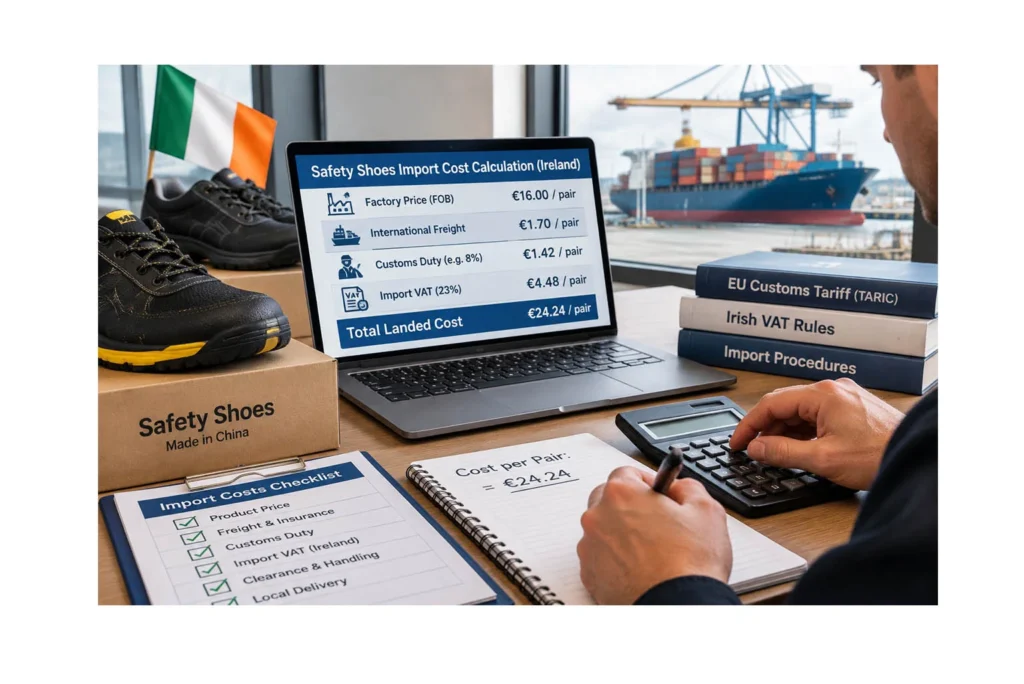
For Irish safety footwear distributors, PPE wholesalers, and workwear retailers, understanding safety shoes import costs Ireland is essential when sourcing products from overseas manufacturers.
Buying safety shoes directly from China can provide access to competitive factory pricing, flexible product specifications, and OEM manufacturing opportunities. However, the factory quotation is only one part of the actual purchasing cost.
International freight, customs duties, import VAT, customs clearance, port handling, insurance, and local delivery can significantly affect the final cost per pair.
For businesses importing hundreds or thousands of pairs, overlooking these expenses can reduce profit margins and create unexpected cash flow problems.
This guide explains how to calculate the total cost of importing safety footwear into Ireland, compare wholesale quotations, estimate landed costs, and develop a more accurate purchasing budget.
It is designed for:
- Safety footwear importers in Ireland
- PPE distributors and wholesalers
- Workwear retailers
- Industrial equipment suppliers
- Construction and manufacturing procurement teams
- Private-label safety footwear brands
- Businesses sourcing wholesale safety shoes from China
Table of Contents
- Why Irish Buyers Need to Calculate Total Import Costs
- What Costs Are Included When Importing Safety Shoes?
- Understand Customs Value and Import Duty
- How to Calculate Footwear Import VAT in Ireland
- Understand Safety Footwear Freight Costs
- FOB, CIF, DAP and DDP: How Shipping Terms Affect Costs
- Wholesale Footwear Cost Calculation: A Practical Example
- How to Calculate Wholesale Selling Prices and Profit Margins
- How to Reduce Total Safety Footwear Import Costs
- Common Import Cost Calculation Mistakes
- Frequently Asked Questions
1. Why Irish Buyers Need to Calculate Total Import Costs
When purchasing safety footwear from overseas manufacturers, the quoted factory price does not represent the final cost of receiving the products in Ireland.
For example, a manufacturer may quote €18 per pair for a safety shoe. However, the actual landed cost could be considerably higher after transportation, customs charges, and other expenses.
Factory Price Is Not the Final Purchasing Cost
Irish importers should consider several cost categories:
- Manufacturing and product costs
- International transportation
- Cargo insurance
- Customs duty
- Import VAT
- Customs clearance
- Port and handling charges
- Local transportation
- Inspection and warehousing
These expenses should be evaluated before confirming a wholesale order.
Why Accurate Cost Calculation Matters
For distributors and wholesalers, accurate costing helps with:
Purchasing decisions: Compare different Chinese manufacturers using the same landed-cost calculation.
Wholesale pricing: Establish realistic selling prices for retailers and industrial customers.
Profitability: Identify which product categories provide better commercial margins.
Cash flow: Understand when customs charges, VAT, and transportation expenses must be paid.
Inventory planning: Determine whether a large order offers sufficient savings to justify the additional stock investment.
2. What Costs Are Included When Importing Safety Shoes?
The total cost of importing safety footwear into Ireland can be divided into several categories.
2.1 Factory Purchase Price
This is the price quoted by the safety shoes manufacturer.
The price depends on:
- Upper materials
- Steel or composite toe caps
- Outsole materials
- Penetration-resistant midsoles
- Product construction
- Branding requirements
- Packaging specifications
- Order quantity
For example, a standard safety shoe and a customised waterproof composite toe boot will have different manufacturing costs.
2.2 International Freight Costs
International freight is an important part of the total cost.
Common shipping options include:
- Sea freight FCL
- Sea freight LCL
- Air freight
- Express courier
Sea freight is generally worth considering for larger wholesale orders, while air freight is more suitable for urgent shipments or smaller quantities.
2.3 Customs Duty
Customs duty is calculated using the applicable customs classification, customs value, and tariff rate.
Safety footwear is generally classified under Chapter 64 of the EU customs tariff.
Different footwear constructions may have different commodity codes and duty rates.
2.4 Import VAT
Imported footwear is generally subject to Irish VAT at the applicable rate.
For adult footwear, the standard VAT rate applies. The standard Irish VAT rate is 23% as of 2026.
Import VAT is calculated using a VAT base that can include customs value, customs duty, and relevant transportation and handling expenses.
2.5 Additional Import Expenses
Other expenses may include:
| Cost category | Description |
|---|---|
| Cargo insurance | Protection against specified transportation risks |
| Customs clearance | Customs broker or agent fees |
| Port handling | Destination port and terminal charges |
| Documentation | Relevant administrative charges |
| Local delivery | Transportation to the Irish warehouse |
| Quality inspection | Independent inspection expenses |
| Warehousing | Storage and inventory handling |
| Banking charges | Currency conversion and international payment fees |
These expenses should be included when calculating the total cost of importing safety footwear.
3. Understand Customs Value and Import Duty
Customs duty is one of the most important factors affecting the cost of importing footwear to Ireland.
How Is Customs Value Calculated?
Irish Revenue generally uses the transaction value method when determining the customs value of imported goods.
The customs value is usually based on the price actually paid or payable, adjusted as required under EU customs valuation rules.
Relevant transportation and insurance costs to the EU point of introduction must generally be included.
A simplified calculation is:
Customs Value = Product Value + Relevant Freight + Insurance + Other Required Adjustments
For example:
| Item | Amount |
|---|---|
| Safety shoes purchase value | €15,000 |
| International freight | €1,400 |
| Insurance | €100 |
| Customs value | €16,500 |
The customs value in this example is €16,500.
How Much Import Duty Applies to Safety Shoes?
There is no universal customs duty rate for all safety footwear.
The applicable rate depends on:
- Upper material
- Outer sole material
- Footwear construction
- Product classification
- Country of origin
- Applicable trade measures
For example, footwear with leather uppers may be classified differently from footwear with textile or plastic uppers.
Irish importers should use the EU TARIC database to verify the correct commodity code and applicable third-country duty.
Official resources:
Do not use one customs duty rate for every safety shoe model.
If the classification is uncertain, consult a customs broker or consider requesting Binding Tariff Information (BTI).
4. How to Calculate Footwear Import VAT in Ireland
Import VAT is another major consideration when calculating total import costs.
What Is the VAT Rate for Safety Footwear in Ireland?
Adult footwear is generally subject to Ireland’s standard VAT rate.
As of 2026, the standard VAT rate is 23%.
This applies to ordinary adult footwear, including safety shoes and safety boots.
Official reference:
Irish Revenue – VAT Treatment of Footwear
How Is Import VAT Calculated?
The VAT base for imported footwear generally includes:
- Customs value
- Customs duty
- Other applicable import duties or taxes, excluding VAT
- Relevant transportation, handling, and insurance costs to the Irish destination
Where onward transportation to the final destination is known at the time of importation, it must also be included as required by the rules.
The simplified formula is:
Import VAT = VAT Taxable Base × Applicable VAT Rate
For example:
| Item | Amount |
|---|---|
| Customs value | €16,500 |
| Assumed customs duty | €1,320 |
| Relevant onward transport | €300 |
| VAT taxable base | €18,120 |
| VAT rate | 23% |
| Import VAT | €4,167.60 |
The assumed duty in this example is purely illustrative and is not a quoted tariff rate for safety shoes.
Can Irish Importers Recover Import VAT?
VAT-registered businesses importing goods for their taxable business activities may generally claim input VAT credit, subject to the normal restrictions and documentation requirements.
Eligible traders registered for VAT and Customs and Excise may also use Postponed Accounting.
This allows import VAT to be accounted for through the VAT3 return rather than being paid at the point of importation.
This can help improve cash flow for wholesale businesses importing large quantities of safety footwear.
Official guidance:
Import VAT should therefore be tracked separately from the underlying product and logistics costs when calculating profitability.
5. Understand Safety Footwear Freight Costs
International freight can significantly influence wholesale footwear cost calculation.
The most suitable transportation method depends on order quantity, delivery urgency, shipping arrangements, and available budget.
Sea Freight
Sea freight is commonly used for large safety footwear orders.
Advantages include:
- Suitable for bulk shipments
- Potentially lower transportation cost per pair
- FCL and LCL options
- Suitable for regular wholesale purchasing
FCL is generally worth evaluating when the shipment volume is sufficient to justify a dedicated container.
LCL allows smaller shipments to share container space.
However, LCL may involve additional consolidation, handling, and destination charges.
Air Freight
Air freight may be appropriate when:
- Products are urgently required
- A distributor needs to replenish inventory
- The order quantity is relatively small
- Delivery speed is a priority
The higher transportation cost should be compared with the commercial value of receiving goods earlier.
Express Courier
Express courier services are generally more suitable for:
- Samples
- Product prototypes
- Small urgent shipments
- Documents
They are usually less economical for large wholesale footwear orders.
Freight Cost Comparison
| Shipping method | Suitable applications | Main consideration |
|---|---|---|
| Sea freight FCL | Large wholesale orders | Container utilisation |
| Sea freight LCL | Smaller bulk shipments | Consolidation and handling |
| Air freight | Urgent shipments | Higher freight cost |
| Express courier | Samples and small parcels | Cost per unit |
What Should Be Included in a Freight Quotation?
When comparing freight forwarders, request a breakdown covering:
- Origin transportation
- Export handling
- Origin documentation
- International freight
- Cargo insurance
- Destination port charges
- Customs clearance
- Local transportation
A low international freight quotation may not represent the lowest total delivery cost.
6. FOB, CIF, DAP and DDP: How Shipping Terms Affect Costs
When sourcing safety shoes from China, importers may receive quotations using different Incoterms.
Understanding these terms helps prevent double-counting or overlooking transportation expenses.
| Incoterm | Main responsibility | Buyer consideration |
|---|---|---|
| EXW | Seller makes goods available at its premises | Buyer arranges most transport and export procedures |
| FOB | Seller delivers goods on board at the named port | Buyer arranges main transportation and subsequent costs |
| CIF | Seller pays cost, insurance and freight to the named destination port | Destination charges and import clearance may remain payable by buyer |
| DAP | Seller arranges delivery to the named destination | Buyer generally handles import clearance and import duties |
| DDP | Seller arranges delivery with import clearance and duties | Confirm the seller can properly fulfil the import obligations |
FOB vs CIF: Which Is Better?
FOB and CIF are common quotation terms when purchasing safety shoes from Chinese manufacturers.
With FOB, the buyer arranges the main international transportation.
With CIF, the seller pays for the main carriage and insurance to the named destination port, although the buyer should still check destination charges and customs obligations.
For experienced importers, FOB may offer greater control over freight arrangements.
For smaller businesses, CIF can simplify the initial quotation comparison.
However, always compare the complete cost rather than choosing based only on the Incoterm or quoted price.
7. Wholesale Footwear Cost Calculation: A Practical Example
Let’s use a hypothetical shipment to demonstrate how an Irish distributor can calculate the total cost of importing safety shoes from China.
Example: Importing 1,000 Pairs of Safety Shoes
Assume the following purchasing arrangement:
| Cost item | Amount |
|---|---|
| Factory price per pair | €16.00 |
| Order quantity | 1,000 pairs |
| Total product value | €16,000 |
| International freight and insurance to EU entry | €1,700 |
| Customs value | €17,700 |
| Illustrative customs duty rate | 8% |
| Customs duty | €1,416 |
| Onward transport to Irish warehouse | €350 |
| Customs broker and other handling fees | €300 |
The 8% duty rate is an example assumption used only to demonstrate the calculation. The actual footwear duty must be verified against the product’s correct TARIC classification and origin.
Step 1: Calculate Customs Value
Product value + freight and insurance:
€16,000 + €1,700 = €17,700
Step 2: Calculate Customs Duty
€17,700 × 8% = €1,416
Step 3: Calculate Import VAT
Assuming the €350 onward transport cost is known at importation and included in the VAT base:
€17,700 + €1,416 + €350 = €19,466
Import VAT:
€19,466 × 23% = €4,477.18
Step 4: Calculate Total Import Cost
| Cost item | Amount |
|---|---|
| Product purchase | €16,000 |
| Freight and insurance | €1,700 |
| Customs duty | €1,416 |
| Onward transportation | €350 |
| Broker and handling fees | €300 |
| Total before import VAT | €19,766 |
| Import VAT cash amount | €4,477.18 |
| Total cash requirement including import VAT | €24,243.18 |
This example excludes any additional VAT charged separately on service-provider invoices and assumes no other customs valuation adjustments or additional trade measures.
Step 5: Calculate Cost Per Pair
Before import VAT:
€19,766 ÷ 1,000 = €19.77 per pair
Including import VAT:
€24,243.18 ÷ 1,000 = €24.24 per pair
For a VAT-registered importer entitled to recover the import VAT, the €19.77 figure is a more useful starting point for assessing the underlying landed purchasing cost.
For a business that cannot recover VAT, the cash-inclusive figure is more relevant.
This distinction is essential when evaluating wholesale footwear profitability.
8. How to Calculate Wholesale Selling Prices and Profit Margins
After calculating the landed cost, importers need to establish an appropriate wholesale selling price.
The selling price should cover operating expenses and generate sufficient profit.
Understand Gross Profit Margin
The basic formula is:
Gross Profit Margin = (Selling Price − Cost of Goods Sold) ÷ Selling Price × 100%
For example, if the landed cost is €19.77 per pair and the target gross margin is 30%:
Selling price = €19.77 ÷ (1 − 30%)
Selling price = €28.24 per pair
This is an illustrative calculation before applicable VAT and other selling expenses.
Additional Business Costs
A distributor should also consider:
- Warehouse rent
- Employee salaries
- Marketing expenses
- Local delivery
- Inventory financing
- Product returns
- Warranty costs
- Sales commissions
- Unsold inventory
A wholesale price that covers only the imported product cost may not be commercially sustainable.
Compare Different Product Categories
Different safety footwear categories may have different purchasing costs and selling opportunities.
| Product category | Important cost factors |
|---|---|
| Steel toe safety shoes | Toe cap and upper construction |
| Composite toe sneakers | Composite materials and lightweight construction |
| Waterproof safety boots | Waterproof materials and sole construction |
| Heavy-duty industrial boots | Reinforced components and durability |
| PVC safety wellies | PVC formulation and moulding |
| Lightweight warehouse shoes | Mesh uppers, cushioning and outsole materials |
For distributors, comparing product-level margins can help identify which categories deserve greater inventory investment.
9. How to Reduce Total Safety Footwear Import Costs
Reducing import costs does not necessarily mean choosing the cheapest manufacturer.
A more effective strategy is to manage the entire supply chain.
Work Directly With Manufacturers
Direct factory sourcing may help reduce unnecessary intermediary costs.
It can also provide better communication about product specifications, MOQ, and manufacturing arrangements.
Consolidate Orders
Combining multiple product models into a suitable shipment may improve freight efficiency.
However, check carton dimensions, shipment volume, and handling charges before consolidating.
Optimise Carton Packaging
Packaging dimensions can affect shipping costs, especially for LCL and air freight.
Discuss carton design and packing efficiency with the manufacturer without compromising product protection.
Plan Orders in Advance
Urgent air shipments can significantly increase the cost per pair.
Forecasting inventory requirements and planning sea freight shipments can help reduce emergency transportation expenses.
Negotiate Based on Total Purchasing Volume
When discussing prices with manufacturers, consider annual purchasing volume rather than evaluating each order separately.
Long-term supply arrangements may create opportunities for more competitive pricing and stable production planning.
Compare Multiple Freight Forwarders
Request quotations from several forwarders and compare all origin, international, destination, and delivery charges.
Avoid comparing only the headline freight rate.
10. Common Import Cost Calculation Mistakes
Using Factory Price as the Final Cost
The factory price excludes several transportation, customs, and distribution expenses.
Always calculate the complete landed cost.
Applying the Wrong Customs Duty Rate
Different safety footwear products can have different customs classifications.
Use the correct commodity code and verify the applicable tariff in TARIC.
Forgetting Import VAT
Import VAT can create significant cash flow requirements.
Even when it is recoverable, importers should understand the timing and documentation requirements.
Ignoring Destination Charges
Port handling, customs broker fees, and local delivery can make a noticeable difference to the final cost.
Comparing FOB and CIF Quotations Incorrectly
Always compare quotations on an equivalent cost basis.
A CIF quotation should not be compared directly with an FOB quotation without adding the buyer’s additional transportation expenses.
Ignoring Currency Fluctuations
Chinese manufacturers may quote in USD, while Irish businesses calculate their purchasing costs in EUR.
Exchange rate changes and bank conversion fees can affect the final transaction cost.
Failing to Include Quality Control Expenses
Product inspection, sample testing, and compliance verification should be included in the sourcing budget.
A low purchase price is not necessarily economical if products fail inspection or cannot be legally placed on the market.
11. Frequently Asked Questions
How Much Does It Cost to Import Safety Shoes to Ireland?
The total cost depends on the factory price, order quantity, freight, insurance, customs duty, VAT, clearance, and local delivery. Importers should calculate the landed cost per pair rather than relying only on the manufacturer’s quotation.
What Is the Import VAT Rate for Safety Shoes in Ireland?
Adult safety footwear is generally subject to Ireland’s standard VAT rate, which is 23% as of 2026. Eligible VAT-registered businesses may claim input VAT credit subject to normal rules.
How Do I Calculate the Total Cost of Importing Safety Footwear?
Start with the product purchase price, add relevant international freight and insurance, calculate customs duty, and include customs clearance, handling, and local delivery. Calculate import VAT separately using the applicable VAT base.
What Is the Difference Between Customs Value and Landed Cost?
Customs value is the value used to calculate customs duty and is generally based on the transaction value plus required adjustments. Landed cost includes the wider expenses of getting goods to the buyer’s destination, such as freight, duty, handling, and delivery.
Is Sea Freight Cheaper Than Air Freight for Safety Shoes?
Sea freight is generally more economical for larger shipments, while air freight is useful for urgent or smaller orders. The final comparison should include all origin, destination, handling, and delivery expenses.
Do Irish Importers Need an EORI Number?
Yes. Businesses importing commercial goods from outside the EU generally need an EORI number to complete customs formalities.
Can Irish Businesses Recover Import VAT?
VAT-registered traders importing goods for their business may generally claim input VAT credit, subject to the normal restrictions. Eligible traders may also use Postponed Accounting to account for import VAT through their VAT3 return.
How Can I Reduce Wholesale Safety Shoes Import Costs?
Consider direct factory sourcing, shipment consolidation, efficient packaging, advance purchasing plans, freight comparison, and long-term manufacturing relationships.
Should I Buy Safety Shoes FOB or CIF?
Both can be suitable. FOB provides greater control over the main transportation arrangement, while CIF includes the seller’s payment of freight and insurance to the named destination port. Compare the complete costs and responsibilities before choosing.
What Should I Ask a Safety Shoes Manufacturer Before Requesting a Quotation?
Ask for product specifications, material details, protective classifications, compliance documentation, MOQ, unit prices, packaging details, production lead times, and available shipping terms.
Conclusion
Calculating the total cost of importing safety shoes into Ireland is essential for distributors, wholesalers, importers, and private-label brands.
The most important principle is to look beyond the factory price.
A reliable purchasing calculation should include:
- Factory purchase price
- International freight
- Cargo insurance
- Customs value
- Applicable import duty
- Import VAT
- Customs clearance
- Destination handling
- Local delivery
- Quality control and other sourcing expenses
By calculating the landed cost per pair, Irish businesses can compare manufacturers more accurately, establish competitive wholesale prices, and protect their profit margins.
Successful sourcing is not simply about finding the cheapest safety shoes. It is about building a supply chain that delivers the right product quality, predictable costs, reliable production, and long-term commercial value.
Source Wholesale Safety Shoes Directly From Ocean Safety Shoes
Ocean Safety Shoes is a professional safety footwear manufacturer serving international B2B customers, including importers, distributors, wholesalers, PPE suppliers, and private-label brands.
We provide manufacturing solutions covering:
- Steel toe safety shoes
- Composite toe safety sneakers
- Lightweight industrial work shoes
- Waterproof safety boots
- Heavy-duty industrial footwear
- OEM and ODM manufacturing
- Custom logos and packaging
- Private-label product development
Working directly with a manufacturer can help Irish buyers evaluate product specifications, compare factory quotations, and develop a more structured wholesale purchasing plan.
Explore the Ocean Safety Shoes product range to review available safety footwear models.
When requesting a wholesale quotation, provide the following information:
- Required safety footwear models
- Product specifications
- Estimated order quantity
- Size assortment
- Upper and outsole preferences
- Branding and packaging requirements
- Required EU compliance documentation
- Preferred Incoterms and destination
This information helps establish a more accurate quotation and supports your total import cost calculation.
Looking for a reliable safety shoes manufacturer for your Irish wholesale business?
Contact Ocean Safety Shoes to discuss factory pricing, product samples, bulk orders, and OEM or private-label manufacturing opportunities.