
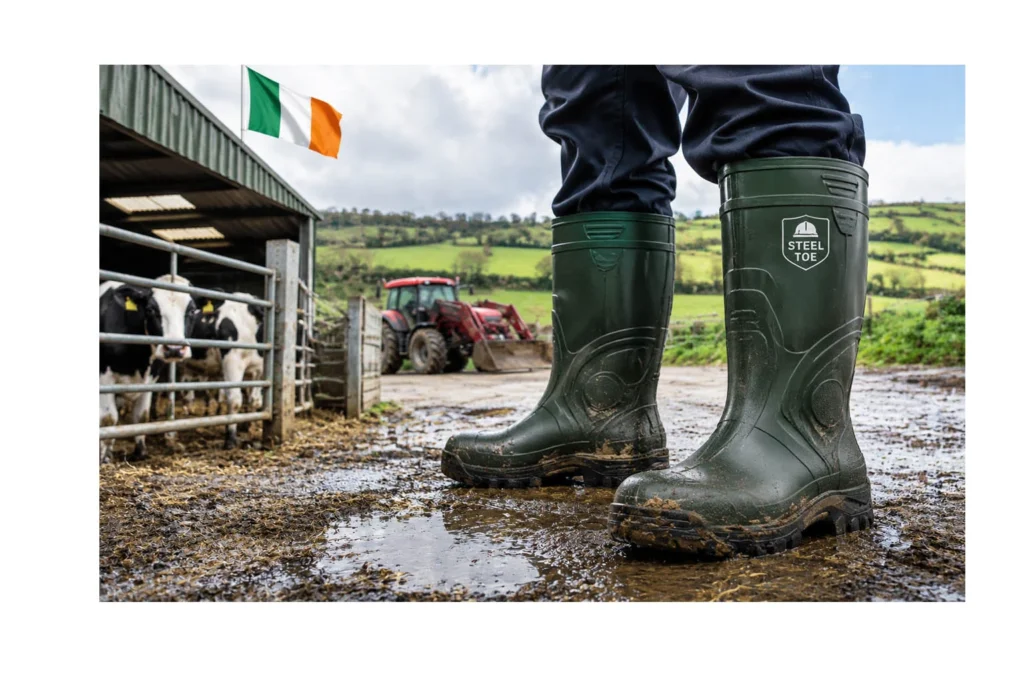
Choosing the right safety wellies Ireland farmers and agricultural businesses need is essential for protecting workers in wet, muddy, and demanding farm environments.
Agricultural work in Ireland frequently involves wet fields, muddy livestock areas, dairy facilities, uneven ground, and exposure to water and other workplace contaminants. Ordinary rubber wellington boots may provide waterproof protection, but they do not necessarily offer the toe protection, penetration resistance, or other safety features required for certain agricultural tasks.
For farmers, agricultural suppliers, PPE distributors, and workwear wholesalers, selecting the right safety wellies means balancing waterproof performance, protective features, durability, comfort, and purchasing costs.
This guide explains how to choose suitable safety wellies for Irish farming and agriculture, compare PVC and rubber materials, understand safety standards, and evaluate manufacturers for wholesale and private-label sourcing.
Whether you supply dairy farms, livestock operations, agricultural contractors, or outdoor workers, understanding these product requirements can help you build a more competitive safety footwear range.
Who should read this guide?
- Agricultural equipment distributors
- Farming PPE suppliers
- Safety footwear wholesalers
- Irish agricultural retailers
- Dairy and livestock businesses
- Farm procurement managers
- Safety footwear importers
- Private-label workwear brands
Table of Contents
- Why Irish Farmers Need Safety Wellies
- What Are Safety Wellies?
- PVC vs Rubber Safety Wellies: Which Is Better?
- Key Features to Look for in Agricultural Safety Wellies
- Steel Toe Wellies vs Standard Wellington Boots
- How to Choose Safety Wellies for Different Farming Applications
- Safety Standards and Compliance Requirements in Ireland
- How to Find a Reliable PVC Safety Wellies Manufacturer
- OEM Safety Wellies and Wholesale Purchasing
- Common Buying Mistakes to Avoid
- Frequently Asked Questions
1. Why Irish Farmers Need Safety Wellies
Agriculture is an important industry in Ireland, with dairy farming, livestock production, beef farming, and agricultural contracting creating demand for protective footwear.
Farm workers regularly encounter conditions that require more than ordinary waterproof boots.
Wet and Muddy Farm Environments
Frequent rainfall and outdoor working conditions can leave fields, farmyards, and livestock areas wet and muddy.
Suitable agricultural wellies should provide:
- Waterproof construction
- Durable upper materials
- Appropriate outsole traction
- Comfortable internal lining
- Easy-to-clean surfaces
The outsole should be selected according to the actual ground conditions rather than relying on appearance alone.
Livestock Handling
Farm workers may need protective footwear when working around cattle, sheep, and other livestock.
Potential hazards include:
- Accidental animal contact
- Heavy objects falling onto the feet
- Uneven surfaces
- Mud and manure
- Wet floors
Steel toe wellies can provide additional toe protection when the workplace risk assessment identifies impact and compression hazards.
Dairy Farming and Cleaning Operations
Dairy farms involve wet floors, water, cleaning activities, and frequent movement between indoor and outdoor areas.
For these environments, buyers should consider:
- Waterproof construction
- Suitable slip-resistant outsoles
- Easy-clean materials
- Appropriate chemical resistance where required
- Comfortable fit for extended working periods
Importantly, ordinary waterproof wellies should not automatically be considered suitable for all dairy or cleaning chemicals.
Agricultural Machinery and Equipment
Farm workers operating around tractors, machinery, and heavy equipment may require additional foot protection.
The Irish Health and Safety Authority recommends suitable safety footwear, including protective toe caps and sole protection, for relevant agricultural work.
For more information, see the HSA agricultural safety guidance.
2. What Are Safety Wellies?
Safety wellies are waterproof protective boots designed for workplaces where ordinary footwear may not provide sufficient protection.
Unlike standard Wellington boots, safety wellies can incorporate protective components and certified performance features.
Main Components of Safety Wellies
| Component | Common materials | Main function |
|---|---|---|
| Upper | PVC, rubber or other polymeric materials | Waterproof protection |
| Toe cap | Steel or composite | Impact and compression protection |
| Midsole | Protective metal or textile insert | Penetration resistance, where required |
| Outsole | PVC, rubber or polyurethane | Traction and durability |
| Footbed | EVA or other cushioning materials | Wearing comfort |
| Inner lining | Textile or polyester | Internal comfort |
Not every safety welly includes all these components.
The appropriate construction depends on the intended application and required safety classification.
Common Types of Safety Wellies
PVC safety wellies
PVC wellies are widely used for agricultural, industrial, and general-purpose wet working environments.
They can offer waterproof protection, practical cleaning, and different outsole designs.
Rubber safety wellies
Rubber wellies are another option for demanding outdoor applications. Depending on the rubber compound and construction, they may provide good flexibility and resistance to certain environmental conditions.
Steel toe safety wellies
These boots incorporate protective steel toe caps and are designed for workplaces where toe impact and compression hazards are identified.
Safety wellies with penetration-resistant protection
Some models include additional sole protection to reduce the risk of sharp objects penetrating through the outsole.
For buyers, the most important consideration is matching the complete product specification to the workplace hazards.
3. PVC vs Rubber Safety Wellies: Which Is Better?
One of the most common questions when purchasing agricultural safety wellies is whether PVC or rubber is the better material.
Both materials have different characteristics, and the right choice depends on the application and product construction.
PVC Safety Wellies
PVC is commonly used in industrial and agricultural protective footwear.
Potential advantages include:
- Waterproof construction
- Practical cleaning
- Different material formulations
- Variety of outsole designs
- Opportunities for cost-effective bulk manufacturing
PVC footwear can be suitable for general farm work, dairy environments, and other wet working conditions when the product is appropriately designed.
Rubber Safety Wellies
Rubber is another established material for protective boots.
Depending on the formulation, it can offer:
- Flexibility
- Durable construction
- Resistance to certain environmental conditions
- Suitability for demanding outdoor applications
However, rubber products vary considerably in composition, weight, and performance.
PVC vs Rubber Comparison
| Comparison | PVC safety wellies | Rubber safety wellies |
|---|---|---|
| Waterproof performance | Available in waterproof constructions | Available in waterproof constructions |
| Flexibility | Depends on PVC formulation | Depends on rubber compound |
| Weight | Varies by construction | Varies by construction |
| Cleaning | Generally easy to clean | Generally easy to clean |
| Chemical resistance | Depends on formulation | Depends on compound |
| Manufacturing cost | Often suitable for cost-conscious ranges | Depends on materials and production |
| Applications | Agriculture and general industrial use | Agriculture and demanding outdoor work |
Which should Irish distributors choose?
PVC safety wellies may be worth considering for distributors targeting general agricultural and industrial markets where competitive pricing is important.
Rubber safety wellies may be suitable for customers who prioritise particular material properties for demanding outdoor conditions.
Neither material is automatically superior. Always evaluate the actual product, material formulation, and test results.
4. Key Features to Look for in Agricultural Safety Wellies
When evaluating safety wellies for Irish farming and agriculture, buyers should focus on several important product characteristics.
Waterproof Construction
Waterproof performance is one of the most important requirements for agricultural wellies.
Check the construction of the boot, including:
- Upper material
- Sole attachment or moulding
- Overall boot construction
- Areas around the shaft and foot
- Product testing information
A well-constructed waterproof boot helps keep feet dry during wet outdoor activities.
Steel Toe Protection
Steel toe caps are useful in agricultural environments where heavy objects, equipment, or livestock-related hazards may create foot injury risks.
Before purchasing, verify the toe protection performance through the product’s relevant conformity documentation.
Slip-Resistant Outsoles
Farm environments can include mud, water, manure, and other contaminants.
The outsole should be selected according to the surfaces on which workers operate.
Consider:
- Tread depth
- Tread pattern
- Rubber or PVC compound
- Abrasion resistance
- Tested slip performance
The Irish HSA specifically advises that footwear should be appropriate for the walking surface and likely contamination.
It also highlights that different tread patterns may be more suitable for fluid contaminants or outdoor surfaces with solid contaminants.
Puncture-Resistant Sole Protection
Agricultural environments can contain sharp objects, metal fragments, and other underfoot hazards.
Where the risk assessment identifies penetration hazards, consider safety wellies with an appropriate penetration-resistant insert.
Comfortable Internal Construction
Farm workers may wear wellies for extended periods.
Important comfort features include:
- Comfortable internal lining
- Appropriate footbed cushioning
- Suitable toe box space
- Practical shaft height
- Adequate flexibility
- Correct sizing
A protective boot that does not fit properly may become uncomfortable and discourage consistent use.
Easy-Clean Surface
Agricultural footwear can accumulate mud, manure, and other contaminants.
Smooth external surfaces can make routine cleaning easier.
Buyers should also consider the manufacturer’s cleaning and maintenance recommendations.
5. Steel Toe Wellies vs Standard Wellington Boots
Standard Wellington boots are primarily designed to provide waterproof protection.
Steel toe wellies add protective toe components for workplaces with relevant impact and compression hazards.
| Feature | Standard wellington boots | Steel toe wellies |
|---|---|---|
| Waterproof construction | Common | Common |
| Protective toe cap | Not necessarily | Steel |
| Impact protection | Not necessarily | Certified performance, where applicable |
| Compression protection | Not necessarily | Certified performance, where applicable |
| Penetration resistance | Not necessarily | Available in selected models |
| Agricultural applications | General wet work | Higher-risk agricultural tasks |
| Typical purchasing purpose | Waterproof footwear | Protective agricultural footwear |
When Should Farmers Choose Steel Toe Wellies?
Steel toe wellies may be appropriate for:
- Livestock handling
- Machinery-related tasks
- Heavy equipment environments
- Agricultural loading areas
- Farmyard operations involving falling-object risks
However, the toe cap material alone does not determine the complete protection level.
Buyers should evaluate the certified product classification and other relevant features.
Are Composite Toe Wellies Available?
Some manufacturers offer non-metallic toe protection in waterproof protective boots.
These products may be attractive for customers who prefer non-metallic construction.
However, availability and suitability depend on the manufacturer’s product range and the required protective specifications.
6. How to Choose Safety Wellies for Different Farming Applications
Different agricultural activities create different footwear requirements.
Irish distributors should consider developing product ranges according to customer applications.
Dairy Farming
Dairy workers often operate in wet areas and around cleaning equipment.
Potential product requirements include:
- Waterproof construction
- Suitable slip resistance
- Easy-clean surfaces
- Protective toe caps where required
- Comfortable internal construction
Livestock Farming
Livestock workers may need protective wellies for muddy fields, animal handling, and farmyard activities.
Consider:
- Steel toe protection
- Durable upper materials
- Suitable outsole traction
- Adequate shaft height
- Easy-clean construction
Beef and Sheep Farming
Outdoor livestock operations may involve muddy fields, uneven ground, and changing weather conditions.
Suitable footwear should combine waterproof protection, appropriate traction, and sufficient durability.
Agricultural Contracting
Agricultural contractors may work across multiple farms and different environments.
Their footwear requirements can vary according to machinery operation, outdoor maintenance, loading, and general farm work.
Farming Application and Product Selection
| Application | Recommended product features |
|---|---|
| Dairy farming | Waterproof, easy-clean, suitable slip resistance |
| Livestock handling | Protective toe cap, durable construction, suitable tread |
| Beef farming | Waterproof upper, outdoor traction, comfortable fit |
| Sheep farming | Lightweight options, waterproof construction, suitable grip |
| Machinery operations | Certified toe protection and sole protection where required |
| General farmyard work | Durable waterproof safety wellies |
The final footwear specification should always be based on a workplace risk assessment.
7. Safety Standards and Compliance Requirements in Ireland
Irish buyers importing or distributing safety wellies must understand the applicable EU PPE requirements.
Regulation (EU) 2016/425
Safety footwear placed on the Irish market must comply with applicable requirements under Regulation (EU) 2016/425 on personal protective equipment.
The regulation covers:
- Product design and manufacture
- Conformity assessment
- CE marking
- Technical documentation
- Manufacturer and importer responsibilities
Official legislation:
EN ISO 20345 Safety Footwear Standard
EN ISO 20345 specifies requirements for general-purpose safety footwear, including protective toe caps and other applicable performance characteristics.
When purchasing steel toe wellies, check:
- Toe cap impact resistance
- Toe cap compression resistance
- Slip resistance
- Water-related protection
- Penetration resistance, where required
- Additional protective properties
Understand Safety Footwear Classifications
Depending on the product construction and applicable edition of the standard, safety footwear classifications may include S4, S5, S6, and S7 categories.
For example, certain fully moulded or polymeric safety footwear designs fall within the S4 and S5 classification families, with additional requirements distinguishing their protective features.
Do not assume that every PVC or rubber safety welly automatically qualifies for a particular classification.
Always check the exact model’s certification and test documentation.
Documents Buyers Should Request
| Document | Purpose |
|---|---|
| EU Declaration of Conformity | Manufacturer’s conformity declaration |
| EU type-examination certificate | Evidence of the relevant conformity assessment |
| Product test reports | Supports protective performance claims |
| Technical documentation | Product construction and technical details |
| User instructions | Use, cleaning and maintenance guidance |
| CE marking information | Evidence of applicable conformity marking |
For importers, it is essential to verify that the documentation relates to the exact product being purchased.
8. How to Find a Reliable PVC Safety Wellies Manufacturer
For agricultural footwear distributors and wholesalers, choosing the right manufacturing partner can influence product quality, pricing, and repeat-order reliability.
Verify Manufacturing Experience
Ask potential manufacturers about:
- PVC safety footwear production
- Rubber boot manufacturing capabilities
- Steel toe wellies
- Injection moulding equipment
- Product testing arrangements
- Quality control procedures
- Export experience
A supplier should be able to explain its manufacturing process rather than simply provide a product catalogue.
Evaluate Product Quality
Request samples and inspect:
- Upper material consistency
- Boot wall thickness
- Toe cap positioning
- Sole construction
- Tread pattern
- Internal lining
- Overall weight
- Size consistency
Where relevant, request independent testing and product-specific certification.
Check OEM and ODM Capabilities
For businesses developing their own agricultural footwear range, customisation capabilities may include:
- Brand logos
- Boot colours
- Upper design
- Outsole design
- Packaging
- Product specifications
Confirm which customisation options are available and whether they affect the MOQ.
Questions to Ask a Manufacturer
| Question | Why it matters |
|---|---|
| Are you a direct manufacturer? | Establishes the supply chain |
| Do you produce PVC safety wellies? | Confirms product capability |
| Do you offer steel toe models? | Checks protective product range |
| Can you provide EU conformity documents? | Supports compliance verification |
| What is your MOQ? | Supports inventory planning |
| Can you customise logos? | Supports private-label development |
| What is your production lead time? | Helps manage purchasing schedules |
| Can you provide product samples? | Allows quality evaluation |
9. OEM Safety Wellies and Wholesale Purchasing
OEM safety wellies can provide opportunities for Irish distributors and agricultural suppliers looking to develop their own footwear brands.
Instead of purchasing only standard products, businesses can work with manufacturers to develop customised safety wellies.
Benefits of OEM Safety Wellies
Potential advantages include:
- Custom brand identity
- Product differentiation
- Custom packaging
- Control over product specifications
- Opportunities for long-term supply arrangements
Factors Affecting Wholesale Prices
The price of safety wellies depends on several factors.
| Factor | Potential impact on cost |
|---|---|
| PVC or rubber formulation | Material costs |
| Steel toe cap | Protective component costs |
| Penetration-resistant insert | Additional materials and construction |
| Outsole design | Mould and production costs |
| Boot height | Material consumption |
| Logo customisation | Branding costs |
| Packaging | Printing and packaging expenses |
| Order quantity | Production economics |
Understand MOQ Requirements
MOQ requirements may vary between standard products and customised designs.
For example, an existing safety welly model may have a different MOQ from a new product requiring custom colours, moulds, or packaging.
Ask for separate quotations for standard wholesale products and OEM orders.
For new distributors, starting with a focused range of popular sizes and protective specifications may help reduce inventory risks.
10. Common Buying Mistakes to Avoid
Choosing Wellies Based Only on Price
Low-cost products may not provide the durability or protective performance required for demanding agricultural applications.
Compare samples, material specifications, and certification before ordering.
Assuming All PVC Wellies Are Safety Wellies
Ordinary PVC Wellington boots do not automatically provide protective toe caps or penetration-resistant soles.
Check the actual product construction and certification.
Ignoring Slip Resistance
A waterproof boot can still be slippery.
Evaluate the outsole performance under conditions similar to the intended working environment.
Overlooking Chemical Compatibility
Agricultural workers may encounter cleaning products, fertilisers, fuels, and other substances.
Do not assume that PVC or rubber is resistant to every chemical.
Request product-specific chemical resistance information where relevant.
Skipping Product Testing
Do not rely solely on product photographs or general manufacturer claims.
Request samples and check the relevant product documentation before confirming bulk orders.
Failing to Plan Repeat Orders
Distributors should assess the manufacturer’s ability to maintain consistent product quality, sizing, and production schedules.
Reliable repeat supply is particularly important for agricultural wholesalers with seasonal demand.
11. Frequently Asked Questions
What Are the Best Safety Wellies for Irish Farming?
The best safety wellies depend on the farming application. Dairy workers may prioritise waterproof construction and suitable slip resistance, while livestock and machinery-related operations may require certified toe protection and penetration-resistant soles.
Are PVC Safety Wellies Suitable for Agriculture?
Yes. PVC safety wellies can be suitable for many agricultural applications when their material construction, protective features, and certification match the workplace requirements.
What Is the Difference Between PVC and Rubber Safety Wellies?
PVC and rubber have different material characteristics. PVC models are often used for practical, cost-conscious industrial and agricultural footwear, while rubber models may offer different flexibility and durability characteristics depending on the formulation.
Do Farmers in Ireland Need Steel Toe Wellies?
Not every agricultural activity requires the same footwear. Steel toe wellies may be appropriate where the workplace risk assessment identifies impact and compression hazards. Employers should select suitable PPE according to the actual risks.
Are Steel Toe Wellies Waterproof?
Many steel toe wellies are designed with waterproof PVC or rubber constructions. However, buyers should verify the product’s actual waterproof performance rather than assuming all safety wellies provide the same level of protection.
What Safety Standard Should Irish Safety Wellies Meet?
Safety wellies covered by EU PPE legislation must meet the applicable requirements of Regulation (EU) 2016/425. EN ISO 20345 is an important standard for general-purpose safety footwear. Buyers should verify the exact product classification and conformity documentation.
Can I Buy Safety Wellies Wholesale From a Chinese Manufacturer?
Yes. Irish distributors and wholesalers can source safety wellies directly from Chinese manufacturers. Before placing an order, check the manufacturer’s production capabilities, product samples, certification, MOQ, and shipping arrangements.
Can Safety Wellies Be Customised With My Own Brand?
Yes. Manufacturers offering OEM services may provide custom logos, colours, packaging, and other product options. However, customised PPE must continue to meet applicable EU conformity requirements.
What Should I Check Before Ordering Wholesale Safety Wellies?
Check material quality, waterproof construction, toe protection, outsole performance, sizing, product certification, MOQ, wholesale prices, production lead times, and repeat-order capability.
Conclusion
Safety wellies are an important footwear category for Irish agricultural businesses, particularly those operating in wet, muddy, and demanding farm environments.
For agricultural distributors, PPE wholesalers, and importers, choosing the right products requires more than comparing prices.
Focus on:
- Waterproof construction
- PVC or rubber material quality
- Steel toe protection where required
- Suitable outsole traction
- Penetration resistance where necessary
- Comfortable fit
- Verified EU PPE compliance
- Reliable manufacturing and repeat supply
A carefully selected product range can help agricultural suppliers meet different farming requirements while developing long-term wholesale relationships.
Source Agricultural Safety Wellies From Ocean Safety Shoes
Ocean Safety Shoes is a professional safety footwear manufacturer serving international B2B buyers, including importers, distributors, wholesalers, PPE suppliers, and private-label brands.
We provide safety footwear manufacturing solutions covering:
- Industrial safety shoes
- Steel toe safety boots
- Waterproof safety footwear
- Agricultural safety footwear
- OEM and ODM manufacturing
- Custom logos and packaging
- Private-label product development
Our manufacturing capabilities support different product designs, materials, protective components, and customer specifications.
Explore the Ocean Safety Shoes product range to review available safety footwear styles.
For Irish agricultural footwear distributors interested in developing a safety wellies range, provide the following information when requesting a quotation:
- Required boot styles
- PVC or rubber material preference
- Steel toe or composite toe requirements
- Penetration-resistant sole requirements
- Target order quantity
- Size assortment
- Logo and packaging requirements
- Required EU product documentation
This information helps establish a clear basis for product selection, sample evaluation, and manufacturing quotations.
Looking for a safety wellies manufacturer for your agricultural footwear business?
Contact Ocean Safety Shoes to discuss wholesale sourcing, product development, and OEM or private-label manufacturing opportunities.