
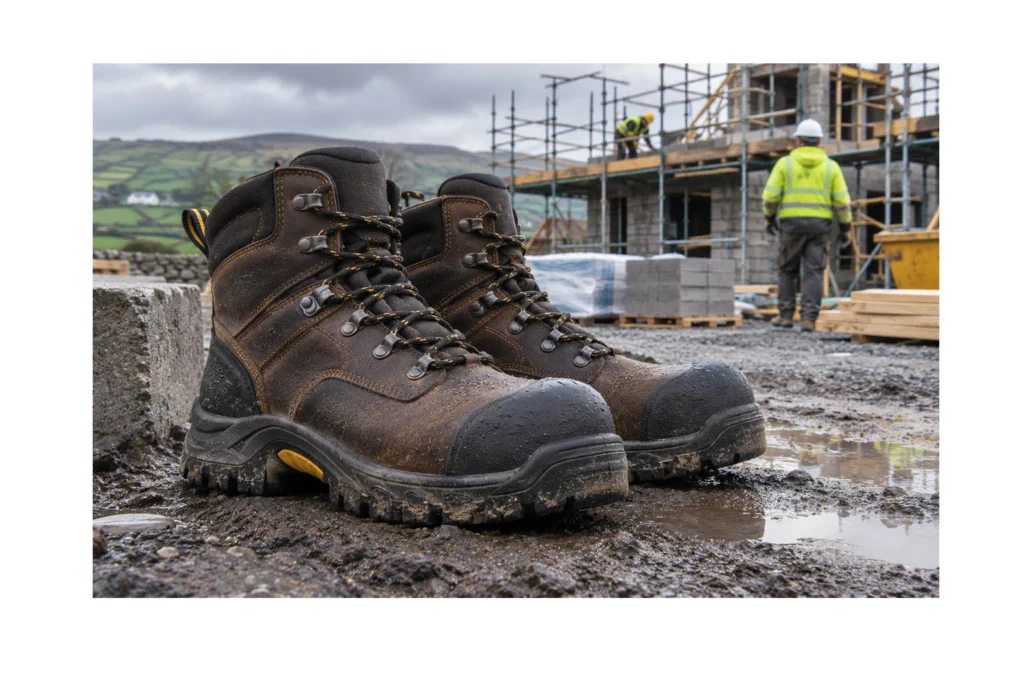
Choosing the best safety boots for construction workers in Ireland requires more than finding footwear with a steel toe cap. Construction sites expose workers to falling materials, sharp objects, wet surfaces, uneven ground, heavy equipment, and long hours of standing or walking.
For construction companies, PPE distributors, wholesalers, and safety footwear importers, selecting the right boots means balancing protection, durability, comfort, and compliance with European safety standards.
In Ireland, general-purpose safety footwear should be assessed against EN ISO 20345, which specifies requirements for protective toe caps and other safety features. The updated EN ISO 20345:2022 standard, including Amendment 1:2024, introduces important changes to penetration resistance, slip resistance, and waterproof footwear classifications.
For most demanding construction environments, S3, S3S, S3L, or S7 safety boots are worth evaluating, depending on site conditions and the level of water protection required.
This guide explains how Irish construction companies can choose suitable safety boots, compare steel and composite toe caps, understand safety classifications, and evaluate manufacturers when purchasing footwear in bulk.
It is particularly useful for:
- Construction companies and contractors
- Building material suppliers
- PPE distributors and wholesalers
- Safety footwear importers
- Civil engineering companies
- Site safety managers
- Procurement and purchasing teams
- Private-label safety footwear brands
Table of Contents
- Why Construction Workers in Ireland Need Proper Safety Boots
- Safety Footwear Standards for Irish Construction Sites
- Best Safety Boot Classifications for Construction Work
- Steel Toe vs Composite Toe Construction Boots
- Essential Features of Heavy Duty Construction Boots
- Choosing Safety Boots for Different Construction Jobs
- Waterproof and Slip-Resistant Safety Boots for Irish Weather
- How to Choose a Reliable Safety Boots Manufacturer
- Wholesale Safety Boots: What Irish Buyers Should Check
- Frequently Asked Questions
1. Why Construction Workers in Ireland Need Proper Safety Boots
Construction environments present multiple hazards that can cause serious foot injuries.
Unlike office or light industrial environments, construction workers regularly encounter changing ground conditions, heavy materials, sharp debris, and outdoor weather.
Common Foot Hazards on Construction Sites
| Workplace Hazard | Potential Risk | Recommended Footwear Feature |
|---|---|---|
| Falling bricks and tools | Toe injuries | Protective toe cap |
| Nails and sharp metal | Sole penetration | Penetration-resistant insert |
| Wet concrete and muddy ground | Slips and instability | Suitable outsole grip |
| Uneven surfaces | Foot fatigue and instability | Appropriate boot construction and fit |
| Heavy materials | Compression injuries | Certified toe protection |
| Rain and standing water | Wet feet and discomfort | Suitable water protection |
| Long working hours | Foot fatigue | Cushioning and ergonomic fit |
A suitable pair of construction safety boots should address the hazards identified in the workplace risk assessment.
Why Proper Footwear Matters for Irish Contractors
Ireland’s construction sector includes residential building, commercial development, infrastructure projects, road construction, and civil engineering.
Workers may move between indoor and outdoor environments throughout the day.
For example, a general construction worker may need protection against falling objects, sharp materials, rain, and uneven ground. A concrete worker may require additional protection against wet cement and chemical exposure.
Choosing footwear based only on price or appearance can therefore create unnecessary safety and replacement costs.
The Irish Health and Safety Authority (HSA) advises employers to assess workplace risks and select suitable PPE that fits the individual worker.
2. Safety Footwear Standards for Irish Construction Sites
Understanding safety footwear standards is essential when purchasing construction work boots in Ireland.
The main European standard for general-purpose safety footwear is EN ISO 20345.
What Is EN ISO 20345?
EN ISO 20345 specifies requirements for safety footwear incorporating protective toe caps.
The toe protection must withstand:
- Impact energy of 200 joules.
- Compression force of 15 kilonewtons.
The standard also covers other protective properties, depending on the footwear classification and additional markings.
These include penetration resistance, slip resistance, water-related performance, and outsole characteristics.
EN ISO 20345:2022 and Amendment 1:2024
The updated standard introduced several changes that construction buyers should understand.
| Feature | Updated Requirement or Marking |
|---|---|
| Toe protection | 200 J impact resistance |
| Compression protection | 15 kN |
| Metallic penetration insert | P |
| Non-metallic penetration insert | PL or PS |
| Water-resistant upper | WPA |
| Whole-footwear water resistance | WR |
| Additional slip resistance | SR |
| Heat-resistant outsole | HRO |
| Cold insulation | CI |
For construction work, penetration resistance and suitable outsole performance are particularly important.
Are S3 Safety Boots Mandatory on Every Irish Construction Site?
There is no universal rule that every construction worker in Ireland must wear S3 footwear.
The required PPE should be determined by the site’s risk assessment and applicable project safety requirements.
However, S3-type protection is frequently worth considering for construction environments because it combines toe protection, water-resistant upper properties, penetration resistance, and a cleated outsole.
Some Irish construction contractors specify S3 footwear or equivalent protection in their site PPE requirements. Buyers should always check the particular contractor’s requirements before placing orders.
3. Best Safety Boot Classifications for Construction Work
Different safety footwear classifications offer different levels of protection.
For Irish construction workers, the most relevant options often include S1P, S3, S3S, S3L, and S7.
S1P Safety Boots
S1P footwear combines the main S1 requirements with penetration-resistant protection.
Typical features include:
- Protective toe cap
- Closed heel
- Antistatic properties
- Energy absorption in the heel
- Penetration-resistant insert
S1P can be considered for relatively dry construction environments where sharp objects underfoot are a concern.
However, it does not provide the same water-resistant upper requirements as S3.
S3 Safety Boots
S3 is a commonly selected classification for construction work.
It includes:
- Protective toe cap
- Closed heel
- Antistatic properties
- Heel energy absorption
- Water penetration and absorption resistance of the upper
- Penetration resistance
- Cleated outsole
S3 safety boots are worth considering for general construction, groundworks, and industrial environments where workers encounter wet surfaces and sharp debris.
It is important to understand that S3 does not automatically mean the entire boot is waterproof.
S3S and S3L Safety Boots
Under EN ISO 20345:2022, penetration-resistant inserts are identified more specifically.
| Marking | Insert Type | Test Nail |
|---|---|---|
| S3 | Metallic insert | 4.5 mm |
| S3L | Non-metallic insert | 4.5 mm |
| S3S | Non-metallic insert | 3.0 mm |
S3S and S3L boots can be attractive options for buyers seeking non-metallic penetration protection.
The correct choice should depend on the workplace hazards and the actual protection required.
S7 Safety Boots
S7 combines S3-type protection with whole-footwear water resistance.
It is worth evaluating for workers regularly exposed to:
- Heavy rain
- Wet ground
- Mud
- Outdoor construction conditions
- Waterlogged working areas
S7 can be a suitable option when whole-footwear water resistance is a priority.
Comparison of Construction Safety Boots
| Classification | Main Protection | Typical Application |
|---|---|---|
| S1P | Toe protection and penetration resistance | Dry construction environments |
| S3 | Water-resistant upper and penetration resistance | General construction |
| S3L | S3-type protection with non-metallic insert | Construction requiring non-metallic protection |
| S3S | S3-type protection with 3 mm nail-tested insert | Construction with demanding penetration risks |
| S7 | S3-type protection plus whole-footwear water resistance | Wet outdoor construction |
The highest classification is not automatically the best choice. Buyers should match the product to the actual site conditions.
4. Steel Toe vs Composite Toe Construction Boots
One of the most common decisions when purchasing construction safety boots is choosing between steel and composite toe caps.
Both can meet EN ISO 20345 requirements when incorporated into appropriately tested and certified footwear.
Steel Toe Construction Boots
Steel toe boots are widely used in construction and heavy industrial environments.
Advantages:
- Strong mechanical protection
- Established manufacturing technology
- Widely available
- Suitable for demanding general industrial applications
- Often cost-effective for bulk purchasing
Considerations:
- Can add weight to footwear
- Conducts heat and cold more readily than non-metallic materials
- May not suit workplaces requiring metal-free footwear
Steel toe construction boots are a practical option for many general labouring and heavy-duty applications.
Composite Toe Construction Boots
Composite toe caps are made from non-metallic materials such as reinforced polymers or fibre-reinforced composites.
Advantages:
- Non-metallic construction
- Can help reduce overall footwear weight
- Does not conduct heat and cold in the same way as steel
- Suitable for metal-detector environments when the complete footwear is appropriately metal-free
Considerations:
- Product weight depends on the overall shoe construction
- Composite designs may have different toe-cap profiles
- The finished footwear must still meet the same required impact and compression performance
Steel vs Composite Toe Comparison
| Feature | Steel Toe | Composite Toe |
|---|---|---|
| EN ISO 20345 protection | 200 J when certified | 200 J when certified |
| Material | Steel | Non-metallic composite |
| Metal-free design | No | Possible |
| Weight | Can be heavier | Often lighter |
| Thermal conductivity | Higher | Lower |
| Construction applications | Suitable | Suitable |
| Bulk purchasing | Widely available | Widely available |
For Irish construction companies, the best choice depends on employee requirements, site conditions, product weight, and budget.
Neither material should automatically be considered safer than the other when both are part of correctly certified footwear.
5. Essential Features of Heavy Duty Construction Boots
Beyond certification, the construction of the boot has a major impact on durability and everyday usability.
When evaluating heavy duty construction boots, buyers should examine several important components.
5.1 Durable Upper Materials
The upper protects the foot and contributes to the boot’s overall durability.
Common materials include:
- Full-grain leather
- Nubuck leather
- Split leather
- Water-resistant leather
- Reinforced synthetic materials
For demanding outdoor work, buyers should evaluate abrasion resistance, stitching quality, and the ability of the upper to withstand repeated use.
5.2 Protective Toe Cap
The toe cap should meet the required EN ISO 20345 performance level.
Steel and composite options are both available.
Buyers should consider toe-cap shape, internal space, and wearer comfort when evaluating samples.
5.3 Penetration-Resistant Midsole
Construction sites can contain nails, screws, metal fragments, and sharp building materials.
A penetration-resistant insert can help protect the sole of the foot.
Available options include:
- Steel penetration-resistant plates
- Non-metallic textile inserts
The choice should reflect the applicable P, PL, or PS requirements.
5.4 Durable Outsole
A suitable outsole is essential for construction environments.
Common materials include PU, PU/PU, rubber, and PU/rubber combinations.
Important considerations include:
- Abrasion resistance
- Slip performance
- Oil and fuel resistance where required
- Flexibility
- Tread depth
- Outsole bonding strength
A cleated outsole is often beneficial on uneven outdoor surfaces.
5.5 Ankle Support and Boot Height
Mid-cut and high-cut boots can provide additional coverage around the ankle.
This may be beneficial for workers moving across uneven ground, rubble, or construction materials.
However, ankle support is not guaranteed by a particular EN ISO 20345 protection class. Buyers should evaluate the actual boot design and fit.
5.6 Comfort and Cushioning
Construction employees may wear safety boots throughout an entire shift.
Important comfort features include:
- Padded collars
- Breathable linings
- Shock-absorbing footbeds
- Suitable toe-box space
- Flexible construction
- Appropriate weight
Comfort should be assessed using wearer trials rather than product descriptions alone.
6. Choosing Safety Boots for Different Construction Jobs
Not every construction worker needs the same footwear specification.
The correct product should be selected according to the work activity and associated hazards.
| Construction Job | Main Hazards | Suggested Footwear Considerations |
|---|---|---|
| General labourers | Falling materials, sharp debris | S3 or S3S |
| Groundworkers | Mud, wet ground, sharp objects | S3 or S7 |
| Concrete workers | Wet concrete, abrasion | Suitable chemical-resistant materials and protective wellingtons where appropriate |
| Scaffolders | Uneven surfaces, climbing | Suitable grip, fit and ankle coverage |
| Electricians | Impact, sharp materials, electrical hazards | Certified safety footwear with task-specific electrical properties where required |
| Roofing workers | Sloped and potentially slippery surfaces | Suitable slip performance and secure fit |
| Civil engineering workers | Heavy equipment, mud and uneven ground | Durable S3 or S7 options |
Safety Boots for General Construction Workers
General labourers often need versatile footwear that balances toe protection, penetration resistance, outsole grip, and durability.
S3 or S3S boots can be useful starting points for product evaluation.
Safety Boots for Groundworkers
Groundworkers frequently operate outdoors and may encounter mud, water, stones, and sharp debris.
S7 footwear can be considered where whole-footwear water resistance is needed.
Safety Boots for Electricians
Electricians need protection against mechanical hazards, but electrical risks require particular attention.
Antistatic footwear should not be confused with electrically insulating footwear.
Where electrical hazards exist, the appropriate specialised footwear must be selected based on a competent risk assessment.
Safety Boots for Concrete Workers
Wet concrete can cause serious skin irritation and chemical burns.
Workers handling wet concrete may need appropriately designed safety wellingtons with toe and midsole protection, together with suitable protective clothing and work procedures.
Leather construction boots should not automatically be assumed suitable for prolonged exposure to wet concrete.
7. Waterproof and Slip-Resistant Safety Boots for Irish Weather
Irish construction workers frequently operate in wet and changeable weather conditions.
Rain, muddy ground, standing water, and slippery surfaces can affect footwear performance.
Water-Resistant vs Waterproof Safety Boots
These terms should not be used interchangeably.
| Marking | Meaning |
|---|---|
| WPA | Water penetration and absorption resistance of the upper |
| WR | Water resistance of the complete footwear |
An S3 boot includes WPA-related upper protection, but it is not necessarily waterproof as a complete boot.
For workers regularly exposed to heavy rain and standing water, S7 footwear may be more appropriate.
Slip Resistance
Construction workers may encounter:
- Wet concrete
- Mud
- Smooth tiles
- Metal surfaces
- Oily workshop floors
- Loose gravel
Under EN ISO 20345:2022, basic slip resistance is incorporated into the standard, while the additional SR marking identifies footwear that has passed an additional slip-resistance test.
However, laboratory testing cannot guarantee identical grip on every construction surface.
Buyers should consider outsole design, surface conditions, and contaminants together.
Outsole Materials for Construction Boots
| Outsole Material | Main Characteristics |
|---|---|
| PU | Lightweight and cushioning |
| PU/PU | Two-layer construction with different performance characteristics |
| Rubber | Good durability and potential heat resistance, depending on design |
| PU/Rubber | Combines cushioning and rubber outsole properties |
The final selection should be based on the manufacturer’s tested product specifications.
8. How to Choose a Reliable Safety Boots Manufacturer
For Irish PPE distributors and construction companies purchasing in bulk, choosing the right manufacturer is as important as choosing the product.
A reliable supplier should offer consistent product quality, appropriate compliance documentation, and dependable production capabilities.
8.1 Check Product-Specific Certification
Request:
- EU Declaration of Conformity
- EU type-examination certificate
- Relevant EN ISO 20345 test reports
- Product specifications
- User instructions
Verify that the documents cover the exact model being purchased.
8.2 Evaluate Manufacturing Experience
Ask about:
- Factory production capabilities
- Monthly manufacturing capacity
- Product development experience
- Quality control procedures
- Material sourcing
- Export experience
A manufacturer with established safety footwear production processes can help support consistent bulk orders.
8.3 Request Samples Before Bulk Orders
Product samples allow buyers to evaluate:
- Fit
- Weight
- Material quality
- Outsole construction
- Stitching
- Toe-box space
- General comfort
Sample approval should be completed before mass production.
8.4 Review OEM and ODM Capabilities
For distributors developing their own product ranges, manufacturing flexibility is important.
Consider whether the supplier supports:
- Custom logos
- Custom colours
- Upper material selection
- Outsole design
- Private-label packaging
- Product development
- Custom specifications
8.5 Evaluate Production Quality Control
Ask the manufacturer how it controls:
- Incoming raw materials
- Upper production
- Toe cap positioning
- Midsole installation
- Outsole bonding
- Final product inspection
- Size consistency
- Finished product traceability
These processes help reduce the risk of inconsistencies between samples and bulk shipments.
9. Wholesale Safety Boots: What Irish Buyers Should Check
Irish construction PPE distributors and wholesalers often need to balance product performance, purchasing costs, and inventory management.
Before confirming a wholesale order, evaluate the following factors.
Product Specification
Clearly define:
- EN ISO 20345 protection class
- Steel or composite toe cap
- Penetration-resistant insert
- Upper material
- Outsole material
- Waterproofing requirements
- Boot height
- Available sizes
Order Quantity and Pricing
Wholesale prices can vary according to:
- Material selection
- Product construction
- Protective components
- Customisation
- Order quantity
- Packaging
- Shipping arrangements
Buyers should compare the total landed cost rather than focusing only on the factory unit price.
Lead Time and Supply Capacity
For larger orders, confirm:
- Sample development time
- Production lead time
- Minimum order quantity
- Available monthly capacity
- Shipping arrangements
- Reordering arrangements
Documentation and Compliance
Before shipment, ensure that product documentation is complete and that the ordered footwear matches the approved product configuration.
For private-label footwear, clarify who assumes the applicable manufacturer’s legal responsibilities under the EU PPE Regulation.
Recommended Wholesale Purchasing Checklist
- Confirm product classification.
- Verify product-specific conformity documents.
- Evaluate the upper and outsole materials.
- Check toe cap and penetration-resistant insert specifications.
- Approve pre-production samples.
- Confirm size assortment.
- Agree on custom branding.
- Confirm MOQ and production lead time.
- Check bulk quality inspection procedures.
- Confirm packaging and shipping requirements.
10. Frequently Asked Questions
What Are the Best Safety Boots for Construction Workers in Ireland?
The best boots depend on the work environment. S3, S3S, and S7 safety boots are worth considering for many construction applications because they can provide toe protection, penetration resistance, and suitable outsole protection. S7 adds whole-footwear water resistance.
Are S3 Safety Boots Required on Irish Construction Sites?
There is no universal requirement for every construction worker to wear S3 footwear. The required protection should be determined through the workplace risk assessment and the project’s PPE specifications. However, S3 footwear is commonly considered for demanding construction environments.
What Is the Difference Between S3 and S3S Safety Boots?
Both offer S3-type protection. The difference concerns the penetration-resistant insert. S3 uses a metallic insert, while S3S uses a non-metallic insert tested with a 3 mm nail.
Are Steel Toe Boots Better Than Composite Toe Boots?
Neither is automatically better. Both can meet the same EN ISO 20345 toe protection requirements. Steel is a traditional, widely available option, while composite toe caps offer non-metallic construction and may reduce footwear weight.
Are S3 Safety Boots Waterproof?
Not necessarily. S3 footwear includes water penetration and absorption resistance for the upper, but not necessarily whole-footwear waterproofing. For whole-footwear water resistance, consider products with WR protection, such as S7.
What Is the Difference Between S3 and S7 Safety Boots?
S3 provides water-resistant upper protection, penetration resistance, and a cleated outsole. S7 adds whole-footwear water resistance to S3-type protection.
What Outsole Is Best for Construction Safety Boots?
The best outsole depends on the surface and workplace hazards. PU, PU/PU, rubber, and PU/rubber constructions are common. Buyers should evaluate slip performance, abrasion resistance, durability, and other relevant properties.
How Long Should Construction Safety Boots Last?
There is no universal replacement interval. Service life depends on working conditions, frequency of use, material quality, and maintenance. Boots should be inspected regularly and replaced when damaged or when their protective performance may have been compromised.
Can Irish Construction Companies Import Safety Boots From China?
Yes. Safety footwear imported from China can be placed on the Irish market if it complies with applicable EU PPE legislation, has completed the required conformity assessment, carries appropriate CE marking, and is accompanied by the required documentation.
What Should PPE Wholesalers Check Before Buying Construction Boots in Bulk?
Wholesalers should verify certification, product specifications, material quality, manufacturing capacity, quality control, sample consistency, MOQ, lead time, and total landed costs.
Conclusion
Choosing the best construction safety boots in Ireland requires a clear understanding of workplace hazards, European footwear standards, product construction, and employee comfort.
For many construction applications, S3, S3S, S3L, and S7 boots are useful classifications to evaluate.
The main purchasing considerations include:
- Appropriate EN ISO 20345 protection
- Certified steel or composite toe caps
- Penetration-resistant midsoles
- Durable uppers
- Suitable outsole grip
- Appropriate water protection
- Comfortable and secure fit
- Reliable manufacturing quality
For Irish construction companies, distributors, and importers, selecting a dependable manufacturing partner is equally important.
By combining suitable product specifications with consistent quality control and verified compliance documentation, buyers can build a more reliable safety footwear supply chain.
Source Construction Safety Boots From Ocean Safety Shoes
Ocean Safety Shoes is a professional safety footwear manufacturer serving international B2B customers, including construction PPE distributors, wholesalers, importers, retailers, and private-label brands.
Our manufacturing capabilities cover a range of industrial and protective footwear, including:
- Steel toe construction boots
- Composite toe safety boots
- S3 safety footwear
- Lightweight safety shoes
- Waterproof safety boots
- Heavy-duty industrial footwear
- Safety gumboots
- OEM and ODM manufacturing
- Custom logos and private-label packaging
For Irish construction footwear buyers, we understand the importance of product specifications, protective classifications, material quality, and manufacturing consistency.
When requesting a quotation, buyers can provide:
- Required safety classification
- Steel or composite toe cap preference
- Penetration-resistant insert requirements
- Upper and outsole materials
- Waterproofing requirements
- Target order quantity
- Size assortment
- Custom branding requirements
- Required compliance documentation
This information helps us evaluate suitable product options and manufacturing requirements.
Explore the Ocean Safety Shoes product range to review available industrial safety footwear.
Looking for a reliable construction safety boots manufacturer for the Irish market?
Contact Ocean Safety Shoes to discuss product samples, wholesale orders, and OEM/ODM manufacturing opportunities.