
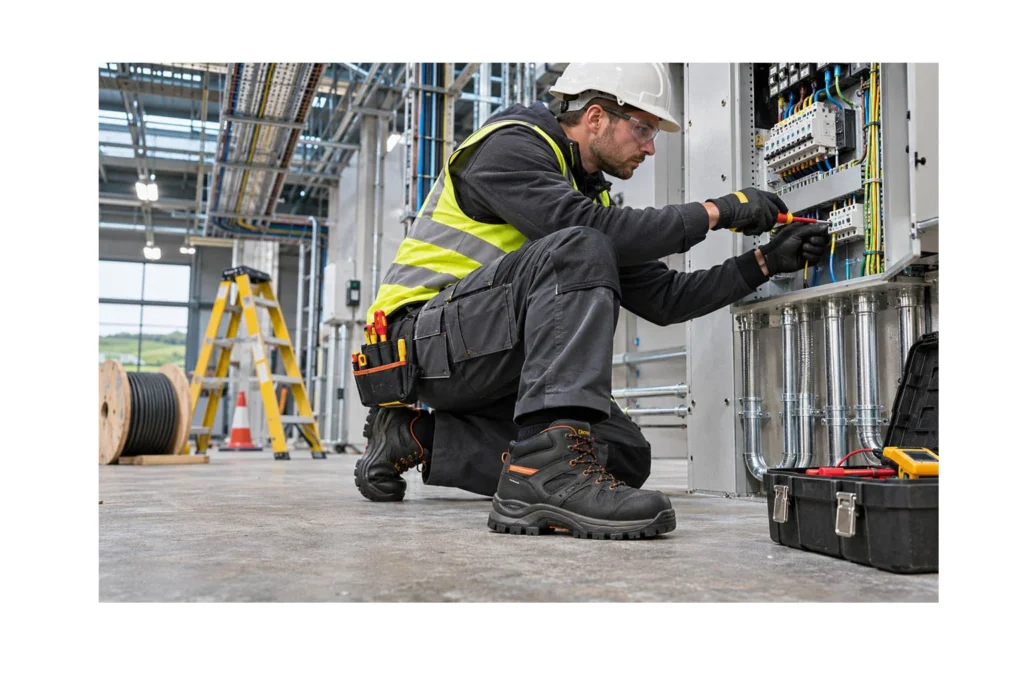
Choosing the right electrician safety boots is an important consideration for electrical contractors, industrial electricians, construction companies, and PPE procurement teams in Ireland. Electricians work in different environments, including residential buildings, commercial construction sites, manufacturing facilities, electrical substations, and industrial maintenance areas. Each environment presents different risks that influence footwear selection.
Unlike general-purpose work boots, footwear for electricians may need to address additional considerations such as electrical insulation, antistatic properties, slip resistance, toe protection, and compatibility with other electrical protective equipment.
For Irish PPE distributors, wholesalers, and safety footwear importers, understanding these differences is essential when selecting products for professional customers.
The most important distinction is that ordinary antistatic safety footwear does not provide protection against electric shock. Where protection against electrical hazards is required, specially tested electrically insulating footwear may be necessary.
This guide explains how to choose suitable electrician work boots in Ireland, compare steel and composite toe caps, understand electrical footwear standards, and evaluate safety footwear manufacturers before purchasing in bulk.
It is designed for:
- Electrical contractors and installation companies
- Industrial electricians
- Construction PPE distributors
- Safety footwear wholesalers
- Electrical equipment suppliers
- Maintenance and engineering companies
- PPE procurement managers
- Private-label safety footwear brands
Table of Contents
- Why Electricians Need Specialised Safety Boots
- Electrical Safety Footwear Standards in Ireland
- Antistatic vs Electrically Insulating Safety Boots
- Steel Toe vs Composite Toe Safety Boots for Electricians
- Essential Features of Electrician Work Boots
- Best Safety Boots for Different Electrical Work Environments
- Slip-Resistant and Waterproof Electrician Boots
- How to Choose a Reliable Electrician Safety Boots Manufacturer
- Wholesale Electrician Safety Boots: What Irish Buyers Should Check
- Frequently Asked Questions
1. Why Electricians Need Specialised Safety Boots
Electricians face a combination of mechanical, environmental, and electrical hazards.
Depending on the working environment, their footwear may need to protect against falling tools, sharp materials, slippery floors, and exposure to moisture.
Common Hazards for Electricians
| Workplace Hazard | Potential Risk | Recommended Footwear Consideration |
|---|---|---|
| Falling tools and equipment | Toe injuries | Protective toe cap |
| Sharp metal and construction debris | Sole penetration | Penetration-resistant insert |
| Electrical hazards | Electric shock | Appropriate electrically insulating footwear where required |
| Static electricity | Electrostatic discharge | Antistatic or ESD footwear where specified |
| Wet floors and rain | Slipping and discomfort | Suitable slip resistance and water protection |
| Long working hours | Foot fatigue | Cushioning and ergonomic design |
| Uneven construction surfaces | Instability and discomfort | Durable outsole and suitable boot construction |
| Oils and workshop contaminants | Outsole deterioration or slipping | Appropriate material and outsole resistance |
Why Footwear Selection Matters in Ireland
Electricians in Ireland work across several industries.
For example:
- Residential electricians install wiring, lighting, and electrical systems.
- Commercial electricians work in offices, shopping centres, and large buildings.
- Industrial electricians maintain electrical equipment and machinery.
- Construction electricians install electrical systems on building sites.
- Utility engineers may work near electrical distribution networks and other high-risk installations.
These occupations do not necessarily require identical footwear.
A residential electrician working in completed buildings may prioritise lightweight, comfortable footwear with toe protection and suitable slip resistance.
An industrial electrician working around specialised electrical installations may need additional electrically insulating PPE based on the work risk assessment.
The correct footwear should therefore be selected according to the actual hazards rather than the job title alone.
2. Electrical Safety Footwear Standards in Ireland
Irish buyers should understand the difference between general safety footwear standards and specialised electrical insulation standards.
Two important standards are EN ISO 20345 and EN 50321-1.
EN ISO 20345:2022 – General Safety Footwear
EN ISO 20345 is the main European standard for general-purpose safety footwear with protective toe caps.
It specifies requirements for:
- Toe cap impact resistance
- Toe cap compression resistance
- Penetration resistance
- Antistatic properties
- Slip resistance
- Water-related performance
- Other protective characteristics
The toe cap must withstand:
- 200 joules of impact energy
- 15 kilonewtons of compression force
Electricians working on construction and industrial sites may require safety boots meeting this standard.
However, EN ISO 20345 certification alone does not establish that footwear is electrically insulating.
EN 50321-1:2018 – Electrically Insulating Footwear
EN 50321-1:2018 is a separate European standard covering electrically insulating footwear and overboots.
It specifies requirements and testing for footwear intended to protect workers against electric shock when working live or close to live parts on installations up to:
- 36,000 V AC
- 25,000 V DC
The footwear must meet the applicable electrical classification and testing requirements.
The manufacturer’s instructions and the specific electrical protection class must be checked before use.
This standard is particularly relevant to specialised electrical work and utility applications.
Comparison of the Two Standards
| Standard | Main Purpose | Typical Application |
|---|---|---|
| EN ISO 20345:2022 | General mechanical safety protection | Construction and industrial work |
| EN 50321-1:2018 | Electrical insulation against electric shock | Specialised electrical work and live working |
A product may be designed to provide both mechanical safety protection and electrical insulation, but buyers must verify the relevant certification for both functions.
Irish Regulatory Considerations
Safety footwear placed on the Irish market must comply with applicable EU PPE legislation, particularly Regulation (EU) 2016/425.
Irish businesses should also consider the Safety, Health and Welfare at Work (General Application) Regulations 2007, including the requirements relating to electrical work and workplace risk assessment.
The Health and Safety Authority (HSA) provides guidance on electrical hazards and PPE selection.
3. Antistatic vs Electrically Insulating Safety Boots
This is one of the most important distinctions when selecting safety boots for electricians.
Although both types relate to electrical properties, they serve different purposes.
What Are Antistatic Safety Boots?
Antistatic safety footwear helps reduce the accumulation of static electricity in the wearer’s body by allowing electrical charges to dissipate through the footwear.
It is commonly used in environments where electrostatic discharge needs to be controlled.
Examples include:
- Electronics manufacturing
- Industrial production
- Certain chemical environments
- Facilities with electrostatic control requirements
Under EN ISO 20345, antistatic properties are identified by the A marking.
However, antistatic footwear does not provide reliable protection against electric shock.
What Are Electrically Insulating Safety Boots?
Electrically insulating footwear is specifically designed and tested to provide protection against electric shock under defined conditions.
It is covered by EN 50321-1:2018.
Important characteristics include:
- Defined electrical insulation performance
- Specific electrical protection classification
- Appropriate electrical testing
- Manufacturer instructions for safe use
- Inspection and maintenance requirements
This footwear may be required for certain electrical utility and specialised live-working applications.
Antistatic vs Electrical Insulation
| Feature | Antistatic Footwear | Electrically Insulating Footwear |
|---|---|---|
| Main purpose | Dissipates static electricity | Provides electrical insulation |
| Relevant standard | EN ISO 20345 | EN 50321-1 |
| Protection against electric shock | Not guaranteed | Designed for specified electrical protection |
| Typical application | Static-controlled environments | Specific electrical work |
| Selection basis | Electrostatic risk assessment | Electrical risk assessment |
| Special electrical classification | No | Yes |
Important purchasing advice: Never assume that an S1, S2, S3, or antistatic safety boot protects an electrician against electric shock.
Likewise, a composite toe cap or metal-free construction does not automatically make a boot electrically insulating.
Electrical insulation must be supported by the appropriate product testing and certification.
4. Steel Toe vs Composite Toe Safety Boots for Electricians
Electricians frequently work around heavy tools, electrical equipment, ladders, and building materials.
Toe protection is therefore an important consideration.
Steel and composite toe caps are both available in safety footwear that meets EN ISO 20345 requirements.
Steel Toe Safety Boots
Steel toe boots are widely used in construction and industrial workplaces.
Advantages:
- Established impact and compression protection technology
- Durable construction
- Widely available
- Suitable for heavy-duty applications
- Often competitive for wholesale purchasing
Considerations:
- May add weight to footwear
- Conducts heat and cold more readily
- Contains metal components
Steel toe safety boots can be a practical choice for electricians who regularly handle heavy materials or equipment.
Composite Toe Safety Boots
Composite toe caps are made from non-metallic materials, such as reinforced polymers or fibre-reinforced composites.
Advantages:
- Non-metallic toe cap
- Can help reduce overall footwear weight
- Lower thermal conductivity than steel
- Suitable for environments where non-metallic toe protection is preferred
Considerations:
- Overall shoe weight depends on the complete construction
- Toe cap dimensions and fit vary by design
- The finished footwear must still pass the required protection tests
Comparison for Electricians
| Feature | Steel Toe | Composite Toe |
|---|---|---|
| EN ISO 20345 protection | 200 J when certified | 200 J when certified |
| Material | Steel | Non-metallic composite |
| Weight | Can be heavier | Often lighter |
| Metal content | Yes | Toe cap is metal-free |
| Thermal conductivity | Higher | Lower |
| Construction work | Suitable | Suitable |
| Electrical insulation | Not guaranteed | Not guaranteed |
For electricians who prefer lightweight footwear, composite toe safety boots may be worth evaluating.
However, buyers should remember that the toe cap material alone does not determine the electrical insulation properties of the entire boot.
5. Essential Features of Electrician Work Boots
When selecting electrician work boots in Ireland, buyers should evaluate the complete footwear construction rather than focusing on one protective component.
5.1 Protective Toe Cap
A certified toe cap protects against impact and compression hazards.
Available options include:
- Steel toe caps
- Fibreglass composite toe caps
- Other approved non-metallic toe cap designs
The correct option depends on the intended application, weight requirements, and product specifications.
5.2 Penetration-Resistant Midsole
Electricians working on construction sites may encounter:
- Nails
- Screws
- Metal fragments
- Broken building materials
- Sharp workshop debris
A penetration-resistant insert can help protect the sole of the foot.
Common options include steel and non-metallic textile inserts.
Under the updated EN ISO 20345 standard, buyers may encounter:
| Marking | Insert Type |
|---|---|
| P | Metallic penetration-resistant insert |
| PL | Non-metallic insert tested with a 4.5 mm nail |
| PS | Non-metallic insert tested with a 3.0 mm nail |
The required performance should be based on the workplace risk assessment.
5.3 Suitable Outsole Construction
Electricians may work on concrete, tiles, metal platforms, workshop floors, and outdoor surfaces.
Important outsole characteristics include:
- Slip resistance
- Abrasion resistance
- Flexibility
- Durability
- Suitable traction
- Resistance to relevant workplace contaminants
Common outsole materials include PU, PU/PU, rubber, and PU/rubber combinations.
5.4 Comfortable Footbed and Cushioning
Electrical installation work can involve long periods of standing, climbing, bending, and walking.
Useful comfort features include:
- Shock-absorbing footbeds
- Padded collars
- Breathable linings
- Flexible forefoot construction
- Appropriate arch support
- Comfortable toe-box space
For wholesalers supplying professional electricians, comfort can be an important product differentiation factor.
5.5 Lightweight Construction
Electricians often carry tools and equipment while moving between different work locations.
Lightweight safety footwear may help improve wearing comfort during long shifts.
Composite toe caps and non-metallic penetration-resistant inserts are common options for lightweight designs.
However, product weight should always be evaluated alongside protective performance and durability.
5.6 Suitable Electrical Properties
If electrical hazards are present, buyers must identify the exact electrical protection required.
Depending on the working environment, the specification may involve:
- Antistatic footwear
- ESD footwear
- Electrically insulating footwear
- Other specialised electrical PPE
These categories should not be treated as interchangeable.
6. Best Safety Boots for Different Electrical Work Environments
Different types of electrical work involve different hazards.
The following table provides a purchasing reference for Irish contractors and PPE buyers.
| Work Environment | Main Hazards | Footwear Considerations |
|---|---|---|
| Residential electrical installation | Tools, nails and building debris | Protective toe cap and suitable sole protection |
| Commercial construction | Falling materials, wet floors and uneven surfaces | S3 or S3S-type protection where required |
| Industrial electrical maintenance | Machinery, heavy components and workplace contaminants | Durable safety footwear with appropriate additional protection |
| Electrical substations | Potential exposure to electrical hazards | Specialised electrically insulating footwear where specified by risk assessment |
| Utility maintenance | Electrical exposure and outdoor conditions | Appropriate electrical PPE and suitable water protection |
| Electronics facilities | Electrostatic discharge | ESD-compatible footwear where required |
| EV maintenance workshops | Electrical systems and mechanical hazards | Task-specific electrical PPE and mechanical protection |
Safety Boots for Residential Electricians
Residential electricians typically move between installation sites, indoor spaces, and construction areas.
A practical footwear specification may include:
- Protective toe cap
- Suitable outsole grip
- Comfortable footbed
- Lightweight construction
- Penetration resistance where required
S1P or S3-type footwear may be considered depending on the working environment.
Safety Boots for Commercial Electricians
Commercial electricians may work on large construction projects involving ladders, tools, cables, building materials, and unfinished floors.
Important features include:
- Toe protection
- Penetration resistance
- Durable upper materials
- Slip-resistant outsole
- Suitable water protection
S3, S3S, or S3L footwear may be worth considering based on the project requirements.
Safety Boots for Industrial Electricians
Industrial electricians often work around machinery and heavy equipment.
Footwear selection may need to consider:
- Mechanical protection
- Oil and fuel exposure
- Slip resistance
- Antistatic requirements where specified
- Long-term durability
The actual product specification should reflect the risks of the industrial facility.
Safety Boots for Electrical Utility Workers
Utility workers may face electrical hazards that are different from those encountered during ordinary electrical installation work.
Where live working or work close to live electrical parts is required, ordinary EN ISO 20345 safety boots should not be assumed to provide electrical insulation.
Specialised footwear complying with EN 50321-1:2018 may be necessary.
Selection should be made by competent personnel using the applicable electrical risk assessment and safe system of work.
7. Slip-Resistant and Waterproof Electrician Boots
Irish electricians frequently work in environments affected by rain, damp surfaces, and changing weather conditions.
Slip resistance and water protection are therefore important considerations.
Why Slip Resistance Matters
Electricians may work on:
- Wet concrete
- Smooth indoor flooring
- Metal platforms
- Outdoor paving
- Construction surfaces
- Workshop floors
Under EN ISO 20345:2022, basic slip-resistance requirements are incorporated into the standard.
The optional SR marking indicates that footwear has passed an additional slip-resistance test.
Buyers should consider the actual work surface and contaminants rather than relying on one marking alone.
Understanding Waterproof and Water-Resistant Footwear
The updated EN ISO 20345 standard distinguishes between upper water resistance and whole-footwear water resistance.
| Marking | Meaning |
|---|---|
| WPA | Water penetration and absorption resistance of the upper |
| WR | Water resistance of the complete footwear |
For example, S3 footwear includes WPA-related protection but is not necessarily waterproof as a complete boot.
S7 footwear combines S3-type protection with whole-footwear water resistance.
For electricians working outdoors in Ireland, the appropriate choice depends on exposure to rain, standing water, and other site conditions.
Outsole Material Comparison
| Material | Main Characteristics |
|---|---|
| PU | Lightweight and cushioning |
| PU/PU | Two-layer construction with different performance characteristics |
| Rubber | Durable and suitable for various industrial applications |
| PU/Rubber | Combines cushioning and rubber outsole properties |
Buyers should request product-specific performance information when comparing different outsole constructions.
8. How to Choose a Reliable Electrician Safety Boots Manufacturer
For Irish wholesalers and distributors, selecting a reliable safety footwear manufacturer is essential for maintaining product quality and supply consistency.
8.1 Verify Product Certifications
Request relevant product documentation, including:
- EU Declaration of Conformity
- EU type-examination certificate
- EN ISO 20345 test reports
- EN 50321-1 documentation where electrical insulation is claimed
- Product specifications
- User instructions
Always check that the documents cover the actual footwear model being purchased.
8.2 Evaluate Manufacturing Capabilities
Ask about:
- Production capacity
- Available footwear categories
- Upper material options
- Toe cap materials
- Outsole manufacturing
- Product development capabilities
- Quality control procedures
A manufacturer with experience in different industrial footwear constructions can provide more flexibility when developing product ranges for electrical contractors.
8.3 Request Samples Before Bulk Purchasing
Physical samples help buyers evaluate:
- Overall weight
- Toe-box space
- Upper flexibility
- Outsole grip
- Stitching quality
- Footbed comfort
- General workmanship
Sample approval is particularly important when developing private-label electrician safety boots.
8.4 Check OEM and ODM Services
For PPE distributors and private-label brands, manufacturing flexibility can be an important commercial advantage.
Consider whether the manufacturer offers:
- Custom logos
- Custom colours
- Upper material selection
- Outsole options
- Custom packaging
- Product development
- Private-label production
8.5 Evaluate Quality Control
A reliable manufacturer should have procedures covering:
- Incoming material inspection
- Component quality checks
- Toe cap installation
- Penetration-resistant insert positioning
- Outsole bonding
- Final product inspection
- Batch identification
Any material or construction changes that could affect conformity should be assessed through the appropriate process before production.
9. Wholesale Electrician Safety Boots: What Irish Buyers Should Check
For Irish PPE wholesalers, the electrician footwear market offers opportunities across construction, industrial maintenance, utilities, and electrical contracting.
However, bulk purchasing requires careful product and supplier evaluation.
Product Specification
Before requesting quotations, define:
- Required EN ISO 20345 classification
- Whether electrical insulation is required
- Steel or composite toe cap
- Penetration-resistant insert
- Upper material
- Outsole construction
- Slip-resistance requirements
- Water protection
- Available sizes
Wholesale Pricing Factors
The price of electrician work boots depends on:
- Material selection
- Toe cap construction
- Penetration-resistant insert
- Outsole materials
- Electrical insulation requirements
- Product design
- Customisation
- Order quantity
- Packaging requirements
Specialised electrically insulating footwear may involve additional testing and production requirements compared with ordinary safety footwear.
Buyers should compare products based on their actual specifications rather than comparing unit prices alone.
Supply Chain and Production
For larger orders, confirm:
- Minimum order quantity
- Sample development time
- Bulk production lead time
- Monthly manufacturing capacity
- Inspection arrangements
- Shipping arrangements
- Repeat-order availability
Recommended Purchasing Checklist
- Identify the electrical hazards and intended application.
- Confirm whether ordinary safety footwear or electrical insulating footwear is required.
- Verify applicable product standards.
- Check the EU Declaration of Conformity.
- Verify the EU type-examination certificate.
- Request relevant test reports.
- Check toe cap and midsole specifications.
- Evaluate slip resistance and water protection.
- Approve product samples.
- Confirm MOQ and production lead time.
- Arrange bulk quality inspection.
- Confirm product labelling and packaging.
10. Frequently Asked Questions
What Are the Best Safety Boots for Electricians in Ireland?
The best boots depend on the electrical and mechanical hazards of the job. General electrical installation work may require certified EN ISO 20345 safety footwear with suitable toe and sole protection. Work involving electrical shock risks may require specially tested electrically insulating footwear under EN 50321-1:2018.
Do Electricians Need Electrically Insulating Safety Boots?
Not every electrician automatically needs electrically insulating footwear. The requirement depends on the electrical hazards, work procedures, and risk assessment. Where protection against electric shock is required, the footwear must have the appropriate electrical insulation performance and certification.
Are Antistatic Safety Boots Suitable for Electricians?
Antistatic boots may be suitable for electricians working in environments where static electricity needs to be controlled. However, antistatic footwear does not guarantee protection against electric shock and should not replace electrically insulating PPE where that protection is required.
What Is the Difference Between Antistatic and Electrically Insulating Boots?
Antistatic boots help dissipate static electricity from the wearer. Electrically insulating boots are specifically designed and tested to protect against electric shock under defined conditions. They serve different purposes and follow different technical requirements.
Are Composite Toe Boots Better for Electricians?
Composite toe boots can be a good choice for electricians who prefer lightweight, non-metallic toe protection. However, composite toe caps do not automatically provide electrical insulation. The complete footwear must meet the appropriate electrical protection requirements if insulation is needed.
Are Steel Toe Boots Safe for Electricians?
Steel toe boots can provide excellent mechanical protection when they meet EN ISO 20345 requirements. However, ordinary steel toe safety boots should not be assumed to provide electrical insulation. Specialised electrical footwear must be selected when the risk assessment requires it.
What Is EN 50321-1:2018?
EN 50321-1:2018 is a European standard specifying requirements and testing for electrically insulating footwear and overboots used to protect workers against electric shock when working live or close to live electrical parts.
What Does S3 Mean on Electrician Safety Boots?
S3 indicates a safety footwear classification under EN ISO 20345. It includes protective toe protection, antistatic properties, heel energy absorption, water penetration and absorption resistance of the upper, penetration resistance, and a cleated outsole. It does not mean that the footwear is electrically insulating.
Are Waterproof Safety Boots Important for Electricians in Ireland?
They can be important for electricians working outdoors or in damp environments. Buyers should distinguish WPA, which relates to the upper, from WR, which relates to whole-footwear water resistance.
What Should PPE Wholesalers Check Before Buying Electrician Safety Boots in Bulk?
Wholesalers should evaluate the required protection classification, electrical properties, conformity documentation, materials, outsole performance, sample quality, manufacturing capabilities, MOQ, lead time, and quality control procedures.
Can Safety Footwear Manufacturers Provide Custom Electrician Boots?
Manufacturers offering OEM and ODM services may provide customised upper materials, toe cap options, outsole designs, colours, logos, and packaging. However, any modification affecting protective performance must be appropriately assessed and included in the relevant conformity documentation.
Conclusion
Choosing the right electrician safety boots in Ireland requires careful consideration of electrical hazards, mechanical protection, workplace conditions, and employee comfort.
For general electrical installation and construction work, suitable EN ISO 20345 safety footwear can provide essential toe and sole protection.
For tasks involving electrical shock hazards, specially tested electrically insulating footwear under EN 50321-1:2018 may be required.
The main purchasing considerations include:
- Appropriate mechanical protection
- Correct electrical footwear category
- Certified toe cap performance
- Suitable penetration-resistant inserts
- Slip-resistant outsole construction
- Appropriate water protection
- Comfortable and lightweight design
- Reliable product documentation
- Consistent manufacturing quality
For Irish contractors, distributors, and PPE importers, the most important step is to match the footwear specification with the actual workplace risk assessment.
Selecting a manufacturer that understands safety footwear construction, product testing, and conformity requirements can also help establish a more dependable supply chain.
Source Electrician Safety Boots From Ocean Safety Shoes
Ocean Safety Shoes is a professional safety footwear manufacturer supplying international B2B customers, including importers, wholesalers, PPE distributors, retailers, and private-label brands.
Our product range includes:
- Steel toe safety boots
- Composite toe safety shoes
- Lightweight safety sneakers
- S3 safety footwear
- Waterproof safety boots
- Industrial work shoes
- Heavy-duty construction boots
- OEM and ODM safety footwear
We provide manufacturing solutions for businesses looking to develop and source safety footwear for different industrial applications.
For Irish electrical contractors and PPE distributors, product selection should begin with clearly defined mechanical and electrical protection requirements.
When requesting a quotation, buyers can provide:
- Intended electrical work application
- Required safety classification
- Steel or composite toe cap preference
- Penetration-resistant insert requirements
- Upper and outsole material preferences
- Slip-resistance requirements
- Waterproofing requirements
- Estimated order quantity
- Custom branding and packaging requirements
- Required conformity documentation
These specifications help establish suitable product options and manufacturing requirements.
Explore the Ocean Safety Shoes product range to review available safety footwear.
Looking for a reliable safety footwear manufacturer for your Irish PPE distribution business?
Contact Ocean Safety Shoes to discuss product samples, wholesale orders, and OEM/ODM manufacturing opportunities.