
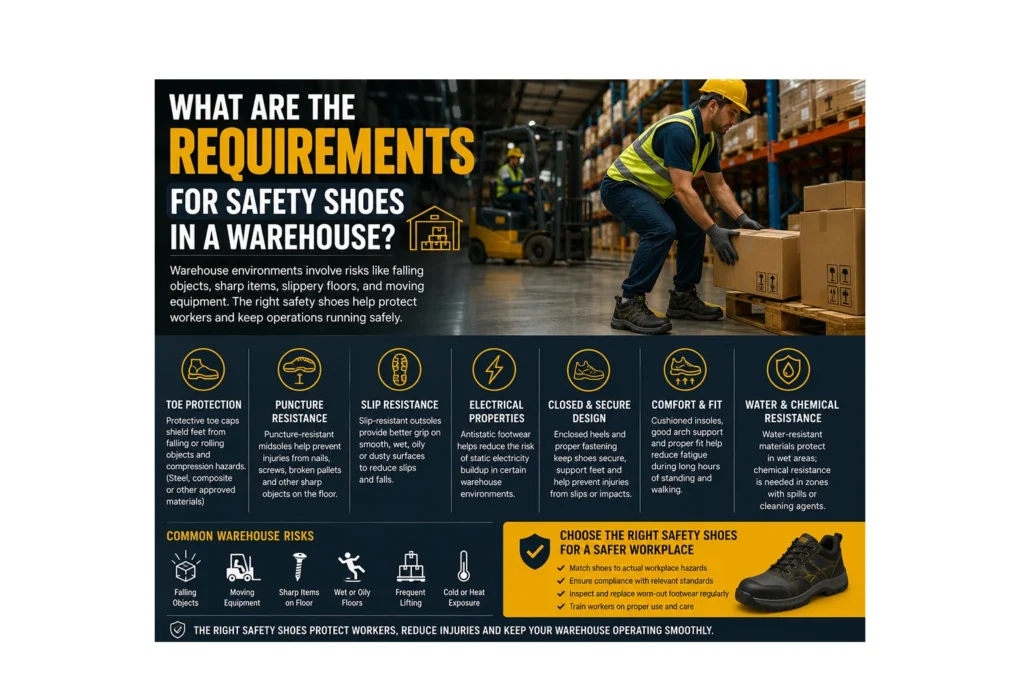
What Are the Requirements for Safety Shoes in a Warehouse?
The requirements for safety shoes in a warehouse depend on the hazards workers face.
That’s the most accurate answer.
Not every warehouse employee automatically needs the same heavy steel-toe boot. A forklift driver, a pallet handler, a cold-store picker, and an office visitor walking through a marked aisle may face very different risks.
Still, warehouse safety footwear commonly needs some combination of:
- Protective toe caps
- Slip-resistant outsoles
- Puncture-resistant midsoles
- Secure heel support
- Suitable electrical properties
- Durable, enclosed uppers
- Correct fit and all-day comfort
- Certification for the target market
The final footwear specification should come from a workplace hazard assessment rather than a general rule such as “everyone must wear S3 boots.”
Here’s the thing: a safety classification is only useful when it matches the job.
A highly protective boot may be unnecessary for one department and inadequate for another. That sounds contradictory, but it isn’t. More features don’t always mean better protection. The right features mean better protection.
For warehouse managers, PPE buyers, footwear importers, and distributors, the real task is to connect each warehouse hazard with a clear footwear requirement.
Let’s work through that carefully.
Usually, as far as we know, Ocean Safety Shoes has manufactured a large number of safety shoes for warehouses. For this type of work boot, the most popular style is lightweight fabric with an EVA midsole and slip-resistant rubber outsole.
Why Are Safety Shoes Required in Warehouses?
According to OSHA, employers must ensure employees wear protective footwear whenever there is a danger of foot injuries from falling or rolling objects, objects piercing the sole, or electrical hazards.
First Things: Are Safety Shoes Mandatory in Every Warehouse?
Not automatically.
In the United States, OSHA requires protective footwear where workers face foot injuries from falling or rolling objects, objects that could pierce the sole, or certain remaining electrical hazards. OSHA also requires the employer to determine which workers are exposed and to select suitable protection.
That distinction matters.
The rule is based on risk, not simply on the word “warehouse.”
A small storage room holding lightweight cartons may not present the same hazards as a busy distribution centre with loaded pallets, forklifts, dock plates, pallet nails, battery-charging stations, and wet loading bays.
The UK’s Health and Safety Executive follows the same practical logic: employers should select footwear according to the actual risks, which may include slipping, falling loads, punctures, electrostatic build-up, chemicals, temperature, or vehicle contact.
Safe Work Australia also places PPE within the wider risk-control process. Businesses should first remove or reduce hazards where reasonably possible, then issue suitable PPE for risks that remain. The footwear must suit the worker and task, fit correctly, and be reasonably comfortable.
So, does every warehouse need safety footwear?
Often, yes.
Does every person need the same safety footwear?
Usually not.
At Ocean Safety Shoes, our customers tell us that many warehouses require safety shoes because warehouses contain various items. The shoes need to have features such as impact resistance, puncture resistance, slip-resistant soles, chemical resistance, and more. In addition, uppers made of knitted or mesh fabric are more popular because they offer breathability and lightweight comfort.
Start With the Warehouse Hazard Assessment
Before selecting a shoe, map the floor.
That’s not meant literally—though walking through the warehouse with a checklist is a pretty good start.
Look at what workers handle, where they move, what can fall, and what lies underfoot. Watch a full shift if possible. The quiet Tuesday morning inspection may not reveal what happens during Friday’s outbound rush.
A useful warehouse footwear risk assessment should consider:
- Loaded pallets and loose cartons
- Forklifts, reach trucks, and pallet jacks
- Dropped tools or machine components
- Exposed nails, staples, or broken pallet wood
- Wet, oily, dusty, or smooth floors
- Battery-charging and electrical work
- Cold rooms and freezer areas
- Chemicals, cleaning products, or leaking goods
- Outdoor yards and loading docks
- Long periods of standing and walking
- Ladders, steps, and dock levellers
This assessment does more than help with compliance.
It stops buyers from purchasing the wrong boot for hundreds of workers.
That’s a costly mistake. Not always on day one, either. The trouble often appears later through returns, poor wear acceptance, slips, damaged soles, and workers quietly changing into their own shoes halfway through a shift.
1. Protective Toe Caps for Falling and Rolling Objects
Toe protection is one of the most common warehouse safety shoe requirements.
Warehouses contain moving stock, stacked cartons, palletised goods, hand tools, wheels, and material-handling equipment. Even a modest item can cause a serious injury when dropped from racking or rolled across a worker’s foot.
OSHA specifically identifies falling and rolling objects as reasons protective footwear may be required.
A certified toe cap may be made from:
- Steel
- Composite material
- Glass fibre
- Aluminium or another approved alloy
The material alone doesn’t decide the safety level.
The complete footwear must pass the required impact and compression tests under the relevant standard. A casual shoe with a hard-looking front bumper is not a certified safety shoe.
That front rubber piece may protect the leather from scuffing.
It doesn’t necessarily protect the toes.
Based on our experience,at Ocean Safety Shoes, for warehouse safety shoes, customers usually choose composite toe or fiberglass toecaps to keep the overall shoe lightweight. Sometimes, they opt for more expensive materials, such as carbon fiber toes combined with aramid midsoles—which are the lightest midsoles available.
Which warehouse roles normally need toe protection?
Toe protection is often appropriate for employees who:
- Load or unload pallets
- Operate near forklifts or pallet trucks
- Handle heavy boxes or machine parts
- Build, repair, or dismantle pallets
- Work in maintenance areas
- Move drums, cylinders, or industrial materials
- Work beneath or beside stored goods
In some warehouses, management requires protective toes throughout the operational area because workers and vehicles frequently cross between zones.
That site-wide policy may be sensible, but it should still be based on the risk assessment.
Steel Toe or Composite Toe for Warehouse Work?
Both can work.
Steel toe caps are compact, durable, and widely used. Composite caps contain no steel and may help reduce metal content and overall weight, depending on the design.
For workers walking thousands of steps on large warehouse floors, lower footwear weight can improve wearer acceptance. Yet a composite cap does not automatically make a boot light, just as a steel cap does not automatically make it uncomfortable.
The whole construction matters:
- Toe-cap shape
- Outsole weight
- Upper material
- Midsole design
- Boot height
- Hardware
- Footbed
Honestly, buyers sometimes spend too much time arguing about toe-cap material and not enough time checking toe room.
A certified cap that presses against the little toe will not be popular, whatever it’s made from.
2. Puncture-Resistant Soles Where Sharp Objects Are Present
Warehouse floors can hide sharp surprises.
Broken pallets leave nails and splinters. Packaging operations produce staples and metal strapping. Maintenance zones may contain screws, wire, or offcuts. Waste and recycling warehouses face even greater underfoot risks.
Where objects could pierce the sole, puncture-resistant footwear may be required. OSHA directly includes sole-piercing hazards in its foot-protection rule, while HSE guidance lists penetration-resistant footwear as a suitable control for relevant risks.
Puncture-resistant components may include:
- Metallic plates
- Non-metallic textile inserts
- Composite layers
- Aramid lightest anti-punture midsole(Ocean Safety Shoes can supply)
For European-market footwear, the current safety classification can distinguish between metallic and non-metallic puncture protection. Buyers should check the full marking and certificate rather than assuming every S3-style product has the same insert.
Puncture resistance is valuable, but don’t add it without thought.
A warehouse with clean, controlled flooring and no sharp-object exposure may not need the same underfoot package as a pallet-repair area. Added protection can influence weight, flexibility, and cost.
Again, hazard first. Product second.
3. Slip Resistance Is Usually Essential
The UK Health and Safety Executive notes that slip-resistant footwear should be selected based on tested coefficient of friction (CoF) values rather than relying solely on “oil-resistant” claims.
Shrink wrap gets dragged across aisles. Rainwater enters loading bays. Oil leaks from equipment. Dust settles on polished concrete. Condensation forms near cold rooms. Cleaning crews leave damp zones.
It doesn’t take much.
HSE notes that footwear should be chosen for the conditions and that sole patterns and materials behave differently around water, oil, and chemicals. Safe Work Australia also recognises slip-resistant footwear as a form of PPE for slip hazards.
A warehouse outsole should be selected according to:
- Floor material
- Surface smoothness
- Wet or dry use
- Oil or chemical contamination
- Cleaning agents
- Temperature
- Indoor and outdoor movement
- Expected tread wear
“Slip resistant” is not one universal thing
An outsole that grips a clean, dry concrete floor may perform differently on wet tile or oily steel.
Deep outdoor lugs may handle gravel and mud but feel awkward on smooth indoor floors. A flatter outsole with broad floor contact may feel stable inside yet collect mud at an outdoor loading yard.
For mixed environments, buyers need a sensible compromise—or separate footwear for different departments.
Look for verified slip testing under the standard used in your target market. Don’t rely only on phrases such as:
- Non-slip
- Super grip
- Anti-skid
- Maximum traction
Those are marketing terms unless backed by a recognised test and a valid product document.
4. The Outsole Must Suit Pallet Trucks, Ladders, and Long Walking
Slip resistance gets the spotlight, but outsole geometry matters too.
Warehouse workers may:
- Push pallet trucks
- Drive forklifts
- climb picking ladders
- Stand at packing stations
- Walk long distances
- Step across dock plates
- Move between concrete and outdoor yards
A thick, stiff outsole may offer durability but reduce pedal feel for drivers. A very soft outsole may feel comfortable but wear quickly under heavy use. Large open lugs may catch on ladder rungs or collect debris.
The best warehouse safety shoes usually balance:
- Stable floor contact
- Forefoot flexibility
- Heel control
- Moderate tread depth
- Abrasion resistance
- Cushioning
- Low unnecessary weight
There’s no need to make a warehouse shoe look like a mountaineering boot unless the working conditions truly call for it.
Workers aren’t climbing Everest between aisle 14 and dispatch.
5. Electrical Properties Must Match the Hazard
Electrical footwear terminology can cause confusion.
Antistatic footwear, conductive footwear, static-dissipative footwear, and electrical-hazard footwear do not all serve the same purpose.
In the US, OSHA includes electrical hazards among the conditions that may require protective footwear after other controls have been applied.
HSE also notes that footwear may be selected for antistatic, conductive, or insulating properties according to the risk.
A standard warehouse may need antistatic footwear to help reduce electrostatic build-up. Certain electronics or specialised handling environments may have stricter electrostatic discharge controls. Electrical maintenance work may call for a different type of protection.
These features shouldn’t be mixed casually.
For example, conductive footwear is designed to release static electricity. Electrically insulating footwear serves another function. One should not be marketed as the other.
PPE buyers should consult the site’s electrical risk assessment and verify the exact footwear marking, test report, and intended use.
A shoe icon on a catalogue page isn’t enough.
6. Enclosed, Secure Uppers Are the Sensible Baseline
Most active warehouse environments require enclosed footwear.
Open toes leave the forefoot exposed. Open heels may reduce stability and can catch during fast movement. Loose slip-on footwear may come off while climbing steps, pushing equipment, or responding to an unexpected vehicle movement.
OSHA does not ban open-toe footwear in every workplace as a blanket rule. Instead, protective footwear is required where the identified foot hazards demand it.
In practice, a warehouse safety shoe will usually have:
- A fully enclosed toe
- A secure heel
- Laces, a zip, elastic panels, or a dial closure
- A durable upper
- Limited snag points
- Enough coverage for the task
Low-cut safety shoes can be suitable for dry indoor logistics work. Mid-cut boots may offer more coverage and a secure feel around the ankle. Higher waterproof boots may suit yards, cold stores, or wet loading areas.
Boot height is not a safety rating by itself.
A tall, loose boot may be less stable than a well-fitted low shoe.
7. Fit and Comfort Are Requirements, Not Luxuries
Safety footwear must protect the worker.
It must also be wearable.
Safe Work Australia states that PPE should fit properly, be comfortable, suit the work, and remain effective. Workers should be consulted during selection, and problems with fit or adverse reactions should be addressed.
OSHA guidance also requires employers to select PPE that properly fits affected employees.
That matters in warehouses because employees may stand and walk for eight, ten, or twelve hours.
Poorly fitted shoes can create:
- Heel rubbing
- Toe pressure
- Forefoot squeezing
- Instep pain
- Excessive heat
- Foot movement
- Early wearer rejection
A good warehouse footwear program should offer suitable size ranges and, where possible, more than one width or last shape.
One model may not fit the whole workforce.
People’s feet missed that memo.
Comfort features worth checking
For long warehouse shifts, look for:
- Removable cushioned footbeds
- Stable heel cups
- Energy-absorbing heel construction
- Flexible forefoot areas
- Breathable lining
- Adequate toe room
- Low unnecessary weight
- Secure adjustment
Softness alone is not enough.
The footbed should retain support instead of flattening after a few weeks. A stable midsole often serves workers better than a thick, marshmallow-soft insert that compresses before lunch.
8. Water Resistance Depends on the Warehouse Zone
Not every warehouse needs waterproof footwear.
For a dry indoor fulfilment centre, a fully waterproof membrane may add heat and cost without giving much practical value.
For outdoor loading docks, chilled environments, refrigerated warehouses, or sites where employees cross wet yards, water protection may be far more important.
There is also an important difference between:
- A water-resistant upper
- Water penetration and absorption resistance
- A fully waterproof footwear construction
Buyers should use the correct claim from the certificate and test report.
Calling every treated leather boot “waterproof” is asking for wet socks and unhappy customers.
In colder warehouses, insulation and moisture management may also matter. The selected footwear should suit the actual temperature and exposure time, while specialist cold environments may require additional controls beyond ordinary warehouse safety shoes.
9. Chemical and Fuel Resistance May Be Needed in Special Areas
A general carton warehouse may have little chemical exposure.
A chemical distribution centre is another story.
Warehouses can store:
- Cleaning products
- Paints and solvents
- Automotive fluids
- Oils and fuels
- Agricultural chemicals
- Industrial ingredients
- Battery electrolytes
HSE lists chemical splash among foot hazards and advises selecting appropriate materials, including oil- or chemical-resistant sole compounds where needed.
A standard leather safety shoe should not automatically be treated as chemical-protective footwear.
Some substances can damage:
- Upper materials
- Stitching
- Adhesives
- Outsole compounds
- Waterproof membranes
Use the safety data sheet, spill risk, exposure route, and site procedure to identify the right footwear. Specialist chemical boots may be required in higher-risk zones.
This is one of those areas where “looks tough” means almost nothing.
Material compatibility needs evidence.
10. Certification Must Match the Selling Market
Warehouse safety shoes should meet the accepted standard for the country where they will be used.
United States
OSHA 29 CFR 1910.136 requires protective footwear for identified hazards and provides criteria based on listed consensus standards or footwear shown to be at least as effective. The OSHA regulation currently references ASTM F2412-2005 and ASTM F2413-2005, along with older ANSI standards, in its regulatory text.
Commercial buyers often request current ASTM test documentation, but the precise legal and customer specification should be confirmed for the intended workplace.
European Union
Safety footwear is generally assessed under the EN ISO 20345 framework. ISO 20345 sets basic and optional requirements covering areas such as mechanical hazards, slip resistance, thermal hazards, and ergonomic behaviour. ISO lists the international base document as ISO 20345:2021, with Amendment 1 published in 2024; the European adoption is commonly referenced as EN ISO 20345:2022 and its amendment.
Common categories for warehouse footwear may include S1, S1P, S1PL, S1PS, S2, S3L, or S3S, S6,S7,S7L,S7S depending on the required protection.
The highest class is not automatically the correct choice.
A dry indoor warehouse may not need a waterproof S7 boot. A pallet-repair warehouse may need puncture resistance that a basic S1 shoe does not provide.
United Kingdom
Footwear should carry the required conformity marking and meet the relevant product and workplace requirements. HSE guidance places the emphasis on selecting footwear for risks such as falling loads, penetration, slipping, temperature, chemicals, and electrostatic build-up.
Australia
The business or PCBU must select suitable PPE for the task, consult workers, ensure correct fit, provide information and training, and check that the equipment remains effective. Requirements are enforced through Commonwealth, state, and territory systems, so buyers should confirm the rules in the relevant jurisdiction.
Australian warehouse customers may request footwear certified to an applicable AS standard or another accepted specification, depending on their procurement policy and risk assessment.
Warehouse Foot Protection Facts
OSHA requires protective footwear where workers face falling objects, puncture hazards, or electrical hazards.
ISO 20345:2021 defines internationally recognized requirements for safety footwear, including impact protection and slip resistance.
HSE recommends selecting footwear based on verified slip-resistance testing rather than marketing claims.
Which Safety Shoe Class Is Suitable for a Warehouse?
There is no single universal warehouse class.
However, the following examples provide a useful starting point for buyers working with EN ISO 20345-style classifications.
| Warehouse condition | Features commonly considered |
|---|---|
| Dry indoor order picking | Toe protection, antistatic properties, heel energy absorption, slip performance |
| Pallet handling and sharp debris | Toe protection plus puncture-resistant midsole |
| Wet loading docks | Water-resistant or waterproof construction and suitable slip resistance |
| Food or liquid storage | Easy-clean upper and outsole suited to wet contamination |
| Cold storage | Thermal protection, moisture control, and suitable grip |
| Electronics handling | Controlled electrostatic properties based on site requirements |
| Chemical warehouse | Material-specific chemical protection based on risk assessment |
| Outdoor yard and indoor warehouse | Durable upper, stronger tread, weather protection, toe and puncture protection where required |
These are purchasing examples, not automatic legal classifications.
A competent site risk assessment must come first.
Safety Shoes for Forklift Drivers: A Small but Important Detail
Forklift drivers may need toe protection because they frequently leave the cab and work near pallets, loads, dock equipment, and pedestrians.
But footwear also affects machine operation.
A very bulky outsole may reduce pedal feel. Deep heel lugs can catch. A loose boot may shift during mounting and dismounting.
Suitable forklift footwear should usually provide:
- Secure fastening
- Good heel hold
- Adequate pedal feel
- A stable, slip-resistant outsole
- Toe protection where the assessment requires it
- No excessive external projections
The best forklift boot isn’t just a walking boot with more rubber.
It needs to work with the machine.
What About Temporary Workers and Warehouse Visitors?
Temporary workers face the same hazards as permanent staff.
Visitors may face them too.
Safe Work Australia states that visitors may need PPE and must wear it correctly according to the information and instructions provided.
A sensible warehouse policy should define:
- Which zones require safety footwear
- Whether visitors can remain in protected walkways
- When visitor toe caps or loan footwear are allowed
- Available sizes
- Cleaning procedures
- Responsibility for inspection
- What happens when suitable footwear is unavailable
Disposable overshoes do not provide impact protection unless they are specially designed and certified for that purpose.
A thin plastic shoe cover protects the floor.
Not the foot.
Inspection and Replacement Requirements
Safety shoes don’t remain protective forever.
The employer or PPE program manager should create a simple inspection and replacement process. Safe Work Australia advises periodic assessment to confirm PPE continues to be effective, while HSE guidance places responsibility on employers for maintaining, storing, and replacing supplied PPE.
Workers should report:
- Exposed toe caps
- Split uppers
- Detached soles
- Deep cuts
- Worn tread
- Damaged closures
- Crushed heel counters
- Water leakage
- Chemical contamination
- Loss of cushioning or support
There is no honest universal statement such as “replace warehouse shoes every twelve months.”
A lightly used pair and a pair worn through two shifts on rough concrete will age differently.
Replace footwear when damage, wear, contamination, or loss of performance means it may no longer provide the required protection.
Training: Yes, Even for Shoes
Safety shoes appear simple.
Put them on. Tie them. Get to work.
Yet a footwear program still needs basic instruction.
Workers should know:
- Where safety shoes are mandatory
- Which hazards the footwear covers
- How to fasten them correctly
- Why personal modifications can be risky
- How to inspect the outsole and upper
- How to clean and dry the footwear
- When to report damage
- Whether replacement insoles are permitted
Safe Work Australia requires information, training, and instructions where PPE is provided, and workers must use it as directed.
Training also prevents odd but common habits—cutting off ankle collars, removing essential insoles, wearing boots untied, or continuing to use a split outsole because “it’ll last another week.”
That final week has a habit of becoming six months.
Common Warehouse Footwear Buying Mistakes
Buying one boot for every department
The freezer, maintenance workshop, dispatch dock, and dry picking aisle may need different footwear.
Choosing by safety class alone
Two shoes with the same marking can differ in fit, weight, grip design, durability, and comfort.
Assuming every slip-resistant sole works everywhere
Test conditions and real floors vary. Conduct workplace wear trials.
Ignoring women’s and wide-fit requirements
Simply issuing smaller men’s sizes may produce poor heel and forefoot fit.
Buying the softest sample
Initial softness does not guarantee support through a long shift.
Forgetting repeat-order consistency
Materials, sizing, outsole hardness, and fit must remain stable from one shipment to the next.
Trusting a certificate without matching the model
Check that the certificate covers the exact upper, outsole, toe cap, puncture insert, and construction being purchased.
A Practical Warehouse Safety Shoe Buying Checklist
Before approving a model, ask:
- What hazards were identified in the warehouse assessment?
- Is protective toe coverage required?
- Is puncture resistance necessary?
- What contaminants appear on the floor?
- Does the outsole suit both indoor and outdoor areas?
- Are antistatic, conductive, or electrical-hazard properties needed?
- Is water or chemical protection required?
- Does the shoe fit the actual workforce?
- Can workers wear it comfortably for the full shift?
- Does the certification cover the exact supplied model?
- Have workers completed a real wear trial?
- Can the supplier maintain quality across repeat orders?
- Is there a clear inspection and replacement policy?
- Are temporary workers and visitors covered?
This list is simple on purpose.
A procurement system doesn’t need to be complicated to catch expensive mistakes.
It needs to be used.
Final Thoughts: What Are the Requirements for Safety Shoes in a Warehouse?
The main requirement is that warehouse safety shoes must protect against the hazards identified at that specific site.
In many warehouses, that means certified toe protection, dependable slip resistance, secure enclosed construction, and enough comfort for long hours on concrete. Puncture resistance, waterproofing, chemical resistance, cold protection, or specific electrical properties may also be required.
The right shoe depends on the floor, the load, the equipment, the climate, and the worker.
Not the catalogue cover.
For PPE managers and safety footwear buyers, a strong warehouse footwear program should combine four things:
Risk assessment. Correct certification. Proper fit. Consistent supply.
Miss one, and the program starts to wobble—rather like a pallet with one broken board.
Get all four right, and safety footwear becomes what it should be: quiet, dependable protection that workers can wear through the whole shift.
Looking for Safety Shoes for Warehouse and Logistics Workers?
We support safety footwear distributors, importers, wholesalers, retailers, and PPE brands with OEM and ODM warehouse safety shoe development.
Our custom options can include lightweight steel or composite toe caps, puncture-resistant midsoles, breathable PU footbeds, slip-resistant PU/TPU outsoles, wide-fit lasts, waterproof constructions, dial or lace closures, custom branding, packaging, and certification support.
FAQs About Warehouse Safety Shoe Requirements
1. Are steel-toe shoes legally required in every warehouse?
No. Steel-toe shoes are not automatically required in every warehouse. Protective footwear is generally required when a risk assessment identifies hazards such as falling loads, rolling objects, punctures, or certain electrical risks. The toe cap may be steel or another certified material.
2. What safety rating is best for warehouse work?
The best safety shoe rating for warehouse work depends on the hazards. Dry indoor picking may need basic toe protection and slip resistance, while pallet handling may also require puncture resistance. Wet loading areas may need additional water protection.
3. Do warehouse safety shoes need slip-resistant soles?
Slip-resistant soles are commonly required where floors may be wet, oily, dusty, smooth, or contaminated. The outsole should be tested under the relevant safety standard and selected for the actual warehouse floor conditions.
4. Can warehouse workers wear low-cut safety shoes?
Yes. Low-cut safety shoes can be suitable for dry indoor warehouses when they provide the required certified protection, secure heel fit, suitable grip, and adequate support. Higher boots may be more suitable for wet, rough, cold, or outdoor areas.
5. How often should warehouse safety shoes be replaced?
Warehouse safety shoes should be replaced when wear, damage, contamination, or loss of performance may reduce protection. Warning signs include worn tread, exposed toe caps, split uppers, damaged closures, sole separation, and compressed cushioning.
We are a factory specializing in warehouse safety footwear. If you are looking for a reliable supplier for warehouse,contact us today to discuss your warehouse hazards, target safety standard, price range, and annual order volume. Request samples and a wholesale quotation for your next logistics or warehouse safety footwear project.