
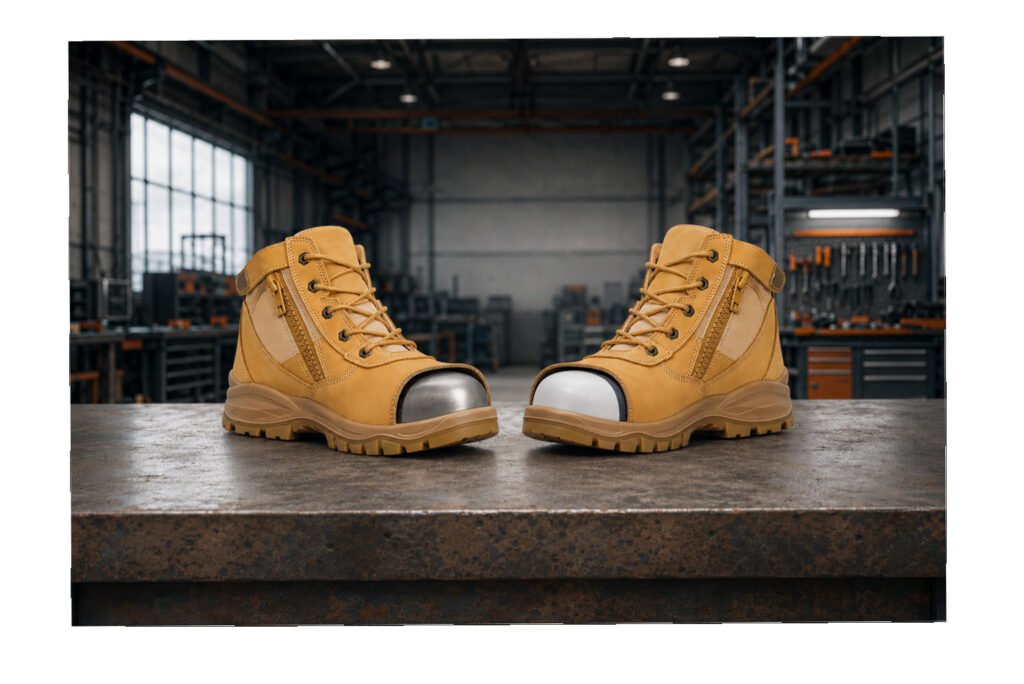
Introduction
Safety footwear plays an important role in preventing workplace injuries, especially in industries where workers are exposed to falling objects, heavy equipment, sharp materials, and electrical hazards.
According to the Occupational Safety and Health Administration (OSHA), protective footwear is required in workplaces where employees face risks such as falling or rolling objects, objects piercing the sole, or electrical hazards. Employers should select footwear based on workplace risks and ensure proper protection for workers.
A warehouse employee spends most of the shift walking between storage racks and loading bays. A construction worker moves across concrete, steel and loose debris. An electrician works near energised equipment, while an outdoor maintenance team operates through rain, mud and winter temperatures.
All of these workers need foot protection, but they may not need the same type of safety toe.
One of the most common questions asked by workers, safety managers and PPE buyers is: Should we choose steel toe or composite toe safety shoes?
The answer is not as simple as saying one material is better. Both types of safety shoes can provide dependable impact and compression protection when they are properly designed, tested and certified. The right choice depends on the workplace hazards, job duties, climate, comfort requirements and applicable safety standards.
Foot injuries are sometimes underestimated because footwear can look protective without actually providing certified protection. A rugged upper, thick outsole or reinforced-looking toe does not necessarily make an ordinary work shoe a genuine safety product. Proper safety footwear is engineered as a complete system, with the toe cap, upper, outsole, midsole and construction working together.
This guide compares steel toe and composite toe footwear in practical terms. It also explains other important features, including puncture resistance, slip resistance, waterproofing, electrical properties, fit, durability and maintenance. For procurement teams, it provides useful advice on selecting suppliers and buying industrial safety shoes in bulk.
What Are Safety Shoes and Why Are They Important?
Safety shoes are a form of personal protective equipment designed to reduce exposure to workplace foot injuries. Depending on their construction and certification, they may protect against:
- Falling tools and materials
- Rolling or heavy objects
- Compression hazards
- Nails and sharp objects
- Slippery floors
- Water and wet conditions
- Fuel and oil
- Hot surfaces
- Static electricity
- Certain electrical risks
A safety toe is only one part of the product. High-quality protective work shoes may also contain a puncture-resistant midsole, slip-resistant outsole, energy-absorbing heel, reinforced scuff cap, waterproof membrane or specialised electrical properties.
Safety Shoes vs Ordinary Work Shoes
Ordinary work shoes may offer comfort and basic durability, but they are not necessarily tested for impact or compression protection. A hard-looking toe area does not prove that a certified safety cap is inside.
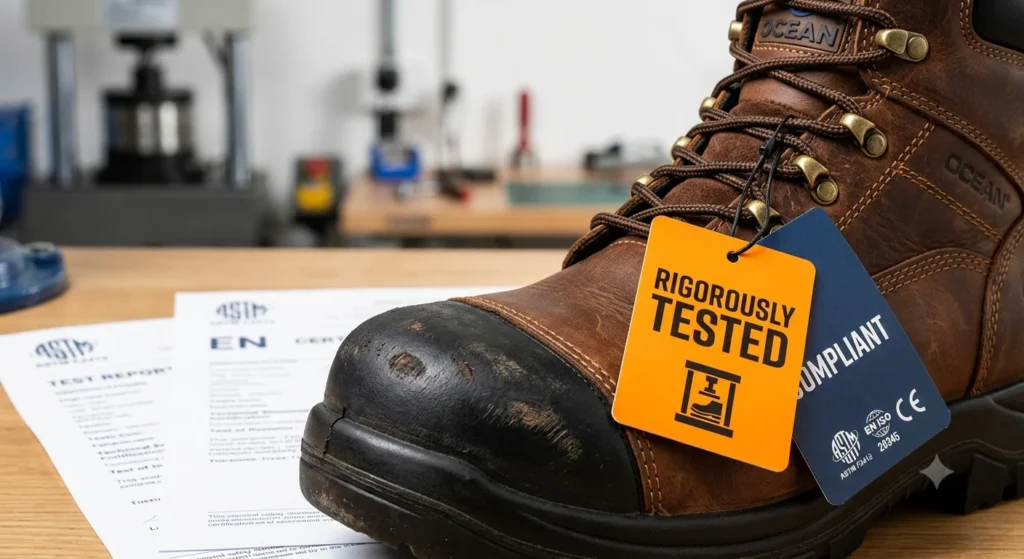
Certified workplace safety footwear is evaluated using recognised test methods. The product must meet defined performance requirements, and the manufacturer must control production so that bulk footwear remains consistent with the tested model.
For businesses, this difference matters. Footwear should be selected according to documented workplace risks—not appearance, marketing language or price alone.
The Role of Safety Footwear in PPE
Safety shoes form part of a larger risk-management program. Employers should first identify hazards and reduce them through workplace design, procedures, training and engineering controls. PPE provides an additional level of protection where risks remain.
Correctly selected footwear is particularly important in:
- Construction
- Manufacturing
- Warehousing
- Logistics
- Engineering
- Mining
- Oil and gas
- Utilities
- Agriculture
- Transport
- Maintenance
The same product will not suit every environment. A heavy-duty construction boot may be excessive for a dry indoor warehouse, while a lightweight mesh shoe may be unsuitable for a muddy outdoor site.
Steel Toe vs Composite Toe Safety Shoes: The Main Difference
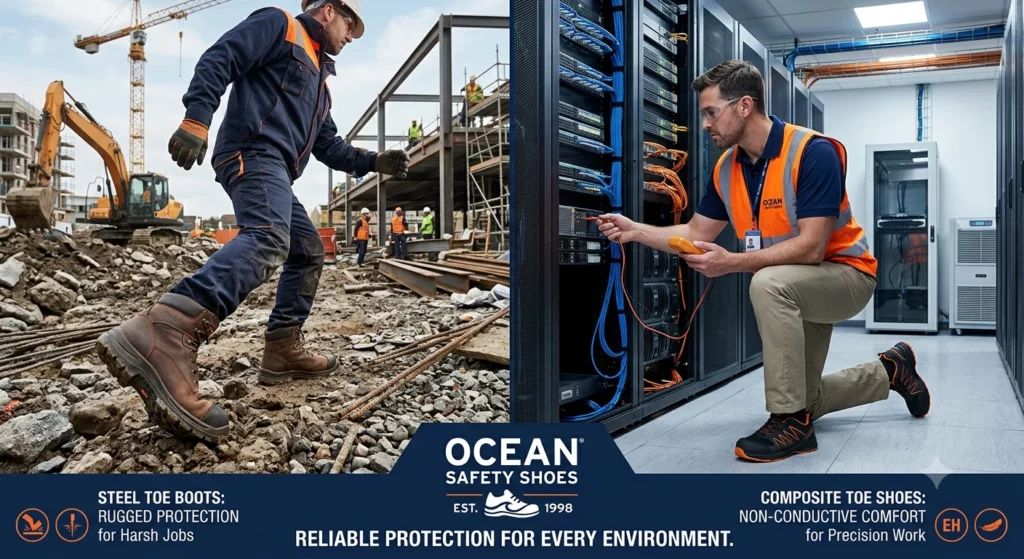
The main difference is the material used to make the protective toe cap.
Steel toe caps are manufactured from metal. Composite toe caps use non-metallic materials such as fiberglass, carbon fibre, reinforced plastic or other engineered compounds.
Both are designed to create a protective space around the toes. When footwear is tested and certified to the same required level, both types can provide suitable impact and compression protection.
The comparison should therefore focus on more than strength. Buyers should consider weight, toe shape, temperature, metal-free requirements, electrical properties, cost and employee comfort.
| Factor | Steel Toe Safety Shoes | Composite Toe Safety Shoes |
|---|---|---|
| Toe-cap material | Metal | Fiberglass, carbon fibre or engineered polymer |
| Impact and compression protection | Strong when certified | Strong when certified |
| Weight | Usually heavier | Often lighter |
| Toe-cap thickness | Often thinner | May require a thicker profile |
| Metal-free | No | Usually yes |
| Temperature transfer | Conducts heat and cold more easily | Lower thermal conductivity |
| Metal detectors | May trigger detectors | Usually detector-friendly |
| Cost | Often more economical | May cost more |
| Typical use | Construction and heavy industry | Logistics, airports and light industry |
| Best buying method | Select by certified performance | Select by certified performance |
Steel Toe Safety Shoes
Steel toe safety shoes are commonly tested according to ASTM F2413 requirements, which specify minimum performance criteria for protective toe footwear, including impact resistance and compression resistance.
Steel toe caps have been used in industrial footwear for decades. They remain a dependable option for demanding workplaces and are available in boots, low-cut shoes, pull-on styles and side-zip footwear.
Features of Steel Toe Protection
A steel toe cap is shaped to cover the toes and resist impact and compression forces. Because steel is strong, the cap can often be manufactured with a relatively slim profile.
Common advantages include:
- Proven industrial protection
- Strong impact and compression performance
- Compact toe-cap dimensions
- Wide availability
- Competitive pricing
- Suitability for heavy-duty footwear
Best Applications for Steel Toe Safety Shoes
Steel toe safety shoes are frequently used in:
- Construction
- Heavy manufacturing
- Mining
- Metalworking
- Engineering workshops
- Machinery maintenance
- Freight handling
- Building-material production
Consider a fabrication workshop where workers handle heavy metal components. The likelihood of dropped objects may be more important than keeping the shoe completely metal-free. A durable leather boot with a certified steel toe, puncture-resistant midsole and oil-resistant rubber outsole may be an appropriate solution.
Limitations of Steel Toe Footwear
Steel toe footwear is not automatically the best choice for every employee.
Possible disadvantages include:
- More weight than some composite alternatives
- Greater transfer of heat and cold
- Potential inconvenience at metal detectors
- Unsuitability for requirements specifying metal-free footwear
- Possible corrosion if a damaged cap is exposed to moisture
The complete shoe design influences comfort. A well-designed steel toe shoe may feel better than a poorly designed composite model, so material alone should not determine the decision.
For food service environments, learn more about whether steel toe shoes are suitable for restaurant work and how to select appropriate footwear for commercial kitchens
Composite Toe Safety Shoes
Composite toe safety shoes use non-metallic protective materials. Fiberglass is common because it can provide certified protection while supporting lightweight, sport-inspired footwear designs.
Features of Composite Toe Protection
Composite toe footwear may offer:
- Lower overall weight
- Metal-free construction
- Reduced heat and cold transfer
- Compatibility with security screening
- Good performance in cold environments
- Flexibility in modern safety shoe styling
These benefits make composite toe footwear attractive to employees who walk long distances or frequently move between work areas.
Best Applications for Composite Toe Safety Shoes
Composite toe models are often selected for:
- Warehouses
- Logistics centres
- Airports
- Security-controlled facilities
- Electronics production
- Light manufacturing
- Transport operations
- Cold-storage work
- Outdoor work in low temperatures
Imagine a warehouse picker who walks several kilometres during every shift. The workplace still requires certified toe protection, but heavy steel construction may add unnecessary fatigue. Lightweight composite toe shoes with breathable uppers, cushioned midsoles and slip-resistant outsoles may be more suitable.
Limitations of Composite Toe Footwear
Composite safety toes also involve trade-offs:
- Some caps require a wider or thicker shape
- The product may cost more
- Quality varies between materials and manufacturers
- “Composite” does not automatically mean lightweight
- Certification must be confirmed for the complete footwear model
A large composite cap can create fitting problems if the last and upper are not designed correctly. Procurement teams should request fitting samples and conduct employee wear trials before ordering in volume.
Which Safety Toe Provides Better Protection?
Neither material should be judged by assumption alone.
If steel toe and composite toe shoes are certified to the same applicable impact and compression requirements, both have demonstrated the required level of performance under those tests. The better choice is the one that meets the standard while fitting the employee and working environment.
Buyers should verify:
- Applicable standard
- Protection category
- Toe-cap test results
- Certificate holder
- Product model identification
- Size range covered
- Certificate validity
- Consistency between the tested sample and production product
A supplier should be able to explain what was tested and provide relevant documentation. Statements such as “stronger than steel” or “completely indestructible” should be treated cautiously.
Different Types of Safety Shoes Explained
Toe protection is important, but selecting steel or composite toe caps does not complete the footwear specification. Other hazards require additional features.
Slip Resistant Safety Shoes
Slip resistant safety shoes use an outsole compound and tread design developed to provide traction on defined surfaces.
Effective outsole design may include:
- Multi-directional tread edges
- Liquid-dispersing channels
- Appropriate heel and forefoot contact zones
- Flexible gripping areas
- Rubber, PU or TPU compounds suited to the application
Wet warehouse floors, oily workshop surfaces and loading bays create different traction challenges. No outsole can prevent every fall, so good housekeeping and spill control remain essential.
Waterproof Safety Shoes
Waterproof safety shoes may use water-resistant leather, sealed seams, waterproof membranes or internal waterproof booties.
Buyers should distinguish between:
- Water-resistant uppers for light moisture
- Waterproof constructions for prolonged exposure
- Water-repellent surface treatments
- Fully moulded waterproof footwear
Outdoor construction, agriculture, utilities and road maintenance may require waterproof protection. Indoor workers may benefit more from breathable shoes that manage heat and perspiration.
Electrical Hazard Safety Shoes
Electrical hazard safety shoes are designed to provide a secondary level of protection under defined test conditions. They may be relevant to electricians, utility employees and maintenance workers.
They should not be confused with antistatic or ESD footwear.
- Electrical hazard footwear is designed to reduce electrical conductivity under specified conditions.
- Antistatic footwear helps prevent excessive static accumulation while maintaining controlled resistance.
- ESD footwear controls electrostatic discharge in sensitive working environments.
These categories have different purposes. A qualified safety professional should define the correct requirement.
Puncture-Resistant Safety Shoes
Workers exposed to nails, screws, sharp metal or construction debris may need a puncture-resistant midsole.
Common options include:
- Steel midsoles
- Aramid or Kevlar-type textile midsoles
- Other high-strength non-metallic materials
Steel plates offer traditional protection, while textile midsoles can reduce weight and improve flexibility. The midsole should meet the relevant test requirement for the intended market.
How to Choose the Right Safety Shoes
1. Start With the Workplace Environment
The correct selection begins with a task-based hazard assessment.
Construction Sites
Construction workers may need:
- Impact-resistant toe caps
- Puncture-resistant midsoles
- Strong ankle support
- Abrasion-resistant uppers
- Deep outsole tread
- Waterproofing
- Scuff protection
Steel toe boots remain common, but certified composite alternatives may be useful when lower weight or reduced temperature transfer is important.
Factories
Factory conditions vary widely. A dry assembly line has different risks from a metal workshop.
Consider:
- Machinery
- Heavy components
- Oil and chemicals
- Hot surfaces
- Static-sensitive products
- Smooth concrete floors
- Standing time
The outsole and electrical classification may matter as much as the toe material.
Warehouses and Logistics
Warehouse employees often value:
- Lightweight construction
- Flexible outsoles
- Breathability
- Shock absorption
- Slip resistance
- Secure heel fit
Composite toe safety shoes can be helpful for mobile employees, although steel remains suitable where heavy-object risks or purchasing requirements favour it.
Outdoor Work
Outdoor jobs may involve rain, mud, cold, heat and uneven ground. Buyers should evaluate waterproofing, outsole traction, upper durability and temperature conditions.
Composite toes transfer less external cold than steel, but insulation, socks, lining and overall boot design still determine thermal comfort.
2. Define the Protection Requirements
Create a written list of hazards before selecting a model.
Ask:
- Is toe protection required?
- What impact and compression level applies?
- Is puncture resistance necessary?
- Are floors wet or oily?
- Will the outsole contact fuel or chemicals?
- Is heat-resistant footwear required?
- Does the workplace need ESD, antistatic or electrical hazard protection?
- Is waterproofing necessary?
- Should the shoe be completely metal-free?
Avoid adding features without a clear reason. Excessive specifications can increase weight, stiffness and cost without improving practical safety.
3. Evaluate Comfort and Fit
Comfort affects whether employees wear PPE footwear correctly.
A suitable pair should provide:
- Adequate toe room
- Secure heel hold
- Correct width
- Balanced cushioning
- Breathability
- Natural forefoot flex
- Stable support
- Manageable weight
A composite toe may be lighter, but toe-cap shape can affect internal space. A steel cap may be heavier, but a well-developed last can provide an excellent fit.
Workers should try shoes with normal work socks. A short workplace trial is more reliable than a few minutes of fitting indoors.
4. Examine Durability
The toe cap does not determine the service life of the complete shoe.
Inspect:
- Upper material quality
- Stitch density and seam security
- Toe and heel reinforcement
- Outsole abrasion resistance
- Flexing areas
- Upper-to-sole bonding
- Eyelets, laces and zippers
- Footbed resilience
- Pair-to-pair consistency
Leather provides structure and abrasion resistance. Mesh, flyknit and technical synthetic fabrics reduce weight and improve airflow. High-wear areas should be reinforced according to the job.
5. Confirm Applicable Safety Standards
Footwear requirements vary by market and workplace.
Common references include:
- EN ISO 20345 for safety footwear sold in European and related markets
- ASTM F2412 and ASTM F2413 for protective footwear testing and performance in the United States
- AS 2210.3 for occupational protective footwear in Australia
- Workplace PPE requirements enforced by authorities such as OSHA in the United States
A standard number alone is not enough. Confirm the protection category and additional markings relevant to slip resistance, puncture resistance, electrical properties, water resistance or outsole performance.
Standards and regulations can change. Buyers should verify current requirements with the appropriate regulator, certification body or occupational safety adviser.
Steel Toe vs Composite Toe Safety Shoes by Industry
Construction
Steel toe boots are widely used because of their established protection, durability and value. Composite toe boots may be preferred for employees working outdoors in cold conditions or those trying to reduce footwear weight.
Recommended supporting features:
- Puncture-resistant midsole
- Abrasion-resistant upper
- Slip-resistant outsole
- Waterproof option
- Reinforced toe area
Warehousing and Logistics
Composite toe footwear is popular for highly mobile roles because it can support lighter shoe designs. Steel toe shoes remain practical for material-handling tasks with significant impact hazards.
Recommended supporting features:
- Shock-absorbing midsole
- Breathable lining
- Flexible outsole
- Slip resistance
- Lightweight upper
Manufacturing
The correct choice depends on production processes. Heavy machinery environments may favour steel, while electronics facilities may require metal-free or ESD-controlled footwear.
Recommended supporting features:
- Oil-resistant outsole
- Suitable electrical classification
- Puncture protection where necessary
- Durable upper
- All-day cushioning
Airports and Security Facilities
Composite toe safety shoes are often more convenient because non-metallic construction may reduce delays at metal detectors. Buyers must confirm that all other components—including eyelets and puncture-resistant layers—also meet any metal-free requirement.
Cold Storage
Composite toe footwear may reduce heat transfer compared with steel. However, thermal lining, sole insulation, waterproofing and correct socks are equally important.
Electrical and Electronics Work
Toe material alone does not determine electrical safety. Composite toes are non-metallic, but the entire shoe must meet the applicable electrical, antistatic or ESD requirement.
Common Mistakes When Buying Safety Shoes
Mistake 1: Assuming Composite Always Means Safer
Composite sounds advanced, but material terminology does not prove certified performance.
Solution: Compare certificates, test results, fit and application requirements.
Mistake 2: Assuming Steel Is Always Stronger
Steel is strong, but certified composite caps can also meet required impact and compression levels.
Solution: Select by tested performance rather than reputation alone.
Mistake 3: Choosing Price Over Quality
A low-cost shoe may wear out quickly or create employee complaints.
Solution: Calculate total cost, including service life, replacement rate, defects and worker acceptance.
Mistake 4: Ignoring Comfort
Uncomfortable footwear may be worn incorrectly or avoided.
Solution: Conduct fitting sessions and workplace wear trials before bulk purchasing.
Mistake 5: Focusing Only on the Toe Cap
Toe protection does not address puncture, slip, water or electrical hazards.
Solution: Develop a complete footwear specification from the hazard assessment.
Mistake 6: Ignoring the Working Environment
A waterproof leather boot may be too warm for indoor logistics. A breathable textile shoe may not survive heavy construction work.
Solution: Match upper, sole and protection features to actual conditions.
Mistake 7: Failing to Plan Maintenance
Even certified footwear becomes unreliable when it is badly worn or damaged.
Solution: Establish cleaning, inspection and replacement procedures.
Safety Shoes Buying Guide for Businesses
Prepare a Clear Product Specification
Before contacting suppliers, define:
- Destination market
- Required safety standard
- Steel or composite toe preference
- Required protection category
- Puncture-resistant midsole
- Outsole material
- Slip-resistance requirement
- Electrical properties
- Waterproofing
- Upper material
- Size range
- Branding
- Packaging
- Order quantity
A detailed brief helps suppliers provide accurate samples and quotations.
Evaluate the Manufacturer
Distributors, importers and corporate buyers should ask:
- Is the supplier the actual factory?
- Does it have an internal development department?
- Can it design new safety footwear?
- Does it produce both injected and cold cement shoes?
- Which outsole constructions are available?
- How are steel and composite toe caps controlled?
- How are incoming materials inspected?
- Can the supplier provide relevant certificates?
- How is bulk-production quality monitored?
- What after-sales support is available?
Approve Samples in Stages
A reliable development process may include:
- Design confirmation
- Material and colour approval
- Fitting sample
- Wear trial
- Certification sample
- Pre-production sample
- Production reference sample
For a steel-to-composite conversion, the manufacturer may need to modify the last, toe shape, upper pattern or internal space. Buyers should not assume that one cap can simply replace the other without development work.
Conduct Quality Inspections
Incoming inspection should verify materials and components. In-process inspection should check stitching, toe-cap position, midsole placement, lasting, bonding and sole production.
Final inspection should cover:
- Appearance
- Sizing
- Pair matching
- Workmanship
- Labels
- Packaging
- Carton markings
- Approved specifications
Laboratory testing confirms specified performance, while factory inspection checks production consistency. Businesses need both.
Review Customisation Options
OEM and ODM choices may include:
- Steel, composite or fiberglass toe caps
- Steel or textile puncture-resistant midsoles
- Leather, mesh or synthetic uppers
- Waterproof membranes
- ESD or antistatic constructions
- PU/PU, PU/TPU or PU/rubber outsoles
- Cold cement sport-style safety shoes
- Custom colours and logos
- Branded footbeds and packaging
Any material or component change may affect certification. Confirm whether additional testing or certificate updates are required before production.
Frequently Asked Questions About Safety Shoes
1. How long do safety shoes usually last?
Many pairs last between six and twelve months under regular use, but service life depends on the job, materials, care and wear. Replace them according to condition rather than age alone.
2. Are steel toe safety shoes better than composite toe shoes?
Neither is universally better. Steel offers proven protection and a compact profile, while composite can reduce weight and temperature transfer. Certified performance and workplace suitability matter most.
3. Are composite toe safety shoes as safe as steel toe shoes?
Composite toe footwear can provide suitable protection when it is tested and certified to the required impact and compression standard.
4. What industries require safety shoes?
Construction, manufacturing, logistics, warehousing, mining, utilities, transport, agriculture, oil and gas, maintenance and many other industries may require them.
5. Are safety shoes comfortable for all-day wear?
They can be when correctly fitted and designed with appropriate cushioning, breathability, flexibility and support. Employee wear trials are recommended.
6. How do I choose the correct size?
Measure both feet, wear normal work socks and follow the manufacturer’s size chart. Check width, toe room and heel security.
7. How often should safety shoes be replaced?
Replace them when the tread, upper, sole bond, fit or protective structure is damaged or seriously worn.
8. What safety standards should safety shoes meet?
Requirements depend on the market and workplace. Common references include EN ISO 20345, ASTM F2413 and AS 2210.3. Always verify current local requirements.
9. Do steel toe shoes create an electrical risk?
Toe material alone does not define electrical performance. The complete footwear construction must meet the required electrical classification.
10. Can safety shoes prevent workplace injuries?
They can reduce the risk or severity of certain injuries when properly selected, fitted and maintained. They must still be used with other workplace controls.
Conclusion: Choosing the Right Safety Shoes for Long-Term Protection
The steel toe vs composite toe decision should be based on workplace hazards, certified performance, employee comfort and operational needs.
Steel toe safety shoes provide established industrial protection, a compact toe profile and competitive value. Composite toe safety shoes may offer lower weight, reduced temperature transfer and metal-free convenience. Neither option is automatically superior in every situation.
The best safety shoes combine suitable toe protection with the correct outsole, puncture resistance, upper material, electrical properties and fit. For businesses purchasing safety footwear, quality also depends on consistent manufacturing, reliable documentation and effective production control.
Choosing appropriate protective work shoes can improve safety, comfort and employee acceptance while reducing replacement costs. Whether buying for construction, warehousing, manufacturing or distribution, long-term value comes from selecting footwear for real working conditions—not from choosing a toe material by reputation alone.
Professional Steel and Composite Toe Safety Footwear Solutions
Looking for reliable safety shoes for your workplace, wholesale business or PPE product range? Ocean Safety Shoes provides professional OEM and ODM footwear solutions designed around protection, comfort and durability.
As a safety shoe factory and wholesale manufacturing partner, we can support steel toe and composite toe development, different upper materials, multiple outsole constructions, private-label branding, custom packaging and bulk production.
Explore Ocean Safety Shoes’ professional safety footwear solutions or contact our team to discuss the right toe protection, construction and certification requirements for your target market.